Architectural Record
search
cart
facebook twitter linkedin youtube
  • Sign In
  • Subscribe
  • Sign Out
  • My Account
Architectural Record
  • NEWS
    • Latest News
    • Awards
    • Interviews
    • Obituaries
    • Podcasts
      • Design:Ed Podcast
      • Sponsored Podcasts
  • OPINION
    • Book Reviews / Excerpts
    • Exhibition Reviews
    • Forum
  • EXCLUSIVES
    • Videos
    • Design Vanguard
    • Top 300 Firms
    • Sponsored Content
    • Sponsored eBooks
    • From the Archives
  • CONTINUING ED
    • Editorial Continuing Ed
    • CE Center
    • CE Academies
  • PROJECTS
    • Buildings By Type
    • Reuse & Renovation
    • Museums & Arts Centers
    • Colleges & Universities
    • Multifamily Housing
    • Interiors
    • Lighting
    • Kitchen & Bath
  • HOUSES
    • Record Houses
    • House of the Month
    • Featured Houses
  • PRODUCTS
    • Products by Category
    • Record Products of the Year
    • Latest Products
  • EVENTS
    • Dates & Events
    • Record on the Road
    • Innovation Conference
    • Sustainability in Practice
    • Women In Architecture
    • Webinars
    • Ad Excellence Awards
    • Submit an Event
  • CONNECT
    • Ask RECORD AI
    • Newsletters
    • Contact
    • Advertise
    • Editorial Calendar
    • Store
    • Customer Service
  • SUBMIT
    • Submission Guidelines
    • RECORD Competitions
  • MAGAZINE
    • Subscribe
    • My Account
    • Digital Edition
    • Current Issue
    • Firm Pass
    • Historic Archive
ProjectsClimate Change & SustainabilityBuildings by TypePark & Public Space Design

A Pair of Distinct Park Pavilions Rise on Manhattan and Hoboken’s Hudson Riverfronts
By Matthew Marani
02_AerialShowingPavilionWithinPark_©IwanBaan.jpg
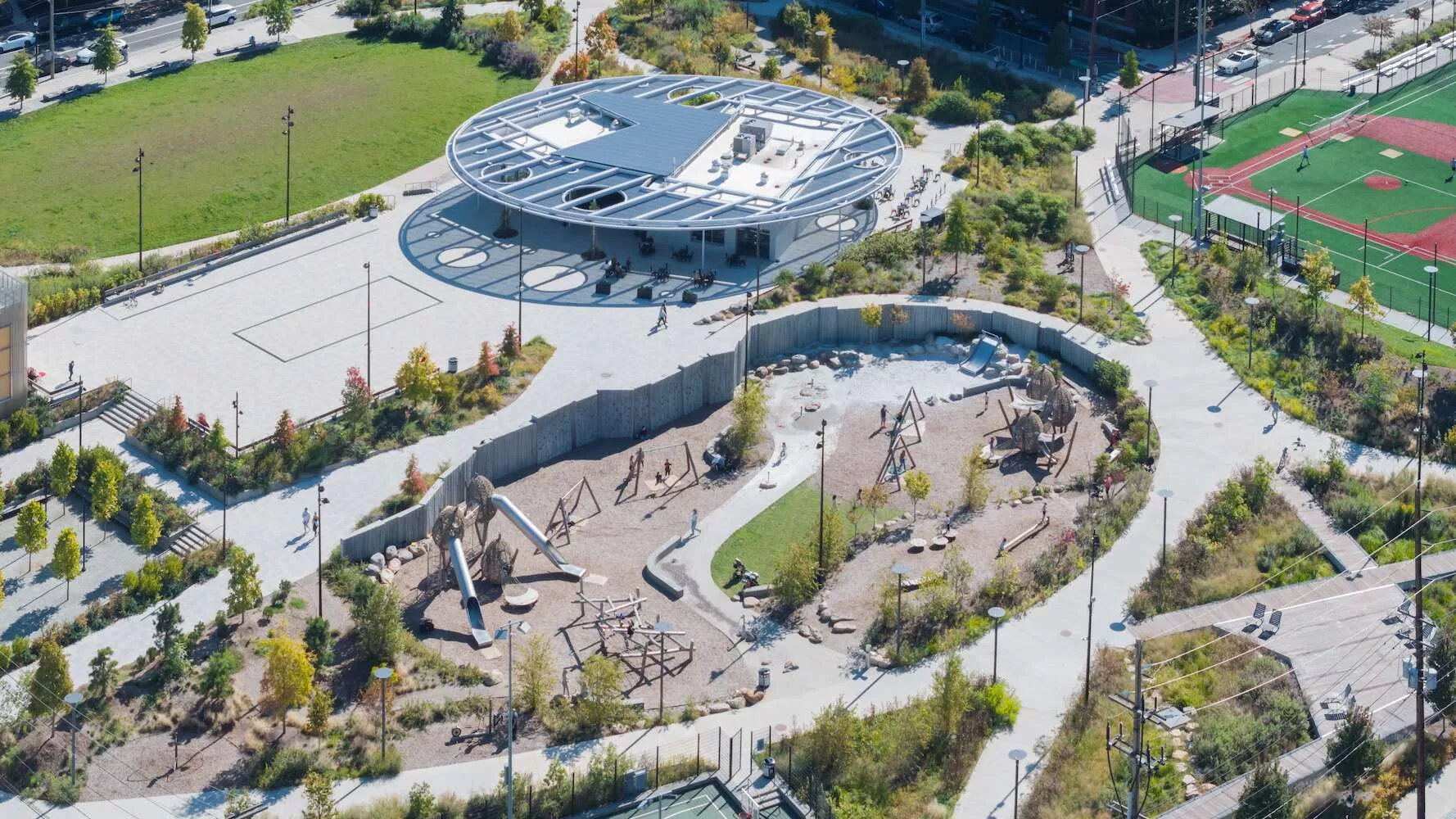
Designed by OLIN with a multifunctional pavilion by nARCHITECTS, ResilienCity Park in Hoboken, New Jersey, offers much needed community space and flood control features. Photo © Iwan Baan
April 8, 2025

Architects & Firms

nARCHITECTS
✕
Image in modal.

The specter of climate change looms large over the New York City metropolitan region, where, by 2050, it is estimated that the sea level may rise by up to 19 inches, according to the New York State Energy Research and Development Authority. Confronting this threat requires significant investments in the transformation of urban waterfront areas into resilient landscapes that act as buffers between the built and natural environments. While formidable, such interventions can also offer opportunities to introduce much-needed parks and civic architecture. Two projects, Gansevoort Peninsula on Manhattan’s West Side and ResilienCity Park, across the Hudson River in Hoboken, New Jersey, fit that bill. Both feature  community-centric landscaping and public pavilions, the latter both designed by Brooklyn-based 2004 Design Vanguard nARCHITECTS.

Aerial image of Gansevoort Peninsula.

Gansevoort Peninsula joins several parks administered by the Hudson River Park Trust. Photo © Iwan Baan

“Each project has a set of unique contexts and challenges to be considered, but broadly, resiliency planning cannot only focus on protecting investments to weather the next storm,” says nARCHITECTS co-founding partner Mimi Hoang. “Project teams need to create multifaceted returns on investment through solutions which serve several goals simultaneously, and during non-emergency events.”

Image of ResilienCity Park.

The ResilienCity Park pavilion is clad in vertically-oriented, stepped granite panels. Photo © Iwan Baan

Image of ResilienCity Park pavilion.

Perforated steel screens shade the pavilion and its immediate surroundings. Photo © Iwan Baan

The Gansevoort Park Pavilion, which opened in October 2024, serves as a maintenance facility and comfort station on the eastern edge of the Field Operations–designed Gansevoort Peninsula (2023). The 5.5-acre Gansevoort Peninsula is one of several parks, like Little Island, developed by the Hudson River Park Trust within the larger Manhattan Waterfront Greenway. Across the river, in Hoboken, the other pavilion, which opened earlier this year, stands centrally within the 5.4-acre ResilienCity Park (2023), where OLIN’s landscape design blends active and passive recreational spaces, like bioswales and a playground.

Riffing off Gordon Matta-Clark’s 1975 Days End installation at the long-demolished Pier 52, the Gansevoort Park Pavilion is composed of three individual volumes with large openings between them. The arrangement is intended to evoke the artist’s architectural incisions, while providing breezeways and viewpoints through to the Hudson River. The three structures, two of which are used for park maintenance and one as public restrooms, are united by a single, thin-concrete canopy, and topped individually with rainwater-absorbing vegetation.

Image of ResilienCity pavilion.

The largest resiliency park in New Jersey populates a former riverfront industrial site. Photo © Iwan Baan

Similarly, in ResilienCity, nARCHITECTS split the program into two, rectangular volumes. One houses restrooms and a community space, and the other a café. They are shrouded above by a pergola-like perforated steel shade. It is hung from a framework of exposed structural steel, painted a light blue, that, at set points, opens to circular oculi of varying diameters to make room for structural columns. Climbing plants on those columns create, what the design team calls, “Dr. Seuss trees,” connecting the structure to OLIN’s surrounding landscape design. Notably, the pavilion, like much of the park, is raised several feet above the abutting streets to make room for detention tanks below, which can hold roughly a million gallons of stormwater.

Image of Gansevoort Peninsula.

The Gansevoort Peninsula pavilion opens to offer direct sightlines to the Hudson. Photo © Michael Moran

Image of Gansevoort Peninsula.

A concrete canopy suspends above the pavilion, and offers shade. Photo © Iwan Baan

Both constructions, located within floodplains and subject to the wear and tear of park goers, required durable materials that are easy to maintain and replace. Each is supported by 10-inch-thick, cast-in-place concrete walls that pull double duty as interior wall finishes. At the Gansevoort Pavilion, the exterior walls are clad in perforated, ultra-high performance concrete panels, which are backlit for a lamp-like effect during evening hours. The Hudson River Palisades, cliffs abutting the inland boundaries of Hoboken, were the main point of reference for cladding of the ResilienCity Park Pavilion. There, vertically oriented and stepped granite panels face the two volumes.

In each circumstance, nARCHITECTS collaborated closely with the respective park’s landscape architects and the public, through numerous community engagement sessions, to create multiple design iterations. In the case of Gansevoort Peninsula, the location of the pavilion shifted from the park center to the street edge, to make room for disparate uses like a soccer pitch, a rocky beach with direct river access for non-motorized boaters, and a dog run. The pavilion in Hoboken was initially envisioned as just a rest station, but based on community input, the design team successfully encouraged the municipal government to expand the scope of work to include its flexible community space and café (though nARCHITECTS had hoped to also include a small branch of the local library).

Looking for quick answers on architecture and design topics?
Try Ask RECORD, our new smart AI search tool.
Ask RECORD →

Image of Gansevoort Peninsula pavilion.

Lighting placed behind perforated concrete panels creates a lamp-like effect. Photo © Iwan Baan

“It’s a balancing act between many different interests, and, when weighing the constraints of a site, something of a three-dimensional puzzle,” notes Hoang.

There is plenty of work to be done to strengthen resiliency in coastal areas like Manhattan and Hoboken, but, the sum of these smaller scale projects can go a long way.

KEYWORDS: New Jersey New York City Pavilion Design resiliency

Share This Story

Looking for a reprint of this article?
From high-res PDFs to custom plaques, order your copy today!

Matthew marani

Matthew Marani is a senior editor at Architectural Record. Previously, he served as program manager at The Architect’s Newspaper and has several years of experience as a freelance writer specializing in urban planning, historic preservation, and architectural technology. Matthew is a born and raised New Yorker and holds an MSc in Architectural Conservation from the University of Edinburgh.

Post a comment to this article

Report Abusive Comment

Subscription Center
  • Create an Account
  • Start a Subscription
  • Manage My Account
  • Sign Up for Newsletters
  • Visit Customer Service
  • Update Preferences

More Videos

Sponsored Content

Sponsored Content is a special paid section where industry companies provide high quality, objective, non-commercial content around topics of interest to the Architectural Record audience. All Sponsored Content is supplied by the advertising company and any opinions expressed in this article are those of the author and not necessarily reflect the views of Architectural Record or its parent company, BNP Media. Interested in participating in our Sponsored Content section? Contact your local rep!

close
  • TAMLYN XtremeTrim Exterior Trim
    Sponsored byTamlyn

    Designing Cleaner Panel Facades: Why Exterior Trim Details Matter

  • Building with Vapor Barriers
    Sponsored byReef Industries, Inc.

    Vapor Barriers Help Control Moisture in Tighter Building Designs

  • Duct Interior with Prodeq System
    Sponsored byHenry, a Carlisle Company

    Designing Resilient Water Containment Systems

DESIGN:ED Podcast
Listen to Architectural Record’s DESIGN:ED Podcast

Events

June 16, 2026

Focus on the Façade: Exploring Steel, Timber & Fire-Rated Curtain Walls and Channel Glass Systems

Credits: 1 AIA LU/HSW; 1 AIBD P-CE; 0.1 ICC CEU

Explore modern façade and glazing systems that enhance daylighting, fire safety, and thermal performance while expanding architectural design possibilities.

June 18, 2026

Rebooting the Aging Office Building

Credits: 1 AIA LU/HSW; 1 AIBD P-CE; 0.1 ICC CEU; 1 PDH

Explore façade retrofit strategies and award-winning design concepts that can transform aging office buildings into healthier, higher-performing workplaces for today’s hybrid workforce.

View All Submit An Event

Products

2026 Architect's Square Foot Costbook

2026 Architect's Square Foot Costbook

See More Products

Popular Stories

Coronado Bridge

The Architect’s Guide to San Diego

SanDiegoAirport

Top 300 Architecture Firms of 2026

Crane Cove, ONO

Design Vanguard 2026 Winners

House on a Hill

Design Vanguard 2026: Forma

House A on a Hill

Design Vanguard 2026: Santiago Valdivieso

Focus on the Facade - Free Webinar - June 16, 2026

Related Articles

  • Shedding new light on a pair of maligned projects

    See More
  • Shedding new light on a pair of maligned projects

    See More
  • Panorama Park

    A Pair of Hilltop Parks by Hood Design Studio Offer Sweeping–and Rarely Seen–Views of San Francisco Bay

    See More

Related Products

See More Products
  • Architectural Record - July 2025

    Architectural Record July 2025 Issue

See More Products
×

The latest news and information

#1 Source for Architectural Design, News and Products

SUBSCRIBE
  • RESOURCES
    • Advertise
    • Contact Us
    • Submit
    • Store
  • ACCOUNT CENTER
    • Create an Account
    • Start a Subscription
    • Manage My Account
    • Sign Up for Newsletters
    • Visit Customer Service
    • Update Preferences
  • PRIVACY
    • PRIVACY POLICY
    • TERMS & CONDITIONS
    • DO NOT SELL MY PERSONAL INFORMATION
    • PRIVACY REQUEST
    • ACCESSIBILITY
  • SERVICES
    • Marketing Services
    • Reprints
    • Market Research
    • List Rental
    • Survey/Respondent Access
  • STAY CONNECTED
    • Linkedin
    • Facebook
    • Instagram
    • YouTube
    • X (Twitter)

Copyright ©2026. All Rights Reserved BNP Media, Inc. and BNP Media II, LLC.

Design, CMS, Hosting & Web Development :: ePublishing