Frank Lloyd Wright’s Price Tower Sells to Preservation-Minded New Owner

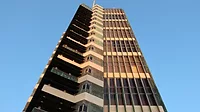
Frank Lloyd Wright's Price Tower, closed since September of last year, in Bartlesville, Oklahoma. Photo by John H. Waters, courtesy the Frank Lloyd Wright Building Conservancy
The Frank Lloyd Wright Building Conservancy is celebrating the conclusion of a fraught chapter surrounding Wright’s now-closed Price Tower in Bartlesville, Oklahoma.
On May 5, the 19-story National Historic Landmark—inaugurated in 1956, it’s Wright’s only realized skyscraper—was sold to McFarlin Building, LLC, for $1.4 million. The sale closed one day before a planned bankruptcy auction for the building and associated collections. However, no competing qualified bids were received by the bankruptcy trustee, and the sale to McFarlin Building moved forward. The Conservancy, which said it “looks forward to the next chapter for the Price Tower” while acknowledging “significant work ahead,” holds a preservation easement protecting the building and certain collection items.

The facade of the concrete structure features embossed copper spandrels and louvers and poured stucco surfaces. Photo by John H. Waters, courtesy the Frank Lloyd Wright Building Conservancy
McFarlin Building, part of a group of companies owned by the preservation-minded Snyder family, has pledged to embark on a $10 million stabilization and restoration effort at the building, which was shuttered last summer under the previous ownership of Copper Tree Group. The Snyder family has purchased and revived several at-risk historic properties in Oklahoma and beyond, including downtown Tulsa’s iconic Mayo Hotel. Under its new ownership, the tower will stay true to its mixed-use roots and house a boutique hotel, as it did before, and apartments.
The McFarlin team’s “creative approach to the reuse of buildings, and the knowledge they have of the regional market, provide a strong foundation for revitalizing this treasured landmark,” the Conservancy said in a statement. “We are grateful that they are taking on this challenge, and we stand ready to support them with expertise and knowledge as they work to stabilize and preserve the building.”
A book could be written about the legal dispute around the concrete-and-copper Price Tower, which rises 221 feet above downtown Bartlesville and is a key tourism-driver for the small city located roughly 50 miles north of Tulsa. In early August 2024, the Bartlesville Examiner-Enterprise first reported that the Copper Tree Group, which acquired the struggling property the previous year from its non-profit owner for a nominal $10, intended to close it “amid financial chaos.” It was also reported that the Price Tower was more than $2 million in debt and Cooper Tree Group had effectively scrapped its initial plans to transform the historic high-rise into a tech hub.

View of the main lobby. Photo by John H. Waters, courtesy the Frank Lloyd Wright Building Conservancy
The move left commercial tenants scrambling to find new space and building employees without jobs. It also raised the hackles of the Conservancy, which threatened legal action over the violation of a preservation easement donated to the Conservancy in 2011 and recorded with the property deed. It forbid the sale of certain protected items—including a trove of Wright–designed furnishings and art objects—without prior review or consent from the organization, even if building ownership was in dire financial straits.
“The owners have no right to sell protected items without our approval,” said Conservancy executive director Barbara Gordon at the time. “This practice is not a sustainable way to fund the tower’s operations. It’s killing the goose that laid the golden egg!”
Looking for quick answers on architecture and design topics?
Try Ask RECORD, our new smart AI search tool.
Ask RECORD →
(The collection items currently located in the building are now owned by McFarlin, and the Conservancy says it is “separately continuing to explore avenues for reuniting the missing items with the collection, but we cannot comment further on that at this time.”)

1

2
Interior (2) and exterior (2) views of the Price Tower. The design of the building was derived from a series of never-realized apartment towers for the East Village of Manhattan that Wright had conceived in the late 1920s. Photos by John H. Waters, courtesy the Frank Lloyd Wright Building Conservancy
A legal imbroglio (and multiple canceled auctions) involving the Conservancy, Copper Tree Group, and McFarlin Building kicked off following the Price Tower’s closure last September. It was the first time in its history the building had been completely shuttered, save for a period of renovations in the early 2000s. In January 2025, a Washington County judge ordered the building be sold to McFarlin Building, with Copper Tree Group principal Cynthia Blanchard filing for Chapter 11 bankruptcy the following month.
The Price Tower, often heralded as one of Wright’s finest works, has a rich history. It was featured in the February 1956 issue of RECORD, with commentary from Wright himself on the nature of tall buildings. At its debut, the tower was pointedly mixed-use: it housed the corporate headquarters of the H.C. Price Company, whose business included pipeline construction, along with luxury apartment units and a variety of retail businesses and offices. Beginning in 1981, the tower was owned by the Bartlesville-founded Phillips Petroleum Company, who used it largely for storage purposes.

The non-profit Price Tower Arts Center owned the tower from 2000 until 2023, adding a museum as well a boutique hotel and restaurant on its upper floors in the early 2000s to help fund maintenance costs. Photo by John H. Waters, courtesy the Frank Lloyd Wright Conservancy
In 2000, Phillips donated the beloved local landmark to the non-profit Price Tower Arts Center (PTAC), which revived the building with a design gallery, restaurant, rentable office and retail spaces, and the Inn at Price Tower, a 21-room boutique hotel designed by Wendy Evans Joseph. PTAC commissioned Zaha Hadid Architects to design a $15 million expansion to its arts complex at the building in 2002, but those plans were never realized.
“The Price Tower has demonstrated remarkable resilience in the face of recent challenges,” writes the Conservancy. “It continues to stand proudly as an exemplar of Frank Lloyd Wright’s design innovation, and an irreplaceable symbol of Bartlesville’s cultural identity. The people of Bartlesville and the broader region deserve a positive outcome for this architectural icon. We are now hopeful that it has a vital future.”
Looking for a reprint of this article?
From high-res PDFs to custom plaques, order your copy today!