Record Houses 2025
Diego Baraona Realizes a Trio of Abodes for Three Siblings
September 2, 2025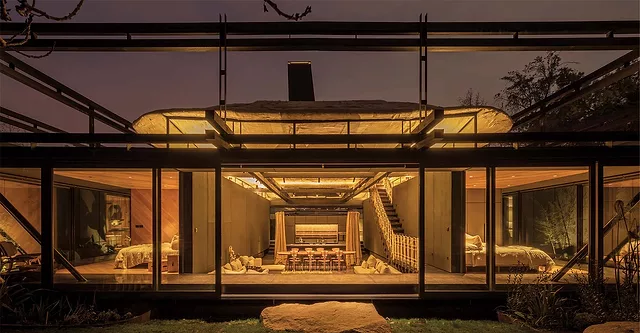
Record Houses 2025
Diego Baraona Realizes a Trio of Abodes for Three Siblings
September 2, 2025
You cannot choose your family, but choosing to be neighbors with family is certainly, to some, a bold decision. For three brothers in Santiago, Chile, who already shared a business and wanted to live together, with their children, architect Diego Baraona designed a trio of equally daring houses. His proposal, neatly woven into the hilly urban fabric of the Lo Barnechea neighborhood, balances privacy with openness—and adds a healthy dash of experimental flair.
1
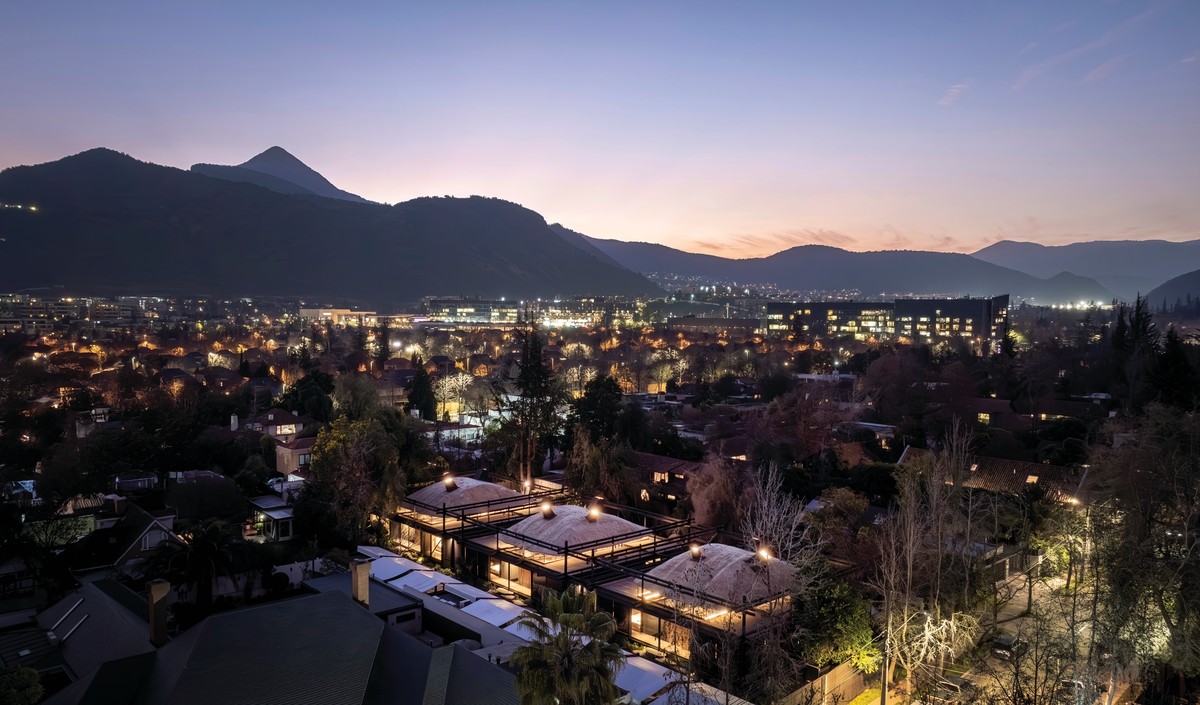
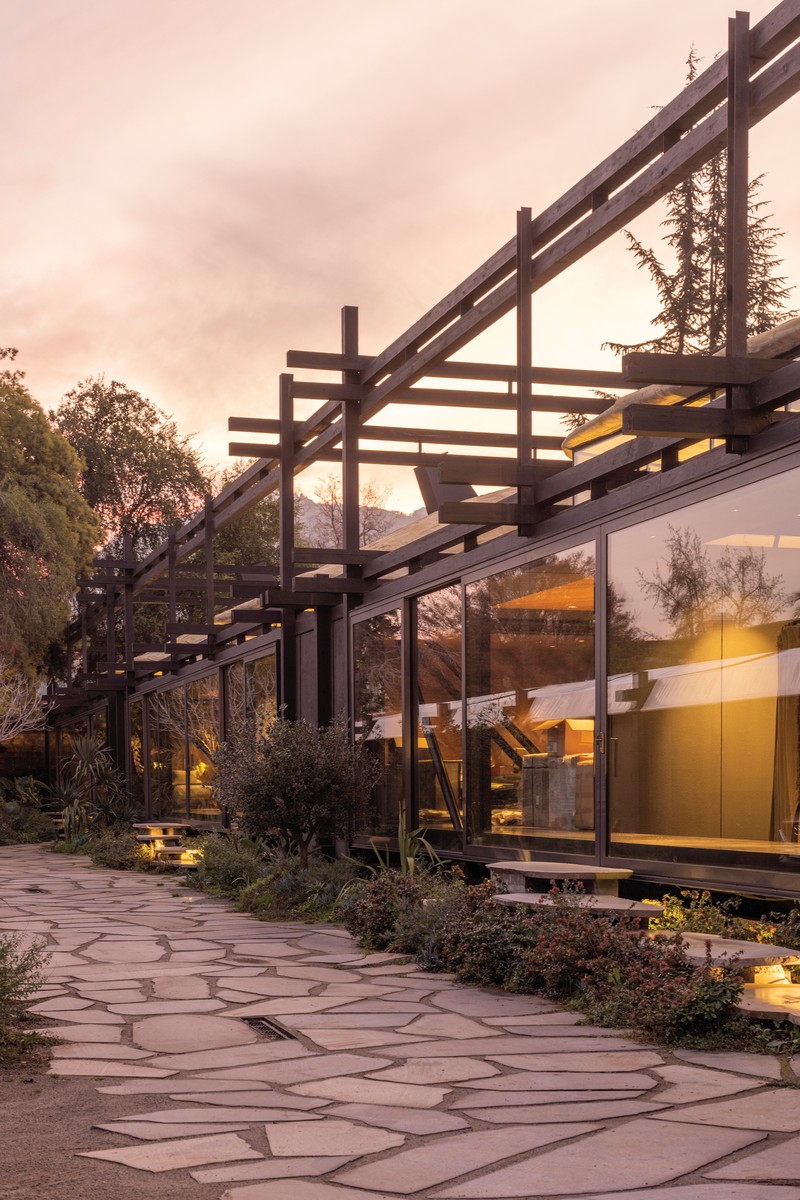
The three discrete houses (1) have been visually unified with an array of double beams and wall panels (2), while the linear outbuilding helps to activate the paved shared patio. Photos © Pablo Casals Aguirre, click to enlarge.
2
Baraona proposed a single house, thrice repeated, along one edge of the brothers’ long and narrow parcel, with ancillary program tucked into an outbuilding along the other, leaving a shared patio between them. “There is an economy of scale,” the 36-year-old says of his approach, “given that the houses are built the same way rather than three different ways.” (Two are identical and the third is mirrored.) But the Chilean architect also went to great lengths—figuratively and literally—to visually unify the composition, using wall panels and an array of overlapping double beams to span the discrete facades.
By situating some aspects of the program—a garage, storage, and lodging for housekeepers—in the outbuilding, Baraona has also activated the patio for the families. “There is a lot of life there, because people move back and forth, intermingling with playing kids, and they often leave the doors open,” he says. “It helps the houses feel larger too.” And, when communal life feels overwhelming, they can retreat to more private rear yards.
Residents step up into the raised 3,600-square-foot houses, which are wrapped in operable window-walls. Each one, 52 feet by 52 feet, roughly takes the plan of a nine-square grid. The grid’s central modules have been combined into a single, elongated living and dining space, and the leftovers become a series of rooms: on one side, kids’ bedrooms and a double bathroom; on the other, a lounge and a primary suite.
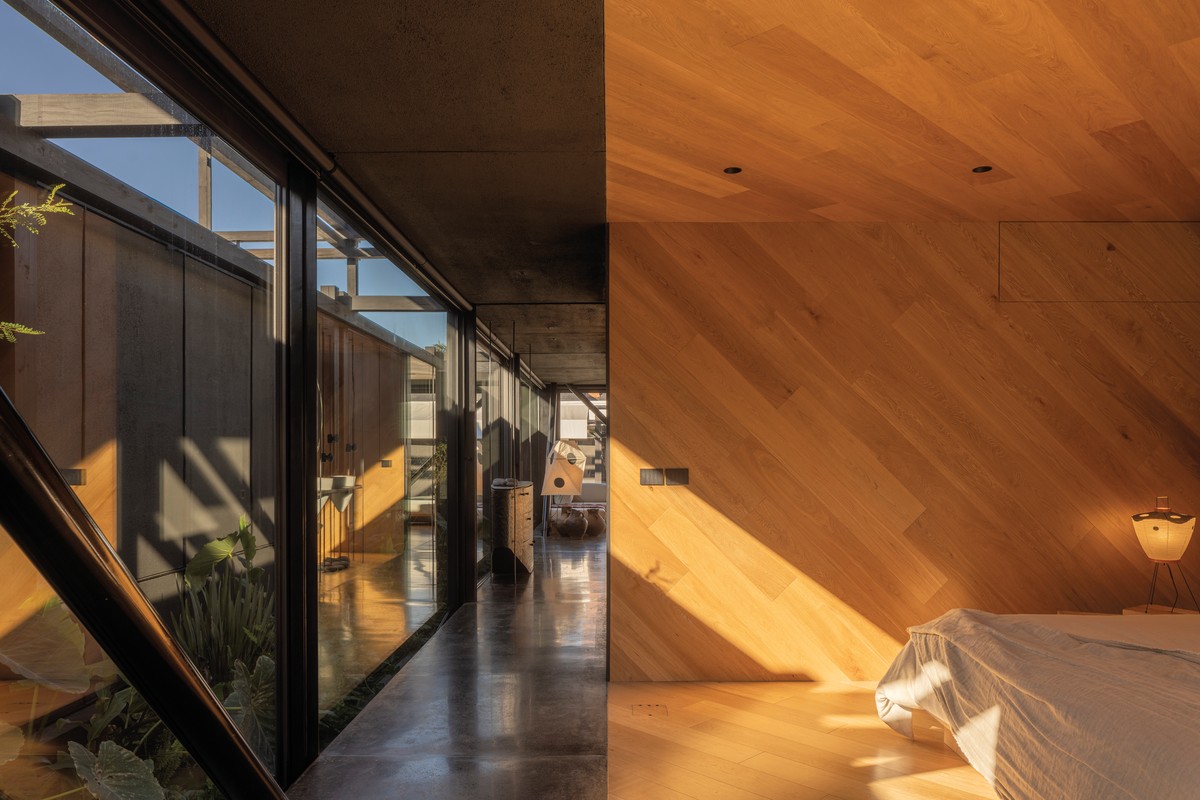
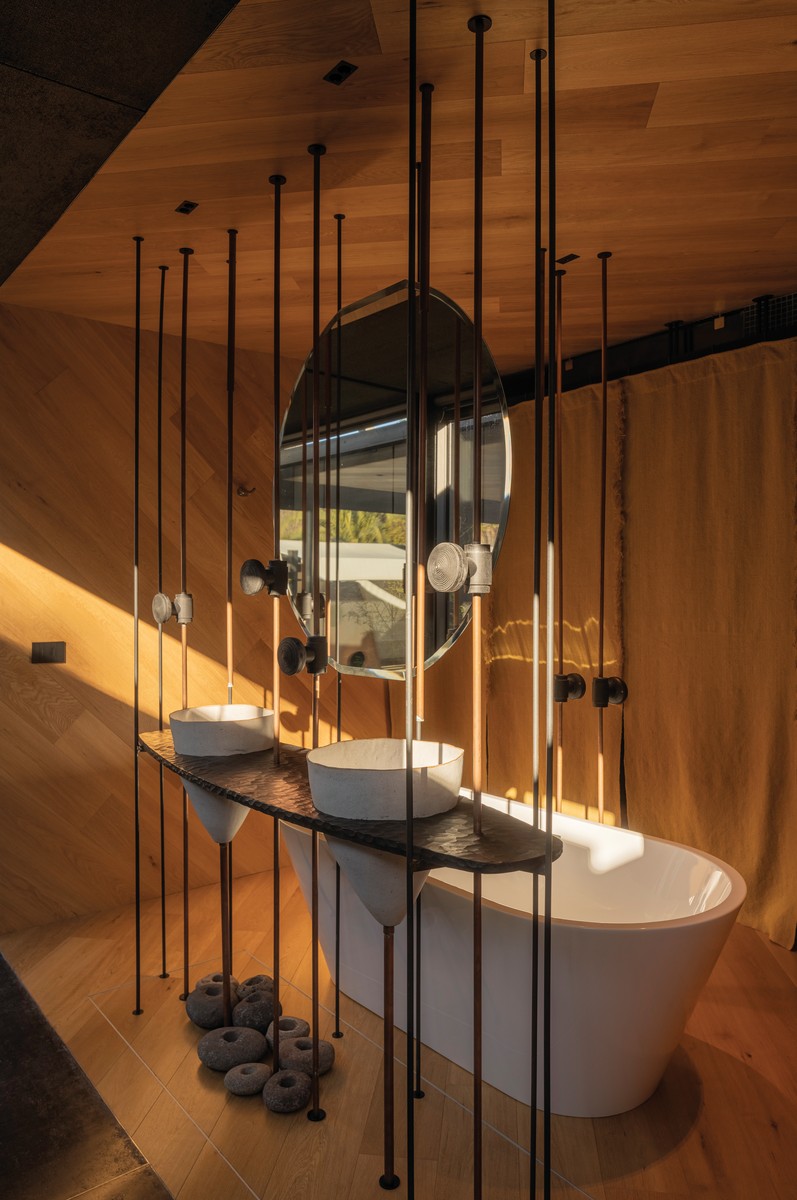
A 6-foot-wide pathway runs around the perimeter of each structure, creating a circulatory loop sandwiched between a dark floor and ceiling. But, off this pathway, the palette changes dramatically. Spaces are lined with diagonally oriented planks of white oak. A bathroom vanity floats, suspended midair from a bosque of copper pipes (some of which supply and drain water). Pocket doors, tucked into the separating walls, extend outward to incorporate the circulation space into the rooms, ostensibly increasing their size.
3
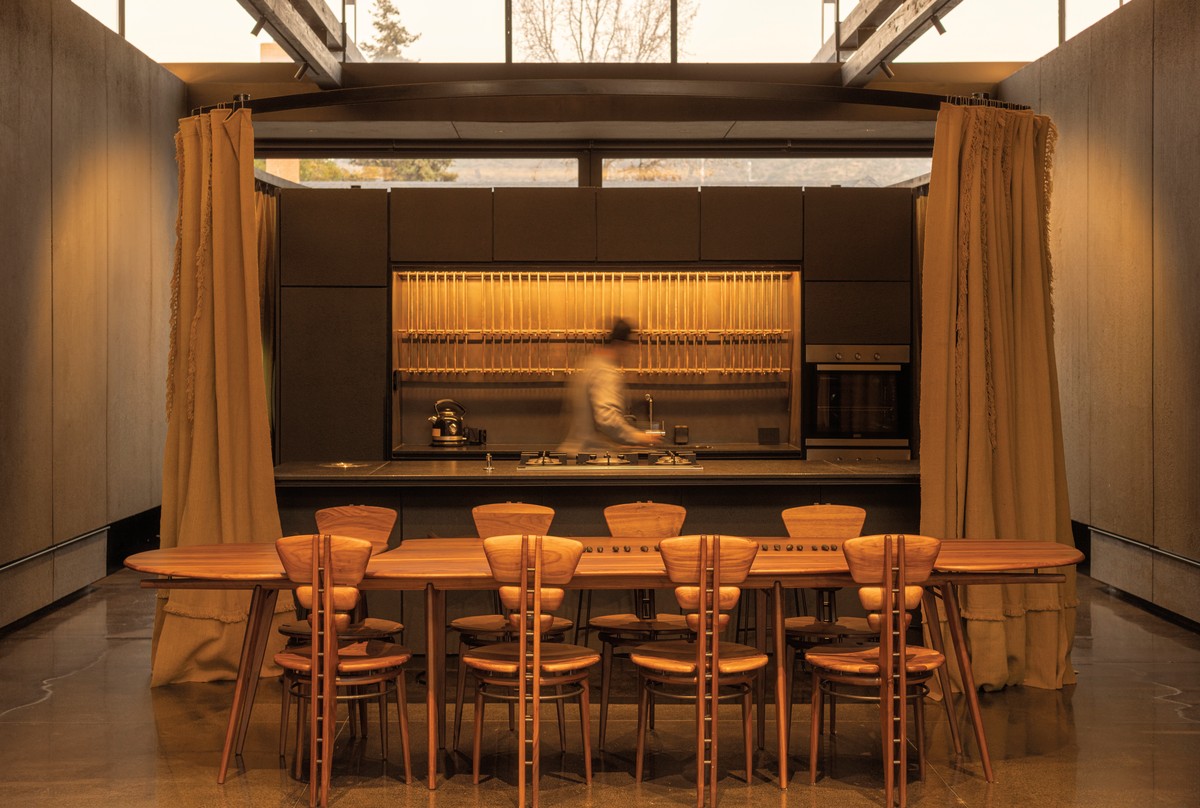
The circulation loop is defined by a dark palette (3) and connects various spaces, including the primary bathroom (4) and the communal living area (5). Photos © Pablo Casals Aguirre
4
5
Baraona is hardly interested in conformity, and, as an amateur ceramist, he frequently enjoys working on his architecture with local artisans. The fruits of those collaborations abound in the three houses: a fabric guardrail of ochre-dyed sheep’s wool, artfully knotted to steel balusters; wood gouged into surfaces of wavelike scallops; charcoal-colored concrete underfoot, polished to reveal black aggregate. Even wall panels of plywood have been rendered with stucco and stamped with a fine agricultural netting, giving them a textile-like finish. “It takes a particular kind of client, though—one willing to entertain extended project timelines,” he stresses, noting that the project took about six years in total. But the explorations are a refreshing antidote to the mass production that defines so many other projects of today.
From the circulation loop, residents step down into a sunken living/dining area. The change in elevation cradles the space, heightening a sense of privacy. A freestanding kitchen and half-bath can be cordoned off behind curtains of the same yellowish wool used on the stair. “Sometimes when you throw a dinner party you just want to hide all the mess,” Baraona says.
Situated at the heart of the plan, and flanked by two solid 14-foot-tall walls, this communal area had one problem: a dearth of natural light. With glazing limited to either end, Baraona looked up for a solution. “In order to give this space a different ambience, I had the idea to put a giant lantern above it,” he says as he muses about his inspiration: Isamu Noguchi’s Akari light sculptures and common lámparas de pergamino—or parchment lamps. In the process of developing the concept, and talking it over with his clients, their design evolved into something of a dramatic, inhabitable second story.
Looking for quick answers on architecture and design topics?
Try Ask RECORD, our new smart AI search tool.
Ask RECORD →
Looking for a reprint of this article?
From high-res PDFs to custom plaques, order your copy today!
6
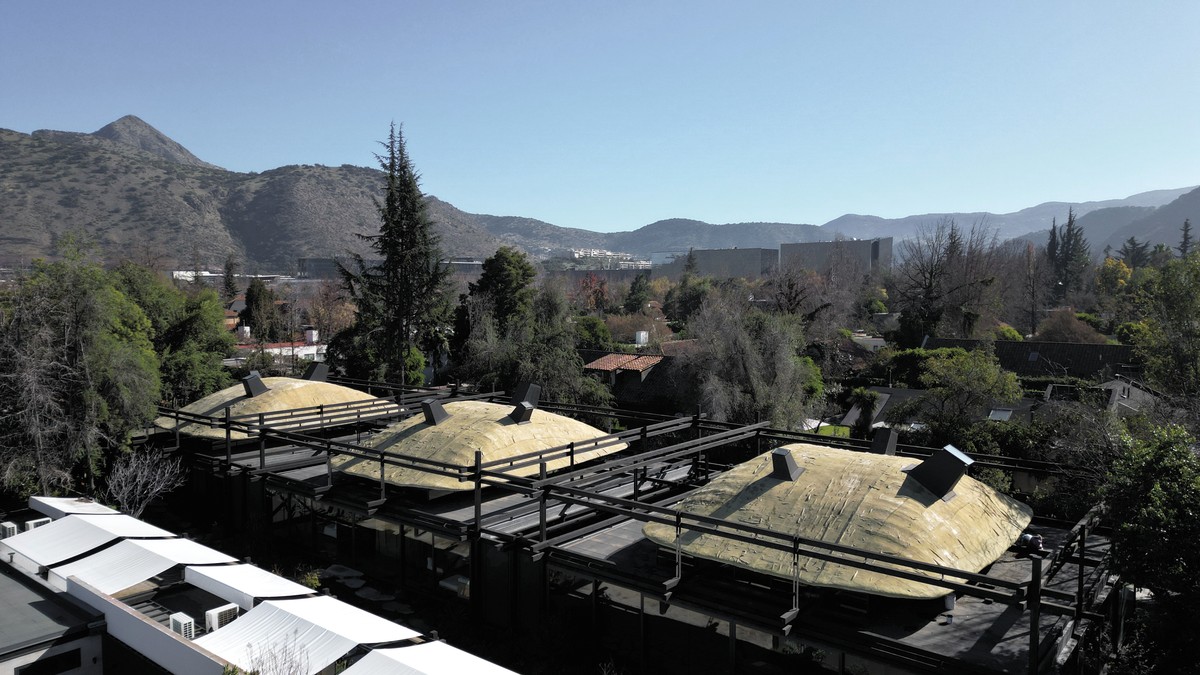
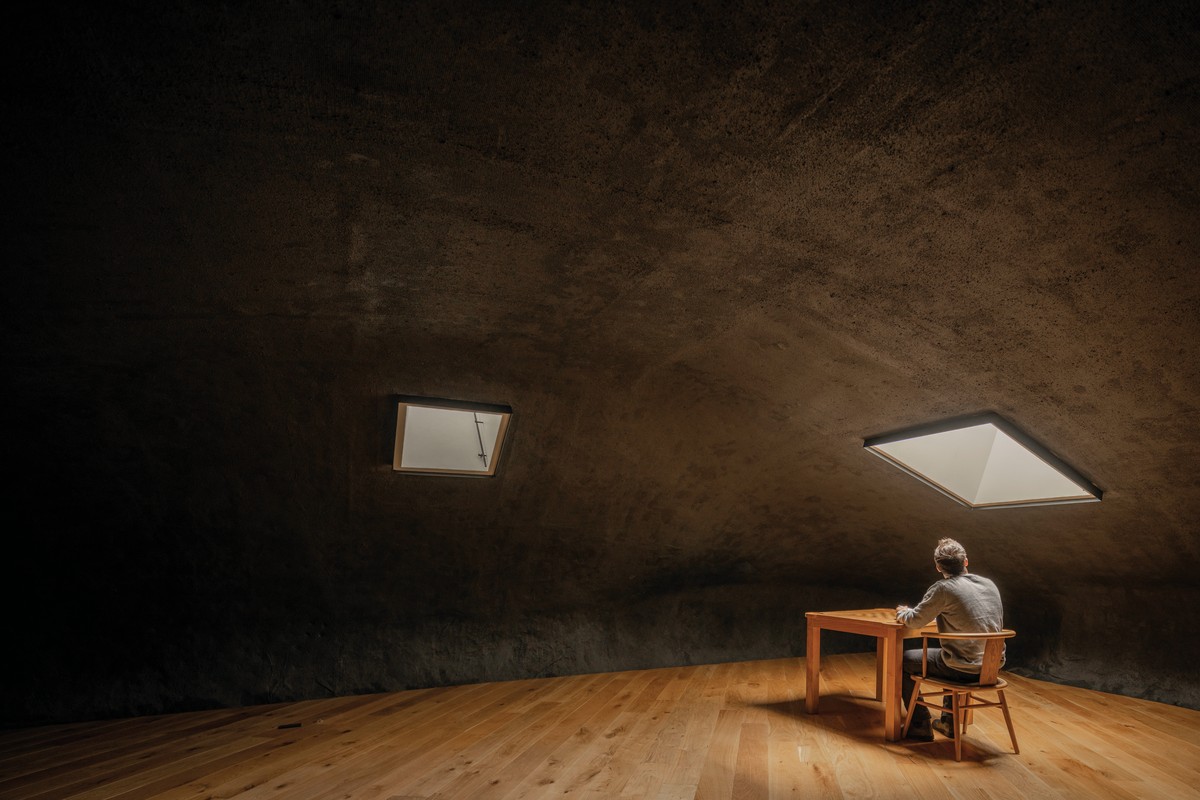
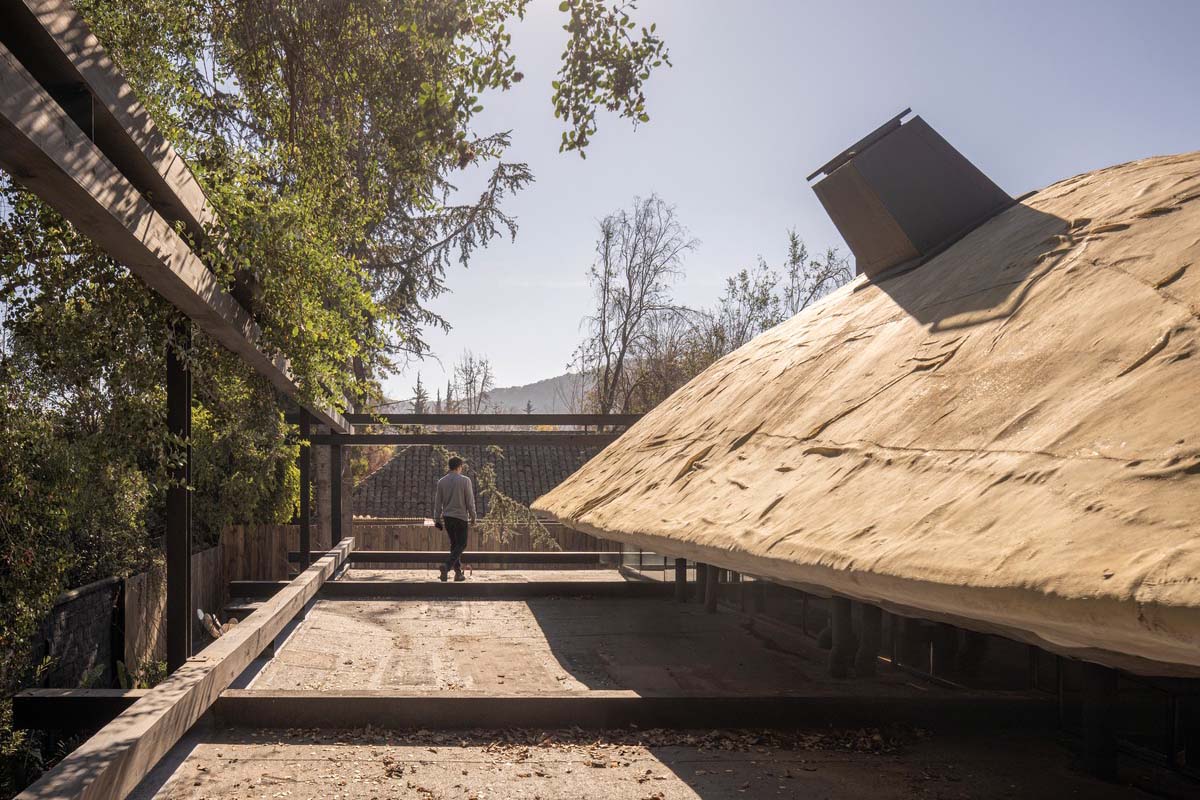
The fiberglass shells atop each house (6) enclose contemplative spaces lit via skylights (7 & 8). Photos © Pablo Casals Aguirre
7
8
Ascension into any of these “attics” induces a somewhat paradoxical feeling: How have I climbed a staircase only to find myself in a mysterious subterranean chamber? The shell overhead appears hefty and earthen—a sensation exaggerated by deep recessed skylights, which bestow an otherworldly glow. But this is a trick of the eye. In reality, the fiberglass envelope is only a few inches thick, and from the outside, the skylights instead reach outward, seemingly trained on faraway celestial bodies. As suitable as these spaces might be for an ascetic or astronomer, the families use them differently—alternately as playroom, home gym, and study.
“I approached this project not to solely build a house but to design an experience, an atmosphere,” says Baraona. Although some might see these contemplative rooms as outlandish, Baraona in fact walks a well-trodden path, pioneered long ago, with this formal experiment. To name but one example, Viennese architect and set designer Frederick Kiesler famously envisioned a novel domesticity as far back as the 1920s with his unbuilt Endless House, which similarly—and less elegantly—positioned amorphous volumes atop a plinth of rectilinear structures. Here the Chilean architect exercises tasteful restraint by offering residents optional and momentary refuge rather than imposing an entirely new way of living.
This was Baraona’s first foray into fiberglass. “And probably my last,” he concedes with a laugh. Finding a builder with the same willingness to experiment proved challenging, but he met an unlikely partner in a company that uses the material to encapsulate toxic waste. The design team used inexpensive lumber to craft a one-to-one scale mockup, which then became a kind of formwork for the application of fiberglass. Once hardened, each shell was cut into six pieces and transported to the site, where they were installed at a rapid clip and then permanently fused together. “Assembly took about two days for each one,” says Baraona.
The enclosures are self-structuring and in fact hang from the steel decking that comprises the second-story floors, curling up and around it to envelop the space. Although necessary insulation robbed them of their intended translucency (not all experiments go as originally planned), by transferring their weight to eight 4-inch-wide raised columns, Baraona was able to insert clerestories above the living space, introducing the light that was always the end goal.
Novelty can be difficult to digest, and even more difficult to realize. On the outskirts of Santiago, Baraona has managed to artfully synthesize the rectilinear and the biomorphic, the practical and the impractical. That’s a good thing. It is architects like him, those who dare to experiment in the field, who continue to push the envelope.
Video by Pablo Casals Aguirre, courtesy DBAA.
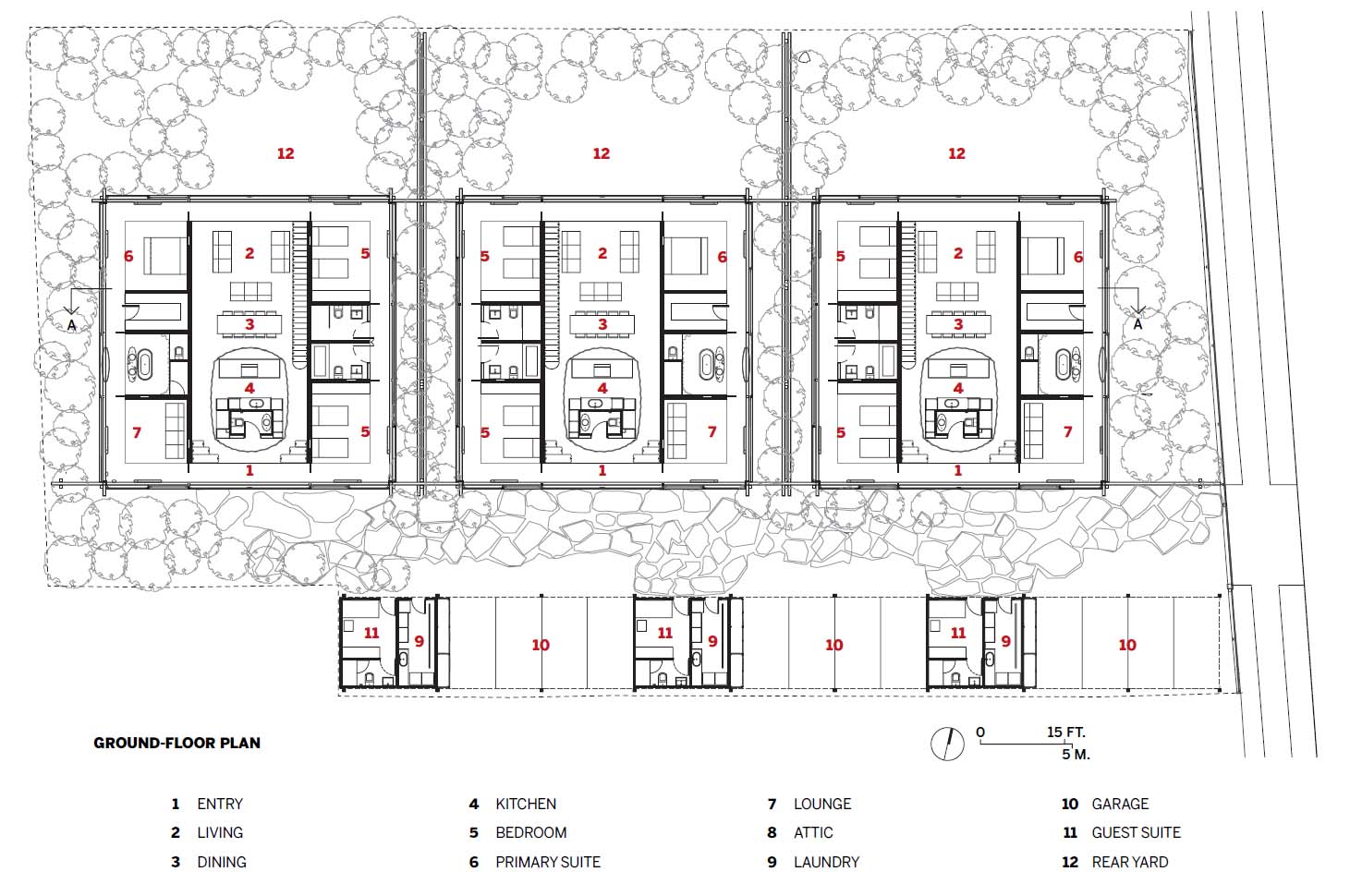
Image courtesy Diego Baraona Arquitectos Asociados, click to enlarge.
Image courtesy Diego Baraona Arquitectos Asociados, click to enlarge.
Credits
Architect:
Diego Baraona Arquitectos Asociados — Diego Baraona, design lead; Maria Jose Laclaustra, Vicente Muñoz Vargas, architects
Engineers:
PRY (m/e/p/AV); Juan Acevedo (structural)
Consultants:
Ricardo Walker (landscape); Marcela Valdés (lighting)
General Contractor:
Constructora Jorge Carrasco
Client:
Withheld
Size:
11,265 square feet
Cost:
Withheld
Completion Date:
December 2024
Sources
Cladding:
Sika (waterproofing)
Skylights:
Protex
Hardware:
JNF Ducasse, Itallinea
Lighting:
Flos, Reggiani, Troll, Evolux; Meanwell (dimming)