British architect Nicholas Grimshaw Dies at 85
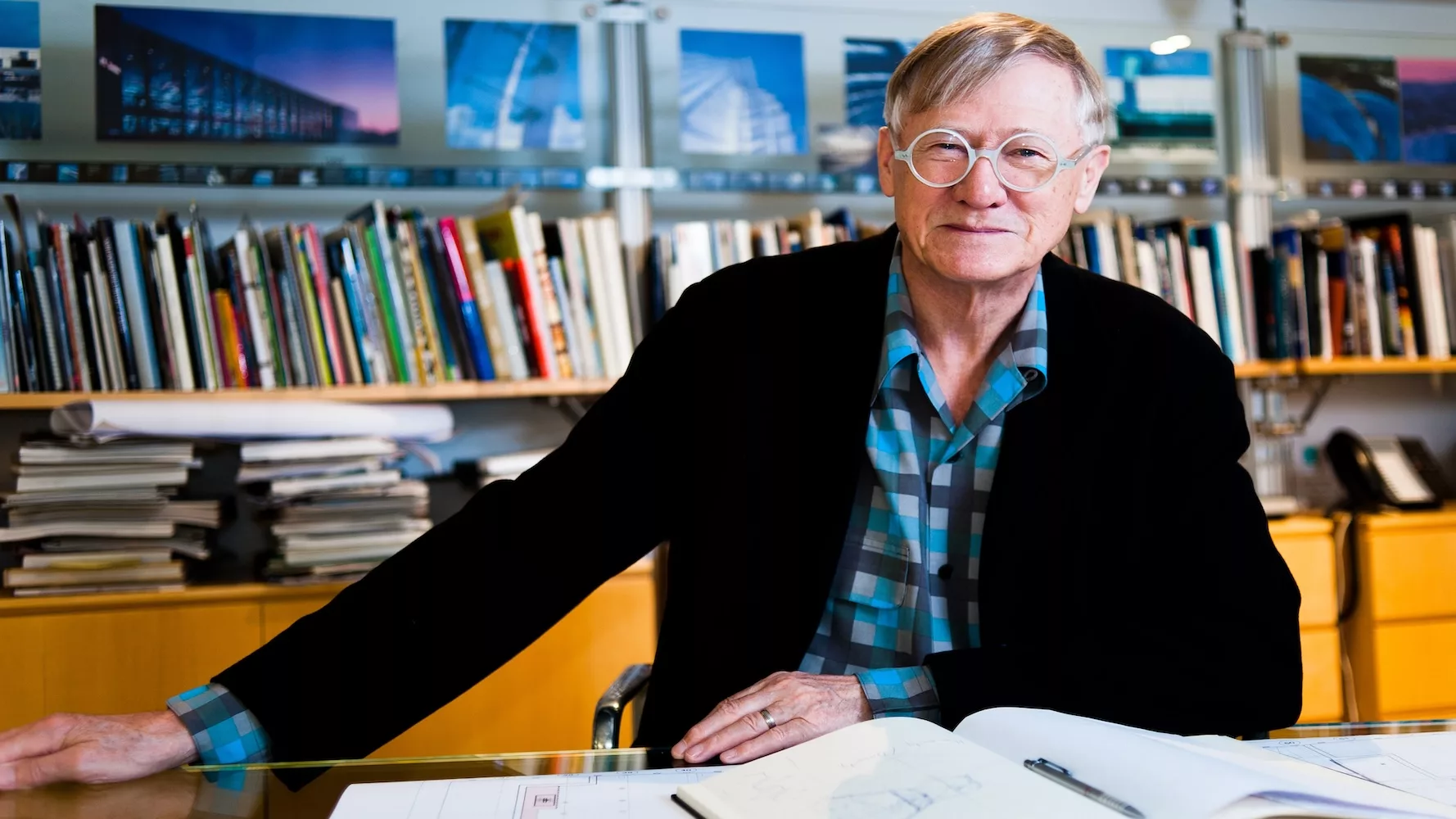
Architect Nicholas Grimshaw died on Sunday, September 14, 2025, at the age of 85. Remembered as a pioneer of the British High-Tech movement and as a peer of prominent architects such as Norman Foster, Richard Rogers, and Renzo Piano, in his nearly 60-year career, Grimshaw explored the poetic intersection of engineering and architectural form and built a legacy of audacious and unmistakable structures.
His death was announced by Grimshaw’s namesake firm, which he led until 2019. That same year, he was awarded the Royal Institute of British Architects (RIBA) Royal Gold Medal for Lifetime Achievement. In awarding the medal, RIBA president Ben Derbyshire praised the architect “for an extraordinary number of buildings and infrastructure projects of international significance, and for the continuous development of an architecture that places technology at the heart of the aesthetic.”
Among Grimshaw’s notable built works are the Herman Miller Factory in Bath, United Kingdom (1976), the Financial Times Printworks in London (1988), and the International Terminal at Waterloo Station (1994), all of which garnered RIBA accolades. Outside the UK, his notable projects include Amsterdam’s Enneüs Heerma Bridge (2001), Southern Cross Station in Melbourne, Australia (2007), the Fulton Center in Manhattan (2014), the Pulkovo Airport in St. Petersburg, Russia (2014), and the Istanbul New Airport (2018).
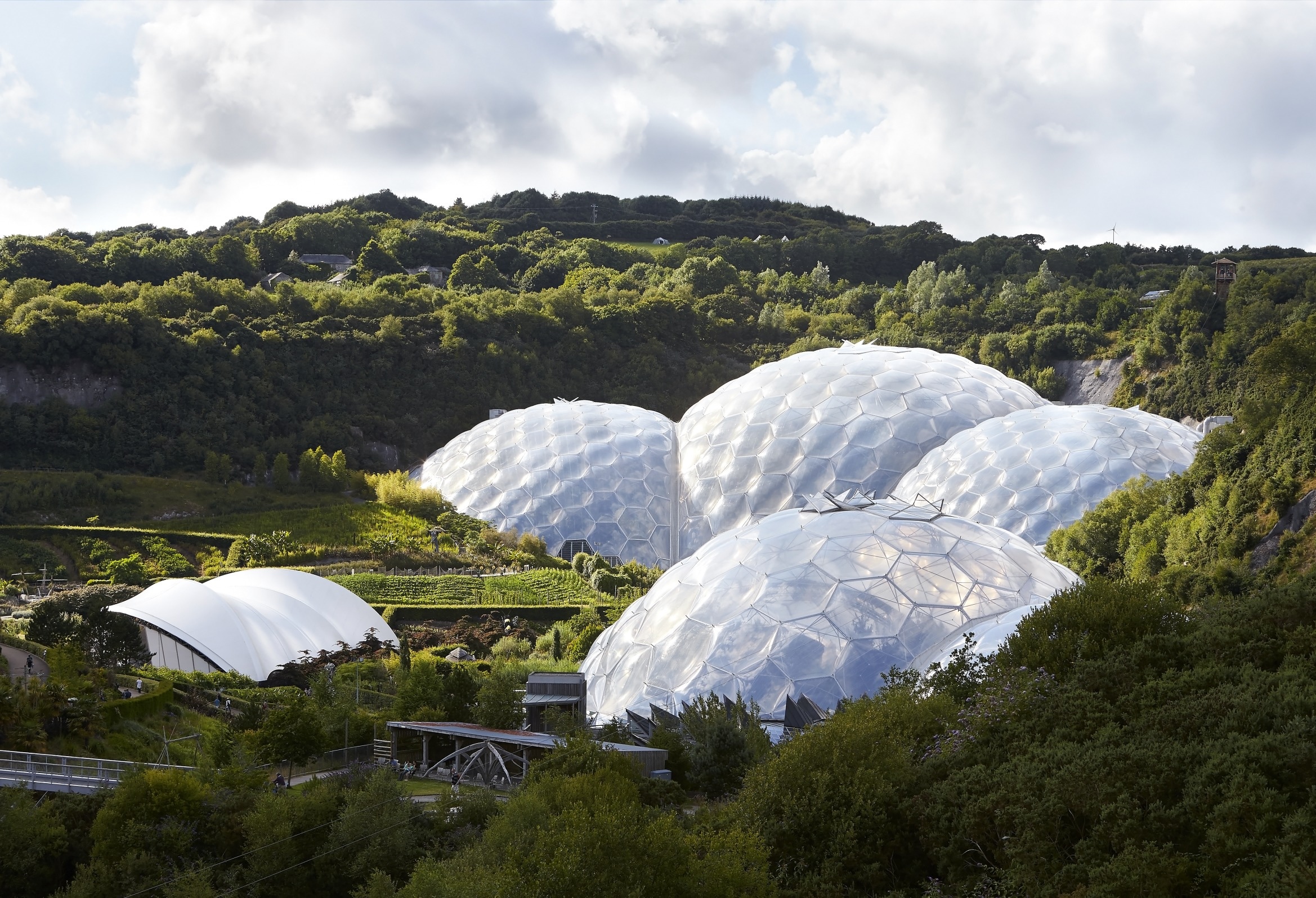
The Eden Project, Cornwall, England. Photo courtesy Grimshaw
Perhaps his most famous design is the Eden Project (2001), a series of gian biomes—recalling the geodesic experiments of Buckminster Fuller, a mentor, and realized in collaboration with famed High-Tech engineer Tony Hunt—constructed of triple-layered hexagonal ETFE “pillows” to house plants from around the world. Built on the site of a former clay quarry in Cornwall, UK, the Eden Project synthesized Grimshaw’s interest in structural ingenuity with his growing commitment to climate-responsive design. Across his oeuvre, there is a bold technical finesse, and though the buildings are marked by their industrial materials and complex yet legible structures, Grimshaw always insisted that his work came out of the legacy of Frank Lloyd Wright’s craftsman-architect approach.
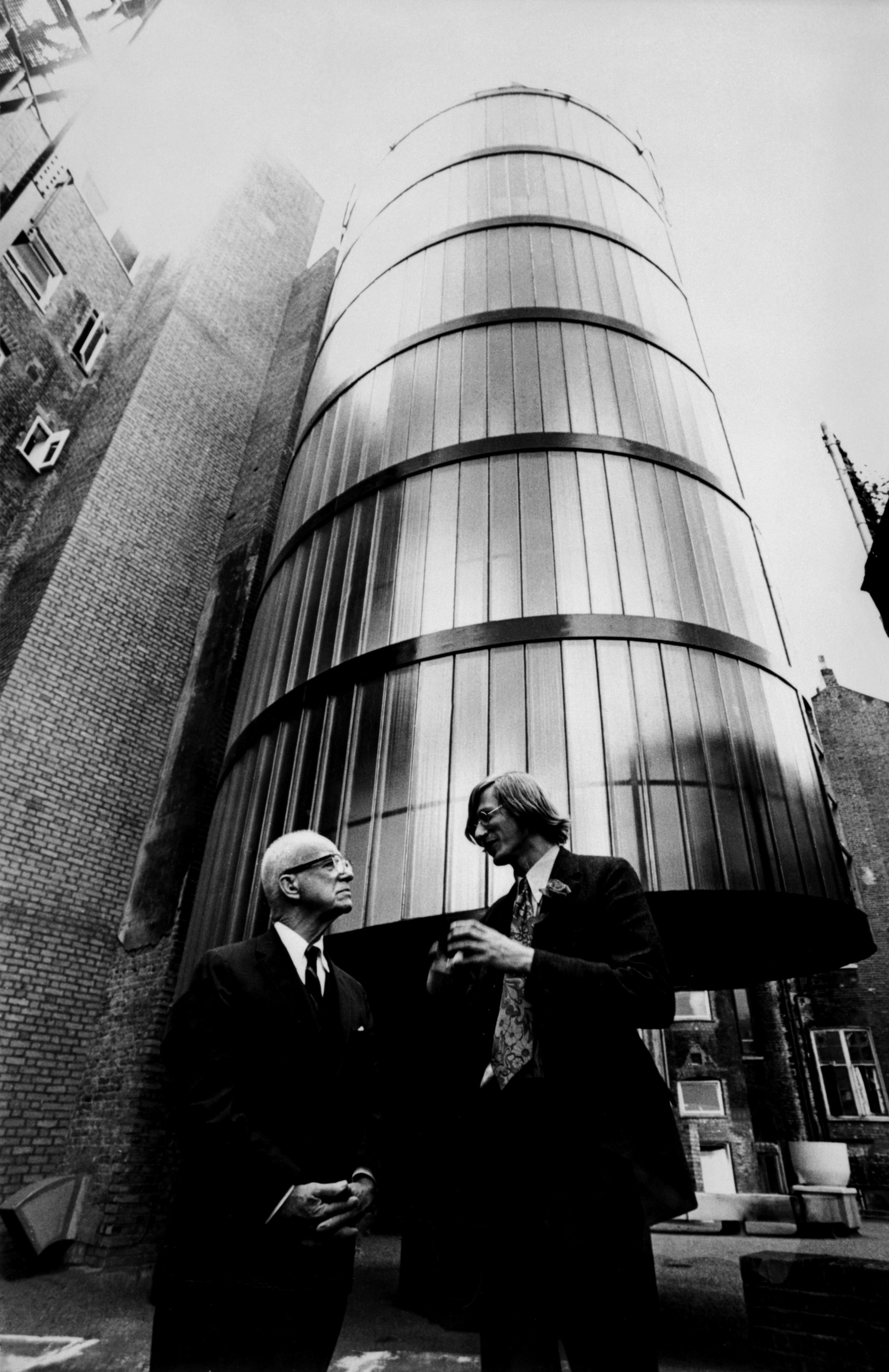
A young Grimshaw (right) with Buckminster Fuller at the now-demolished Service Tower for Student Housing in London. Photo courtesy Grimshaw
Born in Hove, East Sussex, in 1939, Grimshaw studied briefly at Wellington College, in Berkshire, and then at the Edinburgh College of Art before completing his education at the Architectural Association in London in 1965. Upon graduating, Grimshaw, with noted British architect Terry Farrell, started his own practice called Farrell Grimshaw Partnership. Over the next 15 years, before parting ways, the two men would complete numerous buildings in the UK, many of which have been recognized for their historic importance and have received National Heritage List protection. He founded Grimshaw and Partners in 1980, and the firm has grown to now include approximately 650 employees in eight offices spread around the world.
In 2002, Grimshaw was knighted by Queen Elizabeth II for his contributions to architecture, and he served as the president of the Royal Academy of Arts between 2004 and 2011. Reporting on the appointment in 2004, The New York Times described Grimshaw as “a man of good cheer,” a sentiment echoed by those who knew him best: in the firm’s statement announcing his passing, Grimshaw chairman Andrew Whalley recalled that, “from the very first day I arrived at the practice in 1986, I felt the warmth and generosity of Nick’s leadership. . . . His architecture was never about surface or fashion, but always about structure, craft, and purpose—about creating buildings that endure because they are both useful and uplifting and, in Nick’s words, ‘bring some kind of joy.’” Patty Hopkins, a fellow RIBA Gold Medal recipient and founder, with the late Michael Hopkins, of Hopkins Architects, commented that “Grimshaw shared many of our own beliefs about the importance of architecture’s role in the world, achieving buildings through creative experimentation and persuasion.”

Waterloo International Terminal, London. Photo courtesy Grimshaw
Grimshaw is survived by his wife, Lavinia, and daughters Chloe and Isabel. Lavinia and Chloe both serve on the board of the Grimshaw Foundation, which he founded in 2022, with the purpose of creating opportunities for underrepresented youth and helping develop technical skills for success in creative industries—in just three years, the foundation has supported more than 500 young people. Grimshaw’s legacy will live on not only through his foundation, or through the now-global firm that bears his name, but through his life’s work of hundreds of buildings around the world, inhabited by thousands every day.
Looking for quick answers on architecture and design topics?
Try Ask RECORD, our new smart AI search tool.
Ask RECORD →
Looking for a reprint of this article?
From high-res PDFs to custom plaques, order your copy today!