Newsmaker: Barry Bergdoll Awarded the 2025 Vincent Scully Prize

The National Building Museum has announced that Barry Bergdoll will receive the 2025 Vincent Scully Prize at its Washington, D.C., home on October 22. A jury formed of Paul Goldberger (as chair), Andrea Roberts, Nancy Levinson, Stephen Luoni, and Toshiko Mori awarded Bergdoll the $55,000 prize in recognition of his significant contributions as an architectural historian, educator, and curator. The program was founded in 1999 in honor of Scully, the longtime Yale University professor of architectural history who was its first recipient. Bergdoll is the Meyer Schapiro Professor of Art History at Columbia University and was the Philip Johnson Chief Curator of Architecture and Design at the Museum of Modern Art (MoMA), from 2007 to 2013. He is the author of books on Léon Vaudoyer, Karl Friedrich Schinkel, and Mies van der Rohe, as well as the survey European Architecture 1750–1890. Among his other activities, Bergdoll is a member of the jury for the Pritzker Architecture Prize. He received his B.A. from Columbia University (1977); his M.A. from the University of Cambridge (1979); and a Ph.D. from Columbia (1986). Bergdoll recently talked with RECORD contributing editor Suzanne Stephens about teaching in the present climate, as well as his views on current museological approaches and architectural exhibitions.
Does Columbia University’s wrangling with President Trump over his withholding federal funding—due to the university’s purported antisemitism—affect the teaching of architectural history?
The Columbia situation is just the tip of the iceberg that is causing our Titanic—the richness of intellectual life—to sink. Obviously, it is not just pertinent to Columbia: this richness has been one of the extraordinary achievements of the pax americana that came after WWII, which allowed students to encounter different points of view. The attack on the vitality of American culture is a new kind of dumbing down. More and more, the instructor has to teach in a culture of fear and in a period of self-censorship.
Some say that today’s approach to the teaching of architectural history, which emphasizes problems such as climate change and the lack of affordable housing, means that “architecture” itself is shunted aside. What are your thoughts?
I am trained as an art historian, where you analyze form in all the arts. Yet during my education I also was influenced by 1970s thinking, when architecture was placed within a social, political, and cultural context. I have been called a “relentless contextualizer.” However, in recent years, the context has taken over reading of form, and form has gotten lost. This is a problem if you still respond to architecture as a creative act—that is, as fostering movement through space, or the inventive response to a program.
Do you agree that today’s students seem to know less about architecture itself, particularly with regard to the “canon”?
The canon is a set of common references and a shared body of experience that we can debate among ourselves. It fosters visual intelligence and acuity. During a time of complete fragmentation of social discourse, it is helpful to have a shared frame of reference.
However, notions of a canon can still make room for a more complex set of interpretations. For example, it is better to keep Thomas Jefferson’s plan for the University of Virginia in the canon, yet also allow the discussion of how it came into being through enslaved labor.
What about the importance of the architect as the “individual genius”?
There is a shift away from thinking of the architect as a sole creator of most designs. Architects do work as part of a team, even if the public likes to vilify them for being egocentric. Still, teamwork is the reality, not the concept of an individual genius.
As the architecture curator at MoMA, you covered history, current design, and environmental and social issues. What was your reasoning?
In the early days of the museum’s existence the architecture department had a missionary energy. It bonded with the Department of Circulating Exhibitions in order to combat architectural conservatism on a wider scale. For example, the department took an editorial stance in 1937 with a small show criticizing the traditionally designed “Town of Tomorrow,” then being planned for the World’s Fair of 1939. Similarly, when I was the curator of MoMA’s architecture department, I wanted to use exhibitions to engage crucial issues that needed public discussion, such as our 2010 show Rising Currents: Projects for New York’s Waterfront.

Rising Currents displayed the speculative work of architects in residence at MoMA PS1 to address sea-level rise. Photo © Thomas Griesel, Courtesy MOMA, click to enlarge.
In the 1930s, MoMA could put up a lot of exhibitions, since the installations consisted mainly of photos mounted on gallery walls. By the late 1960s, the inclusion of original material such as drawings and models became the norm. It meant curators couldn’t assemble the shows as quickly as they had.
Looking for quick answers on architecture and design topics?
Try Ask RECORD, our new smart AI search tool.
Ask RECORD →
What do you think about the lack of gallery space specifically dedicated to architecture and design today at MoMA, as opposed to the way it was before the renovation in 2019?
I regret not having designated galleries of architecture and design. It is a real loss. True, in the early days, some shows brought together architecture with painting. But later the departments became autonomous—what happens at a certain time in architecture does not necessarily occur in painting and sculpture. Furthermore, it is such a surprise and blessing for visitors to come to see the art and then accidentally find an installation devoted to architecture.
Currently you are preparing an exhibition at the New York’s Bard Graduate Center on the drawings of Eugène-Emmanuel Viollet-le-Duc. Why the focus on Viollet-le-Duc?
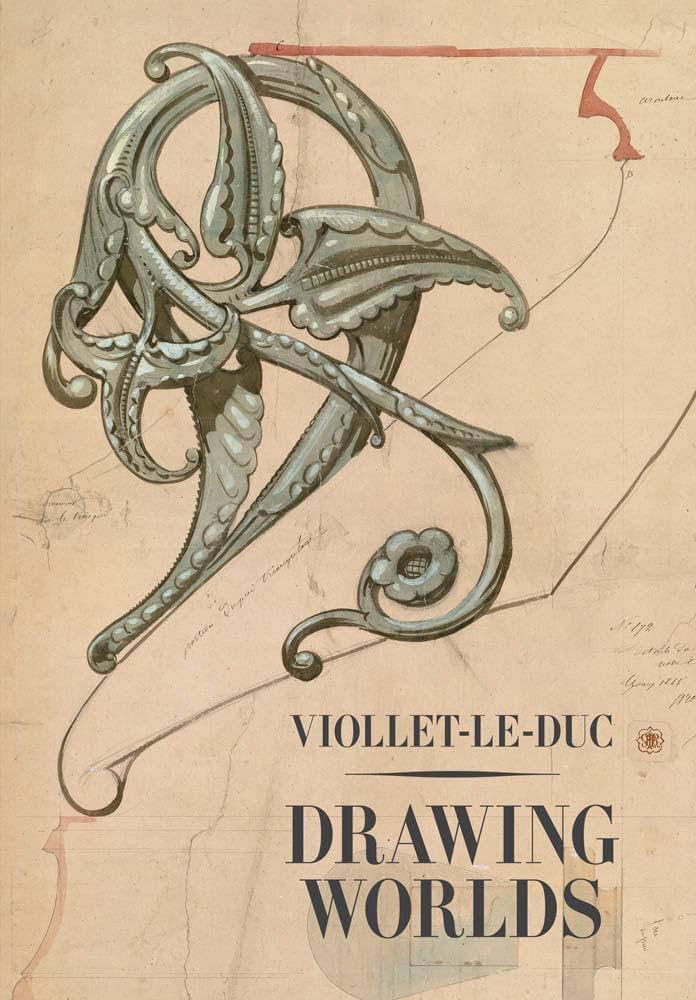
The catalogue for Bergdoll’s next exhibition will focus on Viollet-le-Duc’s drawings. Courtesy Barry Bergdoll
Both I and Martin Bressani, who is an architecture professor at McGill University in Montreal and the author of an amazing book, Architecture and the Historical Imagination: Eugène-Emmanuel Viollet-le-Duc, 1814–1879, have organized the show. We are highlighting Viollet’s distinctive drawing as a practitioner and an educator, and so we chose to display both beautiful presentation drawings as well as working drawings for quarry workers, silversmiths, and craftsmen. We want visitors to look at drawings as drawings. The exhibition—Viollet-le-Duc: Drawing Worlds, which opens January 28, 2026, with an extensive catalogue—shows that he was more than the architect who renovated Notre-Dame in the mid-19th century.
You are currently writing a book on architectural exhibitions. What is their importance?
The book, Out of Site, In Plain View: A History of Exhibiting Architecture Since 1720, explores the origins of the architectural exhibition as part of public debate. It is based on my Mellon Lectures, given in 2013 at the National Gallery of Art, and investigates the attempts of architectural exhibitions to be accessible to a general audience as well as a specialized one. It also deals with the paradox of the architectural exhibition—that architecture is only ever represented through photos, drawings, and models, but not physically displayed except under certain circumstances such as model houses or avant-garde spatial installations.
In one chapter, I address the question of the exhibition and the construction of architectural history. An exhibition on architecture has a lot to do with the invention of a chronology of buildings—that is, the buildings presented are not necessarily erected in a chronological order. The architecture is often divorced from its original settings and rearranged in the gallery space to form a historical narrative—hence the play on words in the title Out of Site, In Plain View.
The 2025 Vincent Scully Prize ceremony honoring Barry Bergdoll will take place the evening of Wednesday, October 22 at the National Building Museum in Washington, D.C. Click here to purchase tickets to this event.
Looking for a reprint of this article?
From high-res PDFs to custom plaques, order your copy today!