Health & Wellness
A Seven-Building Campus in Rural Uganda Becomes a Model for Constructing Off-Grid Medical Facilities
Kyabirwa, Uganda
Architects & Firms
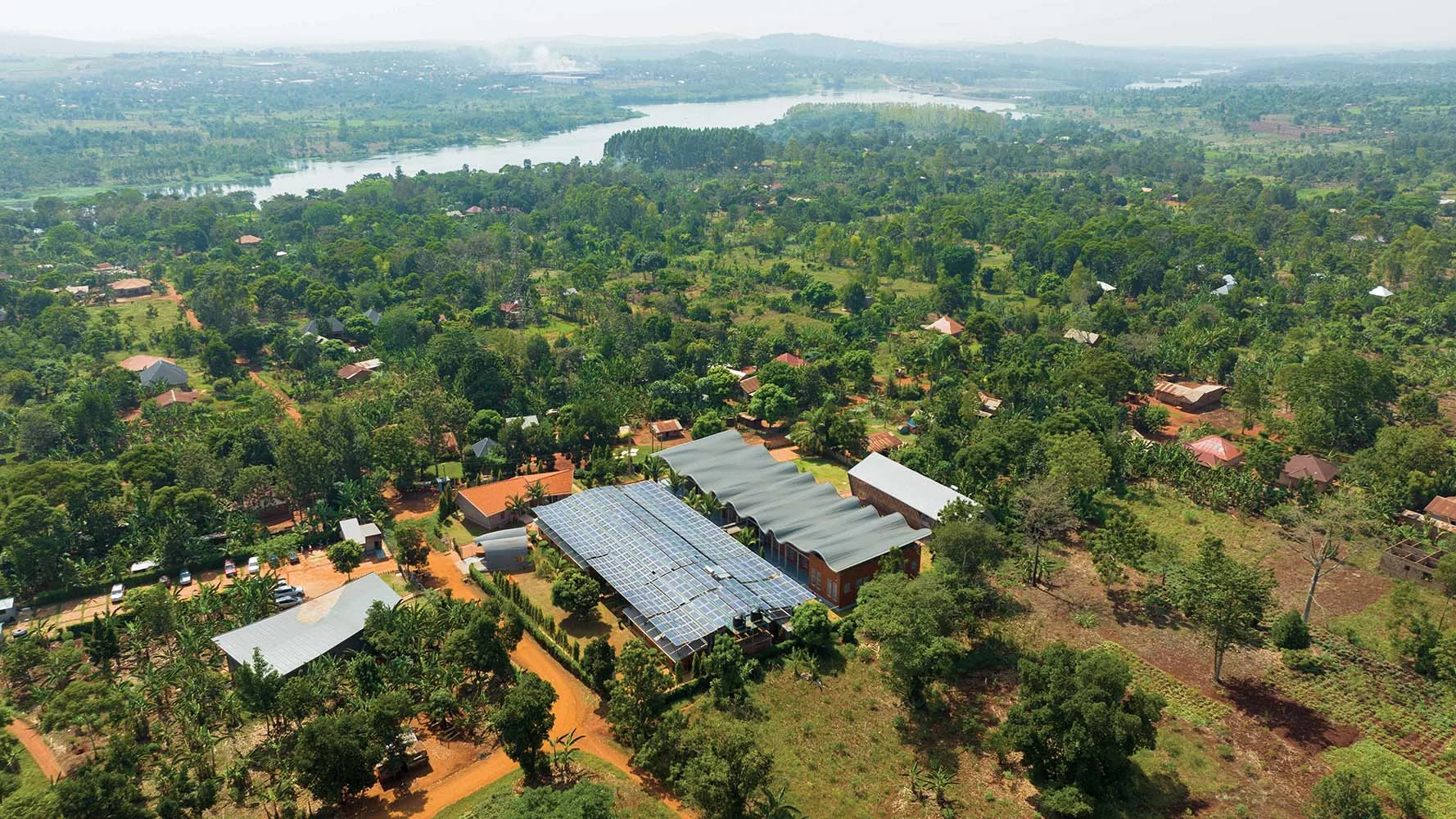
The goal is “to provide surgical care where it is impossible,” says George K. George, principal of GKG in New York City. Located on the banks of the Nile, in the rural Eastern Region of Uganda, the Kyabirwa Surgical Center is a prototype for a completely off-grid facility that offers a wide range of surgical, laboratory, and radiology services, as well as job training and education. In partnership with Mount Sinai Health System, in New York, and developed by the NGO Global Surgical Initiatives (GSI), the center is run by Ugandan doctors and nurses and employs more than a dozen villagers as full-time staff. The construction of the seven pavilions that compose the campus also relied on the skills of local craftspeople, vernacular building techniques, and regionally available materials. As George puts it, the center is “by Ugandans, for Ugandans.”
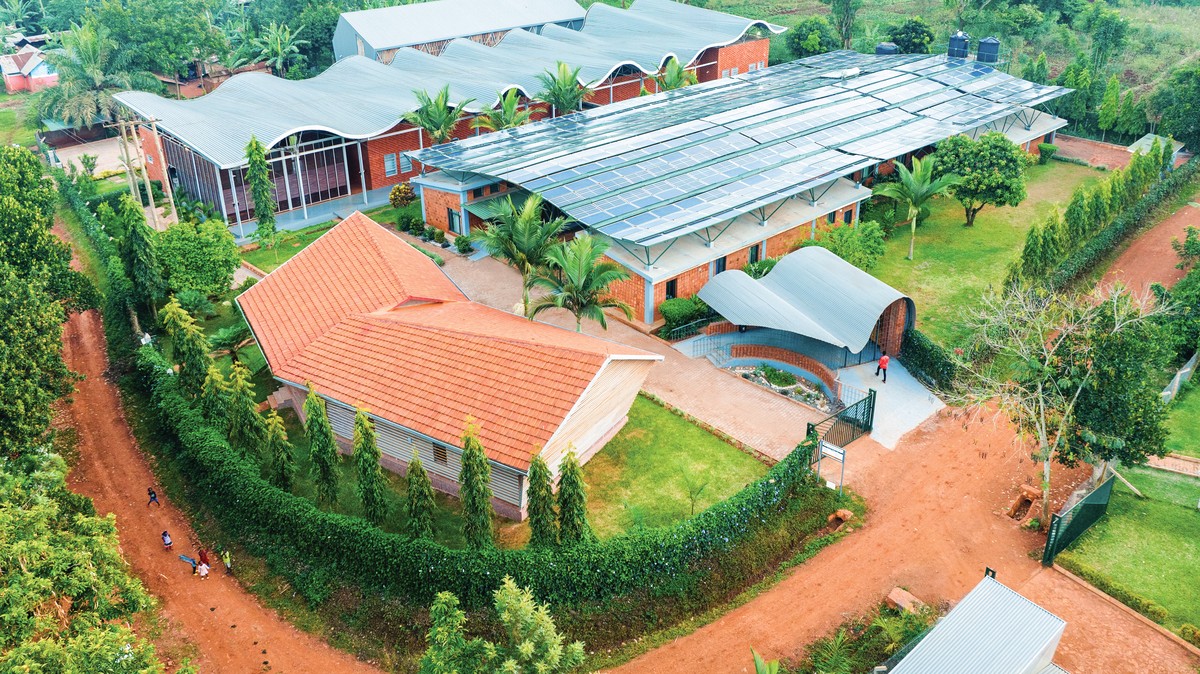
The waiting room has a warped roof of Mangalore tiles, and the guard booth is formed by wrapped sheet metal. Photo © Russell Pictures Entertainment
George first made the day-long series of flights—there are no direct routes between the East African nation and the United States—followed by a four-hour drive to the remote village of Kyabirwa in 2018. GSI’s chairman, Dr. Michael Marin, had commissioned Kliment Halsband Architects, where George was then a partner, to design a surgical facility powered and shaded by a vast solar array. George left to establish GKG shortly before that main building was completed and before Kliment Halsband merged with Perkins Eastman. After the surgical facility opened, Dr. Marin came to George to develop, one by one, additions to the campus as its needs became clearer. GKG completed an overnight patients’ ward in 2023, doctors’ quarters in 2024, and smaller pavilions including a waiting room, ambulance shed, public lavatory, and guard booth in 2025. Each building, as they discovered from previous additions what’s possible with limited resources and in this remote context, is more formally playful than the last. “The first building was a steep learning curve,” says George, “but the joy of exploring forms followed as the program grew.”
1
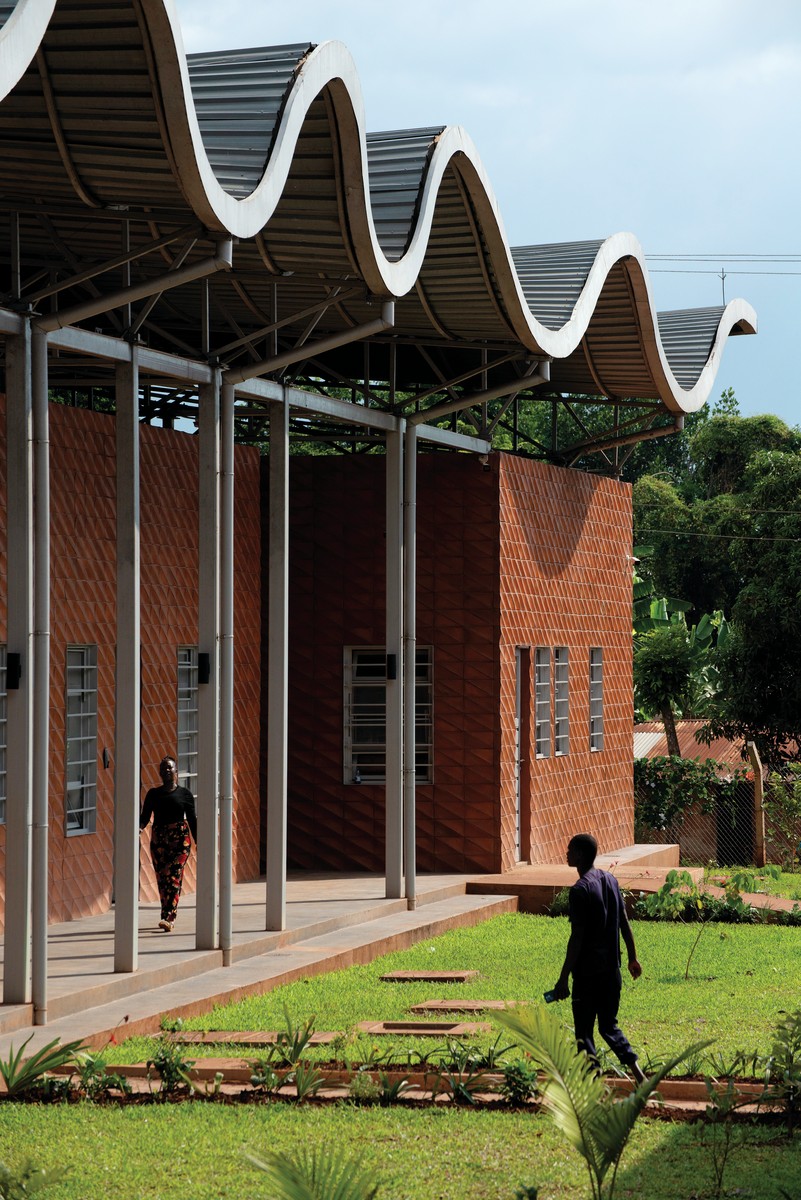
Following the completion of the surgical facility, the campus (top of page) grew to include seven structures in total. The first and largest addition is the patients’ ward (1 & 2). Photos © Russell Pictures Entertainment (1), Will Boase (2), click to enlarge.
2
The village of Kyabirwa was once famous for the rapids found there—this stretch of the river is known as the White Nile for the clay sediment it carries, but the name could just as easily have described the choppy waters. After visiting Kyabirwa on a kayaking expedition, Dr. Jessie Stone built a clinic in 2003, and the village soon became a hub for medical treatment in the region—and thus GSI’s location of choice. In 2012, a hydroelectric dam, paid for by the Aga Khan Fund for Economic Development, tamed the waters. But the power generated there is almost entirely sold off to neighboring Kenya, necessitating the surgical center’s off-grid approach.
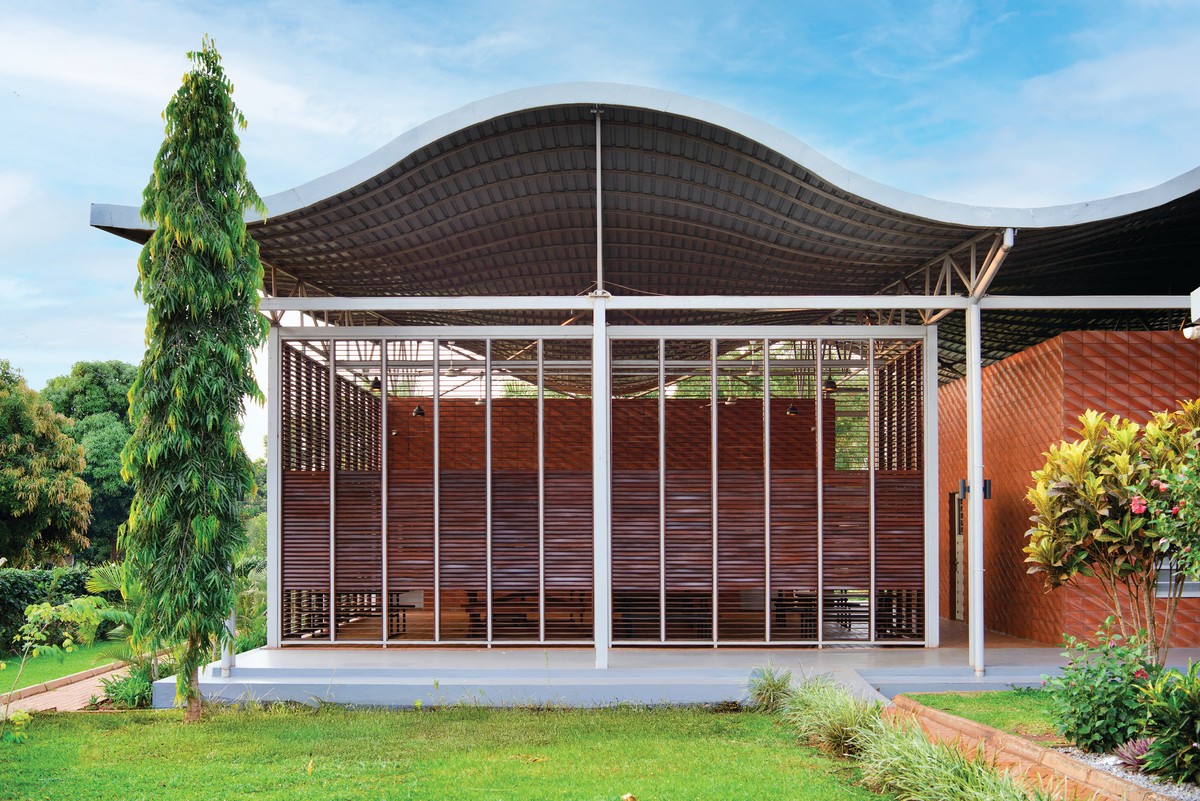
After building the solar-powered facility a few hundred feet from the clinic, GSI quickly realized the campus needed a ward for overnight patients, and it engaged GKG on the design in 2020. Running parallel to the operating facility, and connected to it through a short passageway, the 11,800-square-foot ward also houses a pathology lab, genomics bank, surgical-simulation center for training, administrative offices, and an open-air cafeteria, all under a corrugated-steel secondary roof, elevated above the building for airflow. This canopy mitigates the intense equatorial solar-heat gain, and its rippling form recalls the rapids. The undulating roof channels rainwater into tanks and underground cisterns totaling 42,000 gallons. This collected water is processed through reverse-osmosis and ultraviolet filtration systems and is then used throughout the campus, which has no other source of water. The varied trusses that form the canopy were fabricated in a nearby shop, with the purlins between them and the metal sheets above bent on-site. “The local builders are very good with steel,” explains George. “They’re willing to weld together simple shapes to make any form you like.” The concrete-block exterior walls are clad in scalloped clay tiles, custom-made by a local potter hired by the contractor.
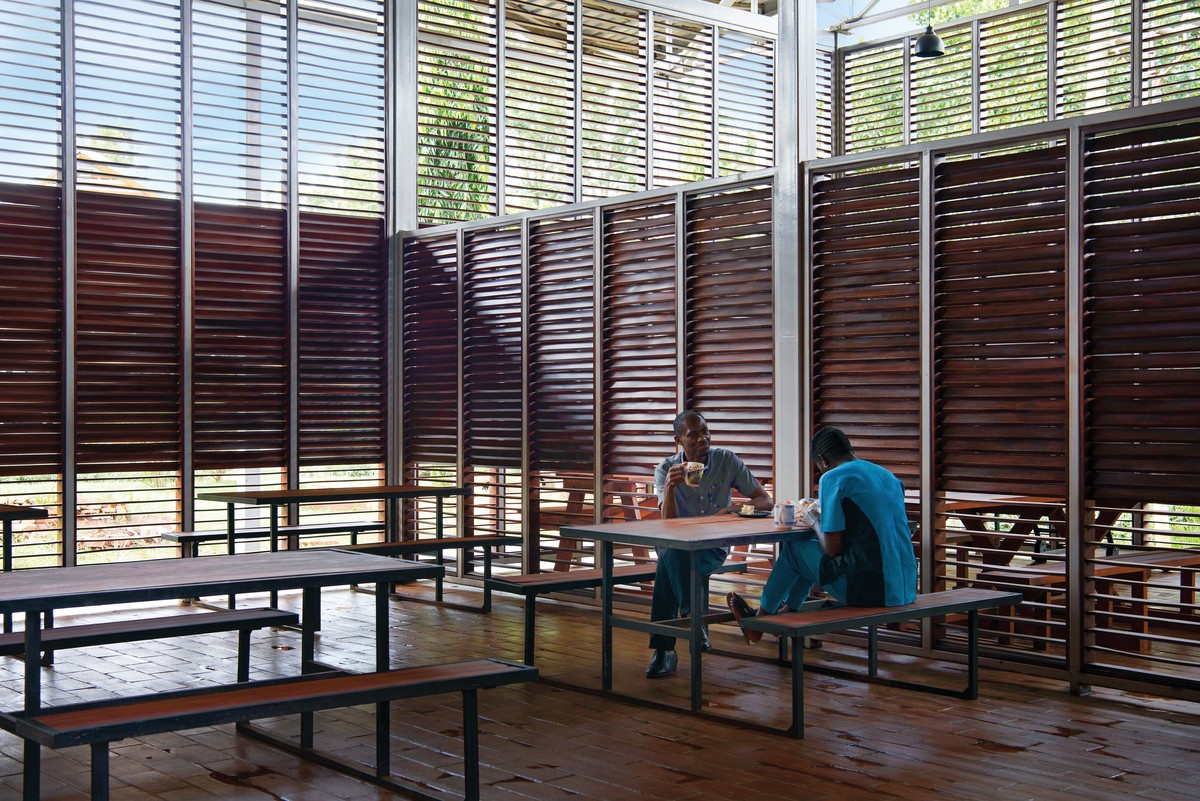
The ward includes an open-air cafeteria, screened by mahogany slats. Photo © Will Boase
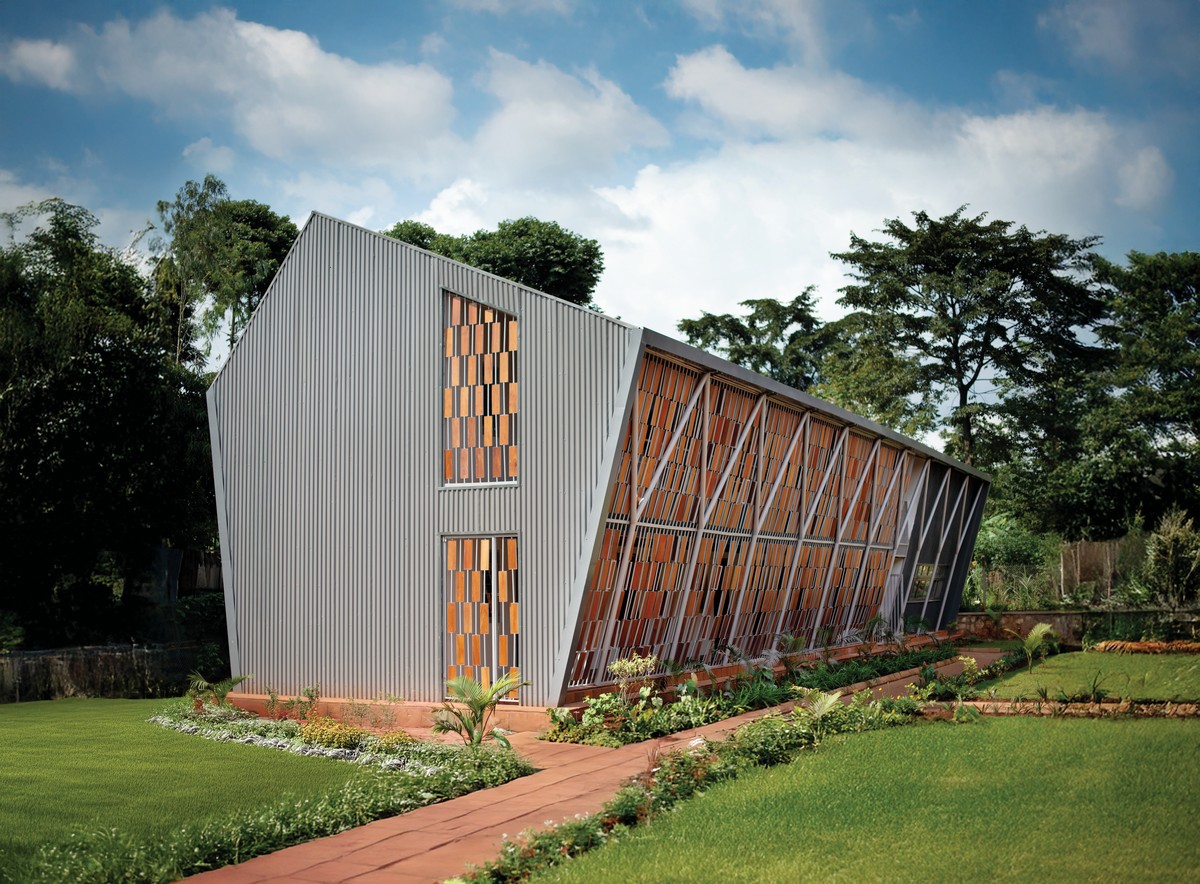
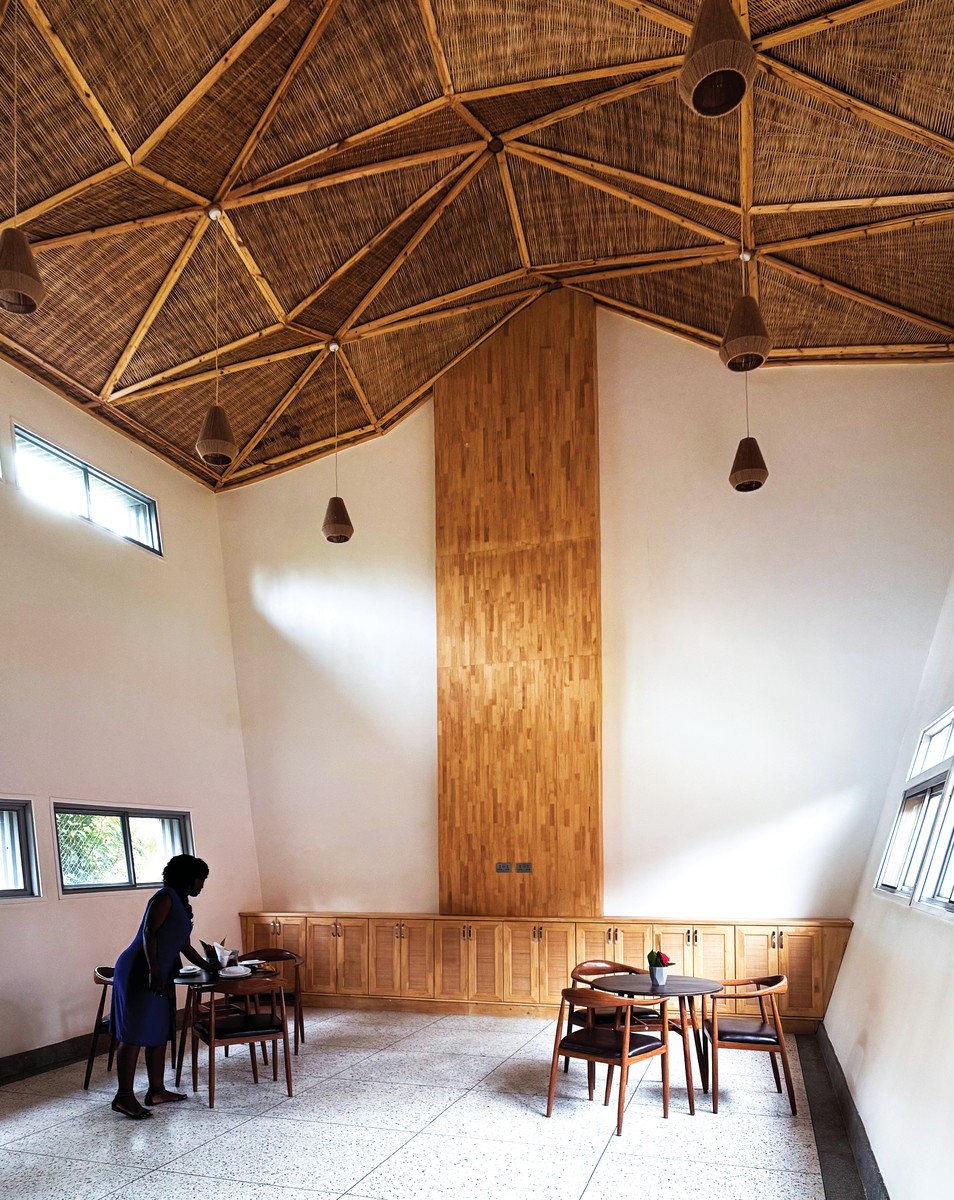
The next major addition was housing for doctors and trainees. Starting in 2022, GKG designed a two-story building shaped like an extruded lozenge, with six bedrooms and a double-height lounge. The roof and three of the exterior walls are of the same corrugated-steel sheets common in the region, but the primary facade is a screen of staggered wood slats layered behind a run of Y-shaped steel columns. The slats, which can rotate to allow for greater airflow and visibility, are made of teak, a precious hardwood that, along with mahogany, is cultivated in Uganda. The ceiling of the common room is clad in tessellated panels made of woven reeds pulled directly from the Nile—again, crafted by local artisans. Like the other buildings, the roof is designed to collect rainwater for reuse on-site.
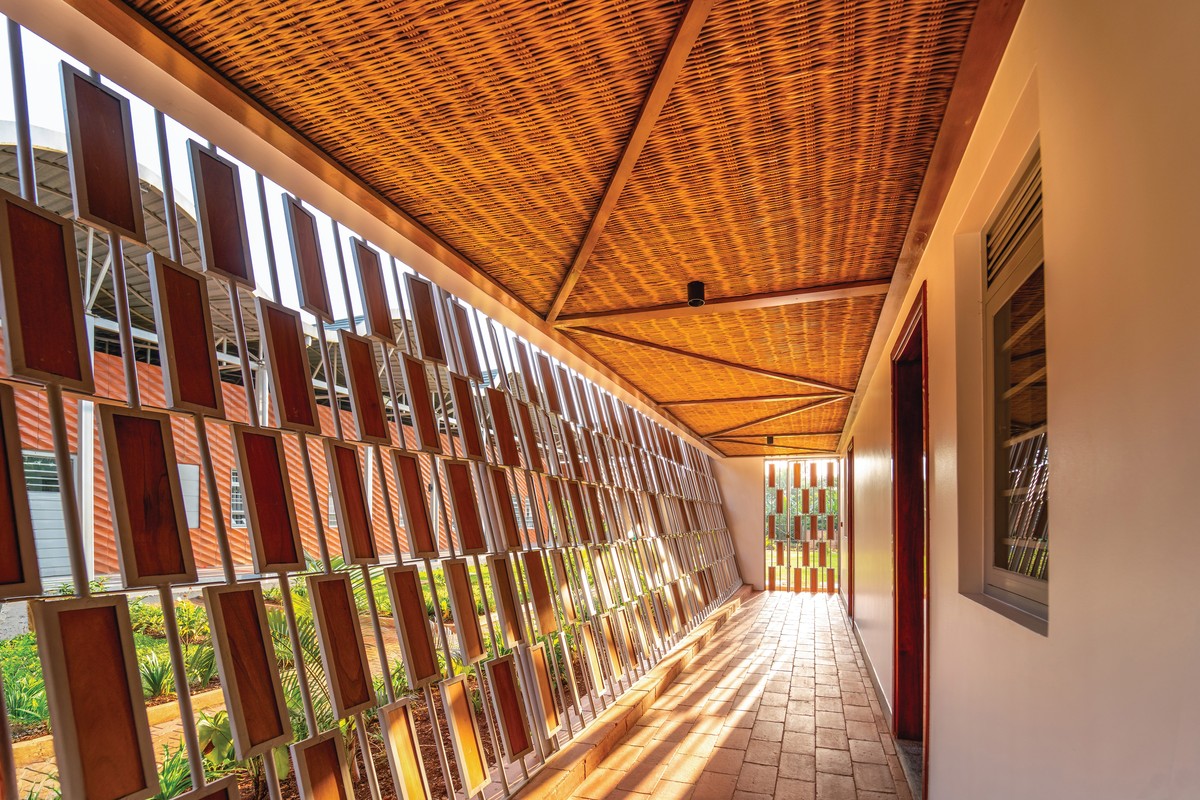
Like the doctors’ quarters, each pavilion explores local materials. Photo © Will Boase
3
Rotating teak planks form the facade of the doctors’ quarters, and woven-reed panels line its ceilings (3 & 4). Photos © Will Boase
4
The formal inventiveness found on the Kyabirwa campus is striking compared to medical facilities in the United States, which are often standardized and sterile. GKG achieved this not by cutting corners—it followed Facility Guidelines Institute recommendations—but through close collaboration with the contractor, Selemani Construction, which took an active role in advising what was and was not possible in such a challenging context. “We as architects tend to beat up on ourselves when we have to compromise, but making compromises helped push the design even further,” explains George. Given the remoteness of the site, construction management was limited to weekly Zoom calls. “If you are willing to give up some control, maybe you can get something even better.”
Developed piecemeal as its needs became apparent, the campus now serves as a model for future centers. GSI is working with GKG on its second location, planned for Chiredzi, Zimbabwe. The team is taking lessons from the Kyabirwa Surgical Center, learning not only what a remote self-sufficient facility needs but also how to build it.
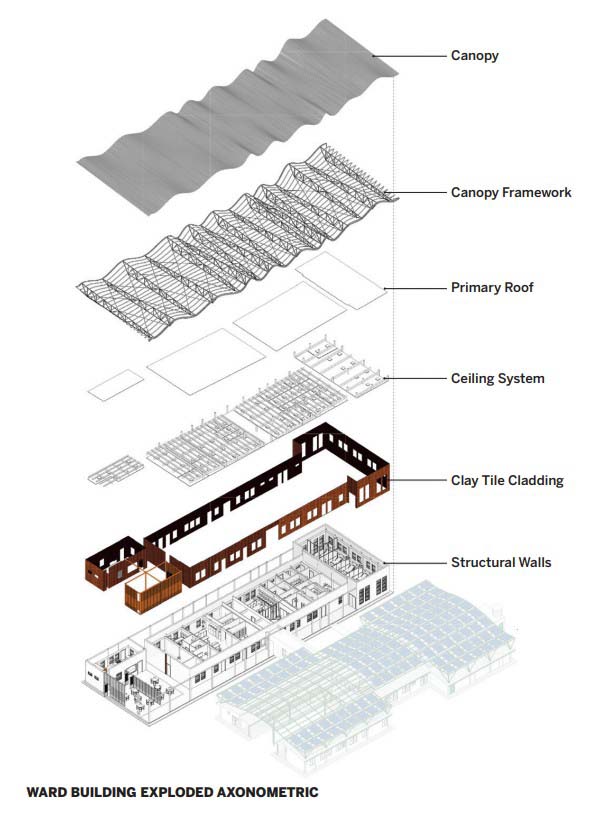
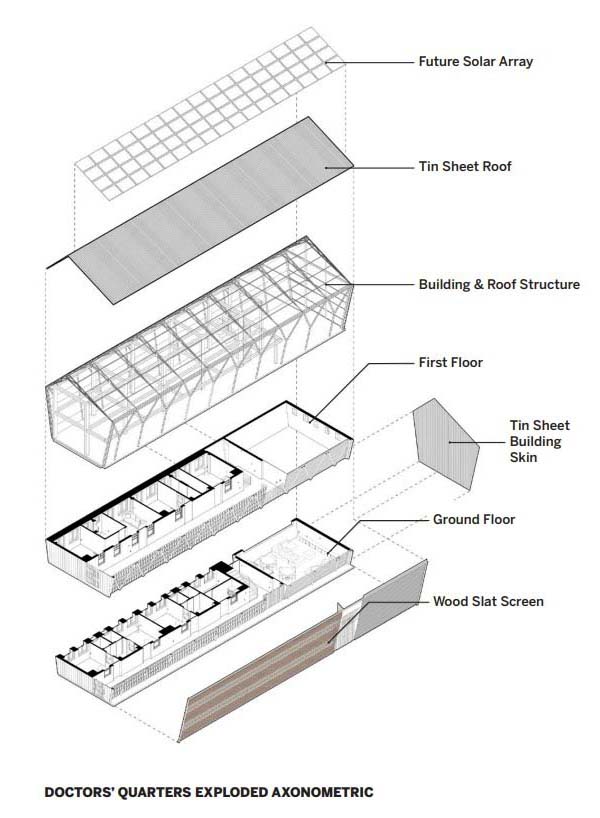
Images courtesy GKG
Read about other Health & Wellness projects from our January 2026 issue.
Credits
Architect:
GKG — George K. George, Max Marin, Nicole Rivera, Sneha Varghese
Architect of Record:
Enjuburr Atelier
Engineers:
Oak Engineers (MEP, HVAC); Selemani Construction (structural)
General Contractor:
Selemani Construction
Client:
Global Surgical Initiatives
Size:
11,800 square feet (ward); 3,500 square feet (quarters)
Cost:
$1.1 million (ward); $380,000 (quarters)
Completion Date:
January 2024 (ward); June 2024 (quarters)
Sources
Masonry:
Eco Crete Masonry Uganda
Wall Tiles:
Kawotto Clays, ABC Ceramics
Lighting:
Chint Uganda, Tronic Uganda
Acoustical Ceilings:
Armstrong Acoustic Panels
Looking for quick answers on architecture and design topics?
Try Ask RECORD, our new smart AI search tool.
Ask RECORD →
Looking for a reprint of this article?
From high-res PDFs to custom plaques, order your copy today!