Collaborative Learning—and Dizzying Fun—Rule at Bernard Tschumi's New Building at Institut Le Rosey
Rolle, Switzerland
Architects & Firms
Founded in 1880 in the Swiss town of Rolle, Institut Le Rosey is reputedly the most expensive school in the world. Leopold III of Belgium, Norman Foster, John Lennon, Rainier III of Monaco, and the penultimate Shah of Iran all sent offspring there. For $135,000 per year, the children of the rich and powerful enjoy not one but two campuses: in addition to the 70-acre main site on the shores of Lake Geneva, the school also owns facilities in Gstaad, where boarders spend the winter semester in the mountains. Over the past 20 years, Institut Le Rosey has been enlarging its premises to accommodate more students, with capacity soon expected to reach 550, compared to 390 in 2005. While Snøhetta’s design for a new building in Gstaad is currently under construction, Lausanne-born, New York–based Bernard Tschumi recently completed the second of two major new structures at the Rolle campus, which is centered around the historic Château du Rosey.
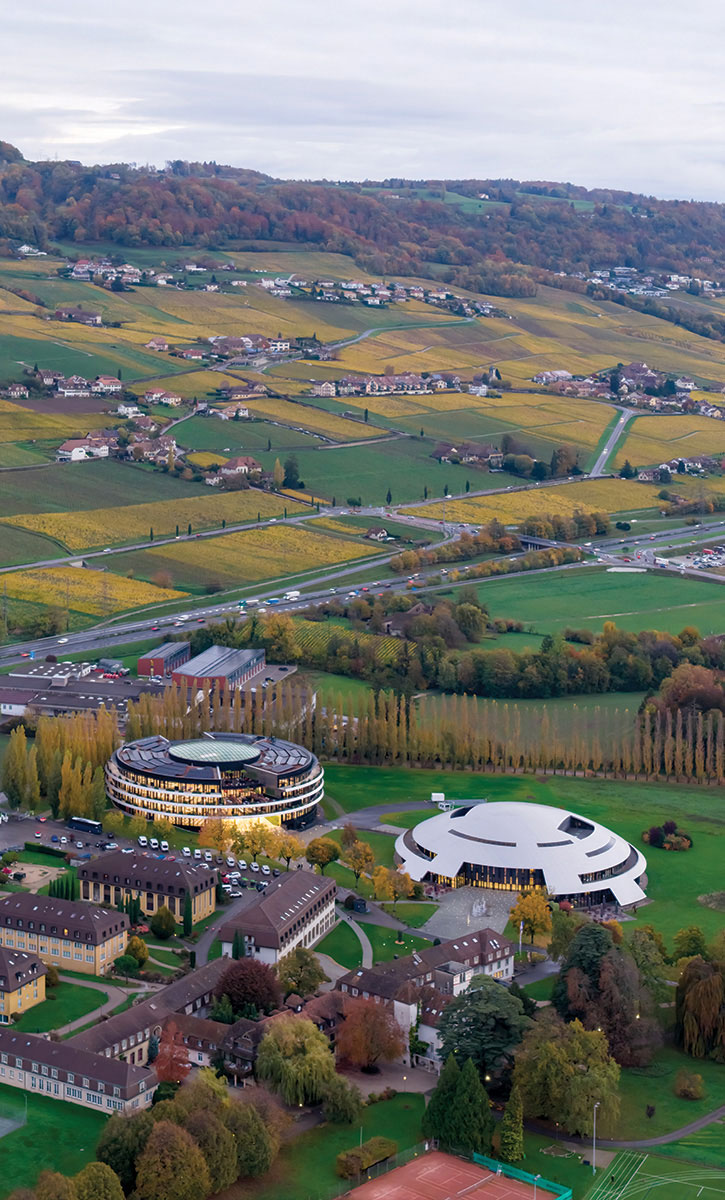
Tschumi’s involvement with the school dates back to 2010, when its directors asked him to take part in a small design competition alongside the Tokyo-based firms SANAA and Tange Associates (the latter headed by former Le Rosey student Paul Noritaka Tange, son of Pritzker Prize laureate Kenzō Tange). With a brief to “bring Le Rosey into the 21st century,” the three candidates were asked to design a new arts complex for Rolle featuring, among other spaces, a 900-seat concert hall, music rehearsal rooms, a library, and classrooms for painting and sculpture. Where Tange and SANAA both proposed fragmented structures, Tschumi chose to organize everything under an enormous freestanding dome, whose rather futuristic flying saucer image seduced the school’s leadership. Located on a grassy plain opposite the older buildings, Paul & Henri Carnal Hall, as the building is known, opened in 2014.
1
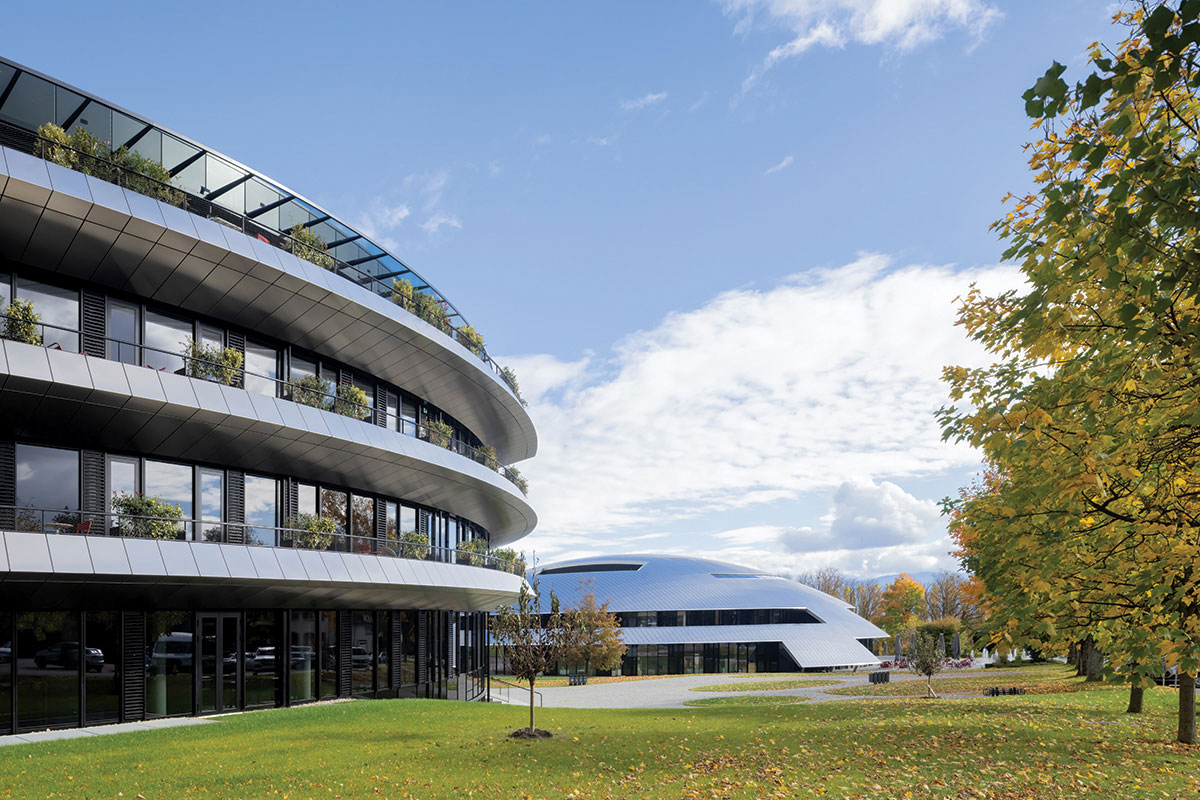
Philo is located next to Carnal Hall (1 & 2). Photos © Iwan Baan, click to enlarge.
2
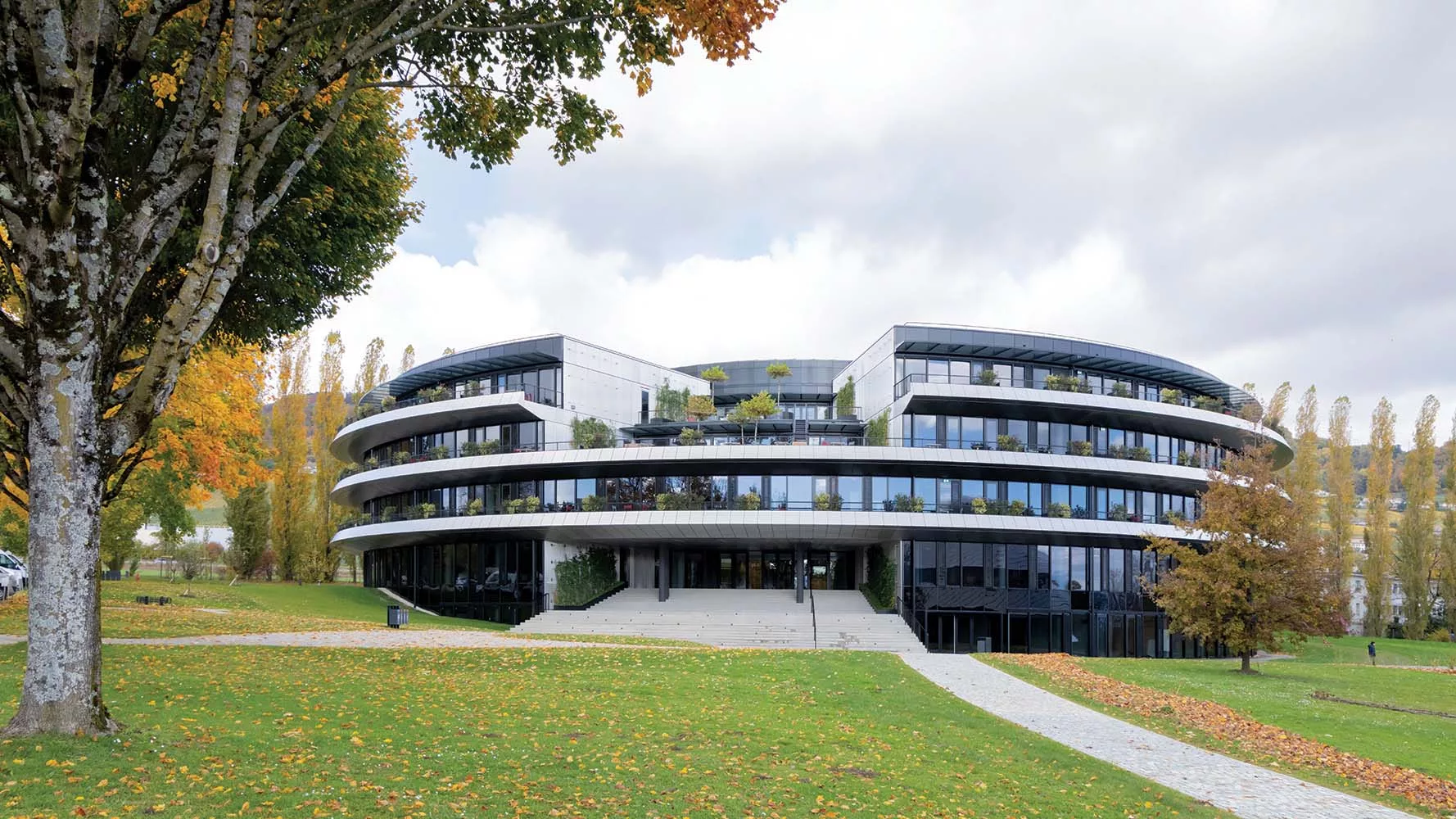
In 2019, Institut Le Rosey turned once again to Tschumi for a second building, this time dedicated to the humanities and the sciences. A pendant to Carnal Hall, the new structure—baptized Philo—contains all the other teaching spaces except for sports, thereby allowing classrooms in the school’s historic premises to become dorms. Sited to the northwest of Carnal Hall, the 175,000-square-foot, five-story building inscribes itself within a 250-foot-diameter circle and rises 60 feet, just like its neighbor. But, in place of Carnal Hall’s hybrid structure, where a timber auditorium stands under a steel dome, Philo is a classic stacking of concrete floors, with pie-shaped slices removed at levels four and five to create outdoor terraces. Planted balconies animate the exterior, which, with its black-lacquered aluminum window frames and brushed-stainless-steel facade panels, bears a family resemblance to Carnal Hall.
Due to the uneven terrain, Philo’s lowest floor is a semi-basement, with the main entrance located on level two. An imposing flight of steps leads up to it, adding a dash of corporate grandeur that continues inside, where a circular central atrium orients the visitor.
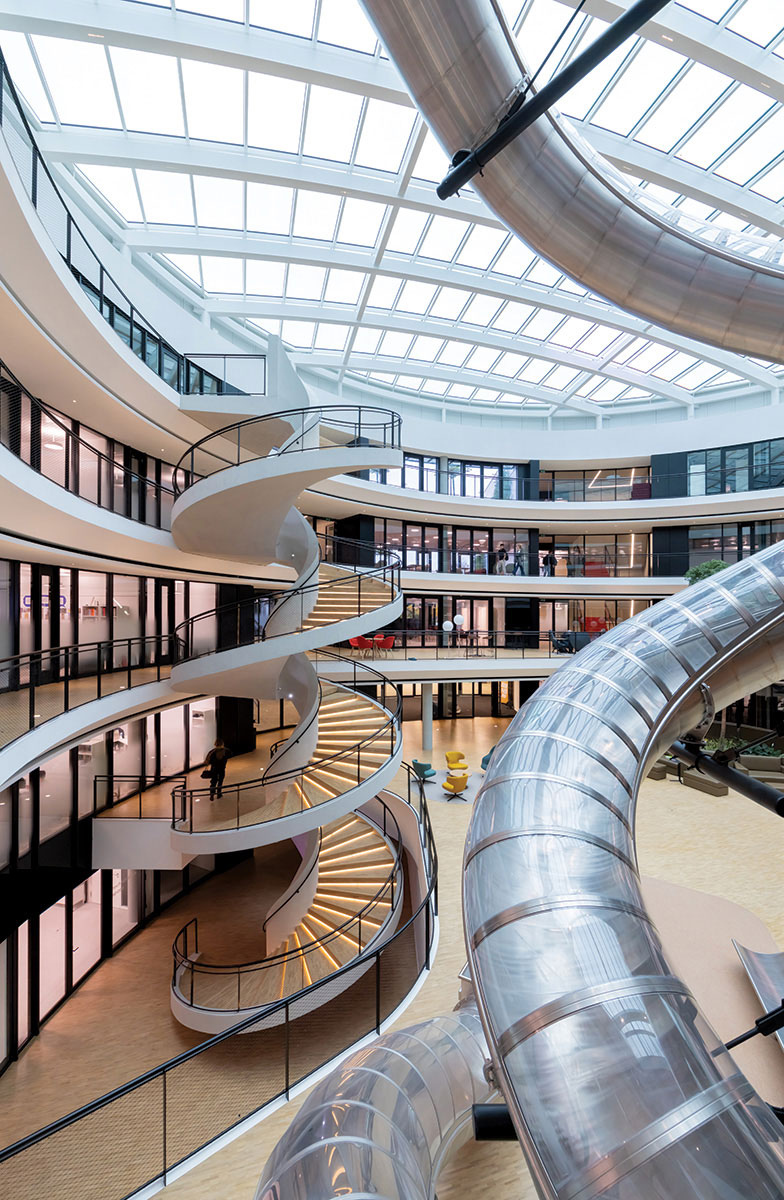
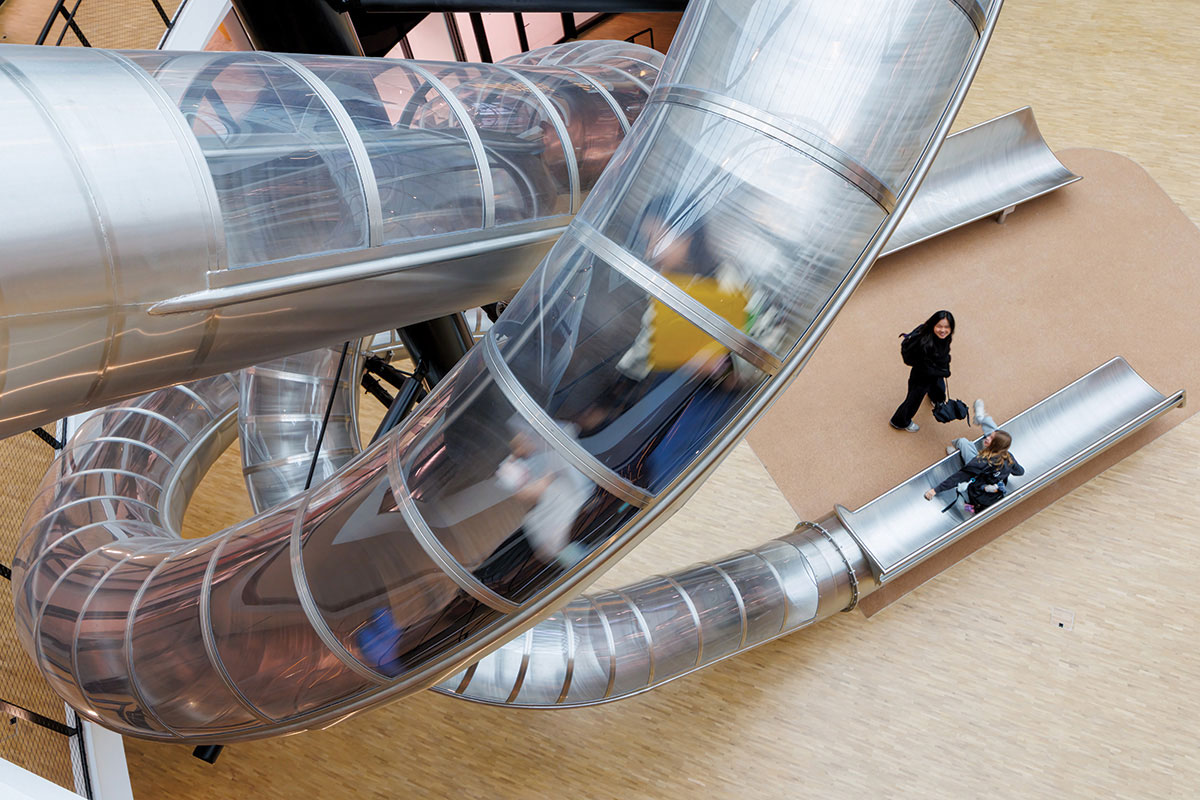
Two twisting slides (above) provide a playful mode of circulation within the five-story building (top of page). Photo © Iwan Baan
These nods to the world of business are far from accidental, since Le Rosey’s leadership wanted to channel entrepreneurial culture as embodied by Silicon Valley citadels like Alphabet Inc.’s Googleplex. In this spirit, the top-lit atrium, whose photosensitive glass roof darkens when exposed to sunlight, features a large black olive tree (an exotic species in Switzerland), a bravura concrete stair spiraling all the way from top to bottom, and two Carsten Höller–style slides that, as well as bringing a dash of double-helix playfulness, allow students in a hurry to save precious seconds when exiting. Suspended from the glass roof, a lighting gantry allows for the installation of temporary exhibitions, while walkways on the atrium’s upper levels access the teaching spaces.
3
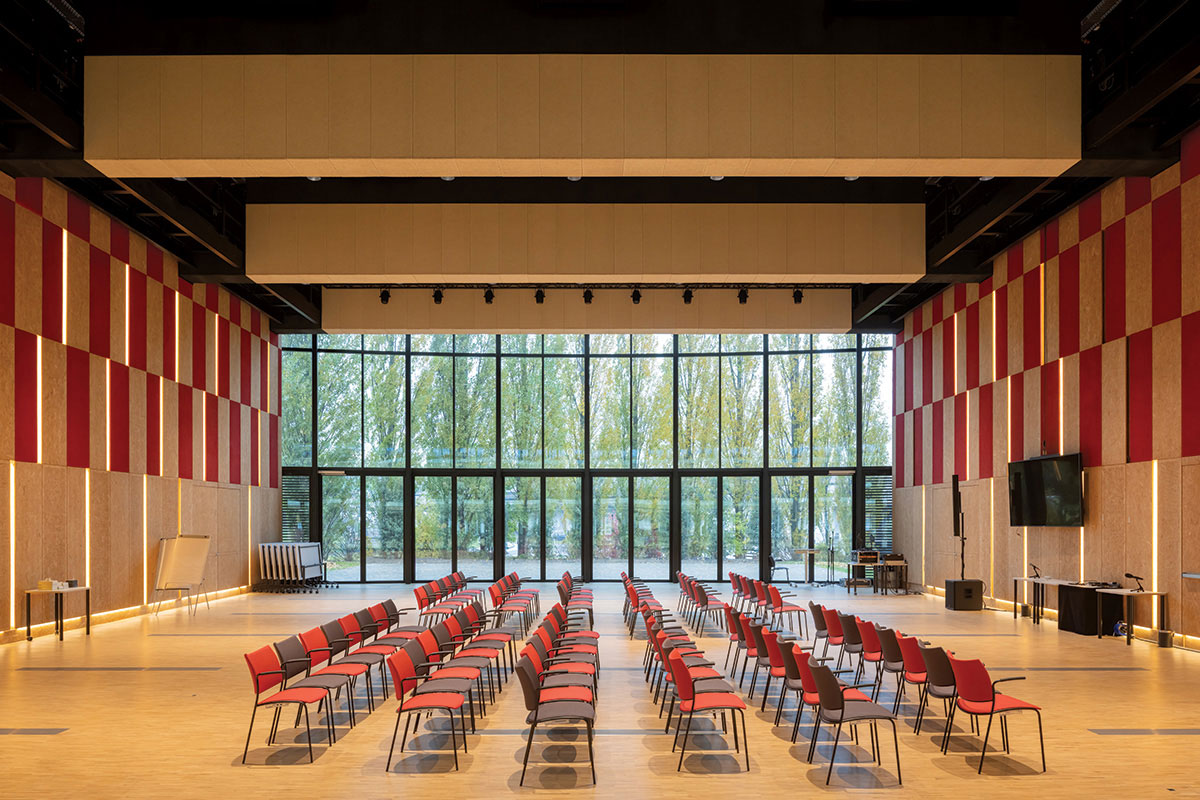
Philo’s various spaces, including an event hall (3), are oriented around the slide-equipped atrium (4). Photos © Iwan Baan
4
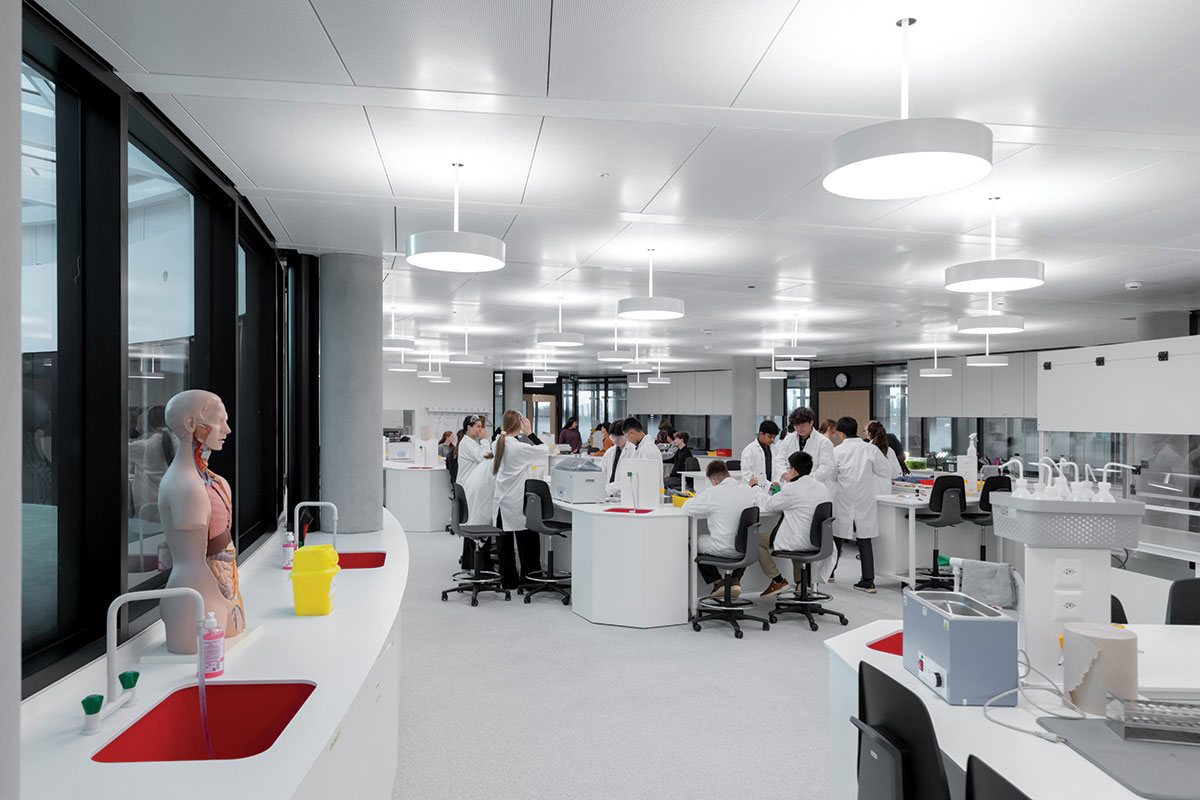
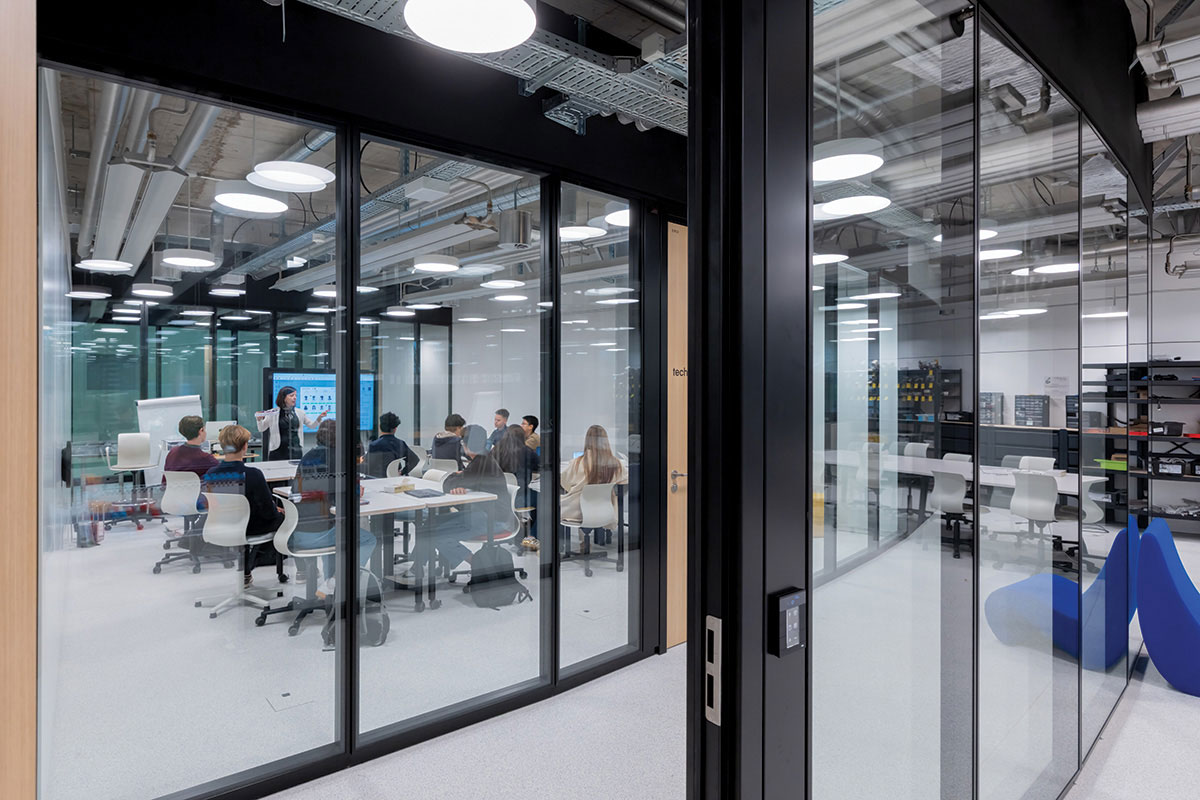
To facilitate installation of fume hoods and their chimneys, Philo’s two “megalabs” are located on the final floor. Rather than fit out multiple small laboratories that remain empty most of the time, the school opted to mutualize equipment in larger spaces that can accommodate three classes at once. On levels three and four, two rings of classrooms, one inner and one outer, are separated by generous circulation spaces that seek not only to break with the monotony of corridors but also to encourage spontaneous activities. For maximum flexibility, the partitions between classrooms can be moved to allow new configurations. On the entrance level, the impressively large “Pitch Room” can accommodate 350 people for public speaking and performance, while next to it a “startup space” allows students to engage with young companies in residence at Le Rosey. As for the semi-basement, it contains fabrication labs and technical areas. On every floor, glass and transparency dominate, making life at Philo relentlessly public.
5
6
Dedicated to the sciences and the humanities, Philo features a variety of flexible lab (3) and classroom spaces (4). Photos © Iwan Baan
This is not the first time Tschumi has tried his hand at circular buildings, which interest him because “they have no front or back and possess a dynamic of motion.” Nor is Philo his only educational project, since he has designed buildings for the architecture schools in Miami and Marne-la-Vallée, France, as well as Lerner Hall at Columbia University. Each time, he sought to stage student life, maximizing the potential for chance encounter and dramatizing movement through space. With its glass partitions and compact cylindrical form, Philo concentrates the student mass in a self-observing hothouse, a machine for inspiring excellence.
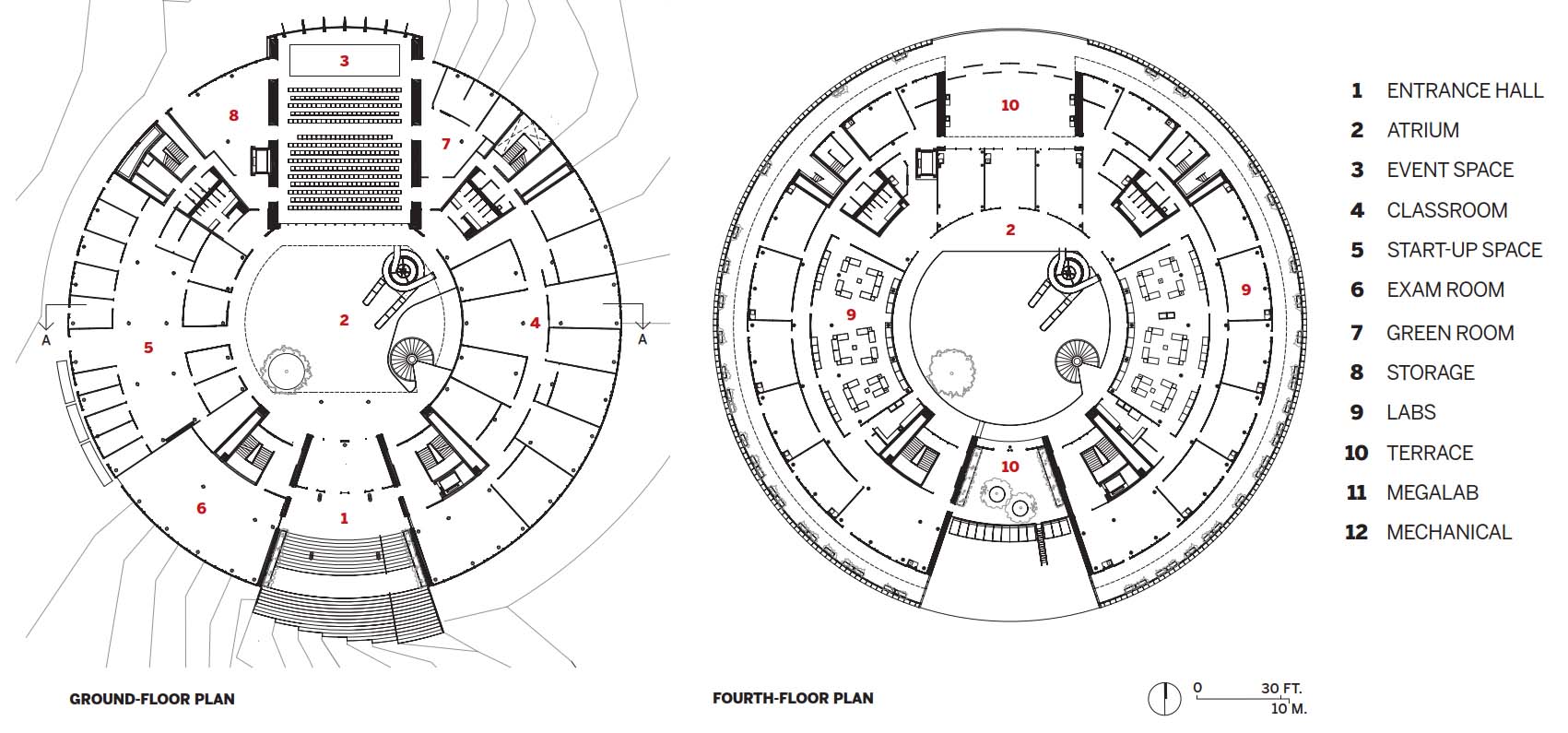
Image courtesy Bernard Tschumi Architects
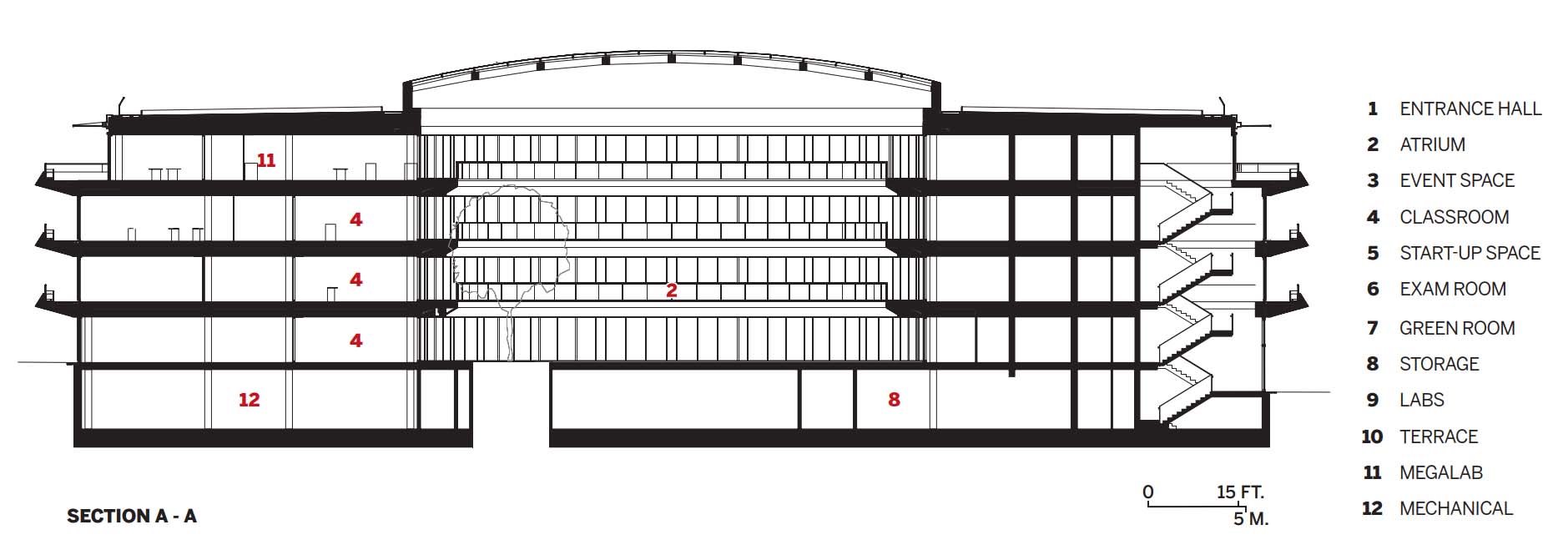
Image courtesy Bernard Tschumi Architects
Credits
Architect:
Bernard Tschumi Architects
Associate Architect/Construction Administrator:
Fehlmann Architectes
Engineers:
Alberti (structural); Arup (structural, cupola); SRG (MEP, fire); Karakas & Français (civil); BCS (facade); EcoAcoustique (acoustics); Lumière Electrique (lighting)
Landscape:
Forster
Client:
Institut Le Rosey/Etablissements du Rosey
Size:
175,000 square feet
Cost:
Withheld
Completion:
July 2025
Sources
Masonry:
Consortium Marti-Perrin
Curtain Wall:
Sottas
Cabinetwork and Custom Woodwork:
Ginox, Strehl, Logicair
Doors:
Delta Turen
Acoustical Ceilings:
Lambda
Looking for quick answers on architecture and design topics?
Try Ask RECORD, our new smart AI search tool.
Ask RECORD →
Looking for a reprint of this article?
From high-res PDFs to custom plaques, order your copy today!