


Underfoot Innovation: Raised Access Flooring Elevates Redmond Public Library’s Mass Timber Design
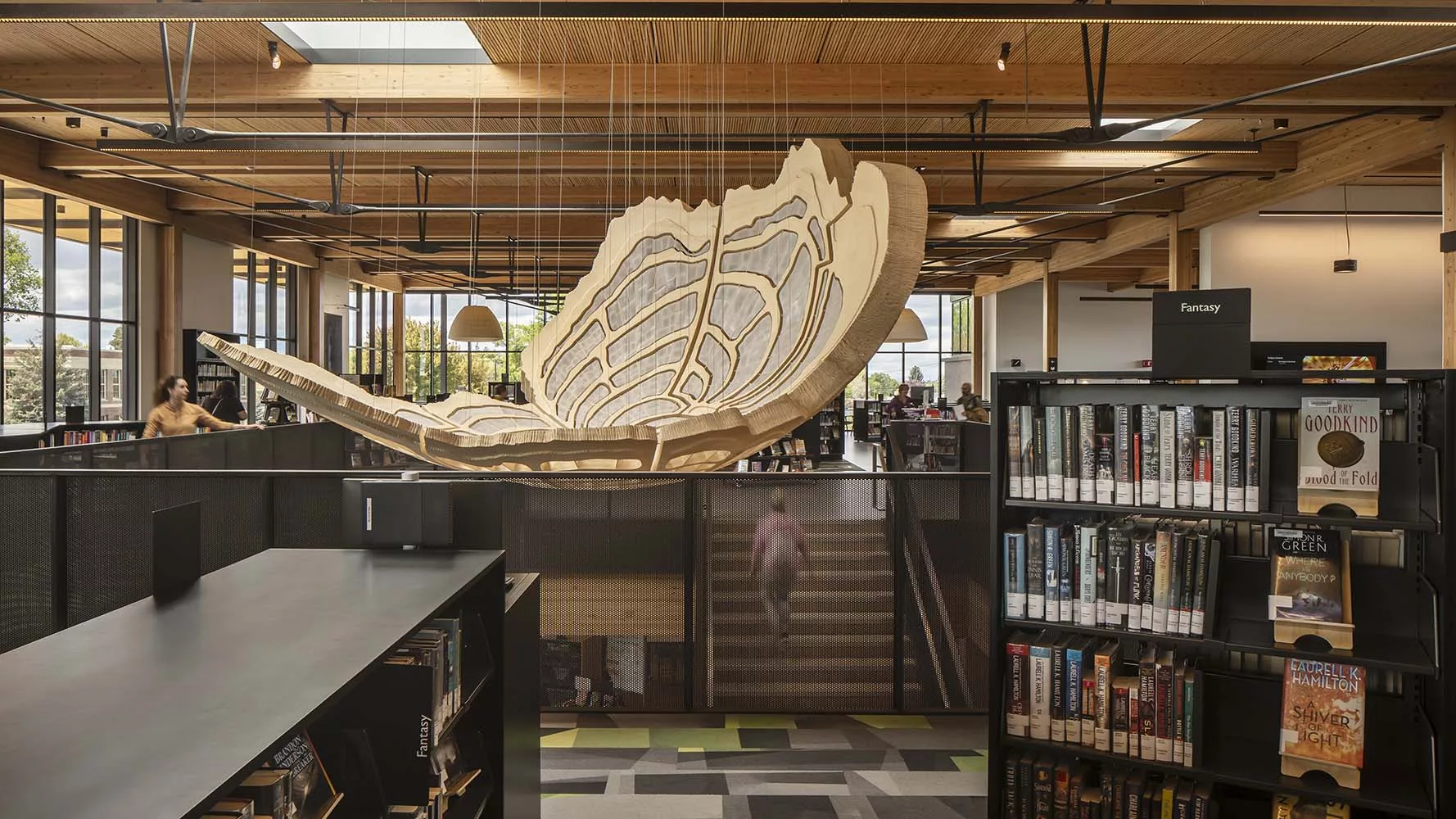
Completed in 2024, the new Redmond Library in Deschutes County, Oregon, embodies a forward-looking vision for community architecture — one where mass timber and raised access flooring combine to create a space that is sustainable, adaptable, and deeply connected to its region.
Designed by The Miller Hull Partnership, the 38,000-square-foot facility (with 18,500 square-feet of access floors) pairs the expressive warmth of dowel-laminated timber (DLT) with the technical precision of Tate’s CCN 1000/1500/1250 raised floor system. The flooring supports a combination of porcelain, carpet, and linoleum finishes, providing tactile variety and performance durability throughout the library.
Mathew Albores, Project Manager at Miller Hull, told us: “If we’re going to invest in a beautiful material like mass timber, we want it to do three things — structure, architecture, and acoustics — and we want it to be seen. The raised access floor makes that possible.”

Photo © Lara Swimmer, click to enlarge.
Design Strategy: Revealing the Structure, Concealing the Systems
The design team viewed mass timber not as a novelty but as a framework for structural, acoustic, and aesthetic integration. DLT panels were shaped to perform acoustically and visually, allowing the natural wood to define the library’s character and eliminating the need for suspended ceilings.
Yet this approach presented a design challenge: how to manage the mechanical, electrical, and data infrastructure without disrupting the clean, open ceiling plane. The answer was found beneath the surface. Tate’s raised access flooring system introduced a modular, underfloor plenum that discreetly routes air, power, and technology services. This plenum also hid the sprinkler pipe system in the raised access floor, which is less common but worked well for this mass timber project. By relocating these systems underfoot, the team preserved the integrity of the timber ceiling — keeping the architecture both visually honest and technically agile.

Photo © Lara Swimmer
“It’s a triple win,” says Albores. “We get exposed structure, concealed systems, and total flexibility for the client’s program.”
Traditionally, mass timber floors are topped with concrete for mass and acoustic separation. The Redmond team broke that convention. By omitting the concrete topping slab and using Tate’s integrated system, they reduced embodied carbon, minimized structural weight, and achieved greater flexibility for future reconfiguration.
The underfloor air distribution system supplies air efficiently at the occupant level, improving comfort and energy performance. Electrical and data systems run invisibly within the plenum, maintaining the uncluttered aesthetic that defines the library’s timber interiors.
When you subtract what you no longer need — ductwork, ceiling chases, even the concrete slab — the access floor isn’t an add-on. It’s a reallocation.

Photo © Lara Swimmer
A Library Built to Evolve
Modern libraries serve as classrooms, community hubs, and digital workspaces — often simultaneously. Flexibility was essential. With Tate’s modular panels, diffusers, outlets, and data ports can be repositioned in minutes, enabling rapid adaptation as technology and programming evolve.
The raised floor made the building perform like a living system. You can change the layout tomorrow without tearing anything out.
Every decision supported the architectural goal of showcasing the timber. Ten-inch gaps between DLT panels allow for hidden conduit routing and recessed sprinklers while maintaining the warmth and rhythm of the wood structure. This coordination enabled 80% of the ceiling surface to remain visible — nearly twice that of a typical CLT project.

Photo © Lara Swimmer
A site-specific sculpture by artist John Grade anchors the main reading hall, reinforcing the library’s commitment to art, craft, and environmental storytelling.
The Redmond Public Library’s sustainability story goes beyond materials — it’s embedded in how the building performs and adapts:
- No concrete topping slab: Reduced weight and embodied carbon
- Underfloor air distribution: Lower energy loads and improved air quality
- Locally sourced timber: Strengthened regional supply chains and environmental stewardship
The architect, Albores, is always looking at the full carbon picture.” According to Albores, “Mass timber gives us the structure; Tate’s system gives us the efficiency and flexibility to make that structure work for decades.”
The Redmond Public Library demonstrates how raised access flooring can unlock the full potential of mass timber architecture. By concealing complexity beneath a flexible surface, Tate’s system allows the architecture to celebrate what matters most — the honesty of materials, the clarity of space, and the enduring value of adaptability.
“Raised access flooring allowed us to keep the wood ceiling exposed, maximizing the design potential of the project,” says Albores. “This library will have a net-zero carbon footprint in its operation — a sustainable future where our structures harmonize with the environment.”
Project Team
Client:
Deschutes Public Library
Todd Dunkelberg, Director
Design Architect:
The Miller Hull Partnership, LLP
Design Lead: Ruth Baleiko, FAIA
Project Manager: Mathew Albores, AIA
Local Architect:
Steele Associates
Contractor:
Kirby Nagelhout Construction Company (KNCC)
Civil Engineer:
HWA
Structural Engineer:
KPFF Consulting Engineers
MEP Engineer:
Interface Engineering
Landscape Architect:
Walker Macy
Lighting:
Blanca Lighting Design
Signage:
Mayer Reed
Early Learning Environments:
Plus and Greater Than
Acoustics:
Tenor Engineering Group
Envelope:
Morrison Hershfield (now Stantec)
ADA:
Studio Pacifica
Photographer:
Lara Swimmer
Dealer:
Advanced Technology Group
By Tony Giansanti, Regional Sales Manager, Tate Raised Access Flooring

Tony Giansanti is the regional sales manager for Tate, the leading authority in raised access floor solutions. A construction solutions sales leader for over twenty years, Tony works with architects and designers, end users, general contractors, and developers to help them all build better. Tony has helped launch solar start-up companies, deployed new product rollouts nationwide, and spearheaded market growth across multiple sectors. He has always focused on those construction solutions that are not only good for the industry but also good for the planet. When he isn’t advancing better construction solutions, Tony enjoys hiking, camping, and traveling. He also enjoys food, knows a bit about wine, and has been known to do a little karaoke singing. He resides in Oakland, California. Tony holds a BFA in interior architecture from the University of Houston.
Looking for a reprint of this article?
From high-res PDFs to custom plaques, order your copy today!