Parks & Recreation 2026
An Elegant Pavilion by In Situ Studio Adds Sheltered Courts and a Gateway to a Public Park in Raleigh
Raleigh, North Carolina
Architects & Firms
Those who play pickup basketball know all about outdoor courts. Rainy weather puts the games on hold. Blistering summer temperatures are tolerated for the love of the game. But the City of Raleigh had something else in mind for its new basketball and pickleball courts at Baileywick Park: sheltered courts that are fit for use come rain or shine.
In approaching the assignment, Matthew Griffith—principal at In Situ Studio, a firm based in the city—had ideas of his own. Rather than put up a pedestrian shed, he wanted to reach for something more distinctive. “How many park shelters have you seen that are unimaginative prefabricated buildings?” Griffith asks. “Here, we tried to take the rationality, the simplicity of the prefabricated option, but rework it into a form that was beautiful.”
The 20,220-square-foot multiuse shelter complements other existing facilities in the 50-acre park, which includes two baseball fields and a playground, picnic shelter, and restroom pavilion. A new concrete pad outside the shelter serves as a drop-off point marking a definable entrance Baileywick never had.
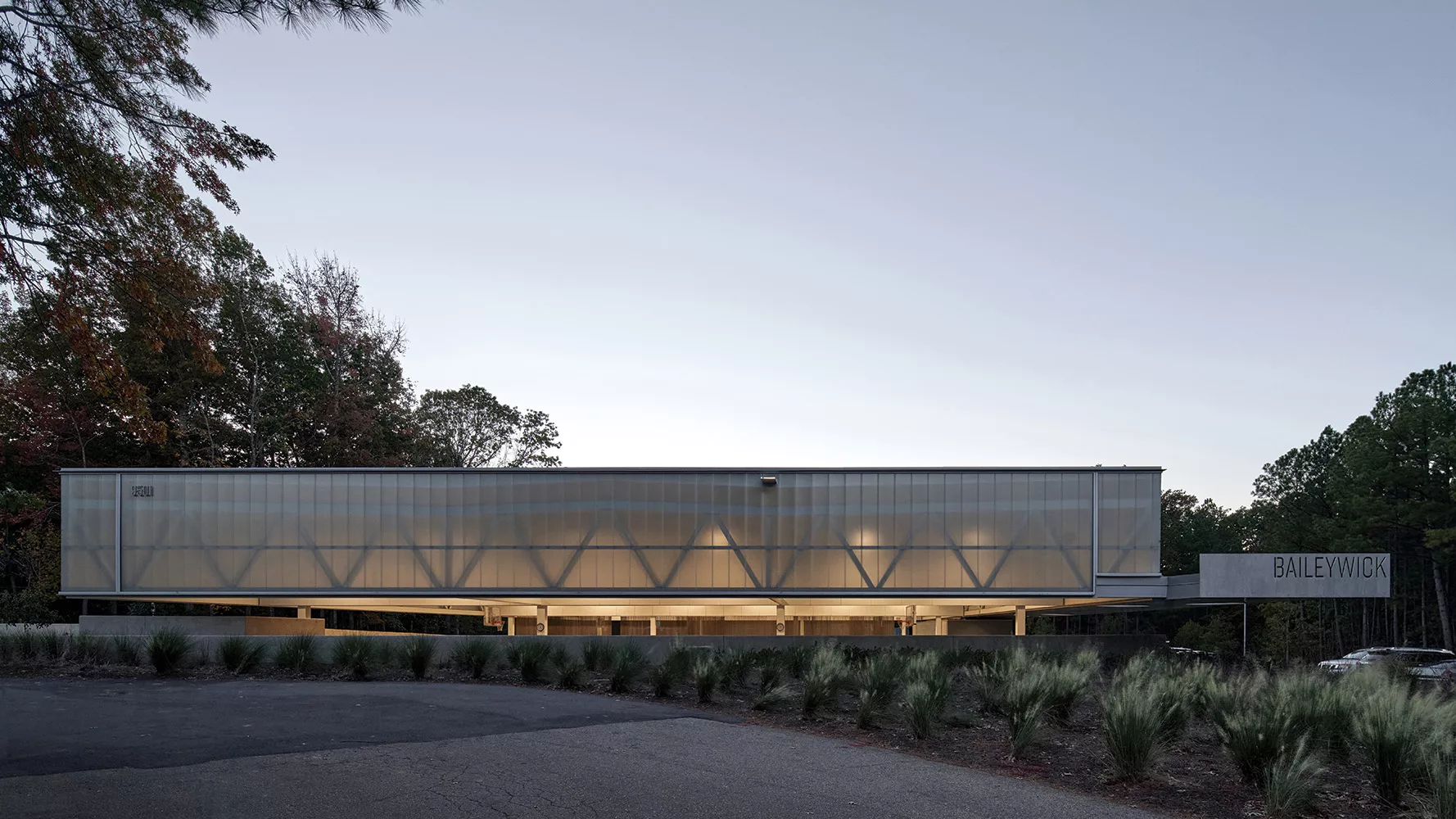
From the beginning, the design team was concerned that the scale of the new shelter, raised on a dozen 12-foot-tall steel columns supporting 10-foot-deep trusses and 2-foot-deep roof joists, might overpower the park’s smaller buildings. “One of the first instincts was to depress the building and use the structure of the building as the enclosure,” says In Situ principal Zach Hoffman. “That allowed us to basically take the roof height—half of the standard for basketball playing—and sink it into the ground, so that the top of the building is no higher than the tops of the picnic shelters close by.”
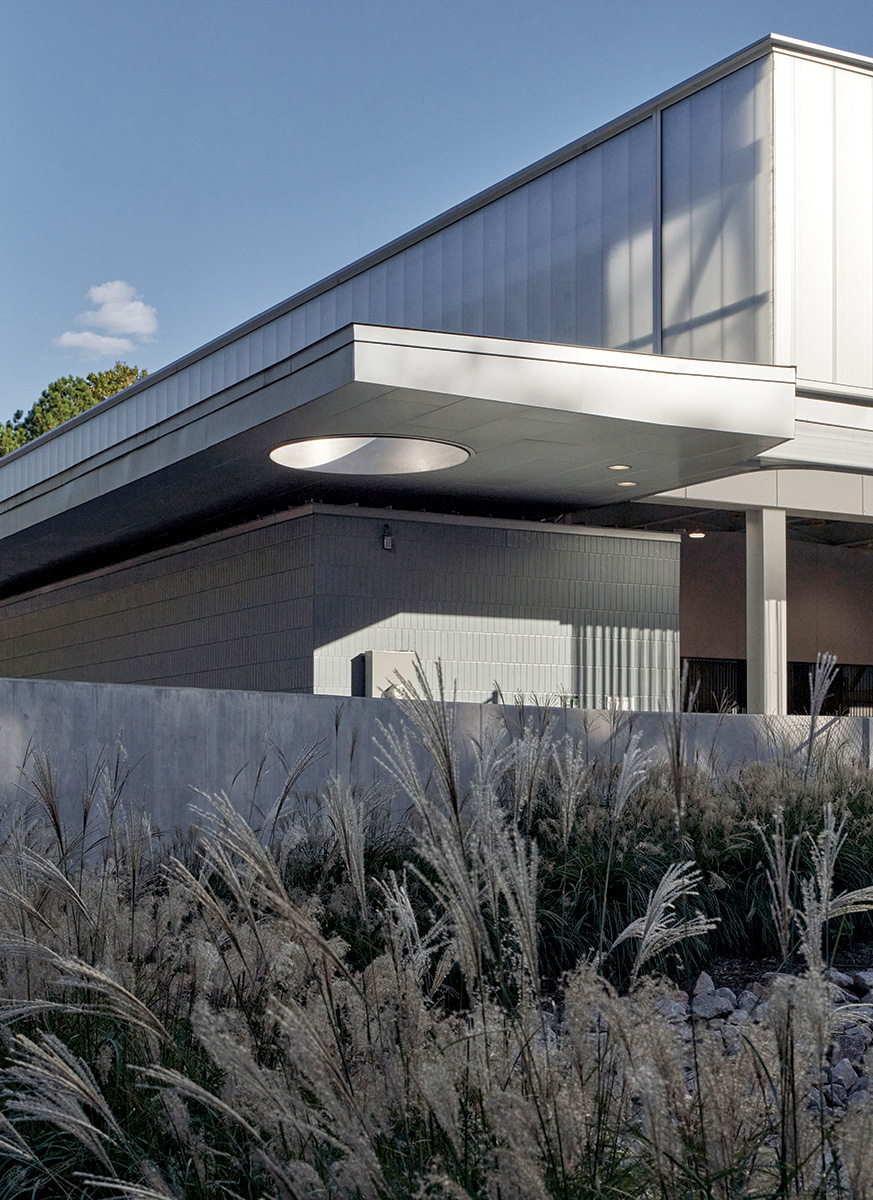
Walls retain the sloping topography. Photo © Cristóbal Palma
1
2
The pavilion is built of structural steel (1); planting beds hem the shelter (2). Photos © Cristóbal Palma
Visitors entering from the southeast corner descend a ramp that’s blended with concrete seating or stairs—a combination stair and ramp sometimes called a “stramp”—to make a resting place for onlookers.
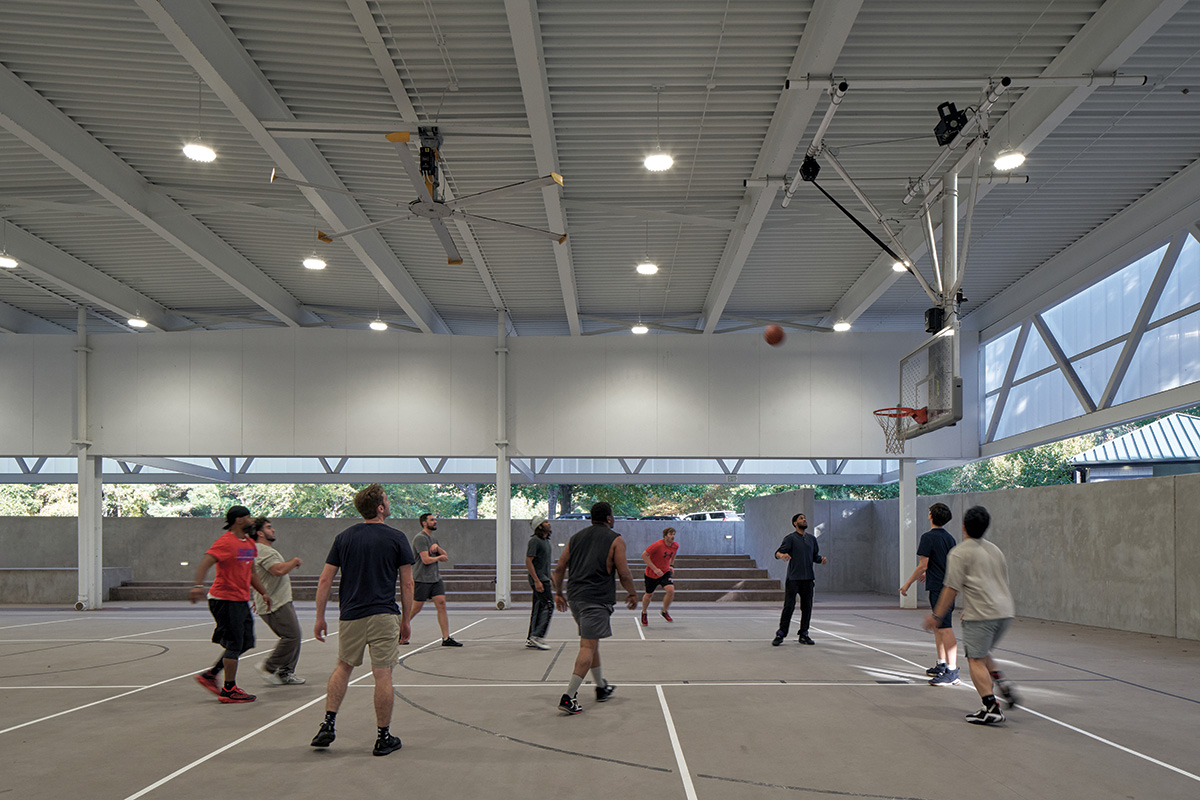
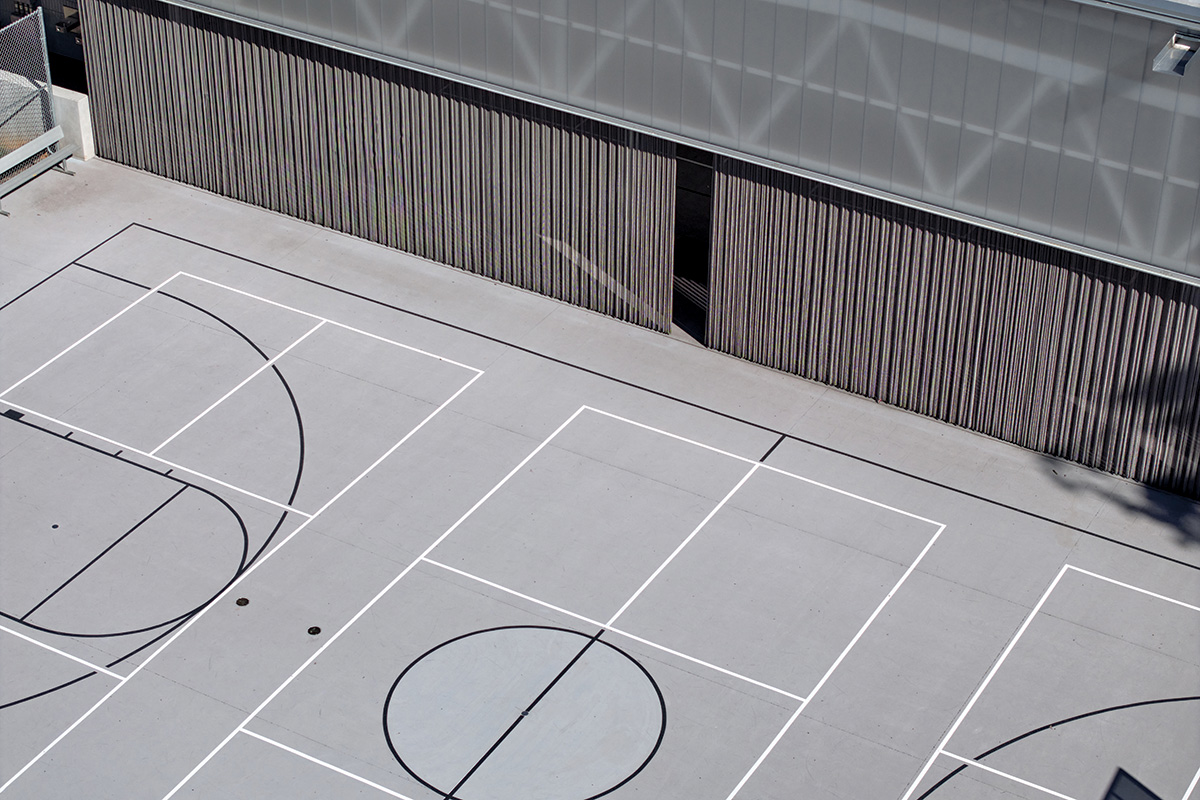
The rectilinear structure is wrapped in a taut polycarbonate skin that lets in filtered light during the day and emits a warm glow at night. Two large courts, each configured as a single basketball court or three pickleball courts, fit comfortably beneath the shelter. A third court is located outside the covered area, a change that occurred when value engineering scaled back the roof.
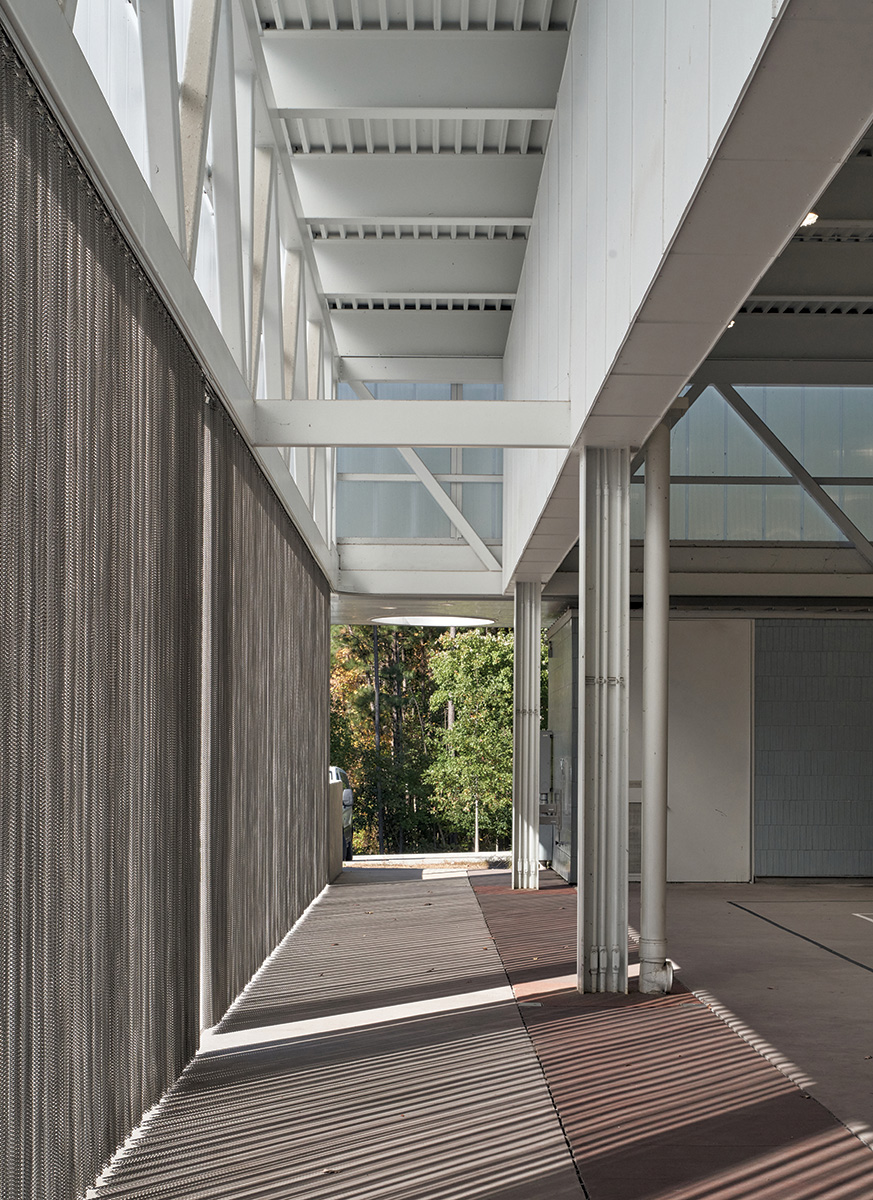
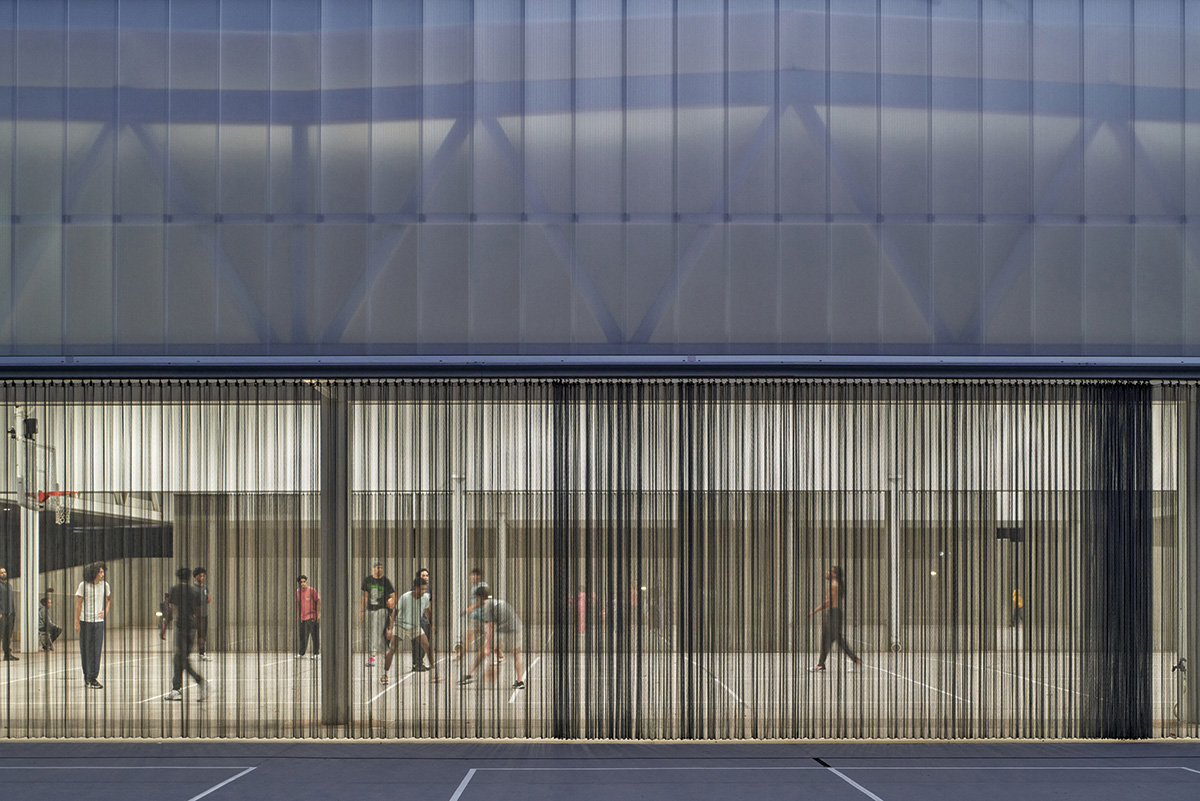
The concrete courts are finished with a textured acrylic coating to provide better footing. Separating each bay of courts are floor-to-ceiling curtains made of stainless-steel chain mail. Their primary purpose is to keep stray balls from interrupting games on adjacent courts, but they also allow light and wind to pass through. A tile-clad support building tucked beneath the shelter anchors the north-side entrance and provides space for storage and utilities.
Looking for quick answers on architecture and design topics?
Try Ask RECORD, our new smart AI search tool.
Ask RECORD →
Subtleties in the building’s design hint at the economic pressures that accompany public infrastructure projects. A close look reveals the top chords of the giant roof trusses are bowed, creating valleys in the roof that direct rainwater toward internal downspouts. That move, Hoffman says, saved $70,000 in roofing materials that would have been needed to build up a pitched underlayer on a flat roof.
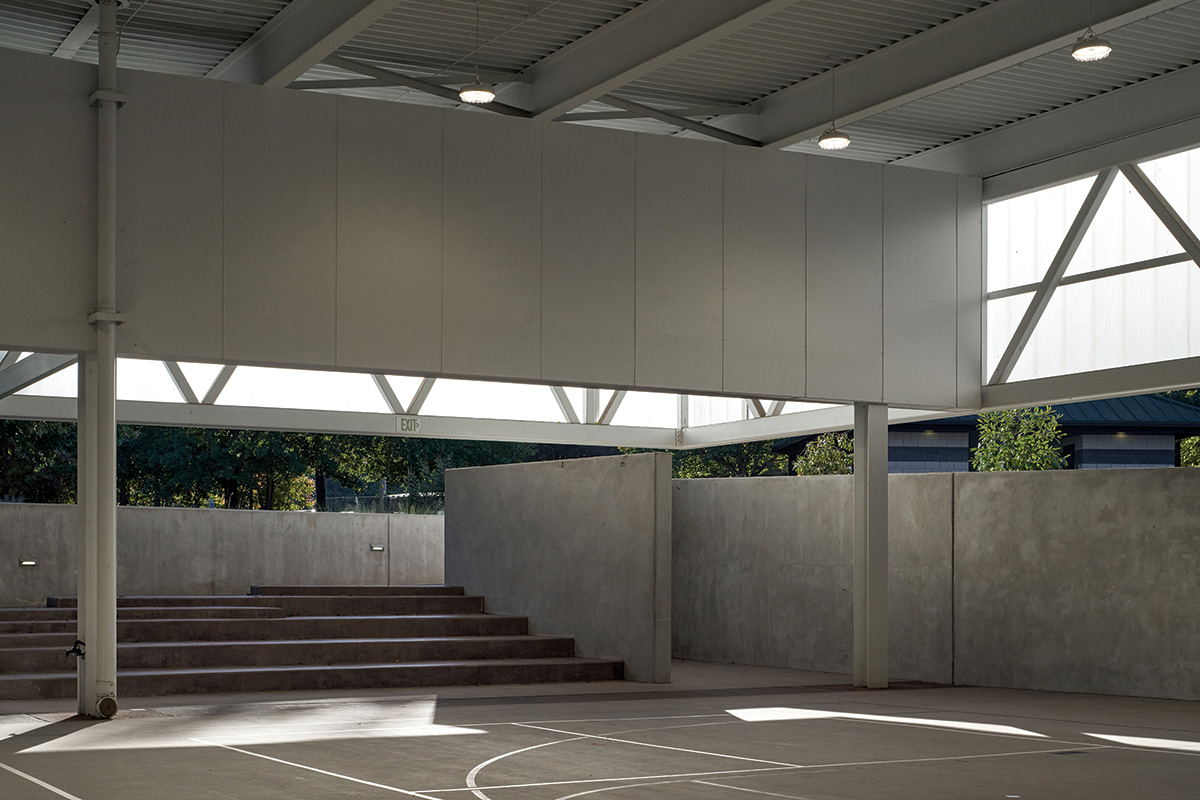
Rows of seating reach down to the courts. Photo © Cristóbal Palma
The building’s disciplined geometry carries through in the details. Lights, conduits, and roof drains are all carefully coordinated with the structure and integrated into the columns. The site walls, however, are a different matter. They retain the sloping site and bound the courts, but also move freely through the landscape and allow planting beds to slide beneath the shelter. In one case, the cantilevered entry awning on the north facade exaggerates that spatial tension by reaching beyond the site walls. “That’s something we do a lot in our work—creating an interplay between structures in the landscape and the architecture,” says Griffith. “The walls and building always have a dialogue.”
3
4
Stainless-steel mesh curtains separate the playing areas (3). One set of courts is placed outside the structure (4). Photos © Cristóbal Palma
The commission also included the addition of a dog park, which In Situ tucked into the woods behind the shelter. Designed with a black chain-link fence that blends into the shade, it preserves the wooded buffer that separates Baileywick Park from nearby neighborhoods. The dog park is fronted by an asphalt path that is part of Raleigh’s growing Capital Area Greenway System, which includes 117 miles of trails.
In addition to attracting basketball and pickleball players, the shelter has become a sought-after venue for other events, including roller sports, markets, and dance classes. “It’s a popular destination—not just for people in the immediate area, but from all over the city,” Griffith says. No prosaic box, it has become a magnet for activity of all kinds.
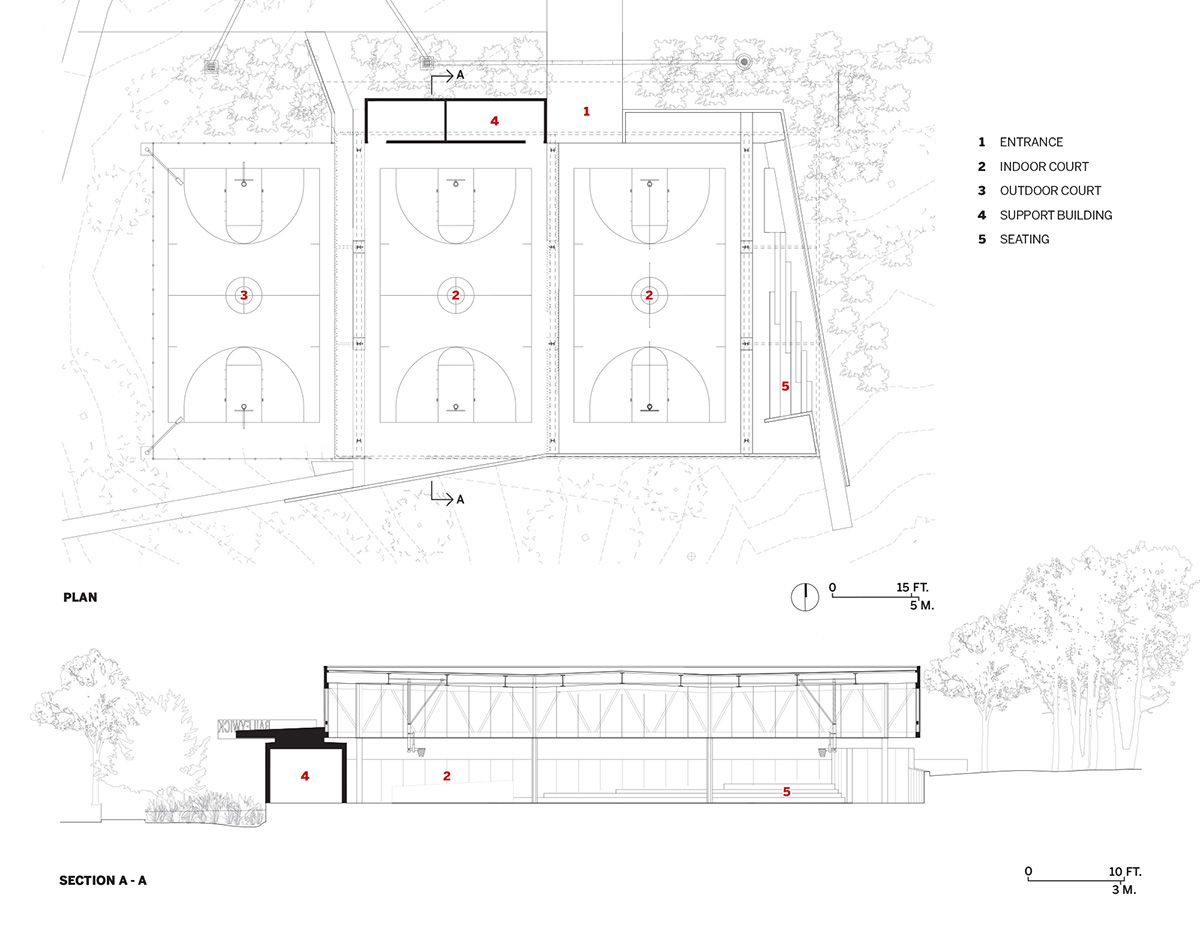
Image courtesy In Situ Studio, click to enlarge
Credits
Architect:
In Situ Studio — Matthew Griffith, principal; Zach Hoffman, project architect
Engineers:
Lysaght & Associates (structural); Diversified Consulting Group (MEP); Grounded Engineering (civil)
Consultant:
Site Collaborative (landscape)
General Contractor:
Muter Construction
Client:
City of Raleigh Parks and Recreation
Size:
20,220 square feet
Cost:
$5.5 million
Completion:
April 2024
Sources
Steel Structural System:
Stick Built
Steel Decking:
New Millennium
Exterior Cladding:
Velux (translucent walls); Armstrong (soffits); DuPont (moisture barrier)
Doors:
Assa Abloy
Hardware:
Schlage (locksets); LCN (closers, pulls)
Steel Curtains:
Cascade Architectural
Paints and Stains:
Sherwin-Williams
Floor and Wall Tile:
Milestone
Lighting:
Cooper Lighting Solutions
Looking for a reprint of this article?
From high-res PDFs to custom plaques, order your copy today!