Parks & Recreation 2026
Perched High Above the Ottawa River, Kìwekì Point Showcases Sweeping Views of the Canadian Capital Region
Ottawa, Canada
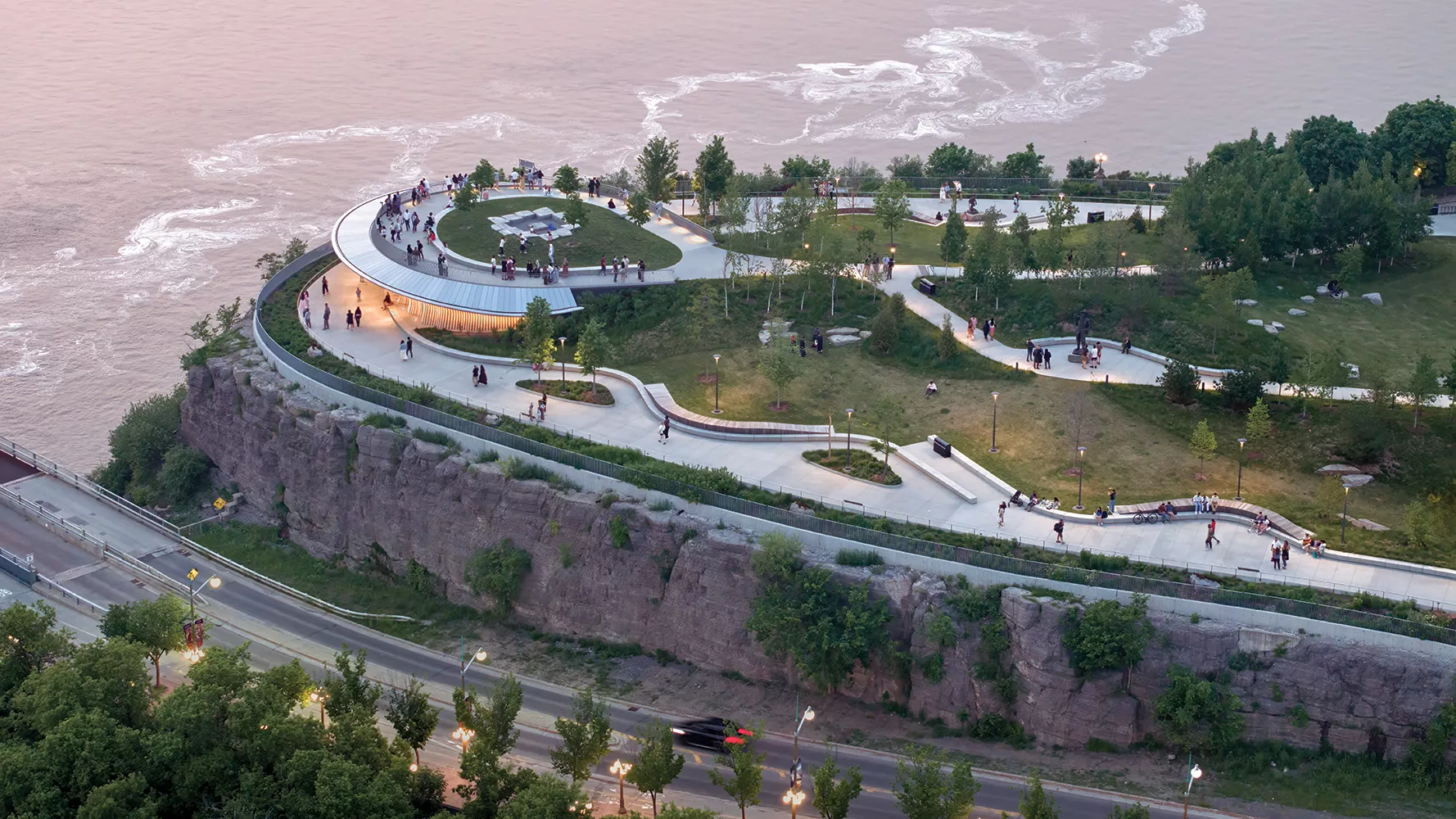
On paper, the former Nepean Point, a promontory rising steeply above the Ottawa River, had everything going for it. Located just north of the UNESCO World Heritage Site Rideau Canal and Parliament Hill in downtown Ottawa, the limestone bluff is one of the Canadian capital’s most dramatic natural landforms, and the sweeping views from atop it are nothing short of impressive. Towering above the historic steel-truss Alexandra Bridge, the National Capital Commission (NCC)–administered site was first developed as public space in the early 20th century. Not just scenic, it is also central, with its immediate neighbors being two of Ottawa’s most popular attractions: Major’s Hill Park, a crowd-drawing green space, and Moshe Safdie’s soaring glass-and-granite National Gallery of Canada (1988).
Yet Nepean Point, from a civic perspective, didn’t work. Obscured by the fortified rear elevation of the National Gallery (the building largely turns its back to the bluff behind it), and lacking clearly defined, easily accessible routes in and out, the space was detached from the fabric of the city around it, underutilized and unsuccessful. In addition to issues of access, the site wasn’t configured to emphasize or expand the sweeping views. In lieu of a proper overlook, a 1915 bronze sculpture of Samuel de Champlain stood at the apex of the hill as the focal point, seemingly claiming it as all his own.
1
2
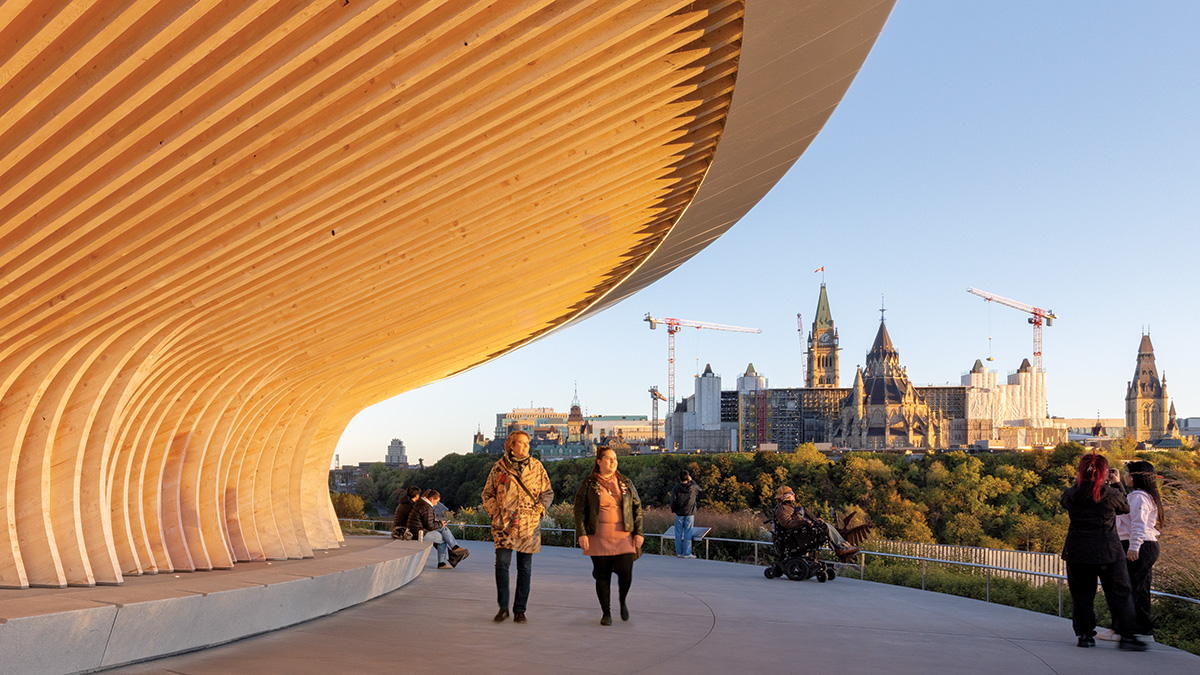
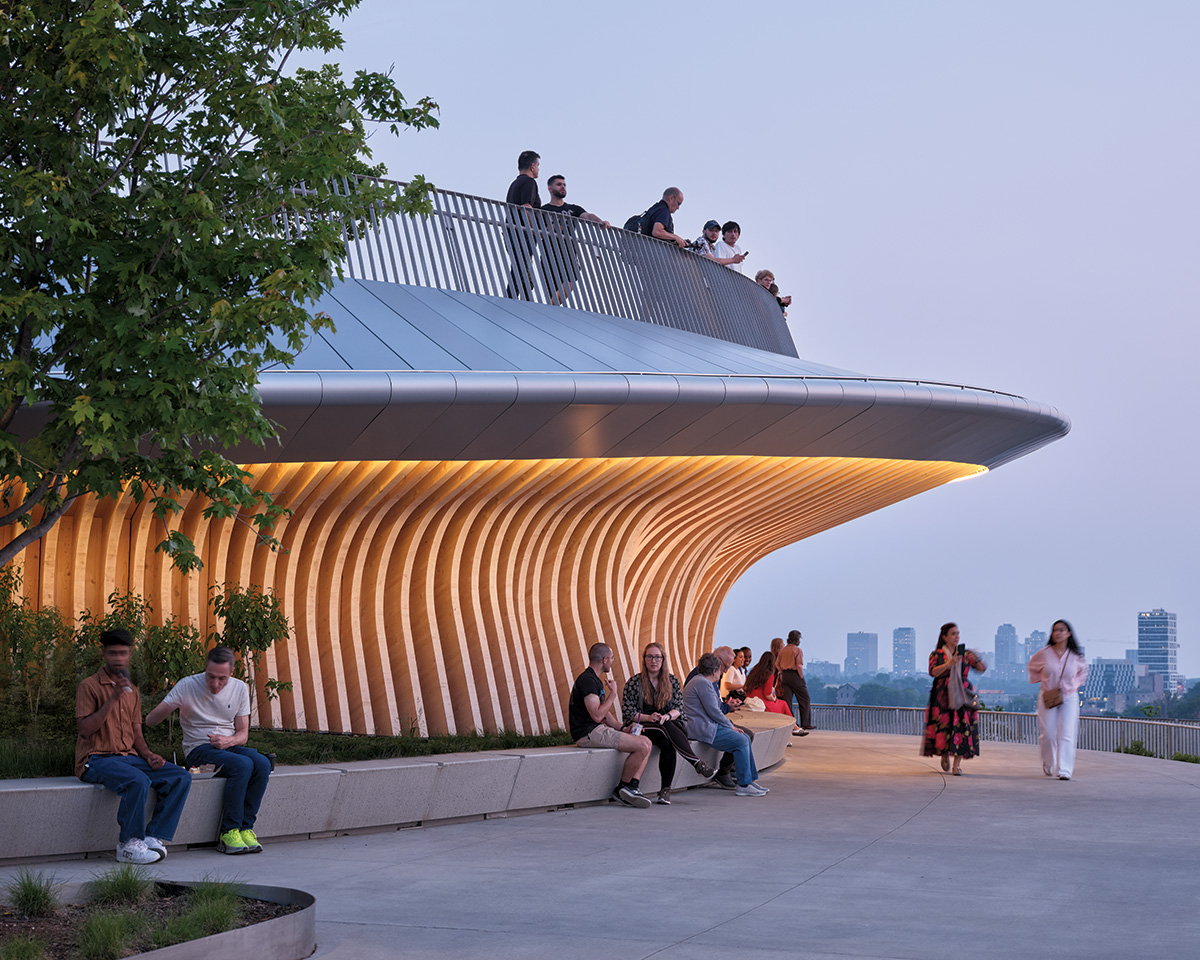
Offering views of the Ottawa River and Parliament Hill (1), the lookout is topped by a sheltering aluminum-panel canopy (2). Photos © Patkau Architects (1), Doublespace (2)
“You ascended toward the Champlain monument, took your photo, and then turned around and walked back down,” says Nicholas Gosselin, senior associate at Toronto-based landscape architecture firm Janet Rosenberg & Studio (JRS).
Now known as Kìwekì (Algonquin for “returning to one’s homeland”) Point, the roughly 3-acre site reopened to the public last spring following a decade-long reimagining that newly recognizes Indigenous culture and history. Critically, the project reconnects once-isolated public space with the city while meeting universal accessibility standards. It also enhances the site’s finest attribute: panoramic views of the Ottawa River and the capital region built up around it. And, yes, Champlain is still there—he’s just been moved to a lower spot where he blends in with the rejuvenated landscape instead of lording over it. His stone plinth has been disassembled to form a sunken gathering circle atop a new overlook where people can sit, linger, and take it all in.
The redevelopment of Kìwekì Point—awarded to JRS and Vancouver-based Patkau Architects following a competition—works so well in large part because of what it doesn’t do. A complex, layered project that deftly navigates challenging site conditions, it avoids excessive programming, so that the reshaped site itself takes center stage. The ingredients are simple: wide, gently graded paths, ample seating, resilient landscaping, and a venue dedicated to taking in the views. “One of the goals was to keep the project expression very quiet, and so the topography had to do a lot of work,” says Greg Boothroyd, principal at Patkau.
3
4
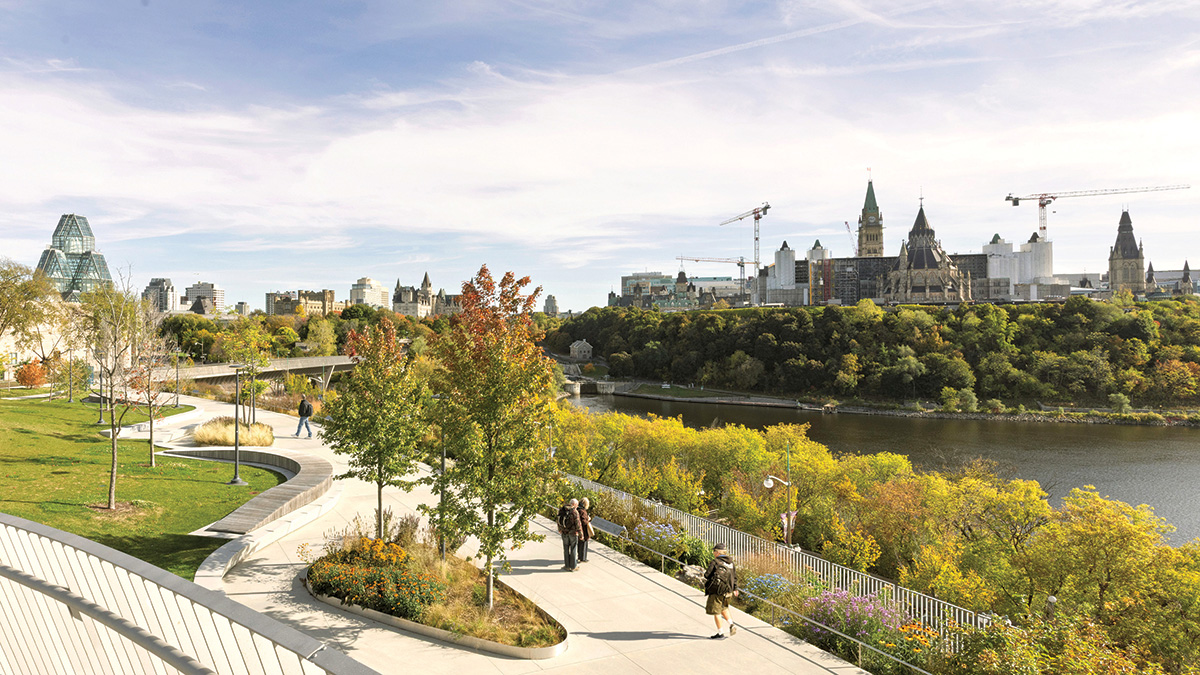
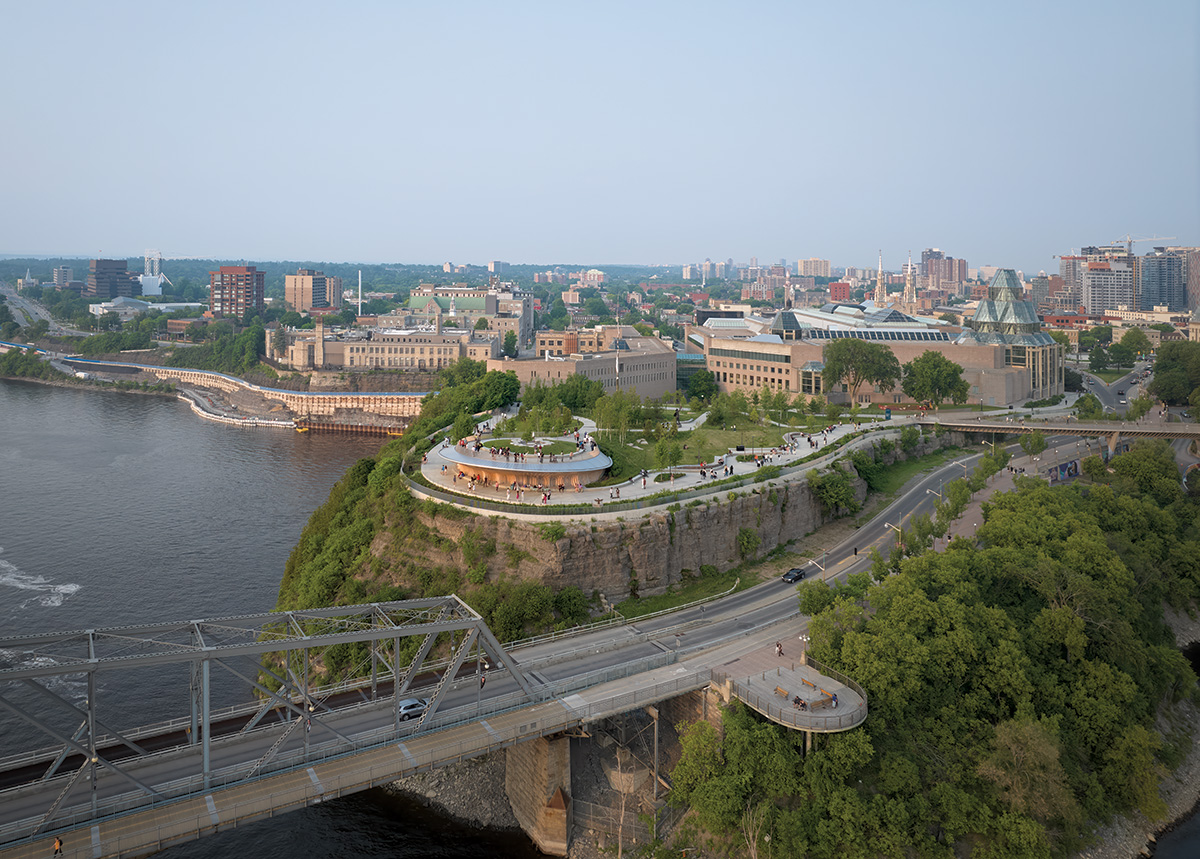
Undulating concrete benches (3) snake along the perimeter path of the bluff-top site (4). Photos © Patkau Architects (3), Doublespace (4)
Visitors will still find statuary, including the relocated Champlain (the NCC required the statue be retained as part of the redesign) and Kichi Zībī Innini (the Great Riverman), an existing sculpture of an Anishinaabe scout previously found kneeling at the feet of the French explorer. Following a temporary stint at Major’s Hill Park, it has returned to the point in a more prominent—and less subservient—location. Joining these repositioned holdovers from the early 1900s is Algonquin interpretive art installed along a pathway clinging to the perimeter of the site. Parallel to this somewhat vertiginous cliffside walk, the design team eschewed standard guardrails in favor of a ha-ha, or sunken fence, comprising safety rails concealed by pollinator gardens. It provides necessary protection but without blocking views.
“It was uninviting before,” adds Boothroyd. “When you’re at a site like this, you always want to get to the edge, and there was no easy way to do so. Now there is.”
Looking for quick answers on architecture and design topics?
Try Ask RECORD, our new smart AI search tool.
Ask RECORD →
Visitors approaching Kìwekì Point from Major’s Hill Park traverse a gateway in the form of a slender, gently twisting steel footbridge that spans 341 feet over the approach to Alexandra Bridge, to reconnect the two sites. Dubbed Pìdàban (Dawn) Passage, the bridge is one of two major architectural interventions at Kìwekì Point, along with its new centerpiece, a circular overlook structure called Whispering Point.
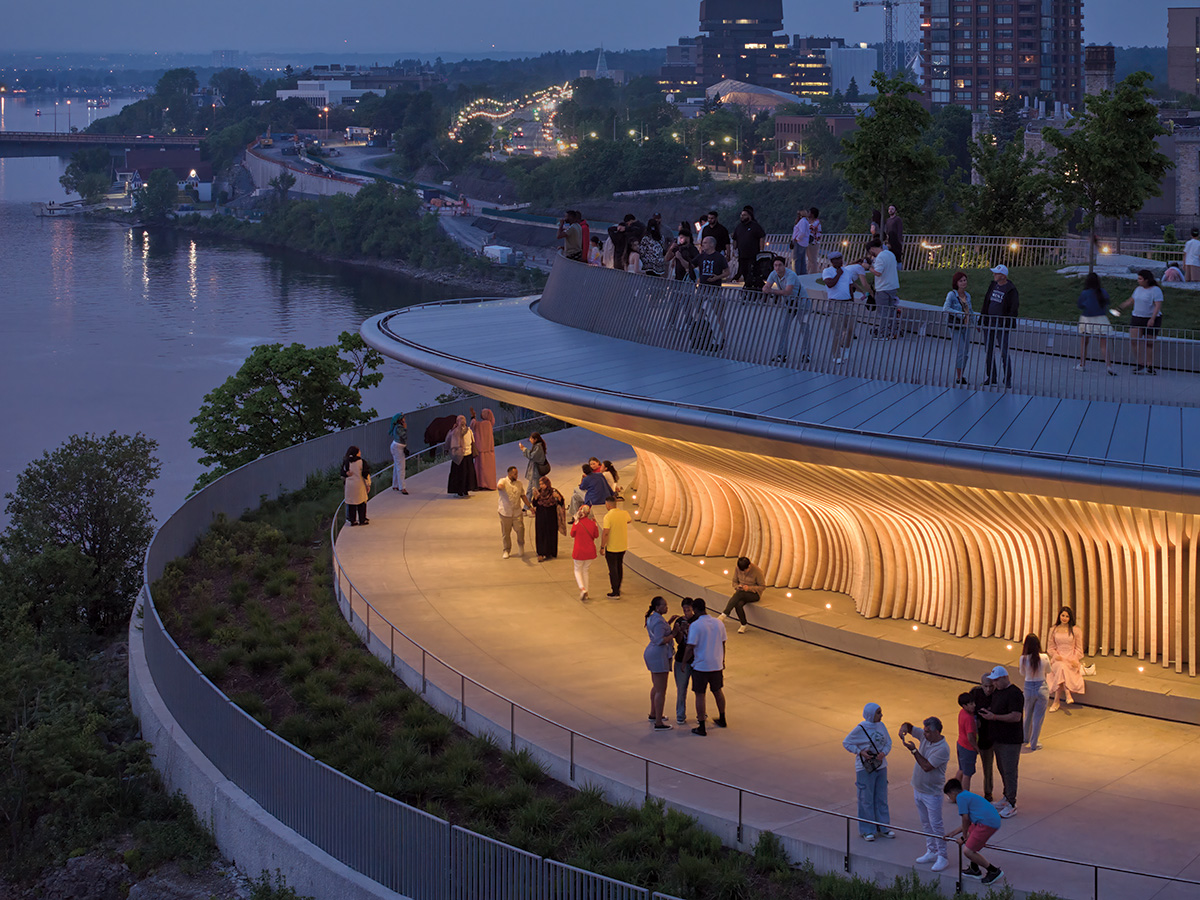
The saucer-shaped overlook’s timber-lined underside adds a welcoming warmth, especially at night when illuminated. Photo © Doublespace
Integrated into the landscape, the clifftop belvedere is experienced both from above and below. From the eastern edge of the site where Kìwekì Point meets the National Gallery’s Cornelia Hahn Oberlander–designed “backyard” (including the late landscape architect’s zigzagging Op-Art Path), visitors ascend Whispering Point via a winding, softly sloping meadow path lined with hardy plants and trees, including trembling aspen, white pine, and paper birch. At the top, a spacious, ring-shaped open viewing area extends over the perimeter pathway below, thrusting itself toward the river. At the center of the overlook is a round patch of lawn featuring the repurposed plinth-stone seating. Alternatively, one can stick to the perimeter walkway, which curves around and under the structure’s disc-shaped cantilever. Here, visitors will find the inverse of the exposed deck located directly above: a protected viewing gallery, clad with laminated yellow cedar fins, that provides shelter from rain, sun, and, to a degree, wind. After dark, the timber underside of Whispering Point is illuminated, transforming it into a glowing riverfront beacon.
“Rather than having a kind of hero-on-the-hill, like the Champlain statue, the idea of a lantern is more inviting,” says Boothroyd. “It draws you to the point at night and acts as a welcoming gesture for visitors.”
As for those unsure of what to expect when they do arrive, Gosselin emphasizes the fact that most first-timers figure it out quickly. “The moment you set foot on the site, you realize you don’t have to do much—the view all around is the most powerful. You can’t compete with it. You just embrace it.”
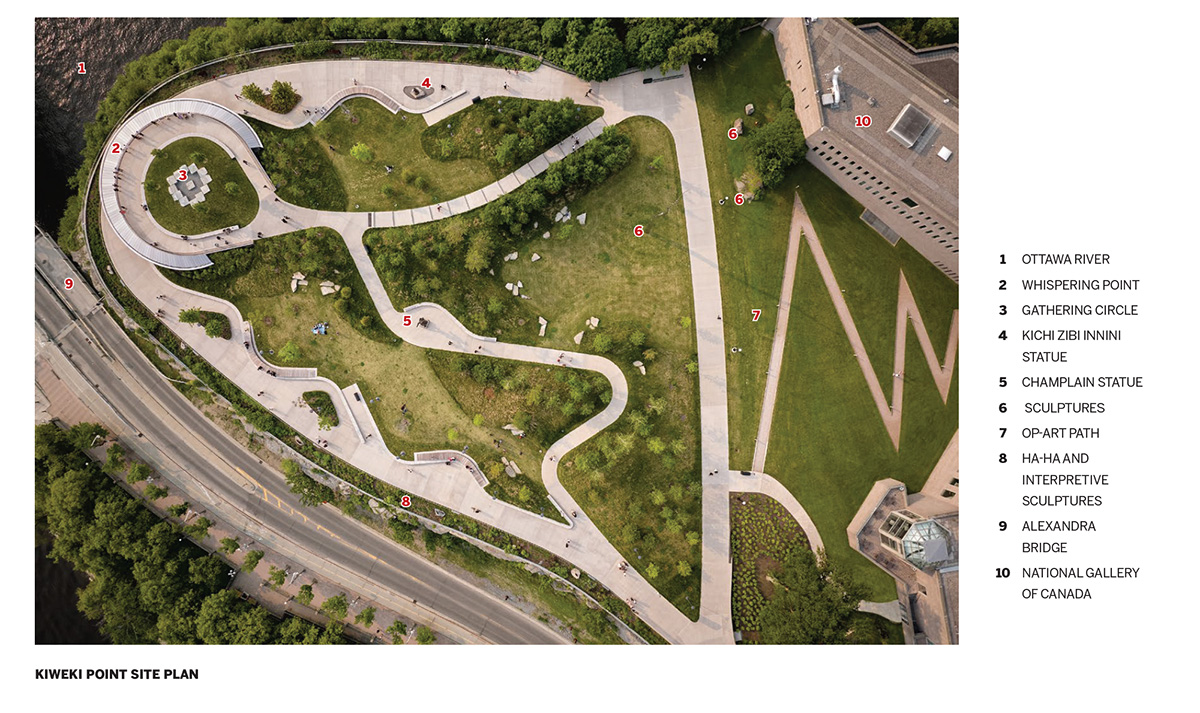
Photo by Doublespace, courtesy Patkau Architects, click to enlarge
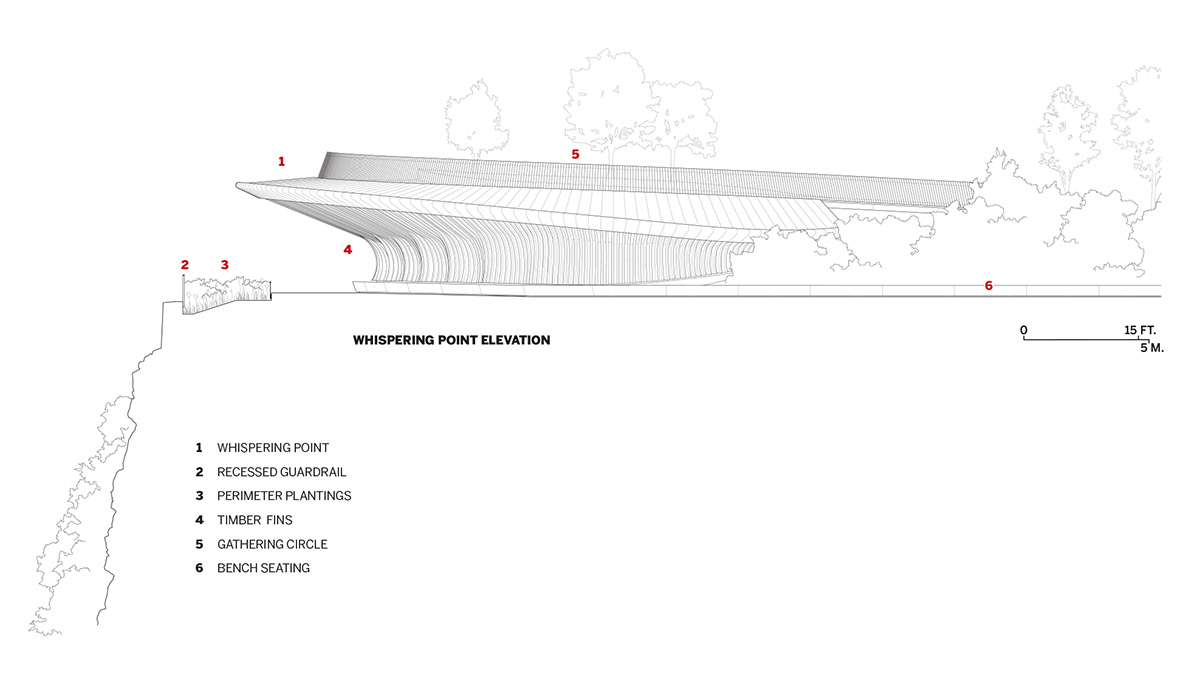
Image courtesy Patkau Architects, click to enlarge
Credits
Architect:
Patkau Architects - John Patkau, Greg Boothroyd, David Shone, principals; Dimitri Koubatis, Patricia Patkau, architects; Marc Holland, Edward Kim, senior designers; Thomas Gaudin, Heba Maleki, designers; Roy Cloutier, associate
Landscape Architect:
Janet Rosenberg & Studio - Janet Rosenberg, founding partner; Wayne Swanton, partner; Nicholas Gosselin, senior associate; Glenn Herman, landscape architect; Robert Beaudin, Horticultural consultant; Bang Wang, designer
Engineers:
Blackwell Structural Engineers; EXP (civil, electrical, mechanical, geotechnical)
Consultants:
ERA Architects (heritage and interpretation architect); Martin Conboy Lighting (lighting design); Smart Watering Systems (irrigation); CIMA+ (transportation); Gradient Wind Engineering (sound & wind); Provencher Roy (site field review)
Construction Manager:
Pomerleau
Client/Owner:
National Capital Commission
Size:
3.7 acres
Cost:
$33 million
Completion:
May 2025
Sources
Timber:
Spearhead
Stainless-Steel Guardrails:
Walters Group
Moisture Barrier:
Soprema
Precast Concrete Benches:
Wausau Tile
Lighting:
BEGA, Flexalighting, Ligman, Wagner
Looking for a reprint of this article?
From high-res PDFs to custom plaques, order your copy today!