Battery Park City: It's a Wrap
More than three decades after its inception, this planned community in Lower Manhattan is nearly complete.
 |
| Photo ' Michael S. Yamashita/National Geographic Stock |
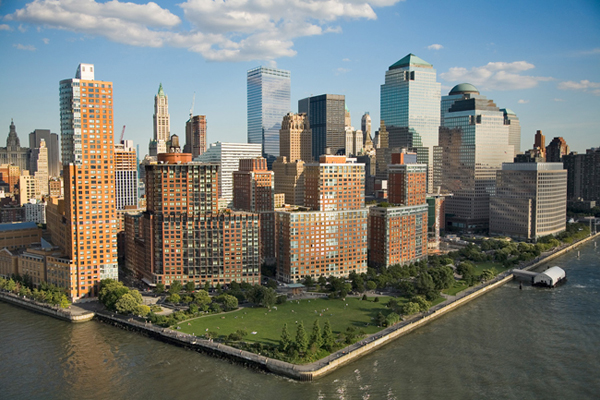
The master plan for Battery Park City was created in 1979. More than three decades later, this 92-acre development in Lower Manhattan is almost finished. |
As Tropical Storm Irene roared toward New York last week, Mayor Michael Bloomberg gave the order to evacuate Battery Park City (BPC), on the waterfront in Lower Manhattan. Now, as the development’s 13,000 residents make their way back, the largely unscathed neighborhood is about to pass a milestone. With two condominium towers nearing completion, every parcel in BPC has now been built out, fulfilling a master plan that has taken 32 years to realize.
Those towers are the 32-story Liberty Luxe and 22-story Liberty Green, both designed by Ehrenkrantz Eckstut & Kuhn Architects (EE&K), a Perkins Eastman company. Along with the 43-story Goldman Sachs headquarters completed last year by Pei Cobb Freed & Partners and an eight-story public school by Dattner Architects that was finished in time for the 2010 academic year, the buildings mark the final elements of a 92-acre plan first drafted in 1979. When it was conceived, the BPC scheme symbolized a pivotal moment in urban planning: the transition away from the Modernist “superblock” and a return to a more streets-and-blocks approach centered on attractive public spaces.
Located on the western edge of Lower Manhattan, BPC evolved from several proposals aimed at keeping the downtown area economically competitive. In 1968, New York governor Nelson Rockefeller established the Battery Park City Authority (BPCA), a public-benefit corporation charged with building and managing the new district.
Using fill excavated from the World Trade Center site and dredged up from the harbor near Staten Island, the BPCA created new land in the Hudson River where dilapidated piers once stood. In the late 1970s, it turned to two New York architects, Alexander Cooper and Stanton Eckstut, to dream up a master plan that was both innovative and appealing to developers.
The crux of Cooper and Eckstut’s proposal was to extend the Manhattan street grid into the site, creating traditional roads and blocks that could be developed in phases as market conditions allowed. A commercial hub was placed at the heart of the neighborhood, with residential buildings extending to the north and south along boulevards paralleling Broadway. Thirty percent of the site was reserved for public space, including parks. Later, the architects would propose detailed massing and design guidelines.
The plan won favor with developers. Olympia & York pledged to construct the World Financial Center, an 8 million-square-foot commercial complex, and other developers soon lined up to build out the southern residential zone.
After weathering several recessions, leadership changes, and September 11, BPC now covers roughly two dozen city blocks and contains more than 13,000 residents, 9 million square feet of commercial space, and several civic and cultural venues. “The buildings have a much more interesting program than we planned,” Eckstut says, citing Stuyvesant High School (Cooper, Robertson & Partners, 1992) and the Museum of Jewish Heritage (Kevin Roche John Dinkeloo and Associates, 1997). “These departures have made it more of a real city.”
BPC’s showpiece is the 1.5-mile-long waterfront esplanade, which features a plaza, marina, and views of the Statue of Liberty. Another vital community amenity: the Cesar Pelli–designed Winter Garden (1988), where free public events are presented year-round.
BPC’s success is attributable to its sustainable aspects. A dozen projects have received or are expected to receive LEED certification, but as Cooper notes, the neighborhood’s most important “green” features — open space, density, and proximity to transit — prefigured the sustainability discourse by decades.
Still, BPC has drawbacks. It’s primarily inhabited by upper-income residents (though BPCA revenues from payment in lieu of taxes, ground rents, and civic facility fees have funded low-income projects elsewhere in the city). Its connectivity to the rest of New York will always be limited by West Street, which obstructs pedestrians with an eight-lane barrier. Architecturally, the buildings are mostly uninspired brick-and-glass towers, and the block-wide parcel sizes, though attractive to developers, can make even the low-rise buildings seem overscaled. For now, the neighborhood also lacks the dynamism of districts that have grown organically over time, where historic architecture abuts modern buildings.
In 2010, the Urban Land Institute recognized Battery Park City with its international Heritage Award, bestowed occasionally to projects 25 years or older with a profound impact. Indeed, many of BPC’s planning principles — street grids, phased development, flexible design guidelines — have become standard practice. This DNA is apparent in Cooper, Robertson & Partners’s master plan for the Central Delaware in Philadelphia, EE&K’s Southwest Waterfront in Washington, D.C., or any number of recently planned cities throughout the Middle East and Asia. When those developments are completed several decades from now, each will owe part of its success to this pioneering corner of Lower Manhattan.
This story appeared in the September 2011 issue of Architectural Record.
Looking for a reprint of this article?
From high-res PDFs to custom plaques, order your copy today!