Bringing Space and Light to the Underground
An imaginative plan for a transit hub has a bumpy ride in the process of being realized.
Santiago Calatrava
World Trade Center Transportation Hub
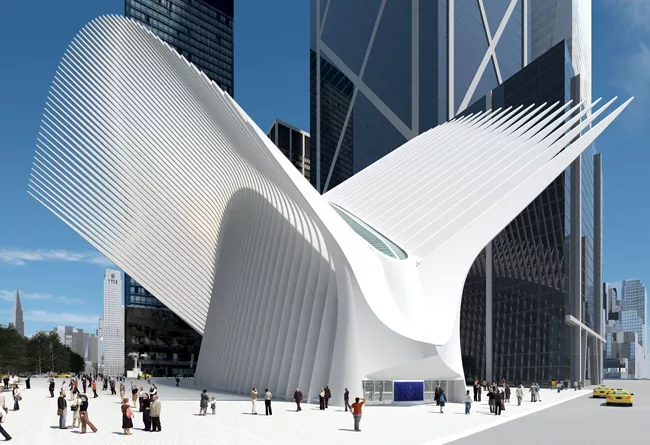
In 2004, when Santiago Calatrava unveiled his plans for the World Trade Center Transportation Hub, an 800,000-square-foot complex knitting together underground train lines, he explained his vision at a press conference by sketching an image of a bird taking flight.
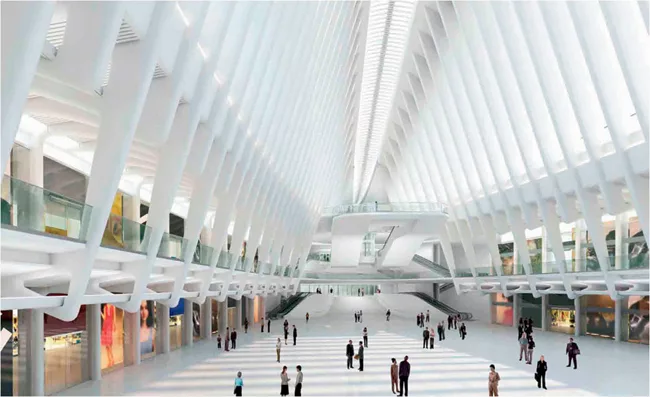
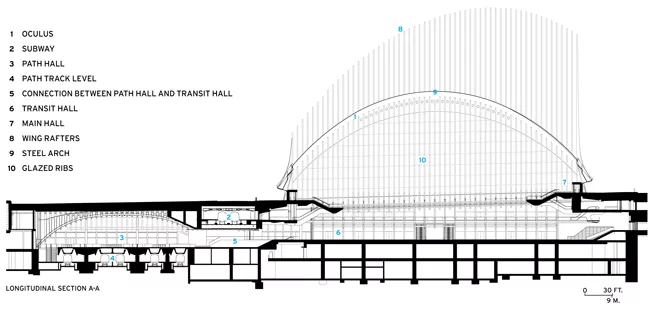
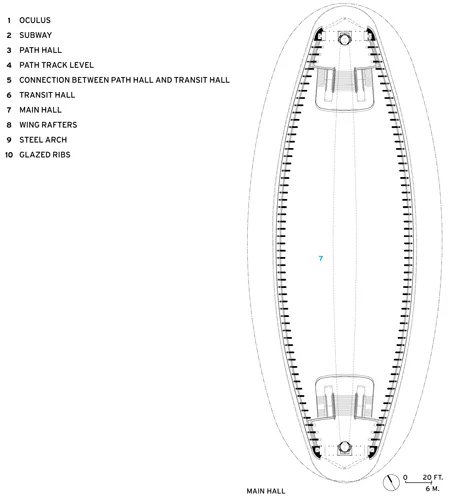
A winged creature was an apt symbol. The part of the hub that was to stand above ground would feature two upturned roof sections, ribbed with steel and webbed with glass, that could actually rise and fall like gently flapping wings.
Not only would that flapping motion open and close a skylight along the spine of the hub’s massive main hall, but it promised to make the building look as if it could almost soar itself. Yet in other ways, a bird might have been an unfortunate metaphor: It’s a creature that can be brought down to earth.
Indeed, in the years since the Spanish architect’s dramatic presentation, the escalating cost of labor and materials for the immense project — it will reach four stories underground, with a five-track New Jersey PATH train terminal, 200,000 square feet of retail, and concourses for 12 subway lines — has caused the project’s price tag to jump from $2.2 billion to $3.4 billion. Because of that spike, the client, the Port Authority of New York and New Jersey, forced Calatrava two years ago to make major changes to his design, including immobilizing those eaglelike arcing steel canopies. In other words, the bird’s wings have been clipped.
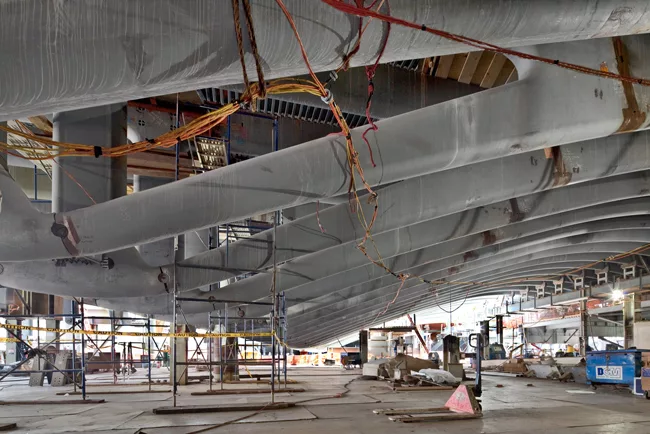
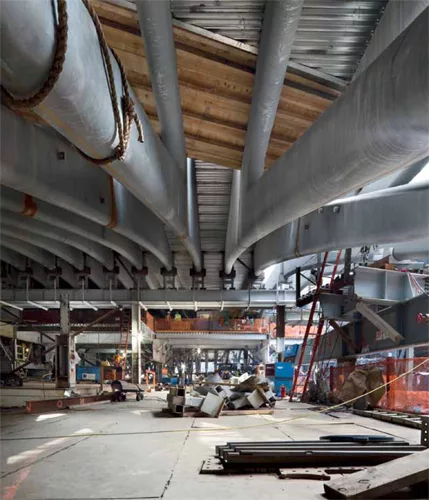
And those aren’t the only changes to address budget woes, although some of Calatrava’s expensive specifications remain. One is the beautiful, custom, curved steel beams that the architect had fabricated in Spain by a company with which he had previously worked. (Other elements are being made in Canada, South Carolina, and Italy.)
The hall west of, and down from, the main one, where commuters will access PATH trains, was conceived as a sweeping column-free space. It now has four columns, rising as high as 46 feet, on which a plate girder sits — a decision made to simplify construction and shorten the time it takes to build the hall’s roof, which supports an outdoor plaza.
In addition, tunnels for the No. 1 subway line, which slices through the site, will now be reinforced concrete, instead of steel, as originally planned by Calatrava (who trained as an engineer as well as an architect). The idea is, again, to hurry along a project that broke ground in 2005 and was supposed to be completed by 2010. While construction proceeds apace, the hub is not slated to open until 2014.
Calatrava acknowledges that spiraling expenses have cast a bit of a shadow over public perception of the project. “The cost for us has always been a concern,” he says. The transit project, which rises only two stories above grade but sprawls underground across four and a half city blocks, is incredibly complicated, he notes, adding, “Building vertically is much easier to do than moving in the horizontal. When you are working with these kinds of projects, you have to be aware that they take a long time.”
Changes to any architect’s plans may be inevitable with a project of this scope, especially at a site fraught with so much emotional significance about what should go where. And Calatrava’s hub is not the only project at Ground Zero to undergo significant revisions since being proposed (see One World Trade Center, page 60). Some of the hub’s tweaks have more to do with those who lost their lives at Ground Zero and the prevention of future attacks than with cutting costs. To wit: Early on, the glass panels that were to be part of the roof’s wings were eliminated over fears that, in the event of explosions, the glass could shatter and rain down on people below. Those wings will now be made only of steel ribs, so that the overall effect will be one of long, curving pergolas. (The ribbed body of the main hall will still be glazed.)
Also, the plaza on the west that sits atop the PATH hall was originally to have rectangular glazed slots to allow daylight to reach the train platforms below. Yet the planners of the adjacent World Trade Center memorial decided that something more contemplative was needed for the plaza. So instead, a grove of swamp white oak trees was planted. “It is more important for the memorial to be able to use that space,” Calatrava says. Now a honeycomb concrete structure covers the PATH hall’s arches to accommodate soil for trees.
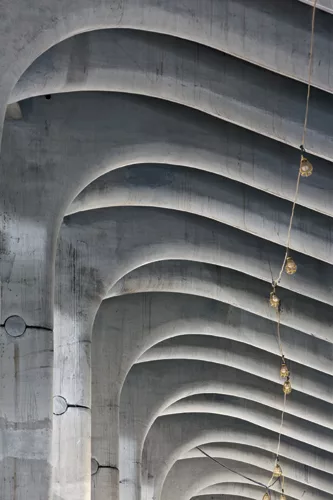
Calatrava has designed a number of train stations worldwide, including the Oriente Station in Lisbon, whose concrete forms evoke the shape of the New York hub’s main hall, and the Liège-Guillemins TGV Station in Belgium [record, March 2010, page 87], characterized by delicate steel arches. The architect insists that what makes the World Trade Center hub truly special has not been compromised. The arched-glass and steel-ribbed enclosure sheltering its main hall will allow natural light to wash through the space where 250,000 commuters and visitors are expected to pass daily through two levels of restaurants and shops.
Moreover, the skylight along the curved roof’s spine, which reaches a height of 161 feet, will open to a width of 30 feet, letting in fresh air and offering glimpses of the sky. And because of the hub’s angled orientation, sunlight (weather permitting) should pour through that skylight unencumbered by shadows every September 11 between the key times of 8:46 a.m. and 10:28 a.m., a feature of Daniel Libeskind’s master plan that survived.
Illuminating transportation centers with daylight has been a priority of Calatrava’s since he first saw the famous historic photo of Grand Central Terminal in which ethereal beams of light slant through the vast space.
The luminous, airy quality, accentuated by the white-painted arches, will be a direct rebuke, says Calatrava, to the modern-day Penn Station, a windowless space that stands in stark contrast to its light-filled predecessor. “We wanted to do exactly the opposite,” says Calatrava about what will be his first completed New York City project. “We want to give the people the comfort of space and light, and easy orientation.”
Although the transit center is a long way from opening, as the 10th anniversary of the terrorist attacks arrives, there are signs of progress. The foundations are in place, as are the beams on the western side of the PATH hall under the plaza, says architect Mike Garz, project manager for the Downtown Design Partnership, a joint venture of STV Group and AECOM, which serves as the hub’s architect and engineer of record. Garz, on the project since 2004, understands that the public might be frustrated with the pace of construction, especially as so much that is happening is not visible. But if people can just be patient, they should be pleased with the results. “What we’ve been trying to achieve is something that is rich, rewarding, and uplifting,” he says, “while recognizing where it is.”
Whether or not the lack of daylight in the PATH hall ends up playing to Calatrava’s worst fears — and commuters feel they are passing through Penn Station instead of Grand Central — remains to be seen. But in many ways the hub could strike an appropriate balance between the needs to memorialize and yet go on with everyday life.
C.J. Hughes is a RECORD contributing editor. His articles have appeared in the New York Times, This Old House, and Departures UK.
Size: 800,000 square feet
Cost: $3.4 billion
Completion date: 2014
Architect:
Santiago Calatrava
Design Architect; Downtown Design Partnership (a joint venture of STV Group and AECOM), Architect and Engineer of Record.
PeopleArchitect: Design Architect; Downtown Design Partnership (a joint venture of STV Group and AECOM), architect and engineer of record. Engineers: Downtown Design Partnership, Santiago Calatrava, Parsons Transportation Group, Weidlinger, Lucius Pitkin (structural) Client: Port Authority of New York and New Jersey Consultant(s): in excess of fifty consultants: Construction manager: Tishman/Turner, a joint venture of Tishman Construction Corporation and Turner Construction Company Photographer: James Ewing | ProductsStructural system Manufacturer of any structural components unique to this project: DCM Erectors, Skanska Koch (principal contractors for custom shaped structural steel) Exterior cladding Interior finishes Floor and wall tile: Stone Wall and Floor (interior) Miller Druck Specialty Contracting (installer) |
Looking for a reprint of this article?
From high-res PDFs to custom plaques, order your copy today!