Architectural Record
search
cart
facebook twitter linkedin youtube
  • Sign In
  • Subscribe
  • Sign Out
  • My Account
Architectural Record
  • NEWS
    • Latest News
    • Awards
    • Interviews
    • Obituaries
    • Podcasts
      • Design:Ed Podcast
      • Sponsored Podcasts
  • OPINION
    • Book Reviews / Excerpts
    • Exhibition Reviews
    • Forum
  • EXCLUSIVES
    • Videos
    • Design Vanguard
    • Top 300 Firms
    • Sponsored Content
    • Sponsored eBooks
    • From the Archives
  • CONTINUING ED
    • Editorial Continuing Ed
    • CE Center
    • CE Academies
  • PROJECTS
    • Buildings By Type
    • Reuse & Renovation
    • Museums & Arts Centers
    • Colleges & Universities
    • Multifamily Housing
    • Interiors
    • Lighting
    • Kitchen & Bath
  • HOUSES
    • Record Houses
    • House of the Month
    • Featured Houses
  • PRODUCTS
    • Products by Category
    • Record Products of the Year
    • Latest Products
  • EVENTS
    • Dates & Events
    • Record on the Road
    • Innovation Conference
    • Sustainability in Practice
    • Women In Architecture
    • Webinars
    • Ad Excellence Awards
    • Submit an Event
  • CONNECT
    • Ask RECORD AI
    • Newsletters
    • Contact
    • Advertise
    • Editorial Calendar
    • Store
    • Customer Service
  • SUBMIT
    • Submission Guidelines
    • RECORD Competitions
  • MAGAZINE
    • Subscribe
    • My Account
    • Digital Edition
    • Current Issue
    • Firm Pass
    • Historic Archive
Architecture News

Apple Headquarters Project Moves Forward After Death of Steve Jobs

By Fred A. Bernstein
April 17, 2012

Architects & Firms

Foster + Partners

Apple Headquarters 
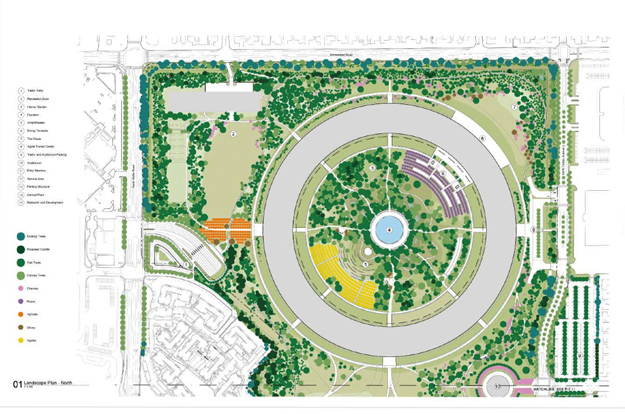
Designed by Foster and Partners, the new Apple headquarters in Silicon Valley will feature a giant donut-shaped structure. Recent plans also show ample fruit trees on the 175-acre campus, meant to recall the area's agricultural heritage.
Image courtesy City of Cupertino

When he described his childhood in California’s Santa Clara (now Silicon) Valley, Steve Jobs often mentioned the apricot orchards that made the area a kind of earthly paradise. So it’s fitting that one of the first things visitors will see at Apple’s new headquarters—the circular building designed by Foster and Partners on a 175-acre site in Cupertino—is an apricot grove.

That’s clear from plans filed last month with the city of Cupertino, and stamped by both Foster and Olin Partnership, the Philadelphia-based landscape architecture firm. The apricot orchard, which in previous submissions to the city had been hidden from view, is now front-and-center at the entrance to the Apple Campus, where some ten lanes of traffic will descend into underground parking lots. Principal Laurie Olin declined to speak about the headquarters, citing a nondisclosure agreement. But Apple’s latest submission to Cupertino states that “the landscape design will recall Cupertino’s pre-agricultural and agricultural past”—clearly Jobs’s dream.

He revised plans show that Olin has given the Foster building a more naturalistic setting since previous submissions last year, with meandering paths added to the vast courtyard inside the torus, amid reconfigured apple and plum orchards. At the same time, the main entrance to the campus has moved away from an existing intersection, further isolating the campus from its neighborhood.

But the big news isn’t about fruit trees and traffic patterns: It’s that the entire project didn’t die with Jobs. The Foster building, meant to house 14,000 workers, was a pet project of the Apple chief, who unveiled the plans last June during one of his final public appearances. His successors have been deterred neither by his death in October nor by withering criticism of the building, a 2.8 million-square-foot donut almost a mile in circumference. Writing in The New Yorker, Paul Goldberger, described its geometric rigidity to that of the Pentagon and said it would be a shame if Jobs’s last contribution was his least meaningful. Los Angeles Times architecture critic Christopher Hawthorne called the project a “retrograde cocoon.”

Clog, an experimental architecture journal, devoted its entire February issue to Apple’s architecture. It included some strong language. Sanford Kwinter called the campus plan “barbarism” and Mark Wigley delivered perhaps the ultimate dig: “It is hard to think of a more analog building.” Kyle May, the editor in chief of Clog, said he is “surprised that the project is moving forward, given all the criticism from the architecture community.” (Clog’s Apple issue will be celebrated in a show on “Archizines” opening tonight at New York’s Storefront for Art and Architecture).

Apple’s decision to proceed is good news for Norman Foster, and not just because of the vast budget. The association with Apple—known not only for superb product design but also for the first-rate architecture of its retail stores (by Bohlin Cywinski Jackson)—can only burnish his reputation, even if few people ever get to see the building. And few will. As Apple states in its latest submission to the city, in preparation for an environmental impact assessment, one of its objectives is to “achieve the security and privacy required for the invention of new products by eliminating any public access to the site, and protecting the perimeters against trespassers.” Apple has always been secretive, but the language is jarring in an era when urban planning tends to be about creating, not curtailing, interaction.

The documents are replete with mentions of green features, including rooftop solar panels. But it’s hard to imagine anything less green than tearing down dozens of existing structures, totaling some 2.65 million square feet, to make way for a new building of almost the same size. That hardly jibes with Jobs’s view of a natural paradise in the Silicon Valley.

Looking for quick answers on architecture and design topics?
Try Ask RECORD, our new smart AI search tool.
Ask RECORD →

Share This Story

Looking for a reprint of this article?
From high-res PDFs to custom plaques, order your copy today!

Fred Bernstein studied architecture at Princeton and law at NYU and writes about both subjects.

Post a comment to this article

Report Abusive Comment

Subscription Center
  • Create an Account
  • Start a Subscription
  • Manage My Account
  • Sign Up for Newsletters
  • Visit Customer Service
  • Update Preferences

More Videos

Sponsored Content

Sponsored Content is a special paid section where industry companies provide high quality, objective, non-commercial content around topics of interest to the Architectural Record audience. All Sponsored Content is supplied by the advertising company and any opinions expressed in this article are those of the author and not necessarily reflect the views of Architectural Record or its parent company, BNP Media. Interested in participating in our Sponsored Content section? Contact your local rep!

close
  • TAMLYN XtremeTrim Exterior Trim
    Sponsored byTamlyn

    Designing Cleaner Panel Facades: Why Exterior Trim Details Matter

  • Building with Vapor Barriers
    Sponsored byReef Industries, Inc.

    Vapor Barriers Help Control Moisture in Tighter Building Designs

  • Duct Interior with Prodeq System
    Sponsored byHenry, a Carlisle Company

    Designing Resilient Water Containment Systems

DESIGN:ED Podcast
Listen to Architectural Record’s DESIGN:ED Podcast

Events

June 10, 2026

Rethinking Stormwater – The Power of Porous Paving

Credits: 1 AIA LU/HSW; 1 AIBD P-CE; 0.1 ICC CEU

Learn how porous paving systems support stormwater management, reduce heat island effects, and enhance sustainable site design performance.

June 11, 2026

Very Early Warning Fire Detection for Mission-Critical Facilities

Credits: 1 AIA LU/HSW; 1 AIBD P-CE; 0.1 ICC CEU

Examine advanced fire detection strategies that support uptime and enhance safety in data centers and other mission-critical facilities.

View All Submit An Event

Products

2026 Architect's Square Foot Costbook

2026 Architect's Square Foot Costbook

See More Products

Popular Stories

Coronado Bridge

The Architect’s Guide to San Diego

Practice Matters illustration

What’s in a (Firm’s) Name? Thinking About Succession and Legacy

Practice Matters illustration

By the Numbers: Counting America's Architects

Inward House

Inward House by VeeV Design Studio

Riverdale House by Studio Lau

Riverdale House by Studio Lau

Broader Sustainability of CMU - Free Webinar - May 21, 2026

Related Articles

  • An Appreciation of Steve Jobs

    See More
  • Video: Steve Jobs Pitches (Foster-Designed?) Apple HQ to Cupertino City Council

    See More
  • Steve Jobs, the Demo Man

    See More

Related Products

See More Products
  • 1118522532.gif

    Future Details of Architecture

  • Architectural Record - October 2025

    Architectural Record October 2025 Issue

See More Products
×

The latest news and information

#1 Source for Architectural Design, News and Products

SUBSCRIBE
  • RESOURCES
    • Advertise
    • Contact Us
    • Submit
    • Store
  • ACCOUNT CENTER
    • Create an Account
    • Start a Subscription
    • Manage My Account
    • Sign Up for Newsletters
    • Visit Customer Service
    • Update Preferences
  • PRIVACY
    • PRIVACY POLICY
    • TERMS & CONDITIONS
    • DO NOT SELL MY PERSONAL INFORMATION
    • PRIVACY REQUEST
    • ACCESSIBILITY
  • SERVICES
    • Marketing Services
    • Reprints
    • Market Research
    • List Rental
    • Survey/Respondent Access
  • STAY CONNECTED
    • Linkedin
    • Facebook
    • Instagram
    • YouTube
    • X (Twitter)

Copyright ©2026. All Rights Reserved BNP Media, Inc. and BNP Media II, LLC.

Design, CMS, Hosting & Web Development :: ePublishing