Architectural Record
search
cart
facebook twitter linkedin youtube
  • Sign In
  • Subscribe
  • Sign Out
  • My Account
Architectural Record
  • NEWS
    • Latest News
    • Awards
    • Interviews
    • Obituaries
    • Podcasts
      • Design:Ed Podcast
      • Sponsored Podcasts
  • OPINION
    • Book Reviews / Excerpts
    • Exhibition Reviews
    • Forum
  • EXCLUSIVES
    • Videos
    • Design Vanguard
    • Top 300 Firms
    • Sponsored Content
    • Sponsored eBooks
    • From the Archives
  • CONTINUING ED
    • Editorial Continuing Ed
    • CE Center
    • CE Academies
  • PROJECTS
    • Buildings By Type
    • Reuse & Renovation
    • Museums & Arts Centers
    • Colleges & Universities
    • Multifamily Housing
    • Interiors
    • Lighting
    • Kitchen & Bath
  • HOUSES
    • Record Houses
    • House of the Month
    • Featured Houses
  • PRODUCTS
    • Products by Category
    • Record Products of the Year
    • Latest Products
  • EVENTS
    • Dates & Events
    • Record on the Road
    • Innovation Conference
    • Sustainability in Practice
    • Women In Architecture
    • Webinars
    • Ad Excellence Awards
    • Submit an Event
  • CONNECT
    • Ask RECORD AI
    • Newsletters
    • Contact
    • Advertise
    • Editorial Calendar
    • Store
    • Customer Service
  • SUBMIT
    • Submission Guidelines
    • RECORD Competitions
  • MAGAZINE
    • Subscribe
    • My Account
    • Digital Edition
    • Current Issue
    • Firm Pass
    • Historic Archive
Architecture News

RECORD Innovation Conference 2013: Finding Simplicity in the High-Tech
By Fred A. Bernstein
October 8, 2013


Architectural Record Innovation Conference 2013
Photo © Steve Hill
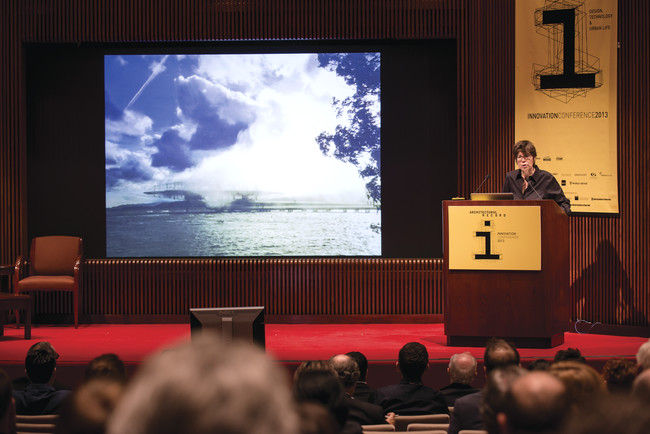
Elizabeth Diller, founding principal of Diller Scofidio + Renfro, discussed the low- and high-tech aspects of the firm's projects during her keynote.

At the start of a day devoted to the connections between architecture and new technology, Elizabeth Diller, of Diller Scofidio + Renfro, urged architects to continue to use “the whole repertoire of old-fashioned tools that are not really getting replaced, just supplemented.” She described the firm’s best-known project, the High Line, as low-tech, and said the popularity of Blur—its first building “for a mass audience”—could be explained by the structure’s simplicity. She conceded that one of the firm’s newest projects, a cinch-waisted condo tower in Manhattan’s Hudson Yards, could not have been designed without CATIA (Computer Aided Three-dimensional Interactive Application), the CAD program that has its origins in aircraft fabrication. Still, she argued, technology shouldn’t be seen as itself a generator of architectural forms so much as ”an agent” to be used “with other, dumber systems.”

 
Photo © Steve Hill
Ole Scheeren, principal of Buro Ole Scheeren, explained how innovative cores helped generate the startling forms of several of his buildings.
 

The challenge Diller described—finding simplicity in a world of dizzying technological innovation—set the tone for the 11th annual Architectural Record Innovation Conference, which drew 400 people to the auditorium of Manhattan's McGraw-Hill Building on October 3. True, Ole Scheeren couldn’t describe CCTV, the five-million-square-foot building he and Rem Koolhaas designed to cantilever over Beijing, as simple, but he did make a strong case that its form grew directly out of its function. And he traced the history of the “service core,” which is part of every skyscraper, to a house designed by “domestic economist” Catharine Beecher in the 1860s. Exploring what he called “core values,” he explained how innovative cores helped generate the startling forms of several of his buildings, including a housing development in Singapore made of tower blocks arranged lengthwise around hexagonal courtyards, and a skyscraper in Bangkok that looks as though parts of it have blown away.

Among architects who spoke during the daylong conference, perhaps the one most clearly indebted to technology was Thom Mayne. The Pritzker Prize-winner (who said that outside the office he is techno-challenged, unable to turn on the television) described the arc of his career in terms of what CAD has made possible. Recalling the days when he conceived of buildings as plans, elevations, and sections, he said those drawings are now just digital “outputs,” and that the latest software is “allowing us to change the direction of architecture aesthetically.” He can now create buildings that are neither drawable nor even “preconceivable.”

David Rockwell, of Rockwell Group; Lise Anne Couture, of Asymptote Architecture; and Keith Besserud of Skidmore, Owings & Merrill (SOM) spoke of ways they integrate the latest research into their architectural practices. But another representative of SOM, structural engineering partner William F. Baker, described the firm’s intensive research into an initiative that sounds almost retro—creating tall buildings with timber frames. Other speakers commented on the connections between technology and craft. As Chris Sharples of SHoP Architects noted, digital tools are helping to connect innovative architects with artisans. Aleksey Lukyanov-Cherny of the firm Situ Studio said, “What technology is doing is not removing the hand—it’s actually allowing more hands to participate.”

Among the most provocative presenters of the day were the members of a panel on how “big data,” the vast amount of information available to architects and planners, can shape the physical world. As moderator and author Andrew Blum stated, “Data has spatial consequences.” Anthony Townsend, a researcher and author, spoke of systems that will help control cities of “tens of millions of people,” noting, for example, that cellphone usage data allowed Istanbul to redesign its bus network, matching routes to demand without the need for cumbersome market research.  Another panelist, law professor Susan P. Crawford, said the effects of supplying the entire country with fiber optic lines will be as profound as those that resulted from the advent of electricity.

It was Mayne who ended the program, noting that digital tools, by eliminating the need to design in two dimensions, have helped architects rediscover what their profession is about. “As architects, we don’t draw drawings,” he said. “We make buildings.”

KEYWORDS: innovation conference

Share This Story

Looking for a reprint of this article?
From high-res PDFs to custom plaques, order your copy today!

Fred Bernstein studied architecture at Princeton and law at NYU and writes about both subjects.

Post a comment to this article

Report Abusive Comment

Subscription Center
  • Create an Account
  • Start a Subscription
  • Manage My Account
  • Sign Up for Newsletters
  • Visit Customer Service
  • Update Preferences

More Videos

Sponsored Content

Sponsored Content is a special paid section where industry companies provide high quality, objective, non-commercial content around topics of interest to the Architectural Record audience. All Sponsored Content is supplied by the advertising company and any opinions expressed in this article are those of the author and not necessarily reflect the views of Architectural Record or its parent company, BNP Media. Interested in participating in our Sponsored Content section? Contact your local rep!

close
  • TAMLYN XtremeTrim Exterior Trim
    Sponsored byTamlyn

    Designing Cleaner Panel Facades: Why Exterior Trim Details Matter

  • Building with Vapor Barriers
    Sponsored byReef Industries, Inc.

    Vapor Barriers Help Control Moisture in Tighter Building Designs

  • Duct Interior with Prodeq System
    Sponsored byHenry, a Carlisle Company

    Designing Resilient Water Containment Systems

DESIGN:ED Podcast
Listen to Architectural Record’s DESIGN:ED Podcast

Events

June 10, 2026

Rethinking Stormwater – The Power of Porous Paving

Credits: 1 AIA LU/HSW; 1 AIBD P-CE; 0.1 ICC CEU

Learn how porous paving systems support stormwater management, reduce heat island effects, and enhance sustainable site design performance.

June 11, 2026

Very Early Warning Fire Detection for Mission-Critical Facilities

Credits: 1 AIA LU/HSW; 1 AIBD P-CE; 0.1 ICC CEU

Examine advanced fire detection strategies that support uptime and enhance safety in data centers and other mission-critical facilities.

View All Submit An Event

Products

2026 Architect's Square Foot Costbook

2026 Architect's Square Foot Costbook

See More Products

Popular Stories

Practice Matters illustration

What’s in a (Firm’s) Name? Thinking About Succession and Legacy

Coronado Bridge

The Architect’s Guide to San Diego

Practice Matters illustration

By the Numbers: Counting America's Architects

Riverdale House by Studio Lau

Riverdale House by Studio Lau

KRESA by DLR

In Kalamazoo, DLR Group Completes a Mass-Timber Hub for Career and Technical Education Programs

Broader Sustainability of CMU - Free Webinar - May 21, 2026

Related Articles

  • Innovation-Conference-2022.jpg

    Architectural Record’s Innovation Conference in New York Brought Together Architects from Around the Globe

    See More
  • Innovation Conference

    RECORD’s Innovation Conference and Inaugural Awards Program Close Out Archtober in New York

    See More
  • Marlon-Blackwell-Innovation-4.jpg

    Join Architectural Record’s Innovation Conference in New York on October 19

    See More

Related Products

See More Products
  • GlobalData_logo_blue_header.png

    Construction in the US - Key Trends and Opportunities to 2023

  • Architectural Record - August 2025

    Architectural Record August 2025 Issue

See More Products
×

The latest news and information

#1 Source for Architectural Design, News and Products

SUBSCRIBE
  • RESOURCES
    • Advertise
    • Contact Us
    • Submit
    • Store
  • ACCOUNT CENTER
    • Create an Account
    • Start a Subscription
    • Manage My Account
    • Sign Up for Newsletters
    • Visit Customer Service
    • Update Preferences
  • PRIVACY
    • PRIVACY POLICY
    • TERMS & CONDITIONS
    • DO NOT SELL MY PERSONAL INFORMATION
    • PRIVACY REQUEST
    • ACCESSIBILITY
  • SERVICES
    • Marketing Services
    • Reprints
    • Market Research
    • List Rental
    • Survey/Respondent Access
  • STAY CONNECTED
    • Linkedin
    • Facebook
    • Instagram
    • YouTube
    • X (Twitter)

Copyright ©2026. All Rights Reserved BNP Media, Inc. and BNP Media II, LLC.

Design, CMS, Hosting & Web Development :: ePublishing