Newsmaker: Patrik Schumacher
Patrik Schumacher is known for writing books with titles like The Autopoiesis of Architecture: A New Framework for Architecture. But the prolific theorist is also highly practical—as evidenced by his involvement in every one of the 80 projects now in development at Zaha Hadid Architects, where Schumacher has worked since the 1980s and is the sole principal other than Hadid herself. The growth of the firm, which has 450 employees, is astonishing, given that Hadid had completed just one building before 2002. Last week, the German-born Schumacher was in Seoul for the opening of the 900,000-square-foot Dongdaemun Design Park, a curvy cultural center that he describes as a "beautiful strange alien transformative experience." From there, he flew to Hong Kong to help inaugurate the 300-foot-tall "innovation tower" at the Design School of Hong Kong Polytechnic University. He spoke by phone from Hong Kong on everything from his high-profile partner to the state of contemporary architecture, about which he has been posting furiously on Facebook.
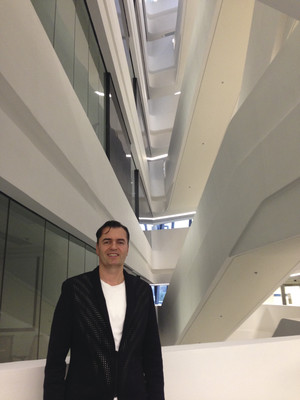 |
| Photo courtesy Patrik Schumacher Patrik Schumacher, in ZHA's new building in Hong Kong, wearing a "parametric" dinner jacket he designed (made from laser-cut neoprene). |
What is it like to inaugurate one of your buildings?
That moment when we walk through a building, experience it together, and discuss its effects, is very important. That’s why we gather hundreds of people from our offices at an event like this one. It’s energizing for the firm.
Are you happy with the way the new buildings are turning out? Critics sometimes point to a gap between what you’ve designed and what actually gets built.
The gap is closing. We are very happy with the results in Baku [the Heydar Aliyev Cultural Center] and Seoul and also here in Hong Kong. For the building to be uplifting, there has to be a high quality of execution; we know that. We’re putting an enormous energy into having people on the ground, wherever we go.
There were reports that the Guangzhou Opera House was badly built.
There was a moment in Guangzhou when we were being rushed. Political deadlines. So things go temporarily wrong and you have to return to repair them. In the end, I still say I’d rather have it than not have it. It’s an uplifting place and experience.
Looking for quick answers on architecture and design topics?
Try Ask RECORD, our new smart AI search tool.
Ask RECORD →
You’ve been posting quite a lot on Facebook, about the lack of respect in the profession for the kind of architecture you do. At times, you’ve sounded angry.
I’m very cool. But I like to have an argument. I thought I’d ratchet up the polemic.
Did something set you off?
One thing was when Rem Koolhaas said that he agreed to direct the upcoming [Venice] Biennale so long as it would “sever all connections with contemporary architecture.”
And that bothered you?
I love Rem. Rem has been one of the great innovators of our discipline, but I am afraid he does not understand what some of us are doing and achieving. A lot of what goes up these days could have been designed 50 years ago. Our discipline would indeed be in its last irrelevant gasps if this was all that was going on, i.e., if parametricism were not saving architecture's reason to exist.
For the uninitiated, how would you explain parametricism?
Parametricism is a design language, a versatile and agile style that can create chameleon-like affiliations, when a building has multiple audiences, with multiple entries and multiple trajectories. The parametric model picks up the various conditions and lets them mesh and mingle on the site, which generates a complex physiognomy.
And it always involves curves?
The curvilinearity clarifies connections. If you tried to do the same thing with straight lines, you’d have 2,000 corners. We allow all angles to exist but we inter-relate them through curvature. That way, the building can pull in various directions at the same time while maintaining a kind of amoeba-like unity.
Does parametricism always erase regional differences?
I’m really against any kind of retro styling, except maybe in resorts, where you want to get transported to a different world for a few moments. Anywhere else, I find symbols of national identity and culture to be a distraction. They impede participation in globalized cultures.
So architecture shouldn’t reflect cultural differences?
I’m interested in the Silicon Valley IT culture versus the city of London finance culture, for example. These are cultures, but they’re not about nostalgia.
Have you gotten a lot of criticism for this stance?
We’re confronting it a lot. Our Seoul project initially elicited a lot of hostility from Korean architects. It was seen as an alien intervention. But once the project was revealed, the mood changed. When you see the way it is used, the way the crowds are moving, the way they become visible to each other, what we did starts to make sense.
You have also posted comments on Facebook about how architects are unlike engineers, even the engineers they depend on.
We need to come to terms with the fact that architecture has nothing to do with engineering. Although we need to collaborate closely with engineers, architecture is in charge of social, rather than technical, functionality, and that means it pushes the communicative capacity of the built environment. And technical means are just this: means to this end.
When you say “communicative capacity”...
Our goal as architects is to frame and facilitate communication. All productivity gains will result from intensification of communication. Online activities still go on, but people also need to be out there and engage.
And your clients want to promote that engagement?
The clients we work with, they come to us looking for spaces that facilitate intense communication. It’s something that minimalism can’t offer, that historicism can’t offer.
You’ve been criticized for working for autocratic regimes, including the government of Azerbaijan.
Looking for a reprint of this article?
From high-res PDFs to custom plaques, order your copy today!