Architectural Record
search
cart
facebook twitter linkedin youtube
  • Sign In
  • Subscribe
  • Sign Out
  • My Account
Architectural Record
  • NEWS
    • Latest News
    • Awards
    • Interviews
    • Obituaries
    • Podcasts
      • Design:Ed Podcast
      • Sponsored Podcasts
  • OPINION
    • Book Reviews / Excerpts
    • Exhibition Reviews
    • Forum
  • EXCLUSIVES
    • Videos
    • Design Vanguard
    • Top 300 Firms
    • Sponsored Content
    • Sponsored eBooks
    • From the Archives
  • CONTINUING ED
    • Editorial Continuing Ed
    • CE Center
    • CE Academies
  • PROJECTS
    • Buildings By Type
    • Reuse & Renovation
    • Museums & Arts Centers
    • Colleges & Universities
    • Multifamily Housing
    • Interiors
    • Lighting
    • Kitchen & Bath
  • HOUSES
    • Record Houses
    • House of the Month
    • Featured Houses
  • PRODUCTS
    • Products by Category
    • Record Products of the Year
    • Latest Products
  • EVENTS
    • Dates & Events
    • Record on the Road
    • Innovation Conference
    • Sustainability in Practice
    • Women In Architecture
    • Webinars
    • Ad Excellence Awards
    • Submit an Event
  • CONNECT
    • Ask RECORD AI
    • Newsletters
    • Contact
    • Advertise
    • Editorial Calendar
    • Store
    • Customer Service
  • SUBMIT
    • Submission Guidelines
    • RECORD Competitions
  • MAGAZINE
    • Subscribe
    • My Account
    • Digital Edition
    • Current Issue
    • Firm Pass
    • Historic Archive
Architecture News

Urban Post-Disaster Housing Prototype Unveiled in New York CIty
By Zachary Edelson
June 13, 2014

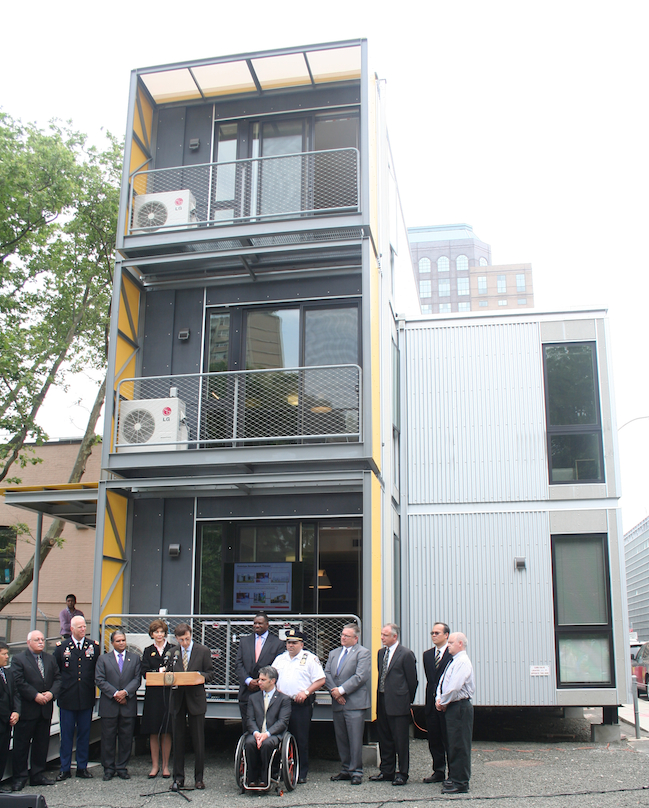
post-disaster housing garrison architects
Photo © Architectural Record
New York City officials unveiled a new modular post-disaster housing unit, designed by Garrison Architects.

It’s nothing short of  building a city within a city overnight.

That’s the fundamental premise behind a new modular post-disaster housing unit, designed by Garrison Architects, which was revealed Tuesday by New York City officials. The premise is simple but ambitious: Post-disaster housing will allow city residents to live in their neighborhood for months or years after a major disaster while their homes undergo repairs. The full-scale and operational prefabricated prototype represents the midpoint of a lengthy quest to change how cities respond to disasters in the 21st century.

The critical problem at hand is a total absence of emergency housing solutions in dense urban settings. Conventional approaches, such as the trailer homes of Hurricane Katrina infamy, are simply infeasible in major cities where space is at a premium. Therefore, the New York City’s Office of Emergency Management (OEM) partnered with Department of Design and Construction and a slew of municipal, state, and federal organizations such as FEMA and the Army Corps of Engineers, to address the issue. They first formulated a set of universal standards and specifications to govern the design of any future post-disaster urban housing in New York City. While the three steely yellow and grey units from Garrison Architects exudes industrial toughness, and is the first project built to these rigorous performance standards, it might represent only the first step in a much broader rethinking of the contemporary urban landscape.

To relocate a neighborhood within its own vacant spaces for months or years implies a potentially massive reassessment of urban infrastructure. The existing prototype’s prefabricated modules were assembled on-site in a mere 13.5 hours and, in the event of an actual disaster, city officials would aim to have all “transitional settlements” up and running after four to eight weeks of planning and prep. Diagrams provided by the city indicate they are also exploring a range of potential configurations that include off-the-grid infrastructure capabilities. However, it would stand to reason that the most vulnerable areas would have extensive planning and specialized infrastructure already in place. The ability to live in these units for extended periods is, after all, their raison d’être. This then raises the question: How will city planners create a ready-to-build city within a city? How will that plan be updated and modified as the city grows and changes?

The Pratt Institute’s Resiliency Adaptation Mitigation and Planning (RAMP) program has already collaborated with the New York City officials in exploring how units such as these could be deployed in the storm surge-vulnerable neighborhood of Red Hook. The work of a recent RAMP studio, displayed throughout the housing prototype during Tuesday’s ceremony, explored everything from placing post-disaster units on waterfront piers to infilling parks and public housing lots. The city has also released an Urban Interim Neighborhood Design “playbook” that outlines post-disaster design considerations and strategies in broad-strokes. However, for now it seems city planners will address the detailed implementation of these units only after a major disaster event.

In the mean time, the prototype sitting next to Cadman Plaza in Downtown Brooklyn will undergo a year of testing from NYU-Poly, Pratt, and intrepid city employees who will live in the units for five-day intervals. If post-disaster housing such as this is embraced by large cities, which seems likely given the proven threat of climate change, then architects and planners can expect the opportunity to reconsider how those major cities can function on an extraordinary scale.

Share This Story

Looking for a reprint of this article?
From high-res PDFs to custom plaques, order your copy today!

Post a comment to this article

Report Abusive Comment

Subscription Center
  • Create an Account
  • Start a Subscription
  • Manage My Account
  • Sign Up for Newsletters
  • Visit Customer Service
  • Update Preferences

More Videos

Sponsored Content

Sponsored Content is a special paid section where industry companies provide high quality, objective, non-commercial content around topics of interest to the Architectural Record audience. All Sponsored Content is supplied by the advertising company and any opinions expressed in this article are those of the author and not necessarily reflect the views of Architectural Record or its parent company, BNP Media. Interested in participating in our Sponsored Content section? Contact your local rep!

close
  • TAMLYN XtremeTrim Exterior Trim
    Sponsored byTamlyn

    Designing Cleaner Panel Facades: Why Exterior Trim Details Matter

  • Building with Vapor Barriers
    Sponsored byReef Industries, Inc.

    Vapor Barriers Help Control Moisture in Tighter Building Designs

  • Duct Interior with Prodeq System
    Sponsored byHenry, a Carlisle Company

    Designing Resilient Water Containment Systems

DESIGN:ED Podcast
Listen to Architectural Record’s DESIGN:ED Podcast

Events

June 18, 2026

Rebooting the Aging Office Building

Credits: 1 AIA LU/HSW; 1 AIBD P-CE; 0.1 ICC CEU; 1 PDH

Explore façade retrofit strategies and award-winning design concepts that can transform aging office buildings into healthier, higher-performing workplaces for today’s hybrid workforce.

June 23, 2026

Enhancing Fire Resistance with Advanced PVC Solutions

Credits: 1 AIA LU/HSW; 1 AIBD P-CE; 0.1 ICC CEU; 1 IIBEC CEH

Evaluate advanced PVC solutions that improve fire resistance, support WUI compliance, and enhance resilience in residential and commercial building design.

View All Submit An Event

Products

2026 Architect's Square Foot Costbook

2026 Architect's Square Foot Costbook

See More Products

Popular Stories

SanDiegoAirport

Top 300 Architecture Firms of 2026

Coronado Bridge

The Architect’s Guide to San Diego

Lorcan O' Herilhy

California Architect Lorcan O’Herlihy Has Died, Age 66

CCA, Studio Gang

The Winners of the AIA’s 2026 Architecture Award Range from Collegiate Rowing Hubs to Housing for the Homeless

Dusk House

Design Vanguard 2026: ONO

Rebooting the Aging Office Building - Free Webinar - June 18, 2026

Related Articles

  • OMA to Design New Museum Expansion

    OMA to Design New Museum Expansion in New York City

    See More
  • SPARC deconstruction

    CO Adaptive Conducts a Salvage Operation at Hunter College in New York City

    See More
  • Prada store scaffold installation, New York

    Prada Sets High Bar for Construction Scaffolding in New York City at Under-Renovation Midtown Store

    See More

Related Products

See More Products
  • 047177751X.gif

    Sustainable Urbanism: Urban Design With Nature

See More Products
×

The latest news and information

#1 Source for Architectural Design, News and Products

SUBSCRIBE
  • RESOURCES
    • Advertise
    • Contact Us
    • Submit
    • Store
  • ACCOUNT CENTER
    • Create an Account
    • Start a Subscription
    • Manage My Account
    • Sign Up for Newsletters
    • Visit Customer Service
    • Update Preferences
  • PRIVACY
    • PRIVACY POLICY
    • TERMS & CONDITIONS
    • DO NOT SELL MY PERSONAL INFORMATION
    • PRIVACY REQUEST
    • ACCESSIBILITY
  • SERVICES
    • Marketing Services
    • Reprints
    • Market Research
    • List Rental
    • Survey/Respondent Access
  • STAY CONNECTED
    • Linkedin
    • Facebook
    • Instagram
    • YouTube
    • X (Twitter)

Copyright ©2026. All Rights Reserved BNP Media, Inc. and BNP Media II, LLC.

Design, CMS, Hosting & Web Development :: ePublishing