Architectural Record
search
cart
facebook twitter linkedin youtube
  • Sign In
  • Subscribe
  • Sign Out
  • My Account
Architectural Record
  • NEWS
    • Latest News
    • Awards
    • Interviews
    • Obituaries
    • Podcasts
      • Design:Ed Podcast
      • Sponsored Podcasts
  • OPINION
    • Book Reviews / Excerpts
    • Exhibition Reviews
    • Forum
  • EXCLUSIVES
    • Videos
    • Design Vanguard
    • Top 300 Firms
    • Sponsored Content
    • Sponsored eBooks
    • From the Archives
  • CONTINUING ED
    • Editorial Continuing Ed
    • CE Center
    • CE Academies
  • PROJECTS
    • Buildings By Type
    • Reuse & Renovation
    • Museums & Arts Centers
    • Colleges & Universities
    • Multifamily Housing
    • Interiors
    • Lighting
    • Kitchen & Bath
  • HOUSES
    • Record Houses
    • House of the Month
    • Featured Houses
  • PRODUCTS
    • Products by Category
    • Record Products of the Year
    • Latest Products
  • EVENTS
    • Dates & Events
    • Record on the Road
    • Innovation Conference
    • Sustainability in Practice
    • Women In Architecture
    • Webinars
    • Ad Excellence Awards
    • Submit an Event
  • CONNECT
    • Ask RECORD AI
    • Newsletters
    • Contact
    • Advertise
    • Editorial Calendar
    • Store
    • Customer Service
  • SUBMIT
    • Submission Guidelines
    • RECORD Competitions
  • MAGAZINE
    • Subscribe
    • My Account
    • Digital Edition
    • Current Issue
    • Firm Pass
    • Historic Archive
Architecture News

Lower Manhattan's New Front Door
By Joann Gonchar, FAIA
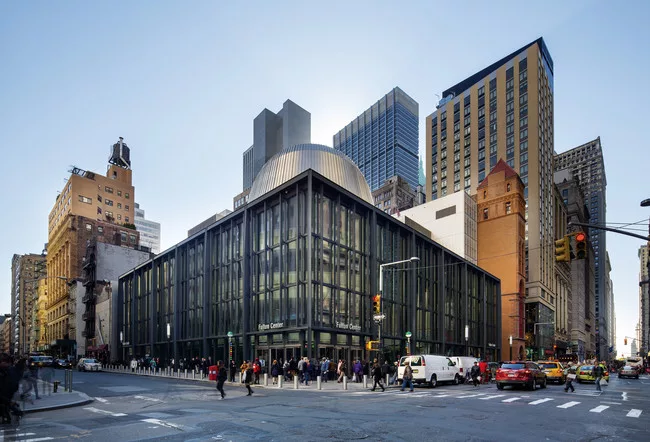
The Fulton Center's metal-clad oculus can be seen emerging from Grimshaw’s steel and glass station. The 125-year-old Corbin building, to the right of the station, was renovated and provides anot
Lower Manhattan's New Front Door
The Fulton Center's metal-clad oculus can be seen emerging from Grimshaw’s steel and glass station. The 125-year-old Corbin building, to the right of the station, was renovated and provides another entrance into the station.
Photo © David Sundberg/Esto
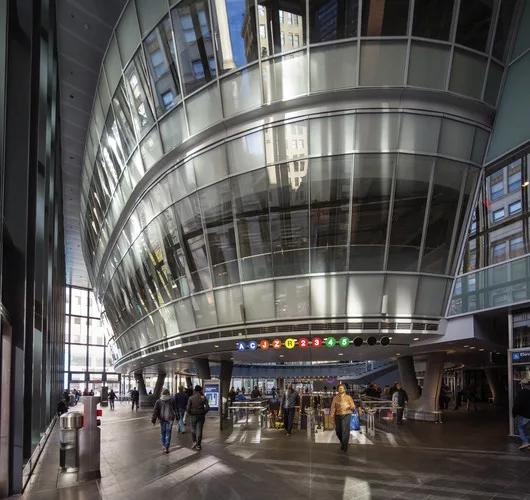
Created with James Carpenter, the oculus, with its perforated aluminum panels, draws daylight into the station.
Lower Manhattan's New Front Door
Created with James Carpenter, the oculus, with its perforated aluminum panels, draws daylight into the station.
Photo © David Sundberg/Esto
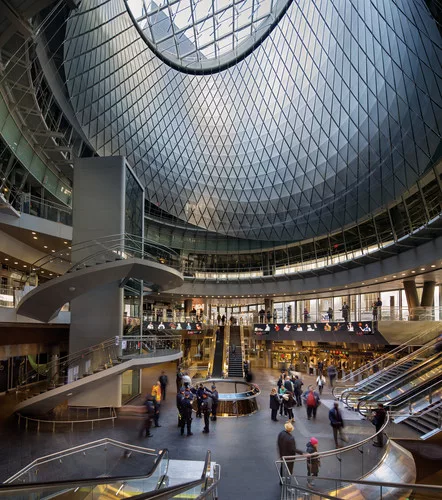
 The “doughnut” will contain retail and restaurants.
Lower Manhattan's New Front Door
 The “doughnut” will contain retail and restaurants.
Photo © David Sundberg/Esto
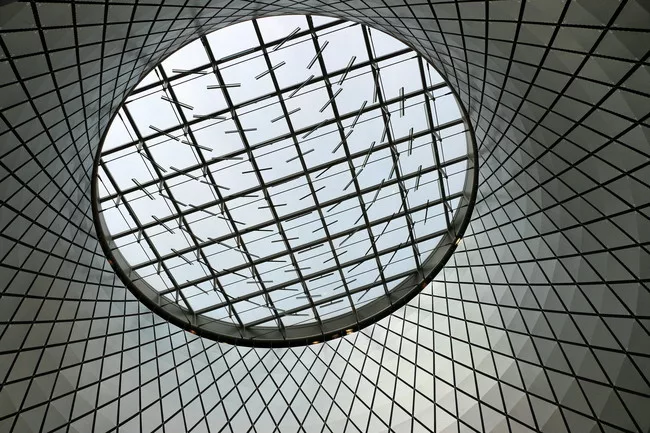
Looking up into the oculus.
Lower Manhattan's New Front Door
Looking up into the oculus.
Photo © Architectural Record
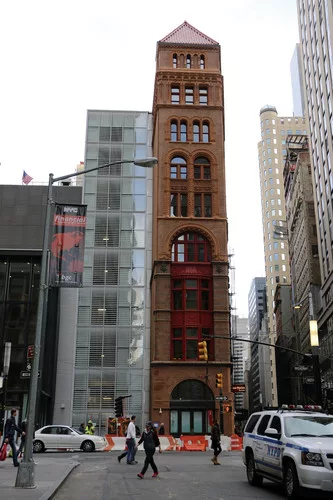
The Corbin Building, designed by Francis Hatch Kimball, has undergone a renovation that included structural reinforcement, restoration of the facade’s terra cotta and cast iron ornament, and a c
Lower Manhattan's New Front Door
The Corbin Building, designed by Francis Hatch Kimball, has undergone a renovation that included structural reinforcement, restoration of the facade’s terra cotta and cast iron ornament, and a complete revamp of building systems.

Photo © Architectural Record
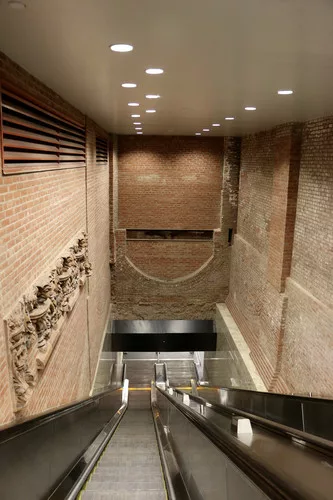
<p>The Corbin Building provides another point of access from the street to the subway platforms  by way of a set of escalators that dramatically descend 20 feet below  Corbin&#8217;s original foundati
Lower Manhattan's New Front Door

The Corbin Building provides another point of access from the street to the subway platforms by way of a set of escalators that dramatically descend 20 feet below Corbin’s original foundations.

Photo © Architectural Record
The Fulton Center's metal-clad oculus can be seen emerging from Grimshaw&#8217;s steel and glass station. The 125-year-old Corbin building, to the right of the station, was renovated and provides anot
Created with James Carpenter, the oculus, with its perforated aluminum panels, draws daylight into the station.
&#160;The &#8220;doughnut&#8221; will contain retail and restaurants.
Looking up into the oculus.
The Corbin Building, designed by Francis Hatch Kimball, has undergone a renovation that included structural reinforcement, restoration of the facade&#8217;s terra cotta and cast iron ornament, and a c
<p>The Corbin Building provides another point of access from the street to the subway platforms  by way of a set of escalators that dramatically descend 20 feet below  Corbin&#8217;s original foundati
November 10, 2014

The Fulton Center's metal-clad oculus can be seen emerging from Grimshaw’s steel and glass station. The 125-year-old Corbin building, to the right of the station, was renovated and provides another entrance into the station.

For months, commuters have been traveling through the almost complete Fulton Center, the transit hub conceived for Lower Manhattan in the wake of the September 11 attacks. But much of the $1.4 billion complex was off limits, hidden by temporary partitions and construction tarps as final construction and systems testing wrapped up. But the tarps and partitions have come down and nearly a decade after the first construction contracts were awarded, the Metropolitan Transit Authority (MTA), the operator of New York City’s subways, declared the station officially open as of November 10.

At its most basic level, the project’s primary aim was to bring order to the jumble of stations for the subway lines that crisscross each other in spaghetti fashion in the city’s financial district. It was confounding to transfer among the lines since they were originally built, some more than a century ago, by competing entities. “There was just loads of friction in the system,” explains Craig Covil, a principal at engineering firm Arup, the project’s prime design consultant.

But, at a ribbon cutting ceremony on November 9, officials pointed to ambitions bigger than making the commute less arduous for the 300,000 people expected to travel through Fulton Center daily. Thomas Pendergast, MTA chairman, welcomed the audience to “New York’s next great public space.” His greeting echoed the sentiments of architects from Grimshaw who were responsible for the three-story-tall glass-and-steel pavilion that is Fulton Center’s primary above-ground component. They refer to the new station as “Lower Manhattan’s front door.”

Grimshaw’s structure, approximately 140-feet square in plan, houses the stairs and escalators that lead to the subway platforms, 40 feet below street level. And overhead is the complex’s defining element: a conical oculus, roughly 70 feet tall and about 50 feet in diameter, created in collaboration with James Carpenter Design Associates. It comprises 952 diamond-shaped perforated aluminum panels held in place by a doubly curved cable net that is tensioned between a compression ring at the top and the second level floor plate at the bottom. The device, called the sky reflector net, harnesses daylight and reflects the sky’s constantly changing colors. The intent, described by Carpenter, “was to bring the image of the sky directly into the space.” (On a more mundane level, the oculus also functions as part of the building’s smoke evacuation system.)

Happily, the station provides multiple vantage points for viewing the oculus, including an intermediary floor plate between the street level and the platforms that the architects refer to as the “lily pad” because of its circular shape, and two glass-enclosed floors that surround the sky reflector, dubbed “the doughnut.” The latter element, which is lifted off the ground plane on Y-shaped columns, houses some of the complex’s 63,000 square feet of commercial space that shopping center giant Westfield Group is in the process of leasing. According to Michael Horodniceanu, MTA capital construction president, the tenants will likely be restaurants and are expected to move in sometime next year.

Over the course of the project’s long history, the scope underwent some fairly significant changes. One of the first was the integration of the 125-year-old Corbin Building, which sits just south of the pavilion, into the station complex. The 8-story masonry and iron structure designed by Francis Hatch Kimball was originally slated for demolition. However, it was landmarked in 2003, after preliminary design for the Fulton Center was already under way. Corbin was deemed historically significant because it was a “proto skyscraper”—at just over 141 feet high, it was briefly Manhattan’s tallest building, according to Page Ayres Cowley, whose eponymous architecture firm was charged with Corbin’s rehabilitation. In addition, it is also one of the first examples of Guastavino tiled vaults.

Now, after a renovation that included structural reinforcement, restoration of the facade’s terra cotta and cast iron ornament, and a complete revamp of building systems, Corbin features ground level retail space with offices above, both of which Westfield will sublet to commercial tenants. The building also provides another point of access from the street to the subway platforms by way of a set of escalators that dramatically descend 20 feet below Corbin’s original foundations (the foundations required underpinning in order to insert the escalators).

Along the way to the Fulton Center’s completion, there were also numerous value engineering changes, including the simplification of the oculus, which was intended to be bigger, dome shaped, and completely clad in glass. Remarkably, neither the oculus nor sky reflector net seems to have suffered. With the colors of the sky shifting across the aluminum panels’ surface and reflected daylight animating the station’s interior, they make a powerful architectural statement just as they are.


Two videos produced by New York's Metropolitan Transportation Authority show the installation of the Fulton Center's Sky Reflector-Net.


Share This Story

Looking for a reprint of this article?
From high-res PDFs to custom plaques, order your copy today!

Joann gonchar

Joann Gonchar, FAIA, LEED AP, is deputy editor at Architectural Record. She joined RECORD in 2006, after working for eight years at its sister publication, Engineering News-Record. Before starting her career as a journalist, Joann worked for several architecture firms and spent three years in Kobe, Japan, with the firm Team Zoo, Atelier Iruka. She earned a Master of Architecture degree from the University of Pennsylvania and a Bachelor of Arts from Brown University. She is licensed to practice architecture in New York State.

Post a comment to this article

Report Abusive Comment

Subscription Center
  • Create an Account
  • Start a Subscription
  • Manage My Account
  • Sign Up for Newsletters
  • Visit Customer Service
  • Update Preferences

More Videos

Sponsored Content

Sponsored Content is a special paid section where industry companies provide high quality, objective, non-commercial content around topics of interest to the Architectural Record audience. All Sponsored Content is supplied by the advertising company and any opinions expressed in this article are those of the author and not necessarily reflect the views of Architectural Record or its parent company, BNP Media. Interested in participating in our Sponsored Content section? Contact your local rep!

close
  • TAMLYN XtremeTrim Exterior Trim
    Sponsored byTamlyn

    Designing Cleaner Panel Facades: Why Exterior Trim Details Matter

  • Building with Vapor Barriers
    Sponsored byReef Industries, Inc.

    Vapor Barriers Help Control Moisture in Tighter Building Designs

  • Duct Interior with Prodeq System
    Sponsored byHenry, a Carlisle Company

    Designing Resilient Water Containment Systems

DESIGN:ED Podcast
Listen to Architectural Record’s DESIGN:ED Podcast

Events

June 16, 2026

Focus on the Façade: Exploring Steel, Timber & Fire-Rated Curtain Walls and Channel Glass Systems

Credits: 1 AIA LU/HSW; 1 AIBD P-CE; 0.1 ICC CEU

Explore modern façade and glazing systems that enhance daylighting, fire safety, and thermal performance while expanding architectural design possibilities.

June 18, 2026

Rebooting the Aging Office Building

Credits: 1 AIA LU/HSW; 1 AIBD P-CE; 0.1 ICC CEU; 1 PDH

Explore façade retrofit strategies and award-winning design concepts that can transform aging office buildings into healthier, higher-performing workplaces for today’s hybrid workforce.

View All Submit An Event

Products

2026 Architect's Square Foot Costbook

2026 Architect's Square Foot Costbook

See More Products

Popular Stories

SanDiegoAirport

Top 300 Architecture Firms of 2026

Coronado Bridge

The Architect’s Guide to San Diego

Dusk House

Design Vanguard 2026: ONO

Crystal Bridges Museum of American Art expansion

Safdie Architects Returns to the Crystal Bridges Museum of American Art for Major Expansion

Hikma Community Complex

Design Vanguard 2026: Mariam Issoufou Architects

Focus on the Facade - Free Webinar - June 16, 2026

Related Articles

  • Paul Rudolph's Lower Manhattan Expressway Lives

    See More
  • Waterfront Promenade Opens in Lower Manhattan

    See More
×

The latest news and information

#1 Source for Architectural Design, News and Products

SUBSCRIBE
  • RESOURCES
    • Advertise
    • Contact Us
    • Submit
    • Store
  • ACCOUNT CENTER
    • Create an Account
    • Start a Subscription
    • Manage My Account
    • Sign Up for Newsletters
    • Visit Customer Service
    • Update Preferences
  • PRIVACY
    • PRIVACY POLICY
    • TERMS & CONDITIONS
    • DO NOT SELL MY PERSONAL INFORMATION
    • PRIVACY REQUEST
    • ACCESSIBILITY
  • SERVICES
    • Marketing Services
    • Reprints
    • Market Research
    • List Rental
    • Survey/Respondent Access
  • STAY CONNECTED
    • Linkedin
    • Facebook
    • Instagram
    • YouTube
    • X (Twitter)

Copyright ©2026. All Rights Reserved BNP Media, Inc. and BNP Media II, LLC.

Design, CMS, Hosting & Web Development :: ePublishing