Architectural Record
search
cart
facebook twitter linkedin youtube
  • Sign In
  • Subscribe
  • Sign Out
  • My Account
Architectural Record
  • NEWS
    • Latest News
    • Awards
    • Interviews
    • Obituaries
    • Podcasts
      • Design:Ed Podcast
      • Sponsored Podcasts
  • OPINION
    • Book Reviews / Excerpts
    • Exhibition Reviews
    • Forum
  • EXCLUSIVES
    • Videos
    • Design Vanguard
    • Top 300 Firms
    • Sponsored Content
    • Sponsored eBooks
    • From the Archives
  • CONTINUING ED
    • Editorial Continuing Ed
    • CE Center
    • CE Academies
  • PROJECTS
    • Buildings By Type
    • Reuse & Renovation
    • Museums & Arts Centers
    • Colleges & Universities
    • Multifamily Housing
    • Interiors
    • Lighting
    • Kitchen & Bath
  • HOUSES
    • Record Houses
    • House of the Month
    • Featured Houses
  • PRODUCTS
    • Products by Category
    • Record Products of the Year
    • Latest Products
  • EVENTS
    • Dates & Events
    • Record on the Road
    • Innovation Conference
    • Sustainability in Practice
    • Women In Architecture
    • Webinars
    • Ad Excellence Awards
    • Submit an Event
  • CONNECT
    • Ask RECORD AI
    • Newsletters
    • Contact
    • Advertise
    • Editorial Calendar
    • Store
    • Customer Service
  • SUBMIT
    • Submission Guidelines
    • RECORD Competitions
  • MAGAZINE
    • Subscribe
    • My Account
    • Digital Edition
    • Current Issue
    • Firm Pass
    • Historic Archive
Architecture News

Guggenheim Restoration Has the Wright Stuff

By Joseph Dennis Kelly
September 26, 2007

Frank Lloyd Wright pushed the limitations of technology with his buildings, sometimes pushing past them and bequeathing problems to future stewards. Fallingwater, the Edgar J. Kaufmann Sr. residence completed in 1939, required a major restoration in 2002. The house’s dramatic cantilevers had deflected dangerously with the main cantilever sagging an alarming seven inches. The restoration team, including structural engineer Robert Silman Associates (RSA) and architect WASA/Studio A were able to halt, but not correct, the deflection with post-tensioning cables—a solution as innovative as Wright’s design.
Philadelphia Museum of Art’s new Ruth and Raymond G. Perelman Building

Philadelphia Museum of Art’s new Ruth and Raymond G. Perelman Building

Philadelphia Museum of Art’s new Ruth and Raymond G. Perelman Building

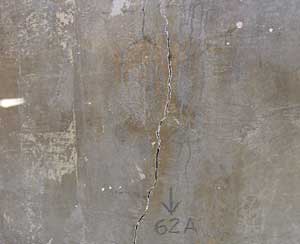
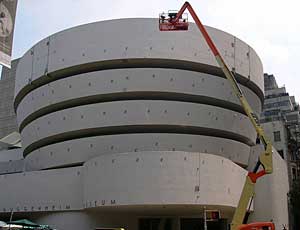
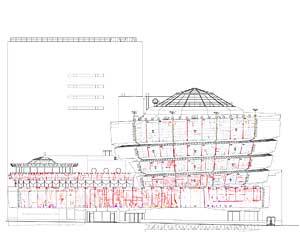
Photo by Robert Johnson, Architectural Business Development, Quantapoint ' The Solomon R. Guggenheim Foundation (top); Drawing by Wank Adams Slavin Associates / Studio A ' The Solomon R. Guggenheim Foundation (middle); Photo by Angel Ayon, Wank Adams Slavin Associates ' The Solomon R. Guggenheim Foundation (above).
Preservation crews scanned the exterior of the Solomon R. Guggenheim Museum in New York City for evidence of deterioration (top). The team made a map of all the cracks on the facade (middle). After removing 17 layers of paint, the cracks were revealed (above).

RSA and WASA/Studio A—formerly Wank Adams Slavin Associates—have partnered again, along with Integrated Conservation Resources, to repair and restore another Wright icon, the Solomon R. Guggenheim Museum in New York City. For two years, the team has undertaken a comprehensive investigation and assessment of the 50-year-old exterior and its infrastructure, focusing on the gunite-covered concrete envelope. An earlier effort completed in 1992, led by Gwathmey Siegel and Associates Architects, had focused on the museum’s interior.

The restoration team removed 11 coats of paint from the exterior, revealing hundreds of surface cracks. With the paint removed, a 17-month monitoring effort began, which measured localized movements of cracks and overall wall movements. Laser modeling and core drilling to gather concrete samples showed that the building remains structurally solid. After extensive laboratory and accelerated weathering testing, mockups of proposed crack fillers and patching materials were monitored through seasonal changes to verify compatibility and performance.

Wright, never one to be shackled by convention, designed the structure without expansion joints in order to create a visually monolithic form. And yet, despite the cracks, the concrete was found to be in remarkably good condition. Credit for this stamina goes to the use of an early version of what is now called elastomeric wall coating—a thick, elastic paint—in its infancy in the 1950s, but its use is a perfect example of Wright’s continuous search for new methods and materials. The restored facade will be coated with a high-performance contemporary elastomeric paint.

The restoration team’s biggest challenge centers on the interior side of the envelope at the top of the rotunda. The wall of the sixth ramp is twice the height of the spiral’s lower ramps and has a different slope. A thorough investigation showed that a difference in geometry meant that the top walls expanded and contracted at different rates. The engineers designed custom steel brackets to reinforce localized discontinuities and applied a carbon-fiber matrix to the interior side of the walls to provide resistance to thermal and wind loads.

In restoring any architectural icon, the goal is preserve the authenticity of craftsmanship and to make sure the intervention doesn’t preclude future restoration. “We strive to make our interventions reversible, but because of the scale of buildings, that is not always possible,” explains Pamela Jerome, AIA, a partner at WASA.  “Therefore, if we cannot achieve reversibility, we at least make sure that our interventions do not preclude re-treatment.”

The total budget for the restoration is $29 million. Scaffolding will remain in place through spring 2008. The museum is expected to remain open throughout the restoration process.

Share This Story

Looking for a reprint of this article?
From high-res PDFs to custom plaques, order your copy today!

Post a comment to this article

Report Abusive Comment

Subscription Center
  • Create an Account
  • Start a Subscription
  • Manage My Account
  • Sign Up for Newsletters
  • Visit Customer Service
  • Update Preferences

More Videos

Sponsored Content

Sponsored Content is a special paid section where industry companies provide high quality, objective, non-commercial content around topics of interest to the Architectural Record audience. All Sponsored Content is supplied by the advertising company and any opinions expressed in this article are those of the author and not necessarily reflect the views of Architectural Record or its parent company, BNP Media. Interested in participating in our Sponsored Content section? Contact your local rep!

close
  • cold storage facility
    Sponsored byCarlisle SynTec Systems

    How Architects Can Design More Continuous Cold Storage Envelopes

  • TAMLYN XtremeTrim Exterior Trim
    Sponsored byTamlyn

    Designing Cleaner Panel Facades: Why Exterior Trim Details Matter

  • Building with Vapor Barriers
    Sponsored byReef Industries, Inc.

    Vapor Barriers Help Control Moisture in Tighter Building Designs

DESIGN:ED Podcast
Listen to Architectural Record’s DESIGN:ED Podcast

Events

June 30, 2026

Generator Selection and Sizing for Outage-Ready Homes

Credits: 1 AIA LU/HSW; 1 AIBD P-CE; 0.1 ICC CEU

Explore how propane-powered systems and whole-home generators can improve energy resilience, reduce electrical loads, and lower long-term residential costs.

July 1, 2026

Hospitality in Higher Education

Credits: 1 AIA LU/HSW; 1 AIBD P-CE; 0.1 ICC CEU

Explore how hospitality-driven campus design can strengthen belonging, wellbeing, and community connection in higher education environments.

View All Submit An Event

Products

2026 Architect's Square Foot Costbook

2026 Architect's Square Foot Costbook

See More Products

Popular Stories

Kìwekì Point, Ottawa, Canada

Perched High Above the Ottawa River, Kìwekì Point Showcases Sweeping Views of the Canadian Capital Region

Baileywick Park

An Elegant Pavilion by In Situ Studio Adds Sheltered Courts and a Gateway to a Public Park in Raleigh

T Bar M Racquet Club

Lake Flato Architects Serves Up a Classic Tennis Clubhouse in Dallas

Reservoir Park and Recreation Center

A Historic Sand Filtration Plant in Washington, D.C., is Transformed into a Multipurpose Green Space

Under Armour Global  Headquarters

In a Former Industrial Area in Baltimore, Gensler Builds an Office Building that Broadcasts its Client’s Ambitions

Generator Selection and Sizing for Outage-Ready Homes - Free Webinar - June 30, 2026

Related Articles

  • The Wright Opens at the Guggenheim

    See More
  • The Wright by Andre Kikoski Architect

    See More
  • Has the boom gone bust?

    See More
×

The latest news and information

#1 Source for Architectural Design, News and Products

SUBSCRIBE
  • RESOURCES
    • Advertise
    • Contact Us
    • Submit
    • Store
  • ACCOUNT CENTER
    • Create an Account
    • Start a Subscription
    • Manage My Account
    • Sign Up for Newsletters
    • Visit Customer Service
    • Update Preferences
  • PRIVACY
    • PRIVACY POLICY
    • TERMS & CONDITIONS
    • DO NOT SELL MY PERSONAL INFORMATION
    • PRIVACY REQUEST
    • ACCESSIBILITY
  • SERVICES
    • Marketing Services
    • Reprints
    • Market Research
    • List Rental
    • Survey/Respondent Access
  • STAY CONNECTED
    • Linkedin
    • Facebook
    • Instagram
    • YouTube
    • X (Twitter)

Copyright ©2026. All Rights Reserved BNP Media, Inc. and BNP Media II, LLC.

Design, CMS, Hosting & Web Development :: ePublishing