Architectural Record
search
cart
facebook twitter linkedin youtube
  • Sign In
  • Subscribe
  • Sign Out
  • My Account
Architectural Record
  • NEWS
    • Latest News
    • Awards
    • Interviews
    • Obituaries
    • Podcasts
      • Design:Ed Podcast
      • Sponsored Podcasts
  • OPINION
    • Book Reviews / Excerpts
    • Exhibition Reviews
    • Forum
  • EXCLUSIVES
    • Videos
    • Design Vanguard
    • Top 300 Firms
    • Sponsored Content
    • Sponsored eBooks
    • From the Archives
  • CONTINUING ED
    • Editorial Continuing Ed
    • CE Center
    • CE Academies
  • PROJECTS
    • Buildings By Type
    • Reuse & Renovation
    • Museums & Arts Centers
    • Colleges & Universities
    • Multifamily Housing
    • Interiors
    • Lighting
    • Kitchen & Bath
  • HOUSES
    • Record Houses
    • House of the Month
    • Featured Houses
  • PRODUCTS
    • Products by Category
    • Record Products of the Year
    • Latest Products
  • EVENTS
    • Dates & Events
    • Record on the Road
    • Innovation Conference
    • Sustainability in Practice
    • Women In Architecture
    • Webinars
    • Ad Excellence Awards
    • Submit an Event
  • CONNECT
    • Ask RECORD AI
    • Newsletters
    • Contact
    • Advertise
    • Editorial Calendar
    • Store
    • Customer Service
  • SUBMIT
    • Submission Guidelines
    • RECORD Competitions
  • MAGAZINE
    • Subscribe
    • My Account
    • Digital Edition
    • Current Issue
    • Firm Pass
    • Historic Archive
Architecture News

Turin Basks in Post-Olympic Glow

By David Sokol
July 7, 2008

In 1999, when Turin, Italy, was chosen to host the 2006 Olympic Winter Games, observers attributed the International Olympic Committee’s selection over favored Sion, Switzerland, to Turin’s million-person population and its close proximity to the Western Alps.
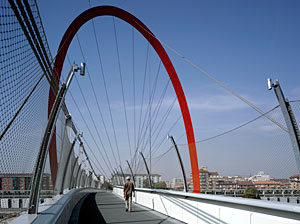
The Olympic Pedestrian Bridge in Turin
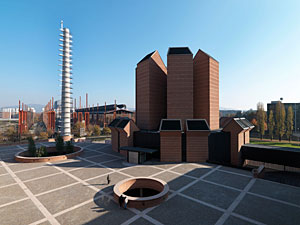
Santo Volto church in Turin
Photo ' Michel Denanc' (top); ' Enrico Cano (above).
The Olympic Pedestrian Bridge (top) was one many structures built for the 2006 Winter Games in Turin, Italy. Olympic facilities have helped propel the city’s long-time effort to redevelop itself into a vibrant, post-industrial metropolis. The modern Santo Volto church (above), designed by Mario Botta, embodies Turin’s eagerness to embrace the 21st century.

Then there was the city’s promise of manmade wonders: 2.6 billion euros in government investment that included the construction of new sporting venues and hotels in and around the Piemonte city. In the urban core, those projects included a 2,500-bed Olympic Village designed by a variety of European architects; the Palasport Olimpico, a stadium designed by Arata Isozaki with Pier Paolo Maggiora; and Lingotto Oval, a speed skating arena designed by HOKSVE, Studio Zoppini Associati, and Buro Happold. The city’s grand plan also called for renovating two existing sporting venues: the mid-century Palavela and the Deco-era Stadio Comunale, which had closed in 1990.

Olympic venues don’t always prove useful for host cities once the Games end, but Turin so far has managed to successfully repurpose the dozen major facilities it constructed for the two-week-long sporting event. Moreover, the buildings have contributed to the northern Italian city’s long-time effort to redevelop itself into a vibrant, post-industrial metropolis. With all eyes turned toward the upcoming summer contests in China, Turin’s conversion of Olympic facilities to everyday use offers a view to the tasks that Beijing officials will soon have to undertake.

According to Carlo Spinelli of the Turin-based Metropolitan Urban Center, preserving Olympic venues helps “sustain Torino’s Olympic legacy.” But it’s more than that. These facilities have reinvigorated neighborhoods, says Benedetto Camerana, principal of Camerana & Partners, the firm that oversaw the design of the Olympic Village. The million-square-foot complex—which wraps around a Modernist fruit-and-vegetable arcade constructed in 1934—is now a thriving multi-use area featuring offices and social housing. It should become even livelier in the next several months as Pirelli Real Estate, a private company, takes over common-area maintenance and rents out the remaining residential units.

Moreover, the Olympic Pedestrian Bridge continues to be heavily trafficked. It connects the Olympic Village to Lingotto, the Fiat factory converted by Renzo Piano into an entertainment and retail center in 1994. Designed by Camerana with the French architect Hugh Dutton, the footbridge is characterized by a 230-foot tall red arch. “It is a symbol of lightness that contrasts the heavy industry of the city’s past,” Camerana explains.

Responsibility for operating former Olympics destinations belongs to Torino Olympic Park, a 50-person foundation with offices in the former Olympic Village. The city created the foundation in September 2006 to manage and develop the Winter Games venues so they continue to draw tourists. So far, the foundation is meeting its goal, says spokeswoman Linda Brizzolara, noting that the recent quarterfinals of the Union of European Basketball Leagues, held within the Palasport Olimpico, attacted 2,000 foreign visitors.

And tourism is vital to the foundation itself: The Italian government initially funded Torino Olympic Park with a 20-million-euro grant, but expects the organization to start paying for itself through facility rentals by 2011. Downtown buildings should produce most of that revenue, Brizzolara says, thanks to their convenient location and original designs that are more flexible than farther-flung sporting venues.

Indeed, the centrally located, 13,000-seat Palasport Olimpico has been a hot venue. In 2007, it was booked 200-plus days for corporate functions, concerts, sporting games, and other events; the foundation hopes to boost that activity by 50 percent this year. Moreover, the city is building on that momentum by constructing a swimming pavilion on an adjacent site. Also designed by Isozaki and Maggiora, the new pavilion will serve as a visual counterpoint to the Palasport Olimpico, taking its straightforward rectilinear volume, tilting it upward on one side, and topping the structure with a folded roof. The 20-million-euro project should be finished by 2009.

Overall, former Olympic facilities hosted events totaling 938 days and drawing 860,000 spectators in 2007, and those numbers are expected to nearly double this year, says Brizzolara. It’s a potent shot in the arm for Turin, which launched its revitalization effort in the 1980s with the Lingotto factory conversion. More recently, the city redeveloped three factory zones into neighborhoods known as “spines”—an undertaking that gave rise to the modern Santo Volto church, designed by the Swiss architect Mario Botta, on the site of a former steel mill. Nontraditional in its design, the church embodies Turin’s eagerness to embrace the 21st century.

Even without a decades-old master plan to guide it, Beijing can look to Turin for guidance. In the long-term, Olympics venues can be a great asset to a city, Brizzolara says, but reuse strategies must be considered early on and implemented soon after the Olympic torch leaves town.


Share This Story

Looking for a reprint of this article?
From high-res PDFs to custom plaques, order your copy today!

David Sokol is a contributing editor to Architectural Record. 

Post a comment to this article

Report Abusive Comment

Subscription Center
  • Create an Account
  • Start a Subscription
  • Manage My Account
  • Sign Up for Newsletters
  • Visit Customer Service
  • Update Preferences

More Videos

Sponsored Content

Sponsored Content is a special paid section where industry companies provide high quality, objective, non-commercial content around topics of interest to the Architectural Record audience. All Sponsored Content is supplied by the advertising company and any opinions expressed in this article are those of the author and not necessarily reflect the views of Architectural Record or its parent company, BNP Media. Interested in participating in our Sponsored Content section? Contact your local rep!

close
  • TAMLYN XtremeTrim Exterior Trim
    Sponsored byTamlyn

    Designing Cleaner Panel Facades: Why Exterior Trim Details Matter

  • Building with Vapor Barriers
    Sponsored byReef Industries, Inc.

    Vapor Barriers Help Control Moisture in Tighter Building Designs

  • Duct Interior with Prodeq System
    Sponsored byHenry, a Carlisle Company

    Designing Resilient Water Containment Systems

DESIGN:ED Podcast
Listen to Architectural Record’s DESIGN:ED Podcast

Events

June 10, 2026

Rethinking Stormwater – The Power of Porous Paving

Credits: 1 AIA LU/HSW; 1 AIBD P-CE; 0.1 ICC CEU

Learn how porous paving systems support stormwater management, reduce heat island effects, and enhance sustainable site design performance.

June 11, 2026

Very Early Warning Fire Detection for Mission-Critical Facilities

Credits: 1 AIA LU/HSW; 1 AIBD P-CE; 0.1 ICC CEU

Examine advanced fire detection strategies that support uptime and enhance safety in data centers and other mission-critical facilities.

View All Submit An Event

Products

2026 Architect's Square Foot Costbook

2026 Architect's Square Foot Costbook

See More Products

Popular Stories

Practice Matters illustration

What’s in a (Firm’s) Name? Thinking About Succession and Legacy

Practice Matters illustration

By the Numbers: Counting America's Architects

House on a Hill

Design Vanguard 2026: Forma

Crane Cove, ONO

Design Vanguard 2026 Winners

KRESA by DLR

In Kalamazoo, DLR Group Completes a Mass-Timber Hub for Career and Technical Education Programs

Broader Sustainability of CMU - Free Webinar - May 21, 2026

Related Articles

  • a timber gridshell roof in a theater

    A Malmö Theater Basks in the Limelight Following a Revamp by Haworth Tompkins and White Arkitekter

    See More
  • Cuningham Group Scores, Belatedly, as South Korea Wins Olympics Bid

    See More
  • The Big Air, view from New Shougang Bridge .jpg

    Olympic Ski Slope Offers a Post-Industrial Vision for China’s ‘Rust Belt’

    See More

Related Products

See More Products
  • book3.jpg

    If Architecture is a Language, Then a Building is a Story

  • GlobalData_logo_blue_header.png

    Construction in the US - Key Trends and Opportunities to 2023

See More Products
×

The latest news and information

#1 Source for Architectural Design, News and Products

SUBSCRIBE
  • RESOURCES
    • Advertise
    • Contact Us
    • Submit
    • Store
  • ACCOUNT CENTER
    • Create an Account
    • Start a Subscription
    • Manage My Account
    • Sign Up for Newsletters
    • Visit Customer Service
    • Update Preferences
  • PRIVACY
    • PRIVACY POLICY
    • TERMS & CONDITIONS
    • DO NOT SELL MY PERSONAL INFORMATION
    • PRIVACY REQUEST
    • ACCESSIBILITY
  • SERVICES
    • Marketing Services
    • Reprints
    • Market Research
    • List Rental
    • Survey/Respondent Access
  • STAY CONNECTED
    • Linkedin
    • Facebook
    • Instagram
    • YouTube
    • X (Twitter)

Copyright ©2026. All Rights Reserved BNP Media, Inc. and BNP Media II, LLC.

Design, CMS, Hosting & Web Development :: ePublishing
