Architectural Record
search
cart
facebook twitter linkedin youtube
  • Sign In
  • Subscribe
  • Sign Out
  • My Account
Architectural Record
  • NEWS
    • Latest News
    • Awards
    • Interviews
    • Obituaries
    • Podcasts
      • Design:Ed Podcast
      • Sponsored Podcasts
  • OPINION
    • Book Reviews / Excerpts
    • Exhibition Reviews
    • Forum
  • EXCLUSIVES
    • Videos
    • Design Vanguard
    • Top 300 Firms
    • Sponsored Content
    • Sponsored eBooks
    • From the Archives
  • CONTINUING ED
    • Editorial Continuing Ed
    • CE Center
    • CE Academies
  • PROJECTS
    • Buildings By Type
    • Reuse & Renovation
    • Museums & Arts Centers
    • Colleges & Universities
    • Multifamily Housing
    • Interiors
    • Lighting
    • Kitchen & Bath
  • HOUSES
    • Record Houses
    • House of the Month
    • Featured Houses
  • PRODUCTS
    • Products by Category
    • Record Products of the Year
    • Latest Products
  • EVENTS
    • Dates & Events
    • Record on the Road
    • Innovation Conference
    • Sustainability in Practice
    • Women In Architecture
    • Webinars
    • Ad Excellence Awards
    • Submit an Event
  • CONNECT
    • Ask RECORD AI
    • Newsletters
    • Contact
    • Advertise
    • Editorial Calendar
    • Store
    • Customer Service
  • SUBMIT
    • Submission Guidelines
    • RECORD Competitions
  • MAGAZINE
    • Subscribe
    • My Account
    • Digital Edition
    • Current Issue
    • Firm Pass
    • Historic Archive
Architecture News

Greening an Icon: The Empire State Building

By Alex Padalka
March 1, 2010

An Economic Approach to Retrofits

Those 38 percent in energy savings will reduce CO2 emissions by 105,000 metric tons over 15 years, according to projections released by the building’s owners.
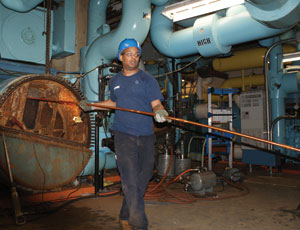
Photo by Alex Padalka
Upgrading the existing chiller cells, some parts of which having been in use since 1931, represented $16 million in savings over what it would have cost to replace the entire plant.

The Goals
“Typically, a building retrofit will get a 15-20-percent [energy savings],” Baczko says. “And that’s if they’re lucky.”

In comparison, the 38 percent the Empire State Building is shooting for seems daunting. But the first goal for the retrofit, the team agreed, was to create a replicable model.

“We decided that if we only do it at the Empire State Building, we will have failed,” says Ray Quartararo, international director for Jones Lang LaSalle, which was also involved with the Bank of America building.

It is more than a number of greener components, however. Sure, there is recycling of construction debris, use of recycled materials, and greener finishes – common sense improvements available to anyone. The overall model the team is offering for replication, however, is an entire process, starting with the proper steps taken in proper order to do the work, and encompassing the interaction between the building and its tenants.

More than 60 ideas were considered, including green roofs, cogeneration, tapping into an aquifer, and wind turbines.

“All things were on the table,” says Arah Shuur, director of CCI’s building retrofit program.” The owner didn’t come in with preconditions on payback, no technologies were taken off the table, so the team played with this infinite number of packages, seeing what can be done within financial requirements.”

The second goal for the project became a stringent adherence to maximizing the cost/benefit of every possible enhancement.

“While we would have gotten the energy reduction, it would not have been commercially viable,” Quartararo says.

The Tweaks
The improvements the team decided to pursue are not incredibly high-tech, expensive, or sexy. It basically came down to eight “ideas,” as the they like to call them.

The chiller plant, some of whose components date back to 1931, was due for a replacement. After careful analysis, however, the team realized that a simple retrofit of existing chiller shells, along with the addition of variable frequency drives, would do the job of upgrading them to today’s standards. The replacement would have cost $20 million while the upgrade a mere $4 million. What was more important was to see beyond the basement and into the rest of the building for thermal inefficiencies.

“We looked at the building as a system rather than a series of components,” Quartararo says. “So instead we made changes on the envelope.”

On the envelope, the team took a thermal image and found that windows constitute the biggest gateway for energy-sucking heat loss and gain. Bur rather than order 6,500 new windows fabricated, pre-assembled, and shipped from elsewhere in the country, the team is refurbishing the windows already in place, using existing glass and sashes, creating triple-glazed panels with an additional reflective membrane, and they’re performing the work right inside the building. The process was set up in such a way that no window will go missing for more than three minutes, according to Rode. Further analysis of the thermal images presented another inexpensive solution – reflective insulation barriers installed behind radiators would further reduce heat loss.

The new LEED offices are being outfitted with occupancy sensors and automatic controls to cut down on artificial lighting needs. In addition, each of the new tenant spaces has a panel that shows energy use across the building, in real time, to allow individual tenants to learn from each other, and the energy services company Johnson Controls is on hand for active management of even further reductions.

“I see programs that tell people how much they’re using, but not how to change that,” Rode says. “We will have a guy walking through the building at least once a month and one of his tasks will be compiling a list of suggestions for the tenants.”

Share This Story

Looking for a reprint of this article?
From high-res PDFs to custom plaques, order your copy today!

Post a comment to this article

Report Abusive Comment

Subscription Center
  • Create an Account
  • Start a Subscription
  • Manage My Account
  • Sign Up for Newsletters
  • Visit Customer Service
  • Update Preferences

More Videos

Sponsored Content

Sponsored Content is a special paid section where industry companies provide high quality, objective, non-commercial content around topics of interest to the Architectural Record audience. All Sponsored Content is supplied by the advertising company and any opinions expressed in this article are those of the author and not necessarily reflect the views of Architectural Record or its parent company, BNP Media. Interested in participating in our Sponsored Content section? Contact your local rep!

close
  • cold storage facility
    Sponsored byCarlisle SynTec Systems

    How Architects Can Design More Continuous Cold Storage Envelopes

  • TAMLYN XtremeTrim Exterior Trim
    Sponsored byTamlyn

    Designing Cleaner Panel Facades: Why Exterior Trim Details Matter

  • Building with Vapor Barriers
    Sponsored byReef Industries, Inc.

    Vapor Barriers Help Control Moisture in Tighter Building Designs

DESIGN:ED Podcast
Listen to Architectural Record’s DESIGN:ED Podcast

Events

June 25, 2026

Designing Glass Railing Systems that Enhance Aesthetics and Meet Code

Credits: 1 AIA LU/HSW; 1 AIBD P-CE; 0.1 ICC CEU

Upon course completion, participants will possess a deeper understanding of glass railings to help ensure that safety, aesthetic, and performance objectives are achieved.

June 30, 2026

Generator Selection and Sizing for Outage-Ready Homes

Credits: 1 AIA LU/HSW; 1 AIBD P-CE; 0.1 ICC CEU

Explore how propane-powered systems and whole-home generators can improve energy resilience, reduce electrical loads, and lower long-term residential costs.

View All Submit An Event

Products

2026 Architect's Square Foot Costbook

2026 Architect's Square Foot Costbook

See More Products

Popular Stories

Lorcan O' Herilhy

California Architect Lorcan O’Herlihy Has Died, Age 66

Obama Presidential Center, Chicago

The Obama Presidential Center Opens on Chicago’s South Side

Spoonbill Ranch

Johnsen Schmaling Architects Integrates Spoonbill Ranch into a Pristine Landscape

Image of Bruce Springsteen Center for American Music

The CookFox-designed Bruce Springsteen Center for American Music Opens in New Jersey

Three Courtyards House

Design Vanguard 2026: Balsa Crosetto Piazzi

Designing Glass Railing Systems that Enhance Aesthetics and Meet Code - Free Webinar - June 25, 2026

Related Articles

  • Greening an Icon: The Empire State Building

    See More
  • Greening an Icon: The Empire State Building

    See More
  • Architectural Record Moves to the Empire State Building

    See More
×

The latest news and information

#1 Source for Architectural Design, News and Products

SUBSCRIBE
  • RESOURCES
    • Advertise
    • Contact Us
    • Submit
    • Store
  • ACCOUNT CENTER
    • Create an Account
    • Start a Subscription
    • Manage My Account
    • Sign Up for Newsletters
    • Visit Customer Service
    • Update Preferences
  • PRIVACY
    • PRIVACY POLICY
    • TERMS & CONDITIONS
    • DO NOT SELL MY PERSONAL INFORMATION
    • PRIVACY REQUEST
    • ACCESSIBILITY
  • SERVICES
    • Marketing Services
    • Reprints
    • Market Research
    • List Rental
    • Survey/Respondent Access
  • STAY CONNECTED
    • Linkedin
    • Facebook
    • Instagram
    • YouTube
    • X (Twitter)

Copyright ©2026. All Rights Reserved BNP Media, Inc. and BNP Media II, LLC.

Design, CMS, Hosting & Web Development :: ePublishing