Interview with Yves Francois, a Haitian Designer
After decades of practicing architecture in New York, François returned to his native Haiti to set up a design and construction firm in Port-au-Prince. Here, he speaks candidly about his experience working in the troubled island country.
Yves François is a firm owner who defies convention. The 45-year-old designer was born in Haiti but spent most of his childhood in Brooklyn. In 1986, he earned an architecture degree from the New York Institute of Technology and went on to work for 10 years at Pepsi as a facility manager and architectural consultant. He later held similar positions at Philip Morris and Cablevision.
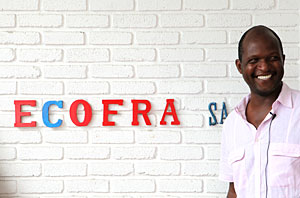
In 2004, after nearly two decades working in corporate America, François started reevaluating his life. “You finally reach a threshold. There’s got to be more to life than making a six-figure salary,” he says. In addition to founding a Brooklyn-based development company that specializes in rehabilitating old properties, François began focusing his energy on Haiti.
In 2006, he started donating money to a school in Jacmel, a coastal town, and took steps to establish an architecture and construction firm in Port-au-Prince. In early 2009, he made the bold decision to fully relocate to Haiti, to see if he could “make a difference” in creating a safer built environment. The move surprised his family. “They thought I was crazy,” he says. “I still believe it was the right thing to do.”
Post-earthquake, François continues to operate his firm, dubbed ECOFRA (derived from his children’s names, Erin and Chandler). He also is working as a consultant for Architecture for Humanity, which opened a Haiti office in March. We recently spoke to François about practicing architecture in Haiti, dealing with corruption, and how he is playing a role in the reconstruction effort.
Jenna M. McKnight: How many people work for ECOFRA?
Yves François I have a professional staff of 10 to 12. Because of the construction projects we do, I sometimes employ upward of 100 people.
JMM: What is the role of the “architect” in Haiti?
YF: I’ve never been called an architect. They call me an engineer. The word “architect” is not in their vocabulary. I’m trying to educate people.
JMM: What does it take to set up a firm in Haiti?
YF: When I first came down, I didn’t know anything from a business point of view. I made a lot of mistakes and lost a lot of money.
Then I realized it’s not that complicated. You go to the government tax office, file a business certificate, and get your tax ID number, which is like an EIN (U.S. Employer Identification Number). It takes about six months.
JMM: Do you pay taxes?
YF: Yes, but the majority [of people] don’t. People ask, ‘Why do I pay taxes?’ But I’m an American.
JMM: Can foreigners set up a company in Haiti?
YF: Yes, absolutely. There are tons of them here. NGOS [nongovernmental organizations] have to register, too, but many operate without it, as they don’t have the infrastructure to get everybody registered.
JMM: How do you get commissions?
YF: Word of mouth. With a U.S. education, it’s a lot easier.
JMM: Do you work on government projects?
YF: Very few. Most of my work now is through international organizations and friends who are well off. Government work is possible, but so far, I’ve stayed away. It’s something I’m going to look into, especially because most of the work is being funded by international organizations. Hopefully it will be a level playing field. RFPs are advertised in the newspaper; knowing someone on the inside helps.
JMM: I hear there’s a lot of corruption in Haiti. Is that something you encounter?
YF: Every day. I keep telling them no, no, I don’t operate like that. For example, I import construction material and equipment. One of my shipments sat at the port for six months. The government official saw my big equipment and he said that he just bought a piece of land and needed to use the machine. Being Yves, I told him “You can keep it. When you’re ready to give it to me, let me know.” I eventually got the call to come pick up my equipment.
If you want to go that route, it can take months. Or you can pay the bribes and keep moving. People who have government contracts often want 25 percent.
JMM: Were you worried you wouldn’t get your equipment?
YF: Oh yeah, I was worried. It was a couple hundred thousands dollars worth of stuff. But if you believe in something and want to make a change, you have to hold your ground.
JMM: In addition to corruption, what are some of the others challenges of working in Haiti?
YF: Safety is an issue. Workers will show up at a job site wearing sandals. I try to talk to them about safety, why they need to wear a helmet and boots. It costs money to get that stuff, though. Sometimes, I’m able to give them the basics, like T-shirts and shoes.
JMM: Are Haitian workers skilled?
YF: Not really. Here in the office, for instance, I’m doing a little sheetrock work. I literally had to show them how to hold screw gun and explain why we have to install studs.
Sheetrock is a novelty here. Most construction is concrete block and poured concrete. They’re excellent at that stuff, but I’m trying to show them best practices. It’s rare that I see a plumb wall in Haiti. There’s a lack of tools, and a lack of eye to know that a wall is not straight. It’s a whole education process, and with my background in running construction projects, I’m able to do that.
JMM: How many projects do you have on the boards right now? (continued on page 2)
Looking for a reprint of this article?
From high-res PDFs to custom plaques, order your copy today!