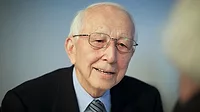
Newsmaker: Fumihiko Maki




|

During his many decades practicing architecture, Fumihiko Maki has accrued an impressive collection of awards, including the Pritzker Prize (1993) and Japan’s Praemium Imperiale (1999). Now, the American Institute of Architects has announced that this year’s Gold Medal will honor the esteemed architect, known for such projects as the Sam Fox School of Design and MIT Media Lab.
A graduate of both Tokyo University and the Harvard Graduate School of Design, Maki was one of the first Japanese architects to study and work in the United States after World War II. Following his graduation from Harvard in 1954, Maki worked and taught in the United States before opening his practice in Tokyo in 1965.
To date, Maki and Associates has completed a range of projects worldwide. The firm currently is working on Tower 4 of the World Trade Center redevelopment, in addition to a host of other buildings overseas.
Architectural Record's Tokyo Correspondent Naomi Pollock recently met with Maki to discuss the architect’s long-standing relationship with the United States.
Naomi Pollock: What does the AIA Gold Medal mean to you?
Fumihiko Maki: I spent my formative years in the 1950s and ’60s in the United States. Since then I have continued to visit quite frequently, initially to participate in academic activities mostly, but later to work on architectural projects. Since I’ve had a very long association with the United States, almost 60 years, I might call it my second home country. For this reason, it is a great honor to receive this award from the AIA.
NP: What projects are you working on in North America right now?
FM: Starting from the north, we are constructing the Aga Khan Museum in Toronto. And our Tower 4 at the World Trade Center site is coming along. Then we are designing a new pharmaceutical research building in East Hanover, New Jersey, for Novartis. And we had a project at 51 Astor Place, just north of Cooper Union in New York that stopped after the Lehman shock. I understand that they will resume activities, but we do not know how soon it will be realized.
NP: At the outset of your career, did you expect that your practice would become so international in scope?
FM: Not so much. But fortunately, when I was teaching at Washington University in St. Louis, I had a chance to design the first building of my career as well as in the United States: Steinberg Hall, completed in 1960. The same year I had a chance to design my first commission in Japan: Nagoya University Toyoda Hall. So my first two buildings were both institutional projects in the U.S. and Japan, respectively. After 50 years, I was asked to expand Steinberg Hall. And I also was asked to renovate Toyoda Hall. Since I started very young, I was able to design the second phases for both buildings.
NP: What was the impact of your study and work experience in the United States on your practice in Japan?
FM: Well, learning in the United States as a student, as a teacher, and as an architect was a very valuable experience that benefited me even when I came back to Japan. In the 1950s, the U.S. was the only country where you could really realize a technologically ambitious project or start a new urban development.
NP: How would you describe your approach to architectural design? What inspires you?
FM: I have been fortunate to receive recognition in the architectural media from the time of my early projects in Japan. But for me, one of the most important and satisfying things as an architect is the recognition by the clients, users, and visitors to my projects. For instance, we are now designing our third building for Nagoya University. This continuous association gives me satisfaction. It is a kind of acknowledgment of what we have done.
NP: Conceptually, do you look for a new idea for each project, or do you tend to want to re-visit some of the old ideas?
FM: I always like to test something new in spatial composition or architectural expression. But before we decide on the design, I have to question myself whether this is really new or good for users and so on. Such conservation may not make my design overly daring. I understand today that some developers want and are asking architects to design eye-catching, iconic buildings. Fortunately, I have not had that kind of client so far.
NP: Construction practices in the United Sates are quite different. How do you accommodate your high standards to this situation?
FM: The selection of the associate architect is very, very important. They must be capable and also understand what we are trying to do. In the case of the MIT Media Lab, our exterior details were very elaborate and needed good fabricators. The general practice is that architects and engineers design or make up the construction documents for bidding purposes. Often we ask the client for stronger, closer coordination with the fabricators, even at the design stage. And in some cases, like MIT, the client understood and allowed the Japanese and U.S. manufacturers to work with us to complete our construction documents, which insured quality.
NP: Do you consider craft an important part of your architecture?
FM: Yes, very much so. Though machines produce building elements, putting things together requires tremendous craftsmanship. Our details often require coordinating different trades. Even when building abroad, we try to maintain the same kind of involvement as in Japan. To make the Annenberg Public Policy Center at the University of Pennsylvania, we had to integrate mullion, fenestration, and wood workers. But sometimes this craftsmanship is not available in other places. Toyo Ito’s or Kengo Kuma’s projects also require quite a bit of craftsmanship. This is a concern of many Japanese architects.
NP: Looking ahead, what are your goals and aspirations? What would you like to do next?
FM: I am now over 80, so I do not have an unlimited number of years. But I am in good health, so I am looking forward to doing a number of things.
NP: Are there any specific building types that you would like to design?
FM: No. Any kind will be challenging. Every time we start from carte blanche. It is always exciting to see how the design develops and how it will be evaluated by time. It is a very challenging but satisfying activity.
Looking for a reprint of this article?
From high-res PDFs to custom plaques, order your copy today!