Making Waves
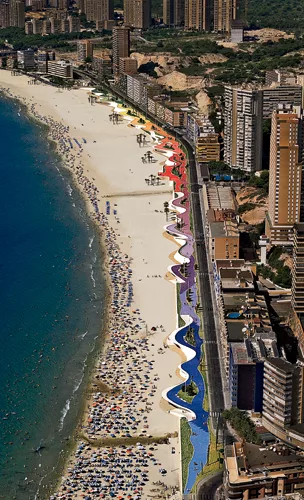
Ferrater and Martí Galí negotiated with city officials to reduce the width of the road in order to maintain the existing expanse of beach and allow for both a broad promenade and new city infrastructure installed beneath it.
Photo: © Aleix Bagué
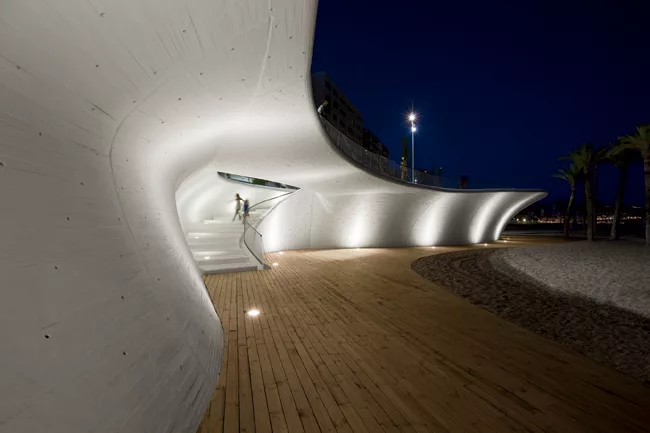
Using local materials, the architects devised an efficient modular system using 18 forms to create a nonrepetitious, 3-inch-thick concrete shell that not only eases the gradient transition (extending up to 13 feet), but also projects to form balconies that double as overhead shelter from sun and rain.
Photo: © Aleix Bagué
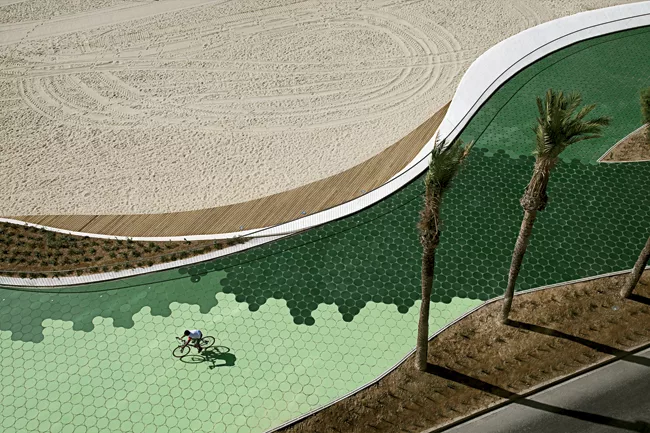
Martí Galí worked closely with local Tile of Spain manufacturer Keramia to develop high-performance, 17-inch-round, colorfast glazed-porcelain tiles (and fillers) in 22 custom hues that were largely determined by the vibrant colors adorning adjacent buildings.
Photo: © Aleix Bagué
A bold urban strategy transforms a worn beachfront into a vivid curvilinear 'plaza' on Spain's Costa Blanca.
When Carlos Ferrater, principal of Office of Architecture in Barcelona (OAB), won the competition to upgrade the mile-long Poniente Beachfront of Benidorm — a sliver of a city dubbed the “Manhattan of Spain” for its concentration of high-rise buildings along the Mediterranean — he and his associate, Xavier Martí Galí, who are the project’s design architects, referenced the landscape and wavy patterning of Roberto Burle Marx’s Copacabana promenade, as well as the work of Antonio Gaudí, to devise an engaging intervention. The resulting esplanade is now the central public meeting place of this thriving tourist city.
Completed in 2009, the architects’ solution is a sinuous structure comprising a sculptural concrete shell and brilliantly color-coded, landscaped tile paths punctuated by stairways and ramps that provide universal access to the town and beach. A slender “boardwalk” winds around the base for strolling, bicycling, and jogging.
A visual and functional tour de force, OAB’s new Benidorm promenade is so successful, says architect and team member Borja Ferrater, that the “City Hall has commissioned us to extend it for about 500 more meters [1,600 feet].” More important, he notes, “Everybody likes it. Not only the architects, but the people who go there.”
Looking for a reprint of this article?
From high-res PDFs to custom plaques, order your copy today!