Architectural Record
search
cart
facebook twitter linkedin youtube
  • Sign In
  • Subscribe
  • Sign Out
  • My Account
Architectural Record
  • NEWS
    • Latest News
    • Awards
    • Interviews
    • Obituaries
    • Podcasts
      • Design:Ed Podcast
      • Sponsored Podcasts
  • OPINION
    • Book Reviews / Excerpts
    • Exhibition Reviews
    • Forum
  • EXCLUSIVES
    • Videos
    • Design Vanguard
    • Top 300 Firms
    • Sponsored Content
    • Sponsored eBooks
    • From the Archives
  • CONTINUING ED
    • Editorial Continuing Ed
    • CE Center
    • CE Academies
  • PROJECTS
    • Buildings By Type
    • Reuse & Renovation
    • Museums & Arts Centers
    • Colleges & Universities
    • Multifamily Housing
    • Interiors
    • Lighting
    • Kitchen & Bath
  • HOUSES
    • Record Houses
    • House of the Month
    • Featured Houses
  • PRODUCTS
    • Products by Category
    • Record Products of the Year
    • Latest Products
  • EVENTS
    • Dates & Events
    • Record on the Road
    • Innovation Conference
    • Sustainability in Practice
    • Women In Architecture
    • Webinars
    • Ad Excellence Awards
    • Submit an Event
  • CONNECT
    • Ask RECORD AI
    • Newsletters
    • Contact
    • Advertise
    • Editorial Calendar
    • Store
    • Customer Service
  • SUBMIT
    • Submission Guidelines
    • RECORD Competitions
  • MAGAZINE
    • Subscribe
    • My Account
    • Digital Edition
    • Current Issue
    • Firm Pass
    • Historic Archive

Welcome to the Animal House
By Beth Broome
Hatched in response to the backyard chicken-raising fad, Nogg, a compact egg-shaped abode, offers a fresh take on the utilitarian coop. By creating a sculptural, self-contained object, fur
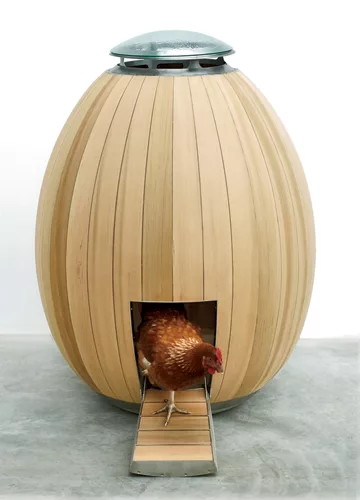
Nogg, by Matthew Hayward and Nadia Turan
Hatched in response to the backyard chicken-raising fad, Nogg, a compact egg-shaped abode, offers a fresh take on the utilitarian coop. By creating a sculptural, self-contained object, furniture designer and engineer Matthew Hayward and his partner Nadia Turan hoped to build on the growing enthusiasm for small-scale domestic farming by eliminating the visual and olfactory mess typically associated with the activity. Made of sustainably sourced cedar, the structure, which can house two to four hens, benefits from the wood's antibacterial properties and pleasant scent. A glass skylight twists and pops up for ventilation; at night, the drawbridge can be raised and fox-proof latches secured to create a safe and sound roost.
Photo courtesy Nogg
The Breed Retreat, by Amsterdam-based furniture designer Frederik Roijé, is a bold experiment in luxury condolike living for urban birds. Responding to the natural “pecking order”
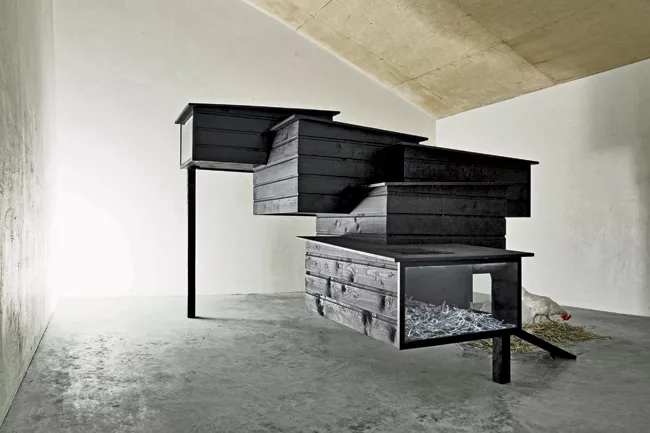
Breed Retreat, by Frederik Roijé
The Breed Retreat, by Amsterdam-based furniture designer Frederik Roijé, is a bold experiment in luxury condolike living for urban birds. Responding to the natural “pecking order” of chickens (in which the dominant ones occupy the highest, or safest, roost or tree branch), the dark-stained pine structure is composed of five connected boxes arranged in a stepped formation. Solar panels on the roof power LEDs within the roost, tricking the hens into thinking it is summertime year-round so they will produce eggs even in winter, when they typically take a break. “It is important to create beautiful spaces where people and animals can coexist in urban settings,” says Roijé, “so we don't lose the connection to where poultry and eggs come from.”
Photo courtesy Studio Frederik Roijé
Designed by London-based Stephen Taylor Architects, this comely cowshed —part of Shatwell Farm on the Hadspen Estate near Castle Cary in Somerset, England—is the first phase of the his
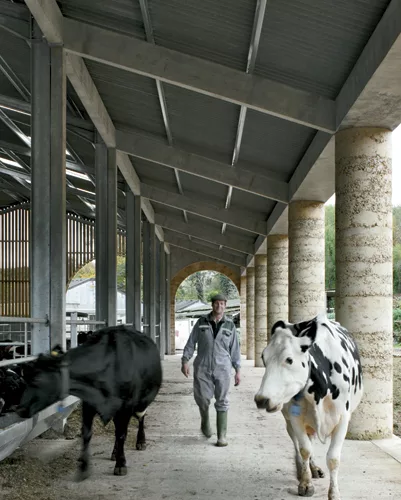
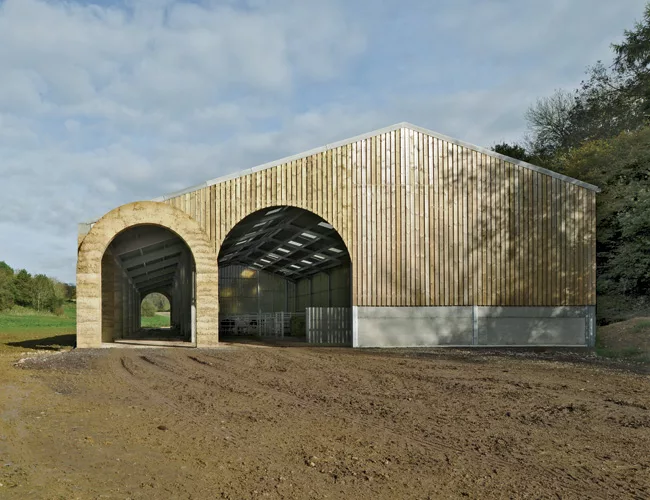
Shatwell Farm, by Stephen Taylor Architects
Designed by London-based Stephen Taylor Architects, this comely cowshed —part of Shatwell Farm on the Hadspen Estate near Castle Cary in Somerset, England—is the first phase of the historic farm's revitalization. Composed of an off-the-shelf steel-frame shed, it is clad with an open-slat wood rainscreen and fronted with a colonnade of poured-in-place orange-beige concrete made from stony clay dug from the site. The material references the estate's other buildings made from locally sourced stone. “My client has this long tradition where agricultural buildings have a worth beyond their simple function,” says Taylor. “On one level it's just a cowshed. But every building has an obligation to its setting—it should not be unto itself.”
Photo courtesy Stephen Taylor Architects
Rolling Pig Pen is the creation of Studio North, a six-day design-build program held on a farm in Norwich, Vermont, and led by Boston architects Moskow Linn. Made of standard pine framing stoc
Shatwell Farm, by Stephen Taylor Architects
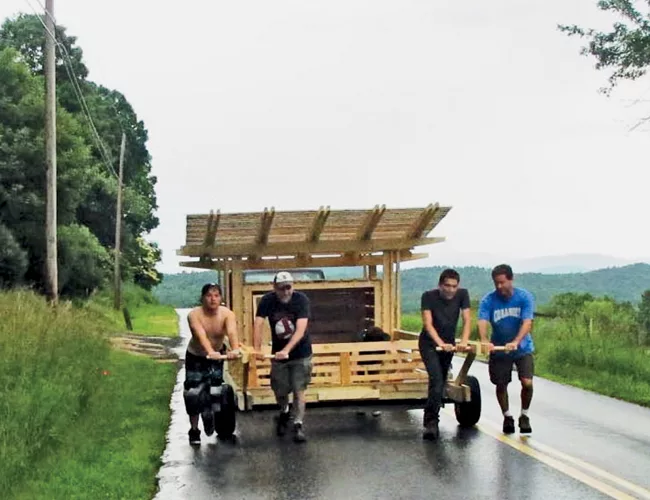
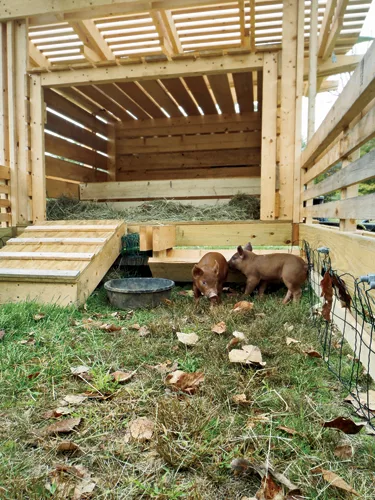
Rolling Pig Pen is the creation of Studio North, a six-day design-build program held on a farm in Norwich, Vermont, and led by Boston architects Moskow Linn. Made of standard pine framing stock, the structure sits atop heavy-duty axles and wheels, enabling it to be pushed by hand. It includes a translucent fiberglass canopy, offering protection from the elements, as well as a trough and storage for feed for its two occupants. “The idea was to build an enclosure that could easily be moved, allowing pigs to both cultivate and fertilize a field,” says principal Keith Moskow. With constant access to fresh soil to turn over with their snouts, he notes, “the pig's life is better for the short time that it is.”
Photo courtesy Stephen Taylor Architects
Rolling Pig Pen is the creation of Studio North, a six-day design-build program held on a farm in Norwich, Vermont, and led by Boston architects Moskow Linn. Made of standard pine framing stoc
Rolling Pig Pen, by Moskow Linn Architects
Rolling Pig Pen is the creation of Studio North, a six-day design-build program held on a farm in Norwich, Vermont, and led by Boston architects Moskow Linn. Made of standard pine framing stock, the structure sits atop heavy-duty axles and wheels, enabling it to be pushed by hand. It includes a translucent fiberglass canopy, offering protection from the elements, as well as a trough and storage for feed for its two occupants. “The idea was to build an enclosure that could easily be moved, allowing pigs to both cultivate and fertilize a field,” says principal Keith Moskow. With constant access to fresh soil to turn over with their snouts, he notes, “the pig's life is better for the short time that it is.”
Photo courtesy Moskow Linn
The winner of the University at Buffalo's Hive City competition, Elevator B provides a new home for a colony of honeybees relocated from an abandoned office building. The 22-foot-tall stee
Rolling Pig Pen, by Moskow Linn Architects
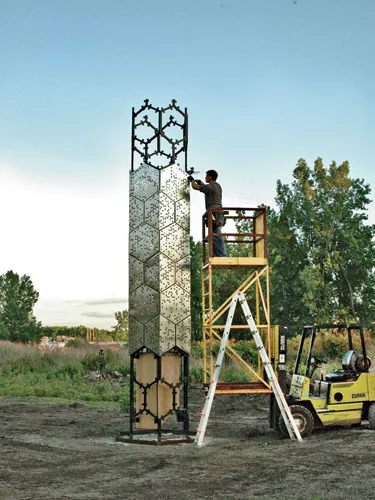
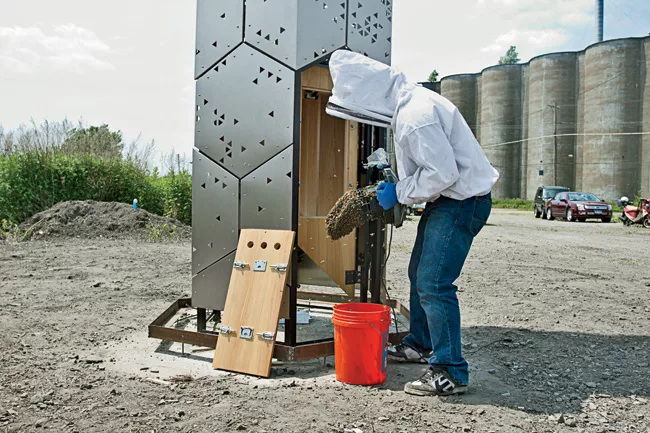
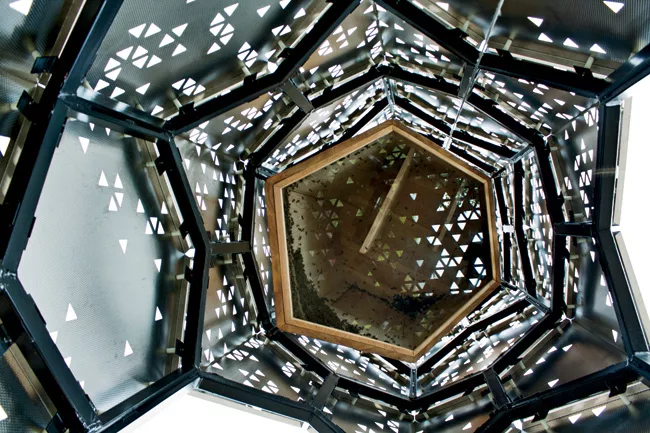
The winner of the University at Buffalo's Hive City competition, Elevator B provides a new home for a colony of honeybees relocated from an abandoned office building. The 22-foot-tall steel structure evokes nearby defunct grain silos and is clad in hexagonal stainless steel panels with parametrically determined perforations that enable solar gain in the winter and shading in the summer. Visitors may enter the tower and gaze up at the bees, which occupy the “bee cab,” a cypress box with a laminated glass bottom. A pulley system allows beekeepers to lower and raise the hive. “We wanted to make something with a physical presence, that would have an impact as a teaching tool,” says Joyce Hwang, assistant professor of architecture and one of the project's organizers.
Photo courtesy Moskow Linn
The winner of the University at Buffalo's Hive City competition, Elevator B provides a new home for a colony of honeybees relocated from an abandoned office building. The 22-foot-tall stee
Elevator B, University at Buffalo
The winner of the University at Buffalo's Hive City competition, Elevator B provides a new home for a colony of honeybees relocated from an abandoned office building. The 22-foot-tall steel structure evokes nearby defunct grain silos and is clad in hexagonal stainless steel panels with parametrically determined perforations that enable solar gain in the winter and shading in the summer. Visitors may enter the tower and gaze up at the bees, which occupy the “bee cab,” a cypress box with a laminated glass bottom. A pulley system allows beekeepers to lower and raise the hive. “We wanted to make something with a physical presence, that would have an impact as a teaching tool,” says Joyce Hwang, assistant professor of architecture and one of the project's organizers.
Photo © Hive City Design Team
Welcome to the Animal House
Elevator B, University at Buffalo
Photo © Hive City Design Team
Welcome to the Animal House
Elevator B, University at Buffalo
Photo © Hive City Design Team
Hatched in response to the backyard chicken-raising fad, Nogg, a compact egg-shaped abode, offers a fresh take on the utilitarian coop. By creating a sculptural, self-contained object, fur
The Breed Retreat, by Amsterdam-based furniture designer Frederik Roijé, is a bold experiment in luxury condolike living for urban birds. Responding to the natural “pecking order”
Designed by London-based Stephen Taylor Architects, this comely cowshed —part of Shatwell Farm on the Hadspen Estate near Castle Cary in Somerset, England—is the first phase of the his
Rolling Pig Pen is the creation of Studio North, a six-day design-build program held on a farm in Norwich, Vermont, and led by Boston architects Moskow Linn. Made of standard pine framing stoc
The winner of the University at Buffalo's Hive City competition, Elevator B provides a new home for a colony of honeybees relocated from an abandoned office building. The 22-foot-tall stee
Welcome to the Animal House
July 16, 2013

Designer shelters for the birds and the bees elevate our view of food production.

Nogg, by Matthew Hayward and Nadia Turan

A Modernist roost for a chicken? A bespoke cow barn on an English country estate? A luxury high-rise for a colony of bees? Some people might say that these structures are unnecessarily extravagant, given the simple programmatic needs of the occupants. But, as architect Stephen Taylor says of the barn he designed at Shatwell Farm in Somerset, England, that responds to the dignified, centuries-old architecture around it: “Every building is always part of something bigger.” While it was a growing interest in urban farming that led to the proliferation of backyard chicken coops, the trend's latest wave has upped the ante with features like solar-powered LEDs and green roofs. “As architects we try to think of things a little differently, and, for example, elevate the pigsty to another level,” says Keith Moskow, one of the Boston architects behind Rolling Pig Pen. “Whether for a person or a pig, we are always asking how we can make an experience better,” adds his partner, Robert Linn. Grabbing attention also increases the value of these shelters as teaching tools, much as the Elevator B beehive has generated awareness of the crisis of the declining honeybee population known as colony-collapse disorder and its larger implications for the ecosystem. The vogue of rejecting industrialized food production and celebrating authenticity and pedigree took hold a generation ago, and continues to evolve. Structures like these—whether motivated by grassroots activism or the current zeitgeist—encapsulate this particular moment in time.

Share This Story

Looking for a reprint of this article?
From high-res PDFs to custom plaques, order your copy today!


Former Architectural Record managing editor Beth Broome is a freelance writer based in Brooklyn, New York.

Post a comment to this article

Report Abusive Comment

Subscription Center
  • Create an Account
  • Start a Subscription
  • Manage My Account
  • Sign Up for Newsletters
  • Visit Customer Service
  • Update Preferences

More Videos

Sponsored Content

Sponsored Content is a special paid section where industry companies provide high quality, objective, non-commercial content around topics of interest to the Architectural Record audience. All Sponsored Content is supplied by the advertising company and any opinions expressed in this article are those of the author and not necessarily reflect the views of Architectural Record or its parent company, BNP Media. Interested in participating in our Sponsored Content section? Contact your local rep!

close
  • TAMLYN XtremeTrim Exterior Trim
    Sponsored byTamlyn

    Designing Cleaner Panel Facades: Why Exterior Trim Details Matter

  • Building with Vapor Barriers
    Sponsored byReef Industries, Inc.

    Vapor Barriers Help Control Moisture in Tighter Building Designs

  • Duct Interior with Prodeq System
    Sponsored byHenry, a Carlisle Company

    Designing Resilient Water Containment Systems

DESIGN:ED Podcast
Listen to Architectural Record’s DESIGN:ED Podcast

Events

June 10, 2026

Rethinking Stormwater – The Power of Porous Paving

Credits: 1 AIA LU/HSW; 1 AIBD P-CE; 0.1 ICC CEU

Learn how porous paving systems support stormwater management, reduce heat island effects, and enhance sustainable site design performance.

June 11, 2026

Very Early Warning Fire Detection for Mission-Critical Facilities

Credits: 1 AIA LU/HSW; 1 AIBD P-CE; 0.1 ICC CEU

Examine advanced fire detection strategies that support uptime and enhance safety in data centers and other mission-critical facilities.

View All Submit An Event

Products

2026 Architect's Square Foot Costbook

2026 Architect's Square Foot Costbook

See More Products

Popular Stories

Practice Matters illustration

What’s in a (Firm’s) Name? Thinking About Succession and Legacy

Practice Matters illustration

By the Numbers: Counting America's Architects

House on a Hill

Design Vanguard 2026: Forma

Crane Cove, ONO

Design Vanguard 2026 Winners

House A on a Hill

Design Vanguard 2026: Santiago Valdivieso

Broader Sustainability of CMU - Free Webinar - May 21, 2026

Related Articles

  • Welcome to My House

    Welcome to My House: Multifamily Housing

    See More
  • The Architectural Experience

    Excerpts from 'Welcome to Your World: How the Built Environment Shapes Our Lives'

    See More
  • Welcome to Corporate Kindergarten

    See More

Related Products

See More Products
  • 3dthinking.jpg

    3D Thinking in Design and Architecture: From Antiquity to the Future

  • GlobalData_logo_blue_header.png

    Construction in the US - Key Trends and Opportunities to 2023

  • iconic house.jpg

    The Iconic House

See More Products
×

The latest news and information

#1 Source for Architectural Design, News and Products

SUBSCRIBE
  • RESOURCES
    • Advertise
    • Contact Us
    • Submit
    • Store
  • ACCOUNT CENTER
    • Create an Account
    • Start a Subscription
    • Manage My Account
    • Sign Up for Newsletters
    • Visit Customer Service
    • Update Preferences
  • PRIVACY
    • PRIVACY POLICY
    • TERMS & CONDITIONS
    • DO NOT SELL MY PERSONAL INFORMATION
    • PRIVACY REQUEST
    • ACCESSIBILITY
  • SERVICES
    • Marketing Services
    • Reprints
    • Market Research
    • List Rental
    • Survey/Respondent Access
  • STAY CONNECTED
    • Linkedin
    • Facebook
    • Instagram
    • YouTube
    • X (Twitter)

Copyright ©2026. All Rights Reserved BNP Media, Inc. and BNP Media II, LLC.

Design, CMS, Hosting & Web Development :: ePublishing