Architectural Record
search
cart
facebook twitter linkedin youtube
  • Sign In
  • Subscribe
  • Sign Out
  • My Account
Architectural Record
  • NEWS
    • Latest News
    • Awards
    • Interviews
    • Obituaries
    • Podcasts
      • Design:Ed Podcast
      • Sponsored Podcasts
  • OPINION
    • Book Reviews / Excerpts
    • Exhibition Reviews
    • Forum
  • EXCLUSIVES
    • Videos
    • Design Vanguard
    • Top 300 Firms
    • Sponsored Content
    • Sponsored eBooks
    • From the Archives
  • CONTINUING ED
    • Editorial Continuing Ed
    • CE Center
    • CE Academies
  • PROJECTS
    • Buildings By Type
    • Reuse & Renovation
    • Museums & Arts Centers
    • Colleges & Universities
    • Multifamily Housing
    • Interiors
    • Lighting
    • Kitchen & Bath
  • HOUSES
    • Record Houses
    • House of the Month
    • Featured Houses
  • PRODUCTS
    • Products by Category
    • Record Products of the Year
    • Latest Products
  • EVENTS
    • Dates & Events
    • Record on the Road
    • Innovation Conference
    • Sustainability in Practice
    • Women In Architecture
    • Webinars
    • Ad Excellence Awards
    • Submit an Event
  • CONNECT
    • Ask RECORD AI
    • Newsletters
    • Contact
    • Advertise
    • Editorial Calendar
    • Store
    • Customer Service
  • SUBMIT
    • Submission Guidelines
    • RECORD Competitions
  • MAGAZINE
    • Subscribe
    • My Account
    • Digital Edition
    • Current Issue
    • Firm Pass
    • Historic Archive

2013: An Office Space Odyssey
By Clifford A. Pearson
Hitoshi Abe drew employees to Building 225, at the northern end of the complex, by creating a futuristic café with a lounge on the side facing the plaza  and an assembly room called the Forum o
2013: An Office Space Odyssey
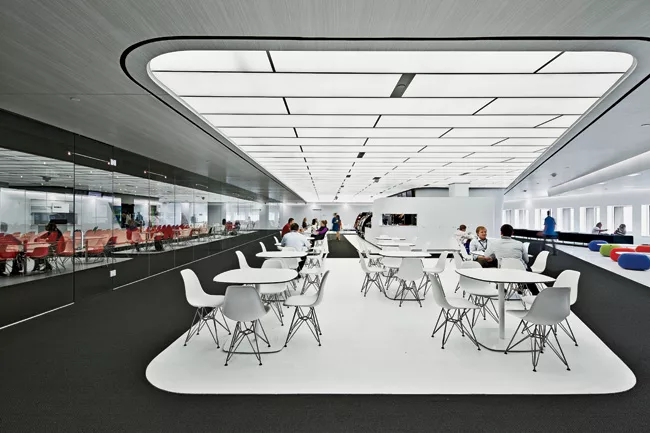
Hitoshi Abe drew employees to Building 225, at the northern end of the complex, by creating a futuristic café with a lounge on the side facing the plaza and an assembly room called the Forum on the other side. Contrasts in color, lighting, and material give the spaces a bold allure
Photo © Daici Ano
Abe and his team transformed a visitors’ parking lot (slide 3) at the center of the site into a plaza shared by all the surrounding buildings. Concrete benches and planters divide the large spac
2013: An Office Space Odyssey
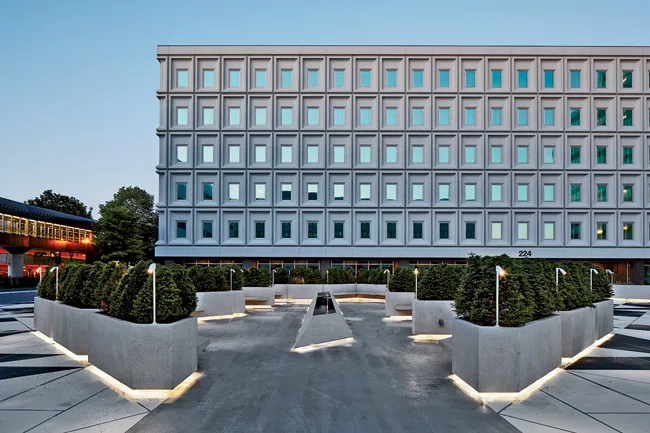
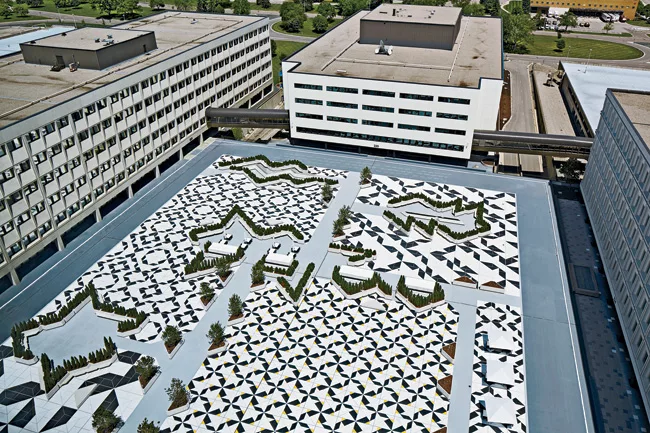
Abe and his team transformed a visitors’ parking lot (slide 3) at the center of the site into a plaza shared by all the surrounding buildings. Concrete benches and planters divide the large space into a set of outdoor rooms (left), while lighting underneath the concrete elements produces a warm glow in the evening (slide 4).
Photo © Daici Ano
Abe and his team transformed a visitors’ parking lot (left) at the center of the site into a plaza shared by all the surrounding buildings.
2013: An Office Space Odyssey
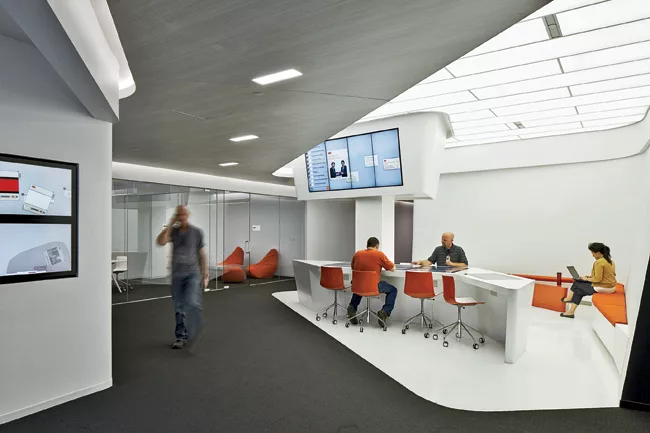
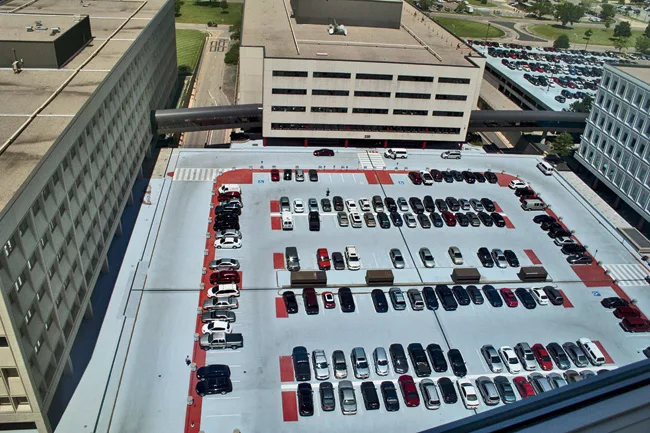
Abe and his team transformed a visitors’ parking lot (left) at the center of the site into a plaza shared by all the surrounding buildings.
Photo © Daici Ano
Abe and his team transformed a visitors’ parking lot (slide 3) at the center of the site into a plaza shared by all the surrounding buildings. Concrete benches and planters divide the large spac
2013: An Office Space Odyssey
Abe and his team transformed a visitors’ parking lot (slide 3) at the center of the site into a plaza shared by all the surrounding buildings. Concrete benches and planters divide the large space into a set of outdoor rooms (slide 2), while lighting underneath the concrete elements produces a warm glow in the evening (left).
Photo © Daici Ano
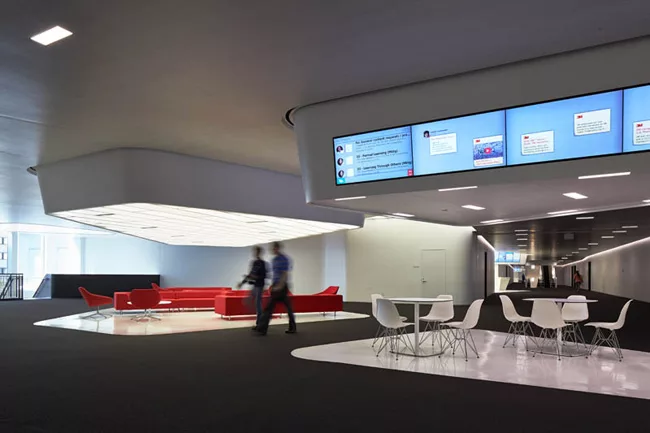
Five different “hubs,” each coded by a particular color, offer unprogrammed spaces for people to meet or relax. Overhead monitors and screens embedded in the work surfaces keep employees i
2013: An Office Space Odyssey
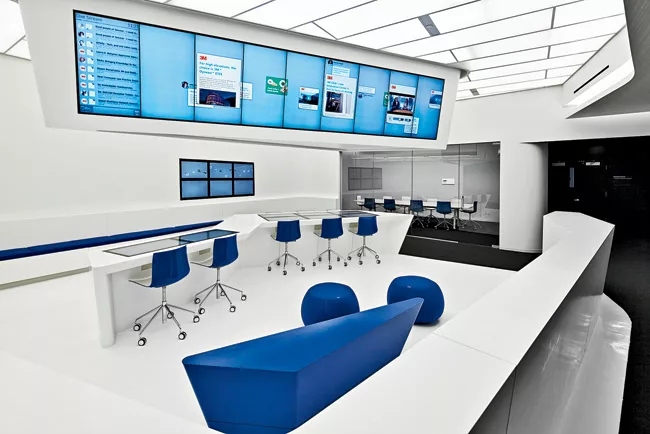
Five different “hubs,” each coded by a particular color, offer unprogrammed spaces for people to meet or relax. Overhead monitors and screens embedded in the work surfaces keep employees in touch with a 3M website that provides information and messages from around the company. The hubs and the areas leading into them form a continuous loop through all five buildings and around the central plaza.
Photo © Daici Ano
Five different “hubs,” each coded by a particular color, offer unprogrammed spaces for people to meet or relax. Overhead monitors and screens embedded in the work surfaces keep employees i
2013: An Office Space Odyssey
Five different “hubs,” each coded by a particular color, offer unprogrammed spaces for people to meet or relax. Overhead monitors and screens embedded in the work surfaces keep employees in touch with a 3M website that provides information and messages from around the company. The hubs and the areas leading into them form a continuous loop through all five buildings and around the central plaza.
Photo © Daici Ano
Peter Ebner designed a new canopy for the south side of Building 220 where visitors now pull up (left). He also designed the landscaping in front of the building, as part of the entry sequence.
2013: An Office Space Odyssey
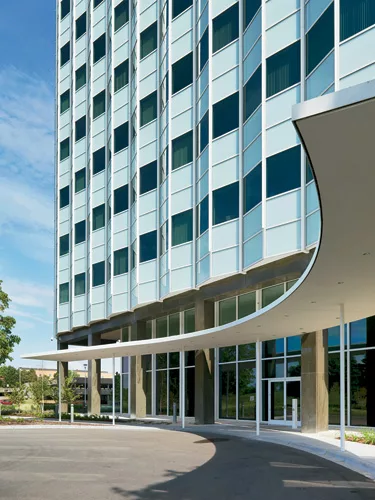
Peter Ebner designed a new canopy for the south side of Building 220 where visitors now pull up (left). He also designed the landscaping in front of the building, as part of the entry sequence.
Photo © Daici Ano
On the first floor of Building 220, Ebner created a series of glass cubes that serve as impromptu meeting rooms, adjacent to a long space that faces the plaza and provides a variety of furniture for i
2013: An Office Space Odyssey
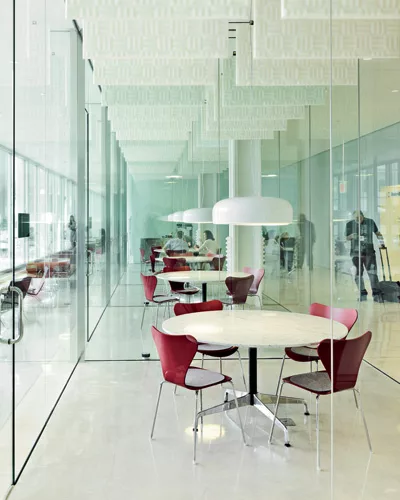
On the first floor of Building 220, Ebner created a series of glass cubes that serve as impromptu meeting rooms, adjacent to a long space that faces the plaza and provides a variety of furniture for individual work sessions or socializing (left). From the ceilings of the glass cubes, he suspended vertical panels of a 3M acoustical material, instead of applying it horizontally.
Photo © Daici Ano
A boxy structure designed by Ebner and his firm stands in the plaza where the old visitors' entrance had been and serves as a dramatic space for important presentations and meetings. Curtains can be c
2013: An Office Space Odyssey
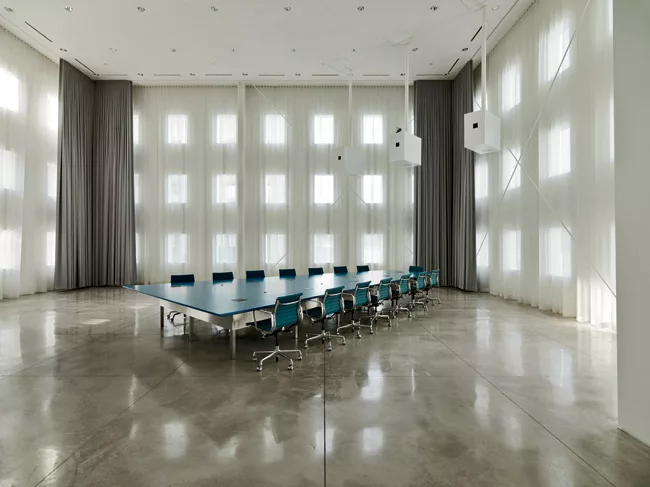
A boxy structure designed by Ebner and his firm stands in the plaza where the old visitors' entrance had been and serves as a dramatic space for important presentations and meetings. Curtains can be closed during presentations and a tall media wall (not seen in photo) is equipped for video conferences.
Photo © Daici Ano
View of visitors parking lot and Building 220 before renovation project.
2013: An Office Space Odyssey
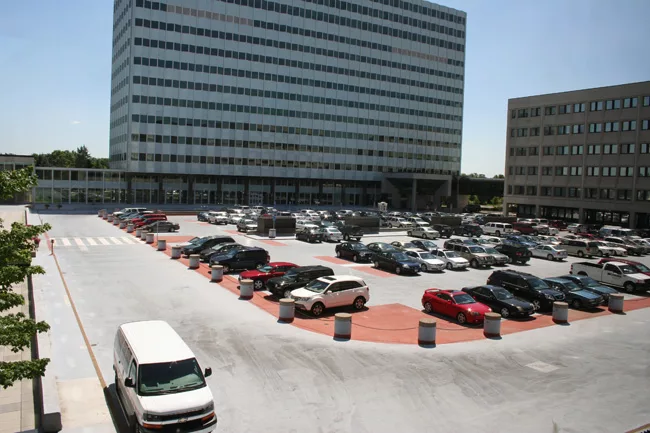
View of visitors parking lot and Building 220 before renovation project.
Photo © Daici Ano
An employee entrance before renovation.
2013: An Office Space Odyssey
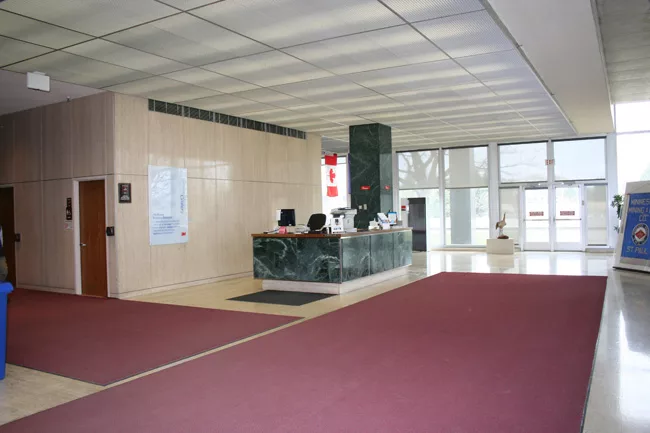
An employee entrance before renovation.
Photo © Daici Ano
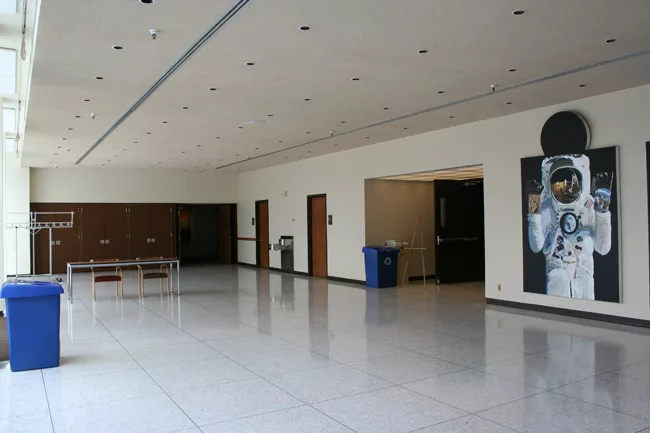
First floor of Building 224 before renovation.
2013: An Office Space Odyssey
First floor of Building 224 before renovation.
Photo © Daici Ano
Hitoshi Abe created a two-story space for a new stair leading from the first floor of Building 224 to the lounge area near the new employee entrance.
2013: An Office Space Odyssey
Hitoshi Abe created a two-story space for a new stair leading from the first floor of Building 224 to the lounge area near the new employee entrance.
Photo © Daici Ano
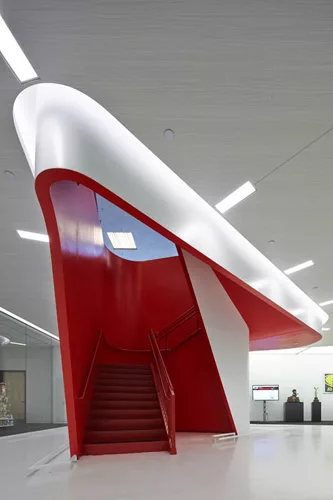
A new red stair by Hitoshi Abe leads from a shopping area on the first floor to a dining area on the second floor.
2013: An Office Space Odyssey
A new red stair by Hitoshi Abe leads from a shopping area on the first floor to a dining area on the second floor.
Photo © Daici Ano
The new employee entrance by Hitoshi Abe.
2013: An Office Space Odyssey
The new employee entrance by Hitoshi Abe.
Photo © Daici Ano
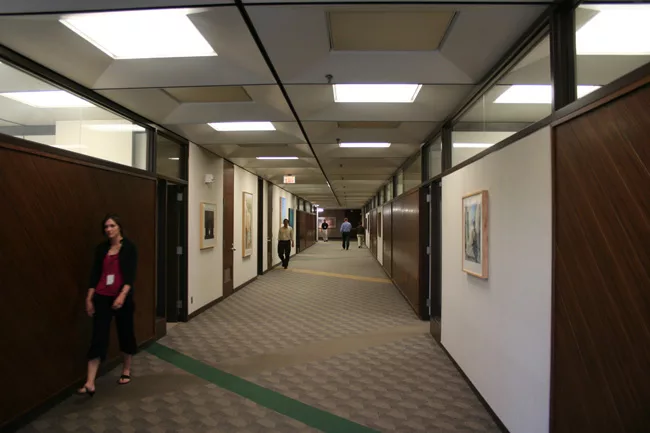
A hallway before renovation.
2013: An Office Space Odyssey
A hallway before renovation.
Photo © Daici Ano
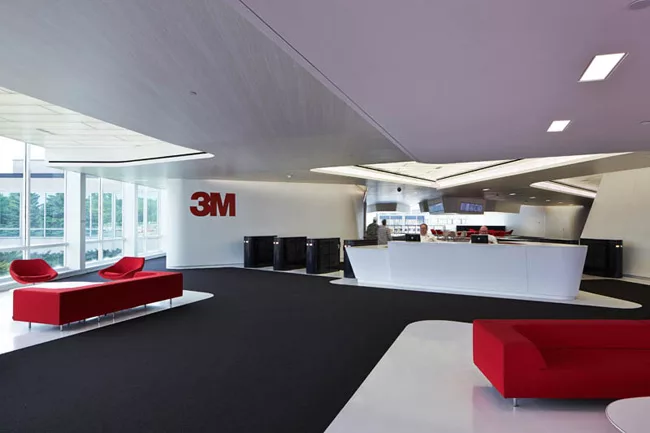
A lounge area in Building 224.
2013: An Office Space Odyssey
A lounge area in Building 224.
Photo © Daici Ano
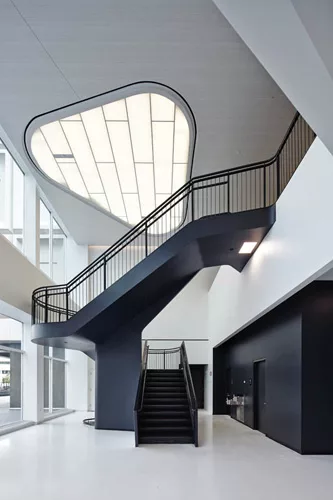
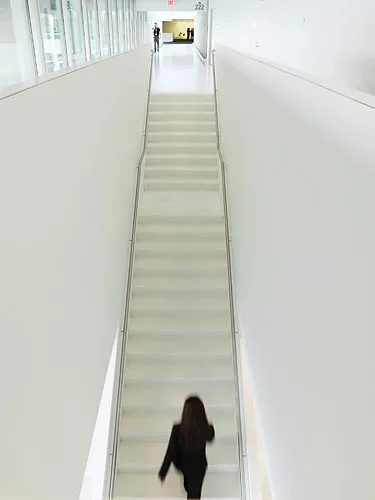
A new stair by Peter Ebner in Building 220.
2013: An Office Space Odyssey
A new stair by Peter Ebner in Building 220.
Photo © Paul Ott
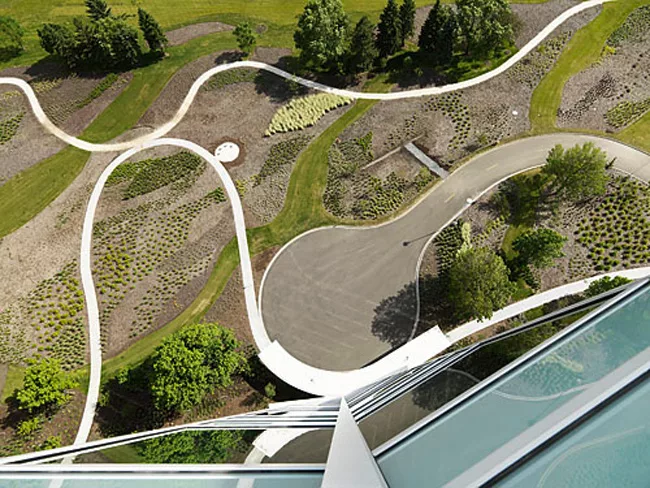
New landscaping by Peter Ebner on the south side of Building 220.
2013: An Office Space Odyssey
New landscaping by Peter Ebner on the south side of Building 220.
Photo © Paul Ott
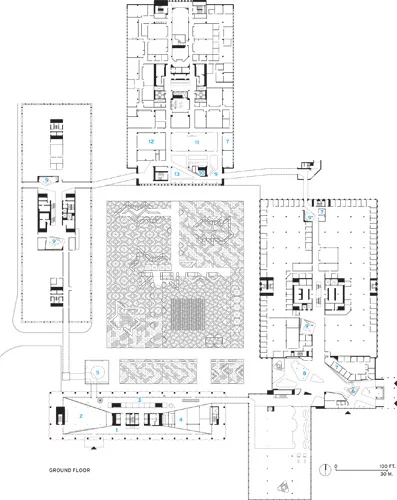
1. Visitor reception<br />2. Multifunction<br />3. Individual work area<br />4. Meeting<br />5. The exchange<br />6. Employee entrance<br />7. Meeting<br />8. Informal meeting<br />9. Hub<br />10. Sky
2013: An Office Space Odyssey
1. Visitor reception
2. Multifunction
3. Individual work area
4. Meeting
5. The exchange
6. Employee entrance
7. Meeting
8. Informal meeting
9. Hub
10. Skyway Café
11. Forum
12. Training
13. Lounge
Drawing courtesy of Atelier Hitoshi Abe
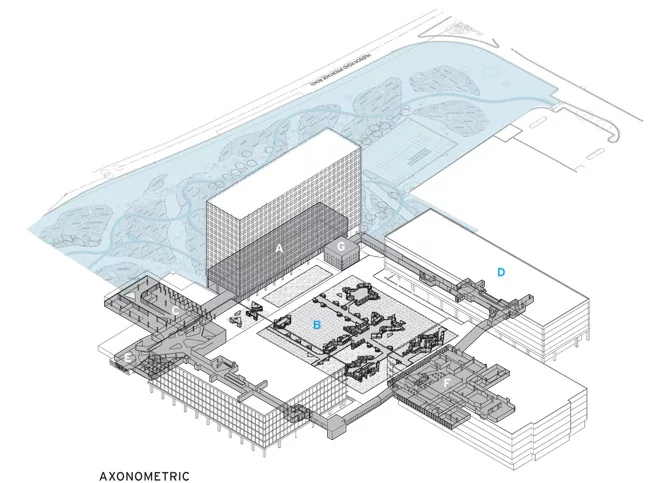
A. Building 220 / Visitor entrance<br />B. Plaza<br />C. Building 222 / Employee mall and private dining<br />D. Building 223 / Green hub and blue hub<br />E. Building 224 / Employee entrance, red hub
2013: An Office Space Odyssey
A. Building 220 / Visitor entrance
B. Plaza
C. Building 222 / Employee mall and private dining
D. Building 223 / Green hub and blue hub
E. Building 224 / Employee entrance, red hub and orange hub
F. Building 225 / Café, forum, lounge, training, and black hub
G. The exchange / Media room
Drawing courtesy of Atelier Hitoshi Abe
Hitoshi Abe drew employees to Building 225, at the northern end of the complex, by creating a futuristic caf&eacute; with a lounge on the side facing the plaza  and an assembly room called the Forum o
Abe and his team transformed a visitors&rsquo; parking lot (slide 3) at the center of the site into a plaza shared by all the surrounding buildings. Concrete benches and planters divide the large spac
Abe and his team transformed a visitors&rsquo; parking lot (left) at the center of the site into a plaza shared by all the surrounding buildings.
Abe and his team transformed a visitors&rsquo; parking lot (slide 3) at the center of the site into a plaza shared by all the surrounding buildings. Concrete benches and planters divide the large spac
Five different &ldquo;hubs,&rdquo; each coded by a particular color, offer unprogrammed spaces for people to meet or relax. Overhead monitors and screens embedded in the work surfaces keep employees i
Peter Ebner designed a new canopy for the south side of Building 220 where visitors now pull up (left). He also designed the landscaping in front of the building, as part of the entry sequence.
On the first floor of Building 220, Ebner created a series of glass cubes that serve as impromptu meeting rooms, adjacent to a long space that faces the plaza and provides a variety of furniture for i
A boxy structure designed by Ebner and his firm stands in the plaza where the old visitors' entrance had been and serves as a dramatic space for important presentations and meetings. Curtains can be c
View of visitors parking lot and Building 220 before renovation project.
An employee entrance before renovation.
First floor of Building 224 before renovation.
Hitoshi Abe created a two-story space for a new stair leading from the first floor of Building 224 to the lounge area near the new employee entrance.
A new red stair by Hitoshi Abe leads from a shopping area on the first floor to a dining area on the second floor.
The new employee entrance by Hitoshi Abe.
A hallway before renovation.
A lounge area in Building 224.
A new stair by Peter Ebner in Building 220.
New landscaping by Peter Ebner on the south side of Building 220.
1. Visitor reception<br />2. Multifunction<br />3. Individual work area<br />4. Meeting<br />5. The exchange<br />6. Employee entrance<br />7. Meeting<br />8. Informal meeting<br />9. Hub<br />10. Sky
A. Building 220 / Visitor entrance<br />B. Plaza<br />C. Building 222 / Employee mall and private dining<br />D. Building 223 / Green hub and blue hub<br />E. Building 224 / Employee entrance, red hub
September 16, 2013

Architects Hitoshi Abe and Peter Ebner help 3M rethink the way its employees work, taking the company and its headquarters on a journey from the past to the future.

More than just Post-it notes and Scotch tape, 3M produces a vast array of items—electronic stethoscopes, solar mirror films, abrasives—and likes to think of itself as an innovative company. But until recently, its headquarters in St. Paul was stuck in the 1970s, its offices a throwback to an era when you programmed a computer with punch cards and used a slide carousel for presentations. This time warp separating appearance and reality sent the wrong message to both the company's staff and visitors to its offices.

In 2010, George Buckley, then 3M's president and CEO, brought in architects Hitoshi Abe and Peter Ebner to inject a new dynamism into the company's dowdy workplace. He had heard Ebner speak at a 3M event, and Ebner then asked Abe to work with him on the project. 3M's campus, with 50 midrise buildings, was too big for a complete overhaul, so the strategy was to jump-start change at critical locations within a five-building core. Abe and Ebner, who have separate practices but are colleagues at UCLA, needed to shake things up without undermining the company's successful work culture. “In our business, we often look to disruptive ventures to advance our goals,” says Stefan Gabriel, president of 3M New Ventures, who was deeply involved in the design project.

Reflecting the growing importance of collaboration in the way people work, 3M focused its effort on getting employees out of their cubicles and interacting more with each other. In 2000, Abe had developed a plan for Sony's headquarters in Tokyo. Although that project didn't move forward, it got him thinking about the new workplace. “In an age when we can work anywhere, how do we create physical places where people want to be and where they can be more productive?” asks the Los Angeles' and Sendai, Japan'based architect.

Abe and Ebner worked together on a master plan for the heart of the 3M campus, then divided responsibilities for renovating the interiors. When they started on the project, the five core buildings—identified in deadpan Midwestern fashion by numbers (220, 222, 223, 224, and 225)—surrounded a visitors parking lot and were connected on their second levels by enclosed skywalks. The architects proposed turning the parking lot into a landscaped plaza and creating a new main entrance on the south side of Building 220.

Moving visitor parking to lots just beyond the central core raised some eyebrows, but the scheme—wisely—didn't mess with employees' spots in the existing garage below the plaza. Though some 3M executives questioned the usefulness of a large outdoor space in a city with long winters, Abe convinced them of its importance. “The plaza is critical to the project,” states Abe, “because it ties everything together, and all the buildings look onto it.”

Abe, who designed the space, used planters to establish a series of outdoor rooms that encourage 3M employees to get out of their offices. Concrete benches attached to the planters and freestanding tables and chairs invite people to hang out or bring their laptops. Instead of specifying stone or concrete pavers, Abe used a 3M traffic tape that's usually applied to roads. Cut into black, white, and yellow triangles and parallelograms and laid onto concrete pavement, the tape creates a jazzy pattern inspired by Chinese puzzles called tangrams. Lighting on the underside of the planters and benches creates a warm glow in the evening.

Meanwhile, Ebner designed a new visitor entry sequence, including a winding drive, rolling landscape, and a crescent-shaped canopy that softens the sharp edges of Building 220, a 1962 structure by Ellerbe Becket that is the tallest on the campus. He also transformed the first two floors of the building, creating a sleek new reception area and a set of glass cubes that serve as meeting rooms facing the plaza. Between reception and the glass cubes, he inserted larger meeting rooms and a multifunction space that seats 350 people. On the second floor, he created a long open space for collaborative work on the plaza side of the building and furnished it with a 138-foot-long table.

“Building 220 was a bad copy of Mies,” says Ebner, “so I tried to give it a better Miesian spirit.” Opening up the interiors and elegantly detailing new elements, such as the glass cubes and a white stair to the second floor, were key parts of that strategy. “With Mies, you always get a sense of generosity at the entrance,” explains Ebner.

To balance the transparency of his spaces in Building 220, Ebner designed a small adjacent structure that's more opaque—a box with punched windows that replaces the old visitors' entry on the plaza side. Called the Exchange, it serves as a high-tech meeting room for video conferences and digital presentations.

While Ebner reconfigured Building 220 and the visitors' entry experience, Abe addressed Buildings 222, 223, 224, and 225 and the movement of employees into and through the complex. Given a lot of real estate and a limited budget, he determined that he could have the greatest impact by reimagining the second-story skywalks and the spaces feeding into them as places for social interaction, not just circulation.

In the past, employees arrived at a number of different locations and dispersed throughout the complex. To bring everyone together at the start and end of the day, Abe created a new entrance in Building 224 and closed most of the others. The Jetsons-meets-Zaha design immediately alerts personnel that this is not their father's 3M. As soon as they get through security, they now find a series of spaces furnished with various tables and chairs for casual and impromptu meetings. Instead of setting these spaces apart with walls or steps, the architect merely changed the flooring material and lowered the ceilings, which employ a 3M product that diffuses LED light to make a uniform, glowing surface and gives the appearance of skylights. (Abe and Ebner were challenged by the client to specify as many 3M products as possible, but apply them in inventive ways.)

Using the same futuristic vocabulary as he did at the entry, Abe carved out a “necklace” of social spaces flowing through the second floor of the old buildings and studded it with five color-coded “hubs” equipped with sleek, molded seating, interactive screens embedded in work surfaces, and suspended monitors displaying communications from 3M employees around the world. In Building 225, he designed a large caf' with lounges and training rooms around it—a cluster of spaces that serves as a magnet for workers from across the complex. “We used to have a set of buildings, connected by skyways, that felt like an airport,” recalls Ian Hardgrove, a 3M senior vice president. “Now we have this remarkable place that positions us as an innovative company.”

The project opened piecemeal from fall 2012 to spring 2013. By July 2013, 3M personnel were still adapting to the new architecture. Some of the hubs and social spaces were thick with people working in teams and on their own, while others—including the plaza—seemed under-utilized. So the company has started holding events in the outdoor space, including a farmers' market and afternoon jogs. While pieces of the complex may still evolve, the redesign as a whole demonstrates a new attitude on the part of 3M: that it is willing to take risks, bring in talent from different parts of the world, and integrate digital technologies into its mission. Good design can't fix everything, but it helps send the message of change.

People

Architect (Buildings 222, 223, 224, 225, and Plaza):
Atelier Hitoshi Abe — Hitoshi Abe, Pierre De Angelis, Jeremy Fletcher, Tim Do, Nathan Smith, Midori Mizuhara, Rafael Sampaio, Manabu Leventhal, Peter Welch, Kentaro Yamada

Architect (Building 220):
Peter Ebner and Friends — Peter Ebner, Sam Chermayeff, Johanna Meyer-Grohbr'gge, Thomas Kosiec, Philip Stalbohm, Alexander Menke, Jennifer Schikora, Lena Bertram

Architect Of Record:
Meyer Scherer & Rockcastle

Engineers:
Meyer Borgman Johnson (structural); Sebesta Blomberg (m/e); TKDA (civil)

Owner:
3M

General Contractor:
PCL Constructors

Size:
260,000 square feet (total project)

Completion date:
Fall 2012'Spring 2013


Products

Custom Furniture:
Corian

Plaza Surface:
Stamark by 3M

Ambient Lighting:
Light Mat by 3M

Recessed Lighting:
Light Mixing by 3M

Share This Story

Looking for a reprint of this article?
From high-res PDFs to custom plaques, order your copy today!

Cliff portrait 2 0t5a1761 0031

Contributing editor Clifford Pearson is the co-author, with A. Eugene Kohn, of The World By Design, and writes about architecture and urbanism.

Post a comment to this article

Report Abusive Comment

Subscription Center
  • Create an Account
  • Start a Subscription
  • Manage My Account
  • Sign Up for Newsletters
  • Visit Customer Service
  • Update Preferences

More Videos

Sponsored Content

Sponsored Content is a special paid section where industry companies provide high quality, objective, non-commercial content around topics of interest to the Architectural Record audience. All Sponsored Content is supplied by the advertising company and any opinions expressed in this article are those of the author and not necessarily reflect the views of Architectural Record or its parent company, BNP Media. Interested in participating in our Sponsored Content section? Contact your local rep!

close
  • cold storage facility
    Sponsored byCarlisle SynTec Systems

    How Architects Can Design More Continuous Cold Storage Envelopes

  • TAMLYN XtremeTrim Exterior Trim
    Sponsored byTamlyn

    Designing Cleaner Panel Facades: Why Exterior Trim Details Matter

  • Building with Vapor Barriers
    Sponsored byReef Industries, Inc.

    Vapor Barriers Help Control Moisture in Tighter Building Designs

DESIGN:ED Podcast
Listen to Architectural Record’s DESIGN:ED Podcast

Events

June 23, 2026

Enhancing Fire Resistance with Advanced PVC Solutions

Credits: 1 AIA LU/HSW; 1 AIBD P-CE; 0.1 ICC CEU; 1 IIBEC CEH

Evaluate advanced PVC solutions that improve fire resistance, support WUI compliance, and enhance resilience in residential and commercial building design.

June 25, 2026

Designing Glass Railing Systems that Enhance Aesthetics and Meet Code

Credits: 1 AIA LU/HSW; 1 AIBD P-CE; 0.1 ICC CEU

Upon course completion, participants will possess a deeper understanding of glass railings to help ensure that safety, aesthetic, and performance objectives are achieved.

View All Submit An Event

Products

2026 Architect's Square Foot Costbook

2026 Architect's Square Foot Costbook

See More Products

Popular Stories

SanDiegoAirport

Top 300 Architecture Firms of 2026

Lorcan O' Herilhy

California Architect Lorcan O’Herlihy Has Died, Age 66

Coronado Bridge

The Architect’s Guide to San Diego

CCA, Studio Gang

The Winners of the AIA’s 2026 Architecture Award Range from Collegiate Rowing Hubs to Housing for the Homeless

Dusk House

Design Vanguard 2026: ONO

Enhancing Fire Resistance with Advanced PVC Solutions - Free Webinar - June 23, 2026

Related Articles

  • Arquipeo

    An Office Complex in Brazil Takes Advantage of its Tropical Setting with Sprawling Outdoor Space

    See More
  • Facebook Reveals New Office Space

    Facebook Reveals New Office Space in Menlo Park, Calif.

    See More
  • Office Space: Venice Biennale Preview

    See More

Related Products

See More Products
  • american arch.jpg

    American Architecture: An Illustrated Encyclopedia

See More Products
×

The latest news and information

#1 Source for Architectural Design, News and Products

SUBSCRIBE
  • RESOURCES
    • Advertise
    • Contact Us
    • Submit
    • Store
  • ACCOUNT CENTER
    • Create an Account
    • Start a Subscription
    • Manage My Account
    • Sign Up for Newsletters
    • Visit Customer Service
    • Update Preferences
  • PRIVACY
    • PRIVACY POLICY
    • TERMS & CONDITIONS
    • DO NOT SELL MY PERSONAL INFORMATION
    • PRIVACY REQUEST
    • ACCESSIBILITY
  • SERVICES
    • Marketing Services
    • Reprints
    • Market Research
    • List Rental
    • Survey/Respondent Access
  • STAY CONNECTED
    • Linkedin
    • Facebook
    • Instagram
    • YouTube
    • X (Twitter)

Copyright ©2026. All Rights Reserved BNP Media, Inc. and BNP Media II, LLC.

Design, CMS, Hosting & Web Development :: ePublishing