Detroit
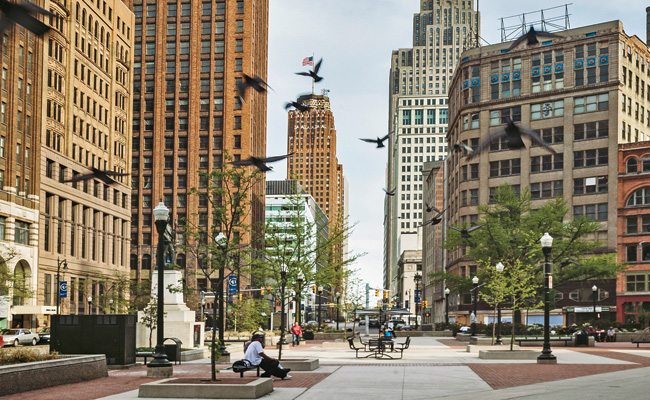
In the long-empty buildings ofthe Motor City's manufacturing past, technology firms are shaping new workspaces for the 21st-century.
Detroit's well-publicized bout with municipal bankruptcy is masking some positive trends taking place in the teetering city. Among the most important: technology firms are flocking to its downtown core, bringing an influx of young workers and remaking many of its older 20th-century buildings into high-tech havens.
From two- or three-person startups to mortgage giant Quicken Loans, companies of all sizes have set up shop in long-neglected structures. Some are embracing the gritty industrial buildings by preserving rugged finishes, taking up the mantle of toughness and quality they embody. Others are turning to the showpiece offices of previous eras while gutting the interiors to suit a new generation of digital industrialists. These projects have given rise to a series of slogans that capture some of the city's new energy and its hoped-for revival: “Detroit 2.0,” “Outsource to Detroit,” and, in a nod to the main boulevard, Woodward Avenue, “Webward Avenue.”
Some 10,000 new workers have arrived in the past few years, and in the technology sector, they tend to be young, educated, and eager to live near downtown, driving up apartment rents in Detroit's Midtown, Corktown, and Eastern Market neighborhoods and fueling the city's rapidly reviving bar, restaurant, music, and retail scene. Their influence can be seen in the growing number of bicycles on city streets, as well as in new brew pubs, wine bars, and coffee shops. Longtime Detroit staple Avalon International Breads opened a new 50,000-square-foot bakery in February, and in Midtown, the Great Lakes Coffee Roasting Company is one of the hot venues of the moment, transforming into a bar and staying open late. Its interior is outfitted with wood from a demolished Detroit home.
Like that caf''s salvaging mementos of the city's past, much of the vibrancy of Detroit's tech scene stems from the look and ambience of the converted structures it inhabits. Local architectural firms including Neumann/Smith, Rossetti, and Kraemer Design Group have evolved a style that keeps the industrial rawness of the original buildings but livens it up with colorful custom-built furniture, fabrics, and artwork. A five-story 1917 structure known as the Madison Theatre Building recently reopened as the M@dison, a hub of digital entrepreneurial activity. “When we were developing the M@dison concept, we were given the task of making it cool—make it open, make it collaborative, make it worthy of somebody who would want to be at Google or anywhere out on the West Coast, and then make it even cooler than that,” says Jennifer Gilbert, founder and CEO of Doodle Home, which designed the interiors. “The younger generation doesn't want to sit at a desk. On Monday they want to work one way, and on Tuesday they may want to work in a completely different way.”
That meant the new offices would contain a lot of wide-open spaces—which, Gilbert notes, was exactly what many of these early 20th-century structures offered. “The M@dison building already had such amazing bones,” she says. “All we had to do was uncover it and expose the industrial brick, the terra-cotta tile, the ductwork. That set the tone.”
Much of the impetus for this burgeoning tech industry comes from Gilbert's husband, Dan Gilbert, the founder and chairman of Quicken Loans, the online mortgage company. Dan Gilbert, who grew up nearby and is one of the nation's wealthiest people (No. 126 on Forbes's list) moved Quicken's headquarters downtown from the suburbs four years ago and became a crusader for the future of the city. Since then, Dan Gilbert and his team have bought or leased more than 30 buildings downtown, from skyscrapers to four-story 1900s-era structures to the Greektown Casino complex, filling up renovated offices.
Dan Gilbert not only boosted downtown's workforce—Quicken and other large employers like Blue Cross Blue Shield of Michigan have accounted for a high percentage of downtown job growth—he also rallied civic leaders to improve the streetscapes, to create amenities like beach volleyball in Detroit's central Campus Martius Park, and pop-up retail in empty storefronts. He hired the New York'based Project for Public Spaces to help shape a vision for downtown. The organization's founder, Fred Kent, says Detroit offers an unparalleled canvas for revival, given its historic, if tattered, Art Deco skyscrapers, downtown parks, and access to the magnificent Detroit River. “Downtown Detroit's geographic location—and particularly the half-mile from the Detroit River to Grand Circus Park—is the most concentrated diversity of urban assets and place-making opportunities anywhere in the world,” he maintains.
In addition to architectural distinction, many of the buildings favored by contemporary tech companies have ties to the city's automotive past. The Green Garage, a former Model T showroom, is on the National Registry of Historic Places. Entrepreneurs Tom and Peggy Brennan bought the building in 2008 and spent three years on a renovation to create a net zero energy structure that quickly became a hub of green tech companies. In the city's Midtown district, a 1927 General Motors building, where the famed Corvette was first designed, is now known as Tech One. It's the location of TechTown, the city's leading business incubator. Founding partner General Motors donated the 140,000-square-foot facility that is currently home to some 50 startups. The structure, designed by Detroit's great industrial architect Albert Kahn, was first a service department for Pontiac and later became the Chevrolet Creative Services building. The auto show displays were built there as well. Now Tech One houses companies like Asterand, a biotechnology firm that supplies tissue samples to drug researchers. Since its inception, TechTown has nurtured at least 250 startup firms and trained thousands of potential entrepreneurs through a variety of programs.
Other businesses are looking beyond the auto industry classics and moving into the city's existing stock of office space, renovating sometimes long-abandoned structures. The 25-story 1001 Woodward tower, built in 1965 as the First Federal Bank Building from a design by the Detroit firm Smith, Hinchman & Grylls (now SmithGroupJJR), stood largely empty after the bank sold it in the 1990s. Developers planned to convert the building into condos before the real estate crash, but in 2010, GalaxE Solutions, a New Jersey'based software firm serving the health-care industry, began to lease a substantial amount of office space, promoting the city as a tech hub with the “Outsource to Detroit” slogan.
In a similar move, Automation Alley, an economic development agency that has operated in Detroit's upscale northern suburbs since 1999, just announced it will open an office in downtown's Broderick Tower, a 1928 office building that was empty for years before a recent renovation. “Our goal is to be a good partner,” says Ken Rogers, Automation Alley's executive director. “We think it's a wonderful opportunity for Detroit.”
While businesses have helped shape the city by rehabilitating old buildings, the structures themselves have clearly helped shape businesses. The M@dison building, designed by noted theater architect C. Howard Crane, originally included an 1800-seat auditorium; that portion was demolished in the early 2000s for a parking lot, while the attached five-story office section stood largely vacant until Dan Gilbert bought it in 2011. Following its renovation, the space quickly filled up with new ventures, and now several established companies have followed suit—last year, Twitter opened a small outpost there. Other M@dison tenants range from tiny mobile-app developers to Skidmore Studio, a graphic design firm whose president, Tim Smith, says the mix of downtown location and open collaborative space has helped his company boost its revenues and galvanize its mostly young workforce. “Creative people are inspired by their surroundings,” says Smith. “And when you're inspired and energized, your work is naturally going to get better.”
John Gallagher is a business and architecture writer for the Detroit Free Press and coauthor of the American Institute of Architects' guide to Detroit architecture.
People | Products |
Looking for a reprint of this article?
From high-res PDFs to custom plaques, order your copy today!