Architectural Record
search
cart
facebook twitter linkedin youtube
  • Sign In
  • Subscribe
  • Sign Out
  • My Account
Architectural Record
  • NEWS
    • Latest News
    • Awards
    • Interviews
    • Obituaries
    • Podcasts
      • Design:Ed Podcast
      • Sponsored Podcasts
  • OPINION
    • Book Reviews / Excerpts
    • Exhibition Reviews
    • Forum
  • EXCLUSIVES
    • Videos
    • Design Vanguard
    • Top 300 Firms
    • Sponsored Content
    • Sponsored eBooks
    • From the Archives
  • CONTINUING ED
    • Editorial Continuing Ed
    • CE Center
    • CE Academies
  • PROJECTS
    • Buildings By Type
    • Reuse & Renovation
    • Museums & Arts Centers
    • Colleges & Universities
    • Multifamily Housing
    • Interiors
    • Lighting
    • Kitchen & Bath
  • HOUSES
    • Record Houses
    • House of the Month
    • Featured Houses
  • PRODUCTS
    • Products by Category
    • Record Products of the Year
    • Latest Products
  • EVENTS
    • Dates & Events
    • Record on the Road
    • Innovation Conference
    • Sustainability in Practice
    • Women In Architecture
    • Webinars
    • Ad Excellence Awards
    • Submit an Event
  • CONNECT
    • Ask RECORD AI
    • Newsletters
    • Contact
    • Advertise
    • Editorial Calendar
    • Store
    • Customer Service
  • SUBMIT
    • Submission Guidelines
    • RECORD Competitions
  • MAGAZINE
    • Subscribe
    • My Account
    • Digital Edition
    • Current Issue
    • Firm Pass
    • Historic Archive

A Woman for All Reasons
By Suzanne Stephens
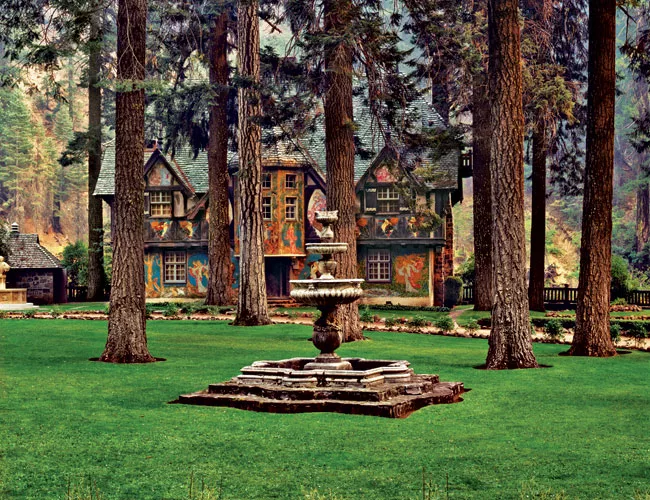
Studies in Paris would lead Julia Morgan to the playful Bear House at Wyntoon in Oregon (1933).
A Woman for All Reasons
Studies in Paris would lead Julia Morgan to the playful Bear House at Wyntoon in Oregon (1933).
Photo © Richard Barnes
Julia Morgan
A Woman for All Reasons
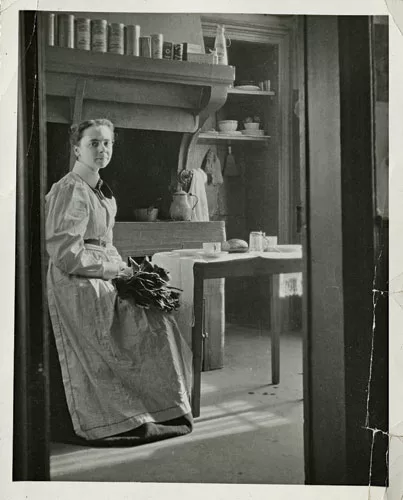
Julia Morgan
Photo courtesy Julia Morgan Papers, Special Collections, California Polytechnic State University
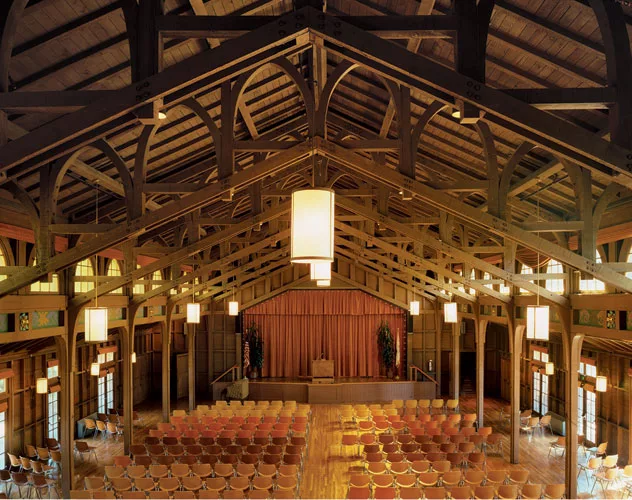
The sturdy Merrill Hall at Asilomar Conference Grounds in Pacific Grove, California, in 1929.
A Woman for All Reasons
The sturdy Merrill Hall at Asilomar Conference Grounds in Pacific Grove, California, in 1929.
Photo © Richard Barnes
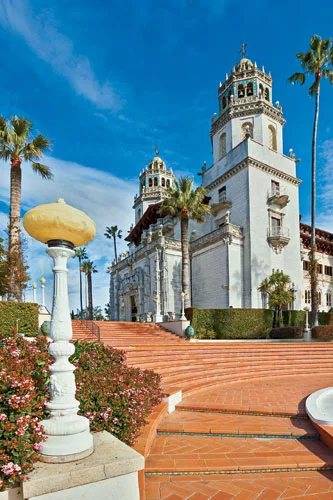
The project took a long time to complete: Morgan looked at the site in 1919; the final touches were made to Casa Grande in 1947.
A Woman for All Reasons
The project took a long time to complete: Morgan looked at the site in 1919; the final touches were made to Casa Grande in 1947.
Photo © Michael De La Paz
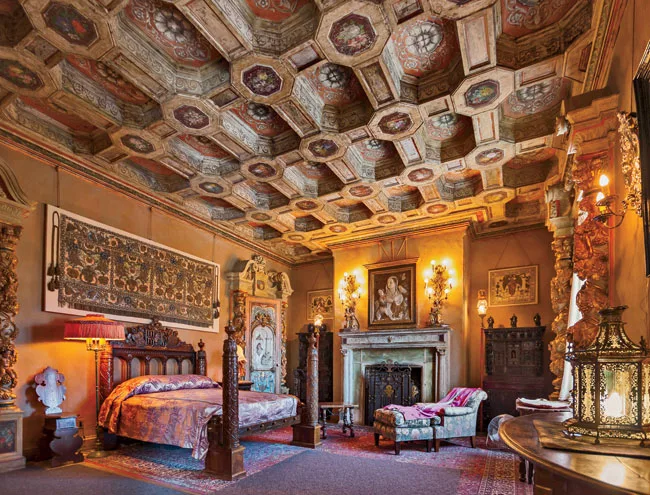
Morgan designed the San Simeon retreat for William Randolph Hearst in reinforced concrete, a material she began working with in 1903. Hearst wanted something grand, in the Spanish Renaissance style. H
A Woman for All Reasons
Morgan designed the San Simeon retreat for William Randolph Hearst in reinforced concrete, a material she began working with in 1903. Hearst wanted something grand, in the Spanish Renaissance style. He collected artifacts, antiques, and objets d'art to furnish the interiors, such as the bedroom, a part of the Doges Suite and one of the 58 bedrooms in the main house and guesthouses.
Photo © Michael De La Paz
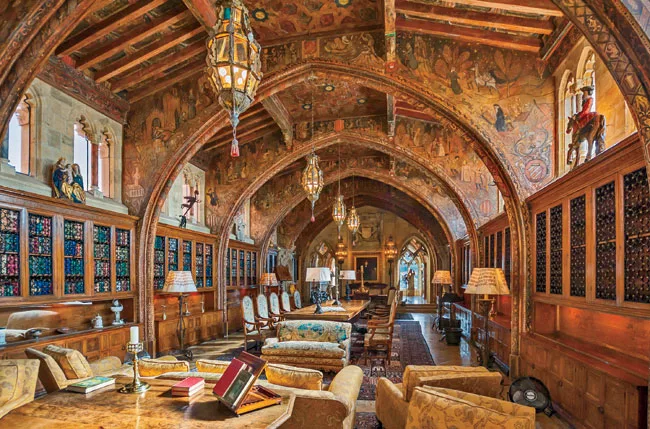
Hearst wanted his own office and library, so Morgan designed the Gothic Study (1931) on the main house's third floor. The ceiling combines 15th-century Spanish beams with arches designed in the Gothic
A Woman for All Reasons
Hearst wanted his own office and library, so Morgan designed the Gothic Study (1931) on the main house's third floor. The ceiling combines 15th-century Spanish beams with arches designed in the Gothic style.
Photo © Michael De La Paz
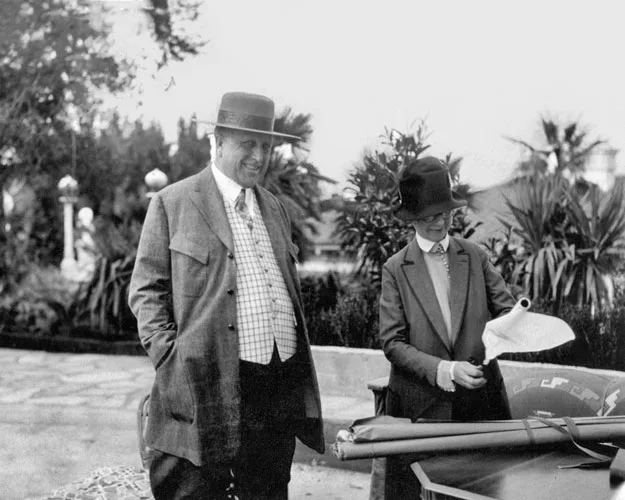
William Randolph Hearst confers with Morgan during construction of the Hearst Castle in San Simeon in 1926. According to biographer Sara Boutelle, Morgan made 558 trips to the site between 1919 and 19
A Woman for All Reasons
William Randolph Hearst confers with Morgan during construction of the Hearst Castle in San Simeon in 1926. According to biographer Sara Boutelle, Morgan made 558 trips to the site between 1919 and 1939.
Photo courtesy of Bison Archives
Studies in Paris would lead Julia Morgan to the playful Bear House at Wyntoon in Oregon (1933).
Julia Morgan
The sturdy Merrill Hall at Asilomar Conference Grounds in Pacific Grove, California, in 1929.
The project took a long time to complete: Morgan looked at the site in 1919; the final touches were made to Casa Grande in 1947.
Morgan designed the San Simeon retreat for William Randolph Hearst in reinforced concrete, a material she began working with in 1903. Hearst wanted something grand, in the Spanish Renaissance style. H
Hearst wanted his own office and library, so Morgan designed the Gothic Study (1931) on the main house's third floor. The ceiling combines 15th-century Spanish beams with arches designed in the Gothic
William Randolph Hearst confers with Morgan during construction of the Hearst Castle in San Simeon in 1926. According to biographer Sara Boutelle, Morgan made 558 trips to the site between 1919 and 19
May 16, 2014

Julia Morgan's impressive legacy of architectural achievements from her 45-year practice in San Francisco has won her the AIA Gold Medal for 2014.

Photo © Richard Barnes
Studies in Paris would lead Julia Morgan to the playful Bear House at Wyntoon in California (1933).
Julia Morgan

The well-publicized announcement that Julia Morgan (1872–1957) is the recipient of the American Institute of Architects' Gold Medal for 2014—the first woman to receive the honor—naturally raises questions about why it took so long. She died 57 years ago. (We also might wonder about the logic of posthumous Gold Medals—but more about that later.) Whatever the nature of the debate, there should be no question about Morgan's deserving the award given “in recognition of a significant body of work of lasting influence on the theory and practice of architecture.”

To begin with, we must acknowledge Morgan's historic role in a male-dominated profession: she was the first female to graduate from the highly prestigious architecture program at the Ecole des Beaux-Arts in Paris in 1902. After Morgan returned to her hometown of Oakland, California, she was the first female in the state to get her license. Then, in 1904, she became the first registered female architect to establish a full-time independent practice in the United States, according to biographer Mark A. Wilson. And she was (posthumously) the first woman to be inducted into the California Hall of Fame in 2008, two years after it was created.

The sheer output of Morgan's work—over 700 buildings, including schools, libraries, community centers, churches, and commercial buildings, not to mention houses—surpasses the achievements of her male and female peers. Frank Lloyd Wright, who completed 532 works of architecture during his lifetime, seems almost a slacker in comparison. Morgan, who never married, could undertake these projects without family responsibilities. But running an office of 8 to 10 men and women to do all this must have been grueling. And Morgan didn't just churn out buildings: her best-known work, Hearst Castle in San Simeon, the estate commissioned by William Randolph Hearst, took several decades to complete: site work started in 1919, and she spent at least 25 years on it.

The medal recognizes more than Morgan's significance as a role model; it acknowledges her technical and artistic accomplishments in architecture, including her pioneering forays into reinforced-concrete construction. Morgan, who graduated with a civil engineering degree in 1894 from Berkeley before going off to Paris, joined the office of John Galen Howard upon her return to the West Coast. He soon put her in charge of supervising the design and construction of the reinforced-concrete Greek Theater (1903) on the Berkeley campus, for which he was the master planner.

Not long after, Morgan opened her own office. Her early projects included a bell tower, out of reinforced concrete, El Campanil, for Mills College (1904)—along with the stately concrete Margaret Carnegie Library for the campus (1906), and the Hicks House in Berkeley (1906), later remodeled by another architect. Her explorations with this new material were contemporaneous with those of Auguste Perret, himself a student at the Ecole in the 1890s and an AIA Gold Medalist in 1952, who finished his concrete apartment building at 25 bis Rue Franklin in Paris in 1904.

Morgan's bold combination of architecture and engineering know-how could be seen in her use of exposed wood beams, struts, and trusses in any number of her projects, almost all in California. She immersed herself in a vernacular tradition that Bernard Maybeck (Gold Medalist, 1951)—with whom she studied and worked before going to Paris—was developing into a regional expression dubbed the First Bay Tradition. Based on the English Arts and Crafts movement, it placed an emphasis on natural materials from local sources, along with craftsmanship and the careful siting of architecture in the landscape. Morgan's sturdily elegant churches, graciously simple YWCA buildings, and other cultural centers in particular present striking examples of this sensibility—although the exposed wood beams and trusses of her roofs arguably adhered to the structural rationalism of French 19th-century thinking. In his letter of support for Morgan's nomination, Frank Gehry commended her for “expressing structure in new ways.”

At Morgan's Asilomar YWCA-commissioned conference center in Pacific Grove (1913–28), a sturdily elegant Merrill Hall features 23-foot-long Douglas fir beams and Gothic arches creating an open-truss structure for the 800-seat room. As Denise Scott Brown noted in her recommendation to the AIA board, “Morgan's larger buildings were masterful exercises in modest monumentality and tender gravitas, beautifully executed.”

Morgan also showed a remarkable ease in synthesizing historic styles, as we see at Wyntoon, a vacation retreat for the Hearst family in California near Mount Shasta, completed between 1924 and 1935. Here Medieval German or Austrian architectural motifs, combined with frescos by Willy Pogany on the Bear House (1933), endow the cottage with a story-book quality in an ultra-picturesque setting.

The plethora of commissions from repeat clients such as Phoebe Hearst and her son William obviously helped Morgan's practice: the latter's Hearst Castle, then called La Cuesta Encantada (Enchanted Hill), is clearly the most sumptuous of her works. While it doesn't appear to be advanced architecturally, the poured-concrete structure, where Renaissance and Baroque architectural motifs from southern Spain create an exotic setting, is suffused by a superb sense of proportion, color, texture, and composition.

For Morgan to get the Gold Medal would seem a slam dunk. Yet it took an extreme effort to organize the campaign, which was spearheaded by Julia Donoho, an AIA board member representing California. Donoho seems to have been sent from on high to carry this out: both an architect and an attorney, she had started out studying engineering at Princeton University before switching to its architecture school for both her bachelor's and her master's degrees.

After practicing architecture, Donoho earned a juris doctorate from Empire College in Santa Rosa—small wonder she approached the task of nominating Morgan as if it were a court case. Donoho garnered support within the AIA, put together an impressive packet of materials, sought letters from prominent professionals (including Michael Graves, as well as Gehry and Scott Brown), and asked one of the country's most innovative female practitioners, Jeanne Gang, to present Morgan's nomination to the AIA Board.

While the mission ended successfully, a posthumous award has raised questions about whether the Gold Medal should be given to those who are no longer with us. Some wonder why such an honor should not go to those who can appreciate it and be gratified by peer recognition. According to Richard Guy Wilson, who wrote The AIA Gold Medal in 1984 and an updated essay on the topic in 2008, the honor was modeled on the Royal Institute of British Architects' Royal Gold Medal, which is not bestowed posthumously. Indeed, in the AIA's case, the first three posthumous awards were accidental: they had been decided on just before the recipients' deaths, including that of Charles Follen McKim, in 1909, who had conceived the program in 1907. Over the years, more posthumous awards were given, often to architects struck down in the prime of their careers (such as Bertram Goodhue, Eero Saarinen, Samuel Mockbee), or were bestowed as belated historical recognition—for example to Louis Sullivan, and, of course, to Morgan, who had been preceded by 11 men, according to Wilson's count.

Considering that the practice of giving the Gold Medal posthumously has become somewhat of a custom by now, it is especially fitting for Morgan to receive it. Perhaps a better idea would be to establish a pantheon of deceased distinguished American architects (which could include non–Gold Medalists, such as Benjamin Latrobe). But this idea would not ease the immense amount of work that needs to be done to get a nomination through the complex selection process as it stands now. To be sure, this extreme effort, where the living architect submits credentials (and the dead need tireless proponents) could be debated as well. But that's another story.

Share This Story

Looking for a reprint of this article?
From high-res PDFs to custom plaques, order your copy today!


Stephens

Suzanne Stephens, a former deputy editor of Architectural Record, has been a writer, editor, and critic in the field of architecture for several decades. She has a Ph.D. in architectural history from Cornell University, and teaches a seminar in the history of architectural criticism in the architecture program of Barnard and Columbia colleges.

Post a comment to this article

Report Abusive Comment

Subscription Center
  • Create an Account
  • Start a Subscription
  • Manage My Account
  • Sign Up for Newsletters
  • Visit Customer Service
  • Update Preferences

More Videos

Sponsored Content

Sponsored Content is a special paid section where industry companies provide high quality, objective, non-commercial content around topics of interest to the Architectural Record audience. All Sponsored Content is supplied by the advertising company and any opinions expressed in this article are those of the author and not necessarily reflect the views of Architectural Record or its parent company, BNP Media. Interested in participating in our Sponsored Content section? Contact your local rep!

close
  • TAMLYN XtremeTrim Exterior Trim
    Sponsored byTamlyn

    Designing Cleaner Panel Facades: Why Exterior Trim Details Matter

  • Building with Vapor Barriers
    Sponsored byReef Industries, Inc.

    Vapor Barriers Help Control Moisture in Tighter Building Designs

  • Duct Interior with Prodeq System
    Sponsored byHenry, a Carlisle Company

    Designing Resilient Water Containment Systems

DESIGN:ED Podcast
Listen to Architectural Record’s DESIGN:ED Podcast

Events

June 10, 2026

Rethinking Stormwater – The Power of Porous Paving

Credits: 1 AIA LU/HSW; 1 AIBD P-CE; 0.1 ICC CEU

Learn how porous paving systems support stormwater management, reduce heat island effects, and enhance sustainable site design performance.

June 11, 2026

Very Early Warning Fire Detection for Mission-Critical Facilities

Credits: 1 AIA LU/HSW; 1 AIBD P-CE; 0.1 ICC CEU

Examine advanced fire detection strategies that support uptime and enhance safety in data centers and other mission-critical facilities.

View All Submit An Event

Products

2026 Architect's Square Foot Costbook

2026 Architect's Square Foot Costbook

See More Products

Popular Stories

Practice Matters illustration

What’s in a (Firm’s) Name? Thinking About Succession and Legacy

Practice Matters illustration

By the Numbers: Counting America's Architects

Riverdale House by Studio Lau

Riverdale House by Studio Lau

House on a Hill

Design Vanguard 2026: Forma

Crane Cove, ONO

Design Vanguard 2026 Winners

Broader Sustainability of CMU - Free Webinar - May 21, 2026

Related Articles

  • A House for All Seasons

    See More
  • Snapshot: Home-for-All

    See More
  • Nonprofit work experience: beneficial for all, but far too rare

    See More

Related Products

See More Products
  • WC_-SCA.png

    Building Great Schools for a Great City

  • 0470126736.gif

    Modern Sustainable Residential Design: A Guide for Design Professionals

See More Products
×

The latest news and information

#1 Source for Architectural Design, News and Products

SUBSCRIBE
  • RESOURCES
    • Advertise
    • Contact Us
    • Submit
    • Store
  • ACCOUNT CENTER
    • Create an Account
    • Start a Subscription
    • Manage My Account
    • Sign Up for Newsletters
    • Visit Customer Service
    • Update Preferences
  • PRIVACY
    • PRIVACY POLICY
    • TERMS & CONDITIONS
    • DO NOT SELL MY PERSONAL INFORMATION
    • PRIVACY REQUEST
    • ACCESSIBILITY
  • SERVICES
    • Marketing Services
    • Reprints
    • Market Research
    • List Rental
    • Survey/Respondent Access
  • STAY CONNECTED
    • Linkedin
    • Facebook
    • Instagram
    • YouTube
    • X (Twitter)

Copyright ©2026. All Rights Reserved BNP Media, Inc. and BNP Media II, LLC.

Design, CMS, Hosting & Web Development :: ePublishing