In Demand Cities: Portland
Oregon's largest city embraces high-density living.
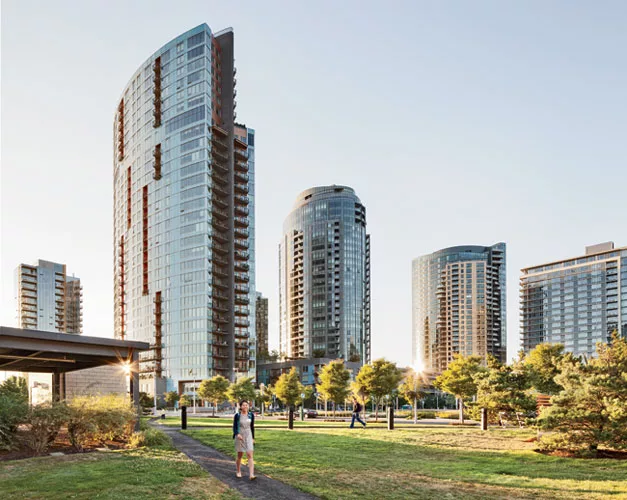
A swath of once-blighted industrial land along the Willamette River has been redeveloped for several luxury residential towers as well as affordable housing. The first apartment projects, completed between 2006 and 2008, were designed by THA Architecture, TVA Architects, GBD Architects, and Perkins+Will. GBD did the master plan.
Photo © Jeremy Bittermann
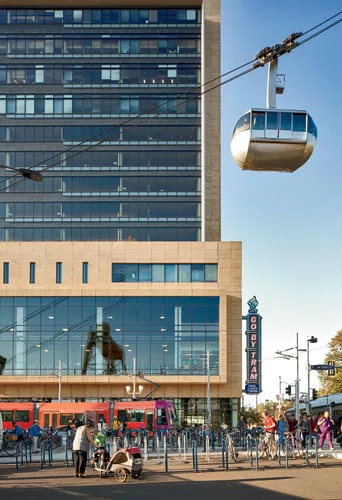
In 2006, Oregon Health & Science University (OHSU) opened its first building in the South Waterfront, the $150 million 16-story Center for Health & Healing. The LEED Platinum 412,000-square-foot facility was designed by GBD. An aerial tram also opened that year to shuttle OHSU affiliates from the new building to the old campus up the hill.
Photo © Jeremy Bittermann
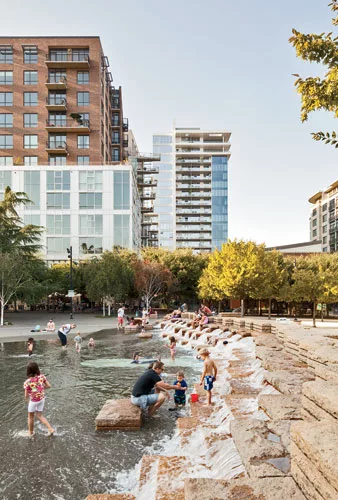
In 2002, Jamison Square, a 0.9-acre pocket park designed by Peter Walker & Partners, was the first completed park in the Pearl District redevelopment master plan. Two more followed. The parks are interspersed between high-rise condos near the waterfront.
Photo © Jeremy Bittermann
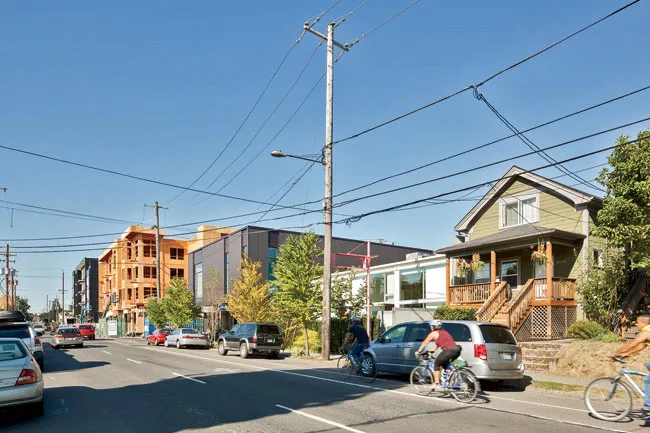
Every day, thousands of cyclists commute between Northeast Portland and downtown on North Williams. The street is also bursting with infill projects, from multifamily to a striking black office building, the Stem, designed by MOSI Architecture and a local creative agency, The Felt Hat.
Photo © Jeremy Bittermann
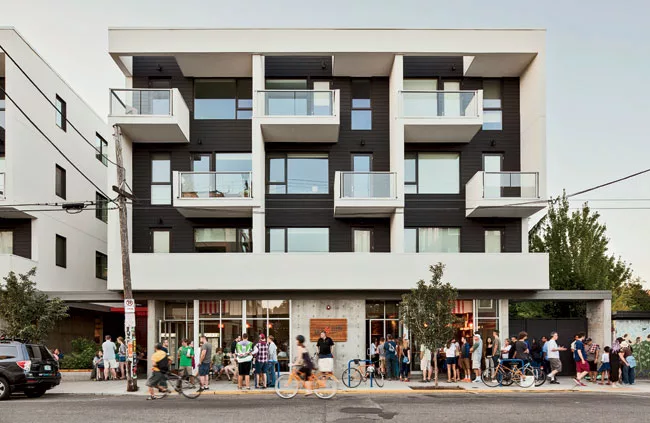
Development + Partners (UD+P) has built five multifamily housing projects along SE Division Street, including 3339 SE Division, designed by THA Architecture. Trendy restaurants and retail, like the artisanal ice-cream shop Salt & Straw, have leased ground-floor space in UD+P's buildings, adding to Division's reputation as a foodie destination.
Photo © Jeremy Bittermann
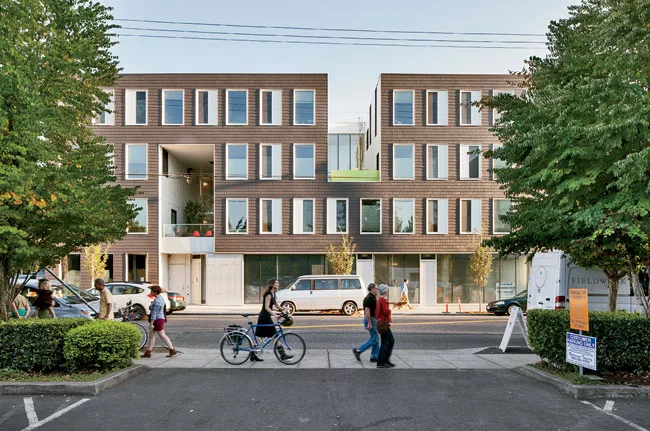
Urban Development + Partners (UD+P) has built five multifamily housing projects along SE Division Street, including 33rd & Division, designed by Works Partnership Architecture.
Photo © Jeremy Bittermann
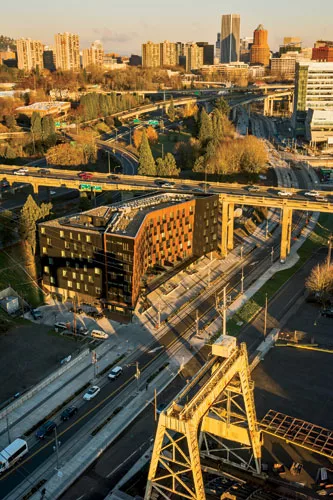
In the South Waterfront, ZGF's 118-unit apartment complex aimed at students and faculty at Oregon Health & Science University (OHSU) opened in October 2013. Rents range from $999 per month for a 450-square-foot studio to $3,000 per month for a two-bedroom.
Photo © Bruce Forster
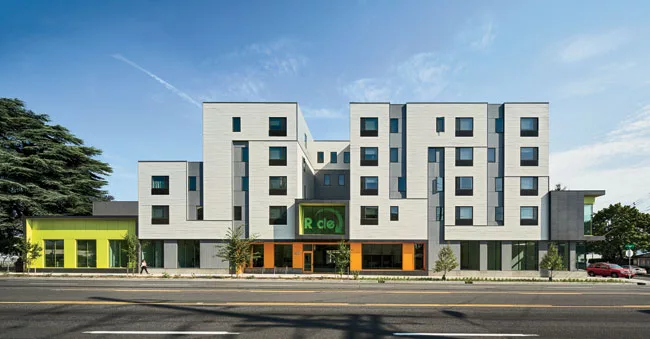
Holst Architecture, a 22-year-old Portland firm known for its well-designed market-rate multifamily work, recently has entered the affordable-housing sector. Its second completed project in this category is Glisan Commons, a $13 million five-story, 67-unit LEED Platinum building in the emerging Gateway District in east Portland. The ground floor is the headquarters of Ride Connection, a nonprofit that provides transportation for the elderly and disabled.
Photo © Andrew Pogue
Portland
2013 Population: 609,456
2010 Population: 583,776
2014 Median home price/sq. foot: $225
2011 Median home price/sq. foot: $150
2014 Median rent per month: $1,310
2011 Median rent per month: $1,100
2012 Percentage of renters spending more
than 35% of income on housing: 45.2%
Cress is not the only one who has embraced the mellow Portlandia culture. The city's population is growing fast, and, with it, an insatiable demand for new housing. Visitors passing through almost any part of Southeast Portland will inevitably see new apartment complexes, either brand-new or in the works.
Portland is in the midst of its biggest multifamily housing boom since the late 1990s. The rental vacancy rate is around 3 percent, and new housing is changing the fabric of the city, inserting itself as multi-unit infill structures in an already dense downtown and disrupting some single-family-home neighborhoods. Portland's demographics also are shifting, thanks to an influx of millennials and economic refugees priced out of Seattle and San Francisco.
Still, the construction binge is barely making a dent in a city whose metropolitan area of 2.3 million is growing by 25,500 people a year. And affordable housing is even harder to come by: more than 20 percent of households spend more than 50 percent of their income on housing. Portland lacks a policy that would meet demands for middle- and low-income housing, partly owing to Oregon's ban on inclusionary zoning (the only other state to have such a ban is Texas). What limited affordable-housing stock exists is mostly on the outskirts, where public transportation is least accessible, though there has been a concerted effort in recent years to locate new affordable developments, like Holst Architecture's Glisan Commons, near a broadening network of transit lines.
Increasing density would seem to be the answer—though Portland is already a dense city by law. In the 1970s, the city created an urban growth boundary to prevent sprawl and encourage high-density development downtown and in selected areas. One of the most famous urban-planning programs in the nation included investment in public transportation, parks, and pathways. Today, you can drive 20 minutes anywhere outside the city and be surrounded by farms, fields, or forest.
While there are few height restrictions downtown, Portland often caps infill development at four stories in traditional residential neighborhoods. So many multifamily projects are built at that scale—most of them standard-form boxes of little distinction. But Portland has one the highest numbers of architects per capita in the nation, and now such leading firms as THA Architecture, Holst, GBD Architects, Lever Architecture, Skylab Architecture, Works Partnership Architecture, and ZGF Architects are designing sculpted forms that add to the character of the street. The new buildings are unobtrusively idiosyncratic, sensitive to the context but gently making their architectural mark. Both young architects and more seasoned design firms here are helping to reshape their city—from the established Pearl District to a reinvented SE Division Street and the up-and-coming South Waterfront.
SE Division is the densest and arguably most successful of these recent revivals. For decades a sleepy thoroughfare of two-story single-family houses, interspersed with auto-repair shops and overgrown vacant lots, it has become, almost overnight, one of Portland's most popular neighborhoods. In 2006, the city's zoning was changed to encourage mixed-use infill development, and now there are multifamily housing projects on almost every block. The street's success—e.g., coolness factor—and architectural distinction is in large part the visionary work of Eric Cress's Urban Development + Partners (UD+P), whose unusual business model is focused on long-term investment.
When land prices plummeted during the recession, UD+P snagged five lots and tapped three leading local architects—Works Partnership Architecture, THA, and Stack—to design LEED-certified buildings, all with courtyards and light-filled units, targeting renters in their 20s and 30s. Most mid-rise residential buildings in Portland are wood framed, but UD+P's buildings rely on more durable light-gauge-steel frames and composite decks of metal plating and concrete. "If you have a short-term investment horizon, it doesn't make sense to build with concrete and light-gauge steel because you're just going to flip the building," says Cress, whose company continues to own and operate its properties.
With alluring ground-floor retail space in well-designed buildings, UD+P has attracted coveted local artisanal food businesses and chefs with growing reputations for its properties. On a spring night, the line is out the door at Salt & Straw, a self-described "farm-to-cone ice-cream shop," with a rather unusual menu—flavors include Bone Marrow and Smoked Bourbon Cherries, and Tomato Water Olive Oil Sherbet. Next door, a small French bakery called St. Honoré Boulangerie makes all of its breads with flour produced by sustainable wheat farmers in the Pacific Northwest. Both are the ground-floor tenants at a THA-designed four-story, 37-unit stucco building with balconies on the upper levels.
Across the street, THA wrapped 30 units around an interior courtyard, eliminated all interior hallways, and designed flexible live-work spaces in back for small businesses. With studios renting for $1,295 per month and one-bedrooms ranging from $1,425 to $1,595, UD+P is getting almost double the average rent per square foot in Southeast Portland.
Perhaps the most artful facade on the street belongs to the 28-unit building by Works Partnership Architecture at 33rd and Division, on an 8,000-square-foot corner site next door to THA's latest project. An S-shaped form in plan, the building's facade is alternately light and dark, with gray-black cement shingle cladding interrupted by glazed voids.
Across town, a public-private initiative has transformed the Pearl District from a place of industrial blight into a successful high-density mixed-use development over the past 15 years. Between blocks of condos, the city called for small public parks—Jamison Square, designed by landscape architect Peter Walker, was the first to open in 2002. Some of Portland's leading architecture firms had breakout projects in this area, including Allied Works' conversion of a 1908 warehouse into the offices of advertising agency Wieden+Kennedy—site of the human bird nest/conference room made famous on the TV show Portlandia.
Today, the Pearl District is looking beyond Whole Foods or the Dr. Martens U.S. headquarters for its next phase of urban revival. The Pacific Northwest College of Art, a small private art institution that has doubled the size of its student body and faculty in the last seven years, wants to raise its profile by expanding in the neighborhood. Allied Works completed a master plan for a new campus in 2005, and its $30 million conversion of a former post office into the college's main academic building is slated to open in January.
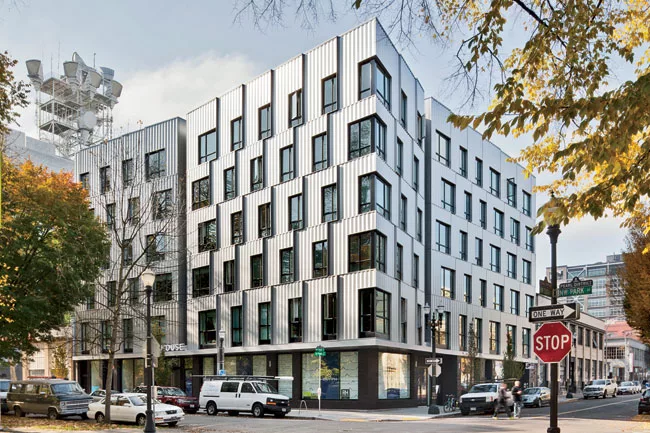
Nearby, Thomas Robinson of Lever Architecture has just completed ArtHouse, the first student residence hall. The six-story, 50-unit structure is clad with shimmering painted metal panels shaped like chevrons, a textured facade that gives the building a depth like that of some of the old historic brick buildings that still dot the district.
Meanwhile, Portland's industrial South Waterfront is the next neighborhood staging a comeback. Once a bustling manufacturing and shipbuilding center along the Willamette River, the area had become a 130-acre brownfield by the early 2000s. But the city sees a future innovation district here, and has teamed up with property owners, ranging from Oregon Health & Science University (OHSU) to an old shipbuilding family.
In 2002, its $1.3 billion plan (phase one) called for major infrastructure cleanup, stormwater collection and treatment, and new public transportation. It also called for parks, luxury and affordable housing, and a new OHSU research center.
By 2006, OHSU had completed a 412,000-square-foot research building as well as a $57 million aerial tram to run between the South Waterfront and its older campus up the hill. The first of the "eco-friendly" luxury residential towers opened, along with a new streetcar line.
While the recession slowed down some plans, the South Waterfront rebounded quickly. In June 2014, OHSU opened a 500,000-square-foot Collaborative Life Sciences Building, the largest academic building in Oregon, designed by Portland-based Sera and L.A.-based CO Architects. In fall of 2015, the city is scheduled to open Tilikum Crossing, a 1,720-foot-long pedestrian, bike and public-transportation bridge connecting the South Waterfront to other parts of the city.
The South Waterfront's last large blank slate is a 33-acre site owned by the Zidell shipbuilding family. The first new project there is the Emery, a seven-story, 88,000-square-foot housing complex aimed at OHSU medical students and faculty with ground-floor retail. In a nod to the neighborhood's gritty industrial history, the architects, ZGF, clad the building with a weathering-steel rainscreen and black metal panels. The eastern facade steps out at each floor, giving the appearance that the building, like a ship's hull, is leaning forward toward the water to the east. Compared to its enormous new neighbors, the Emery is relatively low-scale and quiet. "It's in the Portland psyche to start off modest," says ZGF partner Eugene Sandoval. "The work coming out of Portland is not about a trend. It's more about craft and diligence and maturity rather than making a big splash."
Back to In-Demand Cities
Looking for a reprint of this article?
From high-res PDFs to custom plaques, order your copy today!