

Architectural Record
search
cart
facebook twitter linkedin youtube
  • Sign In
  • Subscribe
  • Sign Out
  • My Account
Architectural Record
  • NEWS
    • Latest News
    • Awards
    • Interviews
    • Obituaries
    • Podcasts
      • Design:Ed Podcast
      • Sponsored Podcasts
  • OPINION
    • Book Reviews / Excerpts
    • Exhibition Reviews
    • Forum
  • EXCLUSIVES
    • Videos
    • Design Vanguard
    • Top 300 Firms
    • Sponsored Content
    • Sponsored eBooks
    • From the Archives
  • CONTINUING ED
    • Editorial Continuing Ed
    • CE Center
    • CE Academies
  • PROJECTS
    • Buildings By Type
    • Reuse & Renovation
    • Museums & Arts Centers
    • Colleges & Universities
    • Multifamily Housing
    • Interiors
    • Lighting
    • Kitchen & Bath
  • HOUSES
    • Record Houses
    • House of the Month
    • Featured Houses
  • PRODUCTS
    • Products by Category
    • Record Products of the Year
    • Latest Products
  • EVENTS
    • Dates & Events
    • Record on the Road
    • Innovation Conference
    • Sustainability in Practice
    • Women In Architecture
    • Webinars
    • Ad Excellence Awards
    • Submit an Event
  • CONNECT
    • Ask RECORD AI
    • Newsletters
    • Contact
    • Advertise
    • Editorial Calendar
    • Store
    • Customer Service
  • SUBMIT
    • Submission Guidelines
    • RECORD Competitions
  • MAGAZINE
    • Subscribe
    • My Account
    • Digital Edition
    • Current Issue
    • Firm Pass
    • Historic Archive

Open Book

By Clifford A. Pearson
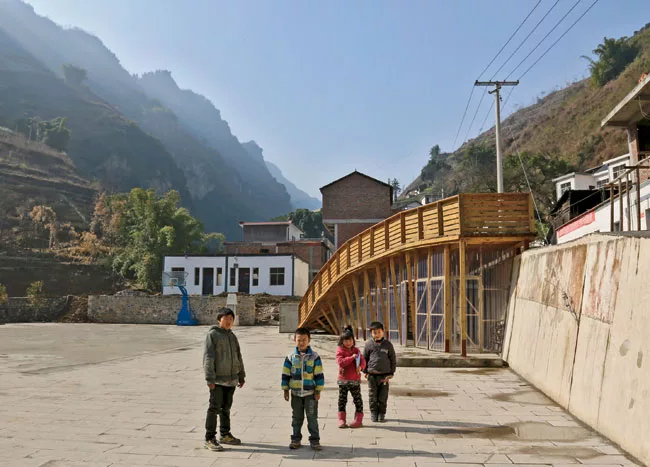
The architects used an existing public plaza and retaining wall as key elements in their design.
The Pinch
Olivier Ottevaere & John Lin
Yunnan Province, China
The architects used an existing public plaza and retaining wall as key elements in their design.
Photo courtesy Olivier Ottevaere & John Lin
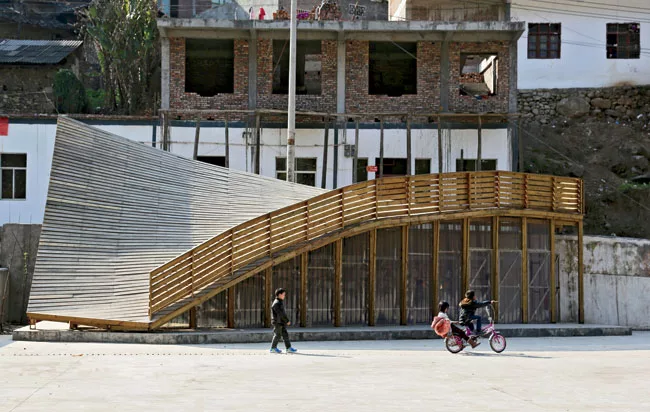
While most new construction in the rebuilt village relies on concrete, the Pinch shows the continuing relevance of the area's traditional wood architecture.
The Pinch
Olivier Ottevaere & John Lin
Yunnan Province, China
While most new construction in the rebuilt village relies on concrete, the Pinch shows the continuing relevance of the area's traditional wood architecture.
Photo courtesy Olivier Ottevaere & John Lin
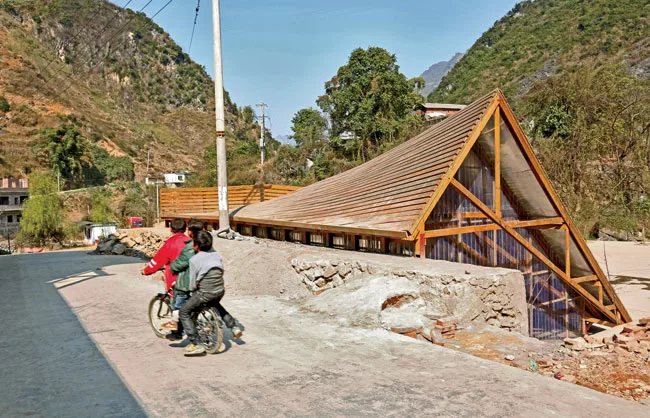
The peaked roof echoes the form of nearby mountains.
The Pinch
Olivier Ottevaere & John Lin
Yunnan Province, China
The peaked roof echoes the form of nearby mountains.
Photo courtesy Olivier Ottevaere & John Lin
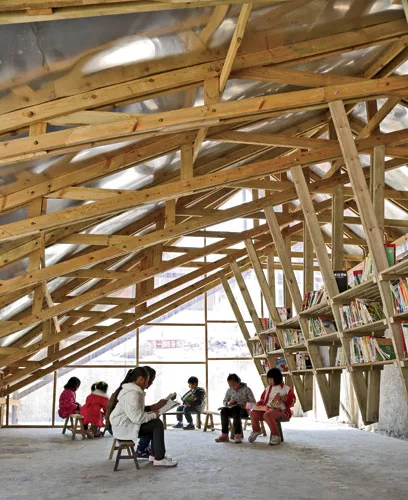
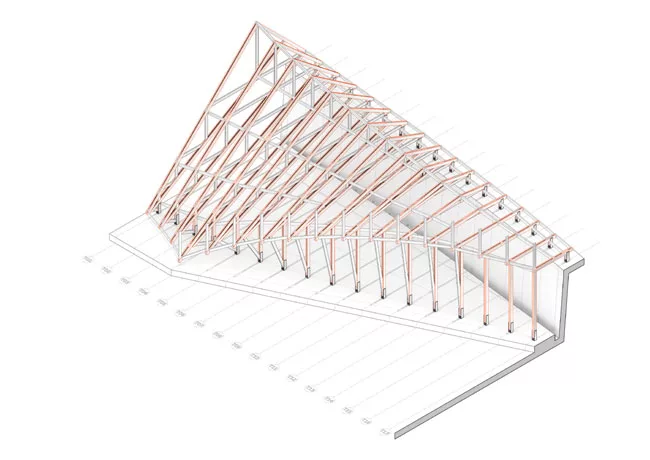
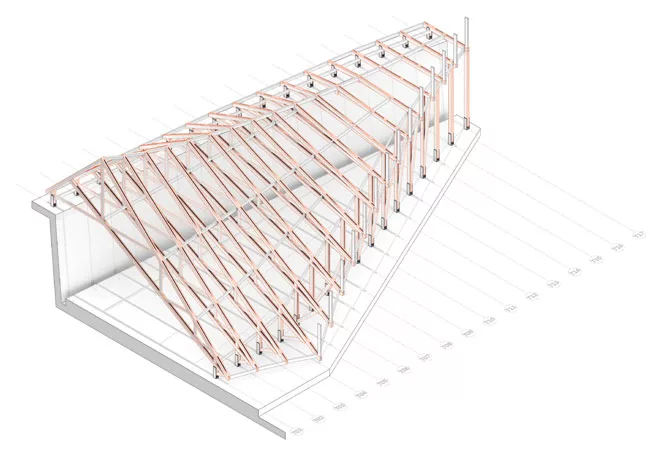
A system of 17 trusses assembled on-site supports the double-curved roof; V-shaped extensions of the trusses support bookshelves that run the length of the space.
The Pinch
Olivier Ottevaere & John Lin
Yunnan Province, China
A system of 17 trusses assembled on-site supports the double-curved roof; V-shaped extensions of the trusses support bookshelves that run the length of the space.
Photo courtesy Olivier Ottevaere & John Lin
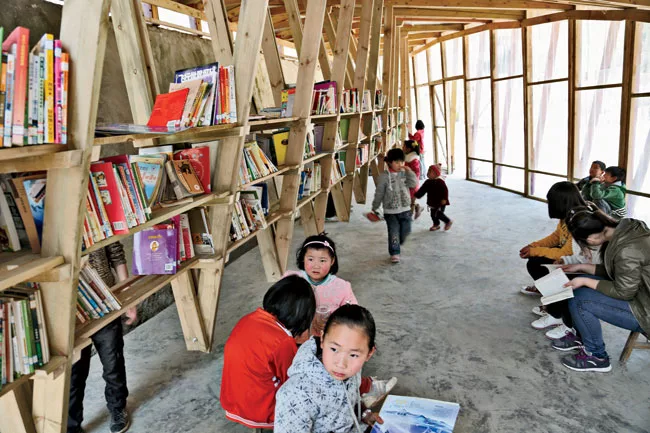
Standard wood benches and stools, found in most rural Chinese schools, serve as the only furniture. Translucent poly'carbonate panels bring daylight into the interior.
The Pinch
Olivier Ottevaere & John Lin
Yunnan Province, China
Standard wood benches and stools, found in most rural Chinese schools, serve as the only furniture. Translucent poly'carbonate panels bring daylight into the interior.
Photo courtesy Olivier Ottevaere & John Lin
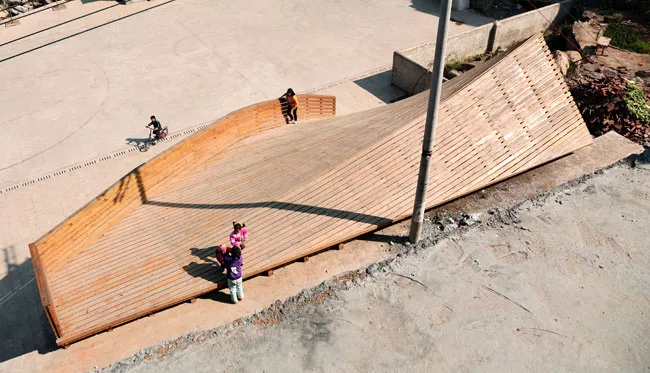
View from above.
The Pinch
Olivier Ottevaere & John Lin
Yunnan Province, China
View from above.
Photograph courtesy Olivier Ottevaere & John Lin
The building in its mountainous context.
The Pinch
Olivier Ottevaere & John Lin
Yunnan Province, China
The building in its mountainous context.
Photograph courtesy Olivier Ottevaere & John Lin
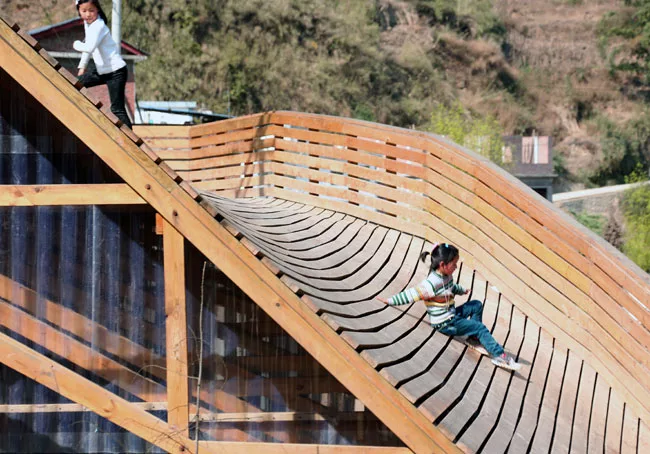
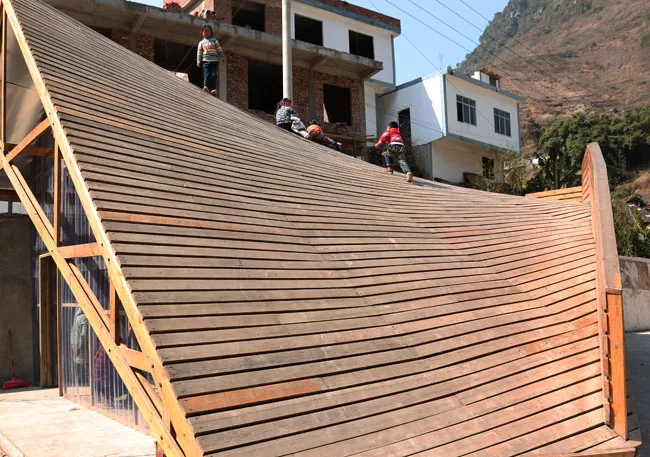
Sliding down the roof.
The Pinch
Olivier Ottevaere & John Lin
Yunnan Province, China
Sliding down the roof.
Photograph courtesy Olivier Ottevaere & John Lin
Climbing up the roof.
The Pinch
Olivier Ottevaere & John Lin
Yunnan Province, China
Climbing up the roof.
Photograph courtesy Olivier Ottevaere & John Lin
Bookshelves inside the library.
The Pinch
Olivier Ottevaere & John Lin
Yunnan Province, China
Bookshelves inside the library.
Photograph courtesy Olivier Ottevaere & John Lin
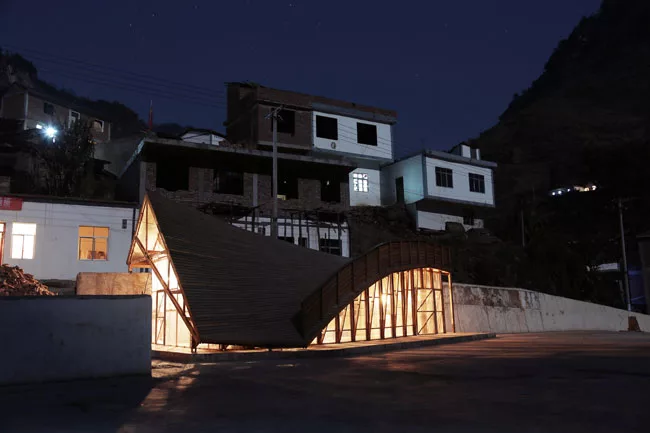
View from the plaza at night.
The Pinch
Olivier Ottevaere & John Lin
Yunnan Province, China
View from the plaza at night.
Photograph courtesy Olivier Ottevaere & John Lin
Roof trusses.
The Pinch
Olivier Ottevaere & John Lin
Yunnan Province, China
Roof trusses.
Image courtesy Olivier Ottevaere & John Lin
Roof trusses.
The Pinch
Olivier Ottevaere & John Lin
Yunnan Province, China
Roof trusses.
Image courtesy Olivier Ottevaere & John Lin
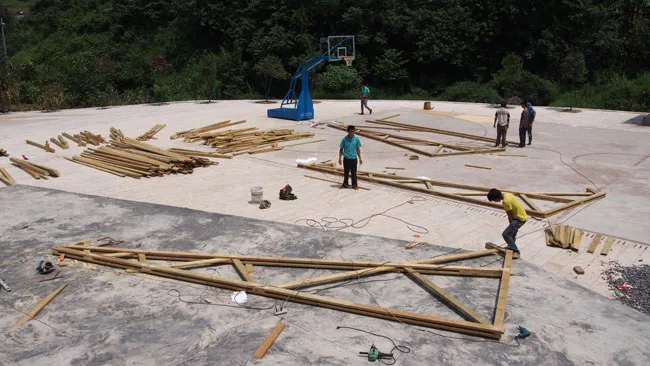
Assembling the trusses on site.
The Pinch
Olivier Ottevaere & John Lin
Yunnan Province, China
Assembling the trusses on site.
Photograph courtesy Olivier Ottevaere & John Lin
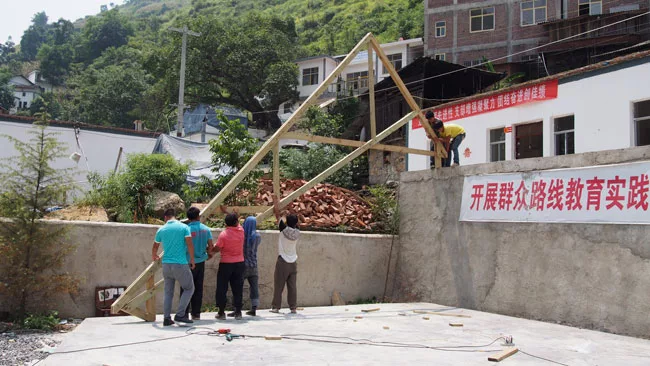
The first truss goes up.
The Pinch
Olivier Ottevaere & John Lin
Yunnan Province, China
The first truss goes up.
Photograph courtesy Olivier Ottevaere & John Lin
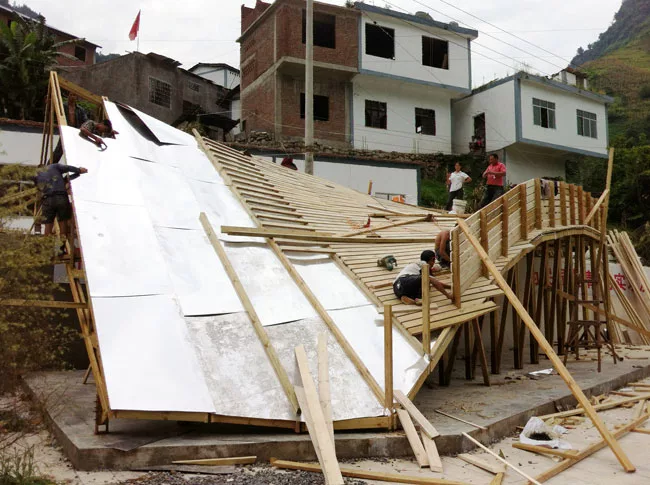
The library under construction.
The Pinch
Olivier Ottevaere & John Lin
Yunnan Province, China
The library under construction.
Photograph courtesy Olivier Ottevaere & John Lin
The architects used an existing public plaza and retaining wall as key elements in their design.
While most new construction in the rebuilt village relies on concrete, the Pinch shows the continuing relevance of the area's traditional wood architecture.
The peaked roof echoes the form of nearby mountains.
A system of 17 trusses assembled on-site supports the double-curved roof; V-shaped extensions of the trusses support bookshelves that run the length of the space.
Standard wood benches and stools, found in most rural Chinese schools, serve as the only furniture. Translucent poly'carbonate panels bring daylight into the interior.
View from above.
The building in its mountainous context.
Sliding down the roof.
Climbing up the roof.
Bookshelves inside the library.
View from the plaza at night.
Roof trusses.
Roof trusses.
Assembling the trusses on site.
The first truss goes up.
The library under construction.
March 1, 2015

Two libraries in remote locations on different continents demonstrate the impact of small projects on communities in need. Both buildings contribute to the civic realm and create spaces that encourage users to engage with the architecture—and have fun.

Photo courtesy Olivier Ottevaere & John Lin

The architects used an existing public plaza and retaining wall as key elements in their design.

The Pinch
Yunnan Province, China
Olivier Ottevaere & John Lin

Devastated by a major earthquake in September 2012, the Chinese village of Shuanghe in the southwestern province of Yunnan suffered neglect and then misguided governmental attention. After living in tents for up to 12 months following the disaster, residents were moved into mostly poured-in-place concrete houses, charmless structures that eschewed the region's traditional mud-brick-and-timber-roof architecture. Realizing that the new village lacked much in the way of social spaces, the government built a large public plaza, but made it a barren concrete surface with nary a tree or a bench to soften its impact.

Olivier Ottevaere and John Lin, professors at the University of Hong Kong who had studied together at Cooper Union in New York, came to Shuanghe at the request of Habitat for Humanity China, which has been active in Yunnan since 2002. On their first visit, Ottevaere and Lin spoke with villagers and learned of the need for a library. They also realized that the soulless plaza offered an opportunity: a free site with a 13-foot-high retaining wall that could serve as part of the library structure and reduce the cost of construction. 'We're always asking ourselves, 'What's the minimum we can do?'' says Lin, who worked on this project separately from his on-going collaborations with Joshua Bolchover and their firm Rural Urban Framework. 'The minimum here was to use what existed'the retaining wall and the plaza'and just put a roof on it,' explains Lin.

In the spirit of making the most out of a little, the roof serves multiple functions'enclosing the building's one large interior space, bridging the drop in elevation from a road above the site to the public plaza, and providing village kids with a wood-decked surface they can play on and slide down. Ottevaere and Lin designed the roof's supporting structure as a series of 17 exposed timber trusses, each one shaped differently so that together they define a sharply pitched, double-curved surface.

An aluminum waterproofing layer and timber decking rest on the trusses to form the roof. Inside the library, the trusses extend down toward'but don't touch'the floor to support floating bookshelves that run the length of the space. Perimeter walls and doors are made of translucent panels of polycarbonate, which bring in plenty of diffuse daylight and provide views to the plaza.

The architects approached the project, which they call The Pinch, as a way of connecting with the region's history of wood construction and demonstrating the material's future potential. They collaborated with a local timber manufacturer, which cut the wood members and shipped them to the site where they were assembled into trusses. They also engaged local carpenters, who are now working with them on other projects, including a viewing platform dubbed The Warp and a third one that will combine wood and poured concrete. 'We want to show that timber structures could be safe' in high seismic zones in China, 'and could engage the participation and pride of the local community,' states Lin.

Ottevaere and Lin worked pro-bono and assembled all the funding for the project ($21,000), with support from the University of Hong Kong and a Knowledge Exchange Project grant from the university, along with funding from the local government and donations of labor from the timber factory. Most of the structure was built in the fall of 2013 and final work on the interior was done in the spring of 2014.

Share This Story

Looking for a reprint of this article?
From high-res PDFs to custom plaques, order your copy today!


Cliff portrait 2 0t5a1761 0031

Contributing editor Clifford Pearson is the co-author, with A. Eugene Kohn, of The World By Design, and writes about architecture and urbanism.

Post a comment to this article

Report Abusive Comment

Subscription Center
  • Create an Account
  • Start a Subscription
  • Manage My Account
  • Sign Up for Newsletters
  • Visit Customer Service
  • Update Preferences

More Videos

Sponsored Content

Sponsored Content is a special paid section where industry companies provide high quality, objective, non-commercial content around topics of interest to the Architectural Record audience. All Sponsored Content is supplied by the advertising company and any opinions expressed in this article are those of the author and not necessarily reflect the views of Architectural Record or its parent company, BNP Media. Interested in participating in our Sponsored Content section? Contact your local rep!

close
  • TAMLYN XtremeTrim Exterior Trim
    Sponsored byTamlyn

    Designing Cleaner Panel Facades: Why Exterior Trim Details Matter

  • Building with Vapor Barriers
    Sponsored byReef Industries, Inc.

    Vapor Barriers Help Control Moisture in Tighter Building Designs

  • Duct Interior with Prodeq System
    Sponsored byHenry, a Carlisle Company

    Designing Resilient Water Containment Systems

DESIGN:ED Podcast
Listen to Architectural Record’s DESIGN:ED Podcast

Events

June 10, 2026

Rethinking Stormwater – The Power of Porous Paving

Credits: 1 AIA LU/HSW; 1 AIBD P-CE; 0.1 ICC CEU

Learn how porous paving systems support stormwater management, reduce heat island effects, and enhance sustainable site design performance.

June 11, 2026

Very Early Warning Fire Detection for Mission-Critical Facilities

Credits: 1 AIA LU/HSW; 1 AIBD P-CE; 0.1 ICC CEU

Examine advanced fire detection strategies that support uptime and enhance safety in data centers and other mission-critical facilities.

View All Submit An Event

Products

2026 Architect's Square Foot Costbook

2026 Architect's Square Foot Costbook

See More Products

Popular Stories

Practice Matters illustration

What’s in a (Firm’s) Name? Thinking About Succession and Legacy

Coronado Bridge

The Architect’s Guide to San Diego

Practice Matters illustration

By the Numbers: Counting America's Architects

House on a Hill

Design Vanguard 2026: Forma

Crane Cove, ONO

Design Vanguard 2026 Winners

Broader Sustainability of CMU - Free Webinar - May 21, 2026

Related Articles

  • Open Book

    See More
  • The Nakanoshima Children’s Book Forest.

    Close Up: Nakanoshima Children’s Book Forest by Tadao Ando Architect & Associates

    See More
  • Peter Gluck Builds an Open-and-Shut Case for Inventive Design with the Inverted Guest House

    See More

Related Products

See More Products
  • arch concept.jpg

    The Architecture Concept Book

See More Products
×

The latest news and information

#1 Source for Architectural Design, News and Products

SUBSCRIBE
  • RESOURCES
    • Advertise
    • Contact Us
    • Submit
    • Store
  • ACCOUNT CENTER
    • Create an Account
    • Start a Subscription
    • Manage My Account
    • Sign Up for Newsletters
    • Visit Customer Service
    • Update Preferences
  • PRIVACY
    • PRIVACY POLICY
    • TERMS & CONDITIONS
    • DO NOT SELL MY PERSONAL INFORMATION
    • PRIVACY REQUEST
    • ACCESSIBILITY
  • SERVICES
    • Marketing Services
    • Reprints
    • Market Research
    • List Rental
    • Survey/Respondent Access
  • STAY CONNECTED
    • Linkedin
    • Facebook
    • Instagram
    • YouTube
    • X (Twitter)

Copyright ©2026. All Rights Reserved BNP Media, Inc. and BNP Media II, LLC.

Design, CMS, Hosting & Web Development :: ePublishing