The Sea Ranch at 50
An Earthly Paradise: In planning, design, and sustainability, the Sea Ranch, now 50 years old, was far ahead of its time.
| Photo © Jim Alinder |
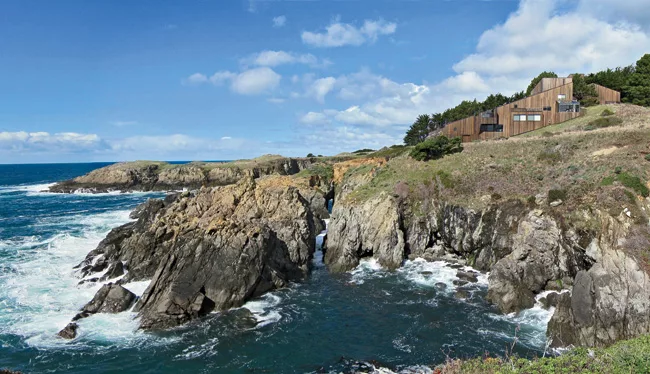
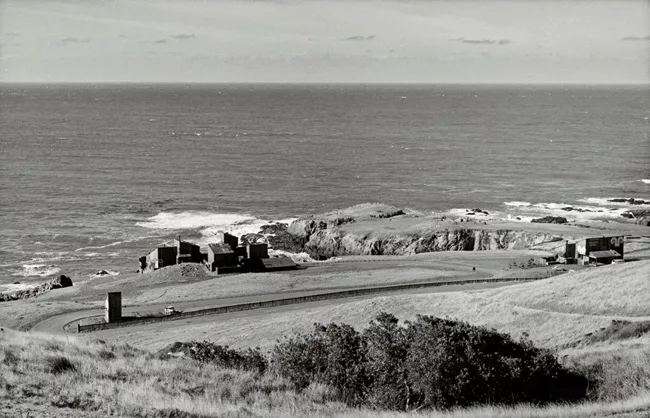
| Condominium One, in all its rustic majesty, presides over an outcropping above the Pacific. |
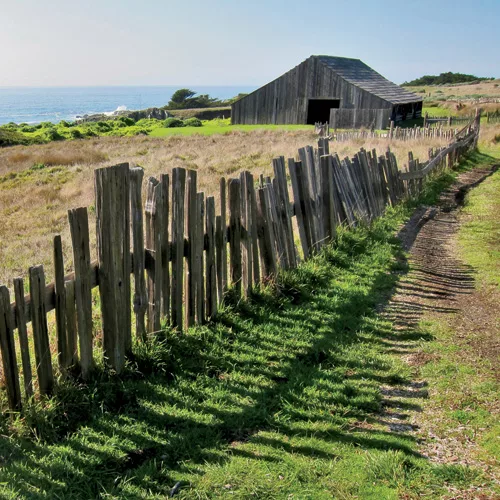
If you drive north from San Francisco, along the wildly beautiful Sonoma coast beyond the Russian River, you eventually arrive at the Sea Ranch. Stretching along 10 miles of rugged cliffs that hover above the crashing waves of the Pacific, this enclave of weathered weekend houses began as a unique experiment in design. Scattered over 4,000 acres, the community was planned in the idealistic spirit of the 1960s—it was a satellite, in a way, of the countercultural capitals of Berkeley and San Francisco, 100 miles to the south. Even the name—the Sea Ranch—conjured up a romantic utopia and spoke to the primacy of the natural surroundings, while the simple early houses, clad in boards or shingles, with shed roofs, nestled self-effacingly into the windswept meadows or forest hillsides. The highly prescribed architecture of the development meant that the structures were “not to be married to the site but to enter into a limited partnership with it,” as the original architects put it.
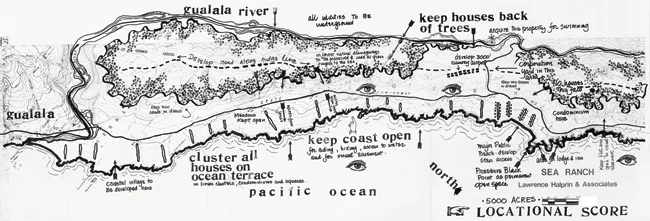
Those prescriptions were filed as detailed covenants with the property's title in May 1965. Now, as the Sea Ranch celebrates its 50th anniversary, both newcomers and long-time residents are still grappling with the ideals set forth by its original planner, Lawrence Halprin (1916'2009), the landscape architect. He had been hired by Oceanic Properties, the Hawaii-based developer that bought the timber and grazing lands for $2.3 million in 1963, to plan a new town of second homes. Halprin's enchanting hand-drawn sketches depict his careful study of the Sea Ranch's winds, tides, sunlight, wildlife, and vegetation, and contain the powerful central ideas of the community he envisioned. His principles were based on both natural and human ecology. He wanted to maintain the landscape, with its grasses and old cypress hedgerows—and to ban non-native plants and suburban-style lawns and to “avoid prettiness.” Even more important, his plans called for siting the unprepossessing houses in clusters that allowed open views of the sea and left large parts of the meadows as untouched common land for the community. “The usual curvilinear 'cutesy-pie' subdivision plan is anathema,” wrote Halprin, who was inspired by the model of the kibbutz and a belief that the Sea Ranch should attract a diverse socioeconomic group of residents.
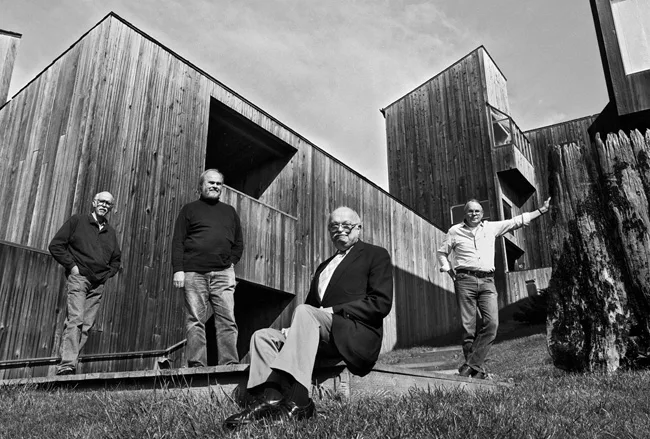
Halprin recommended to Oceanic the first architects to build on the land, which had been mostly populated by sheep: Joseph Esherick and the young Berkeley firm of Moore Lyndon Turnbull Whitaker (MLTW), whose design for the famous Condominium One brought them wide acclaim. Just the idea of a condo in the country was radical; the original plans called for others, but this 10-unit building was the only one realized. Designed for a high, exposed outcropping, the building is a series of strong, clustered orthogonal forms—but with shed roofs—that march in a procession down a slope overlooking the sea. Built around a courtyard, no two condos are alike. In his essential book The Sea Ranch: Fifty Years of Architecture, Landscape, Place, and Community on the Northern California Coast (2014, with photography by Jim Alinder), former MLTW principal Donlyn Lyndon, FAIA, describes how he and his partners—Charles Moore, William Turnbull, and Richard Whitaker—experimented with the design of the complex volumes by stacking sugar cubes from the office coffee service. The exterior was clad in vertical redwood boards, left to weather like the old ranch barns, while the multilevel light-filled interiors, with their stunning views, revealed the heavy timber structure in ways that were both powerful and playful.
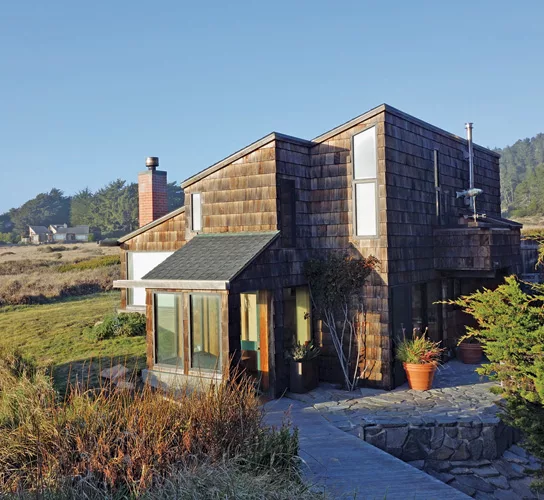
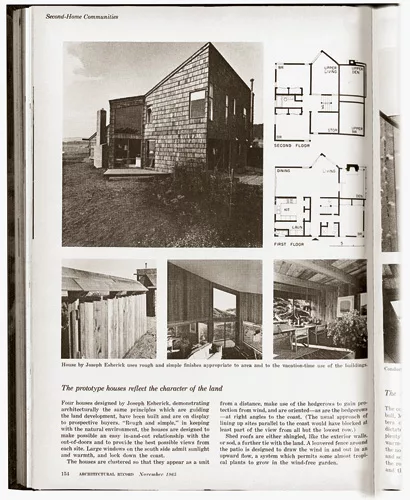
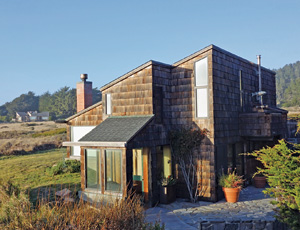
In contrast to the rustic majesty of Condominum One, which won the AIA Twenty-five Year Award in 1991, Esherick designed six modest houses, in a loose composition along a sheltering hedgerow in the meadow. With roofs sloping into the wind, they are deceptively simple. The smallest, he built for himself: its footprint is a mere 875 square feet, but with the ingenious creation of multilevel spaces, it feels both spacious and cozy. In a laudatory article about the Sea Ranch in November 1965, Architectural Record described how the bioclimatic studies of wind and solar radiation had inspired the structures' design.
Yet Esherick's houses were a little out of step with the era. While some critics applauded the simple wood-clad timbered dwellings—cousins of the Bay Area's regional modernism—they were hardly considered cutting-edge. As the late critic Donald Canty points out in an essay in Lyndon's book, these buildings of natural materials, designed in response to the environment, were at odds with the sophisticated “object” houses of high modernism. Canty reports that a colleague at Architectural Forum, where he was then an editor, dismissed Esherick's work as “stick architecture.”
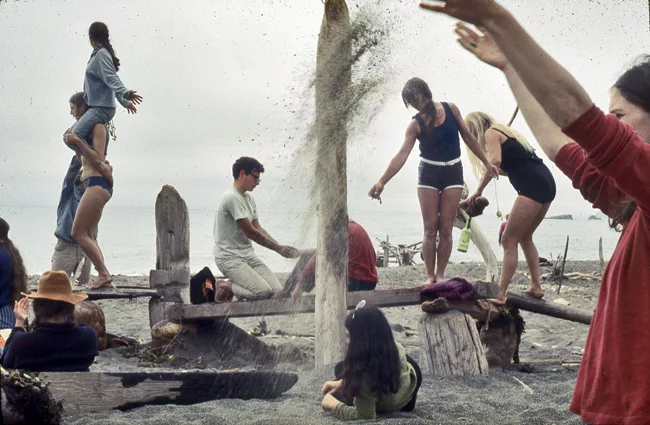
Not that Halprin and his colleagues would have been likely to care about such criticism. In the early days of the Sea Ranch, their utopian ideals were still playing out. The communal values—with residents coming together for consensus on common issues—were expressed in the interdisciplinary workshops that Halprin and his wife, the choreographer Anna Halprin, now 94, held at the Sea Ranch, where the couple built a house, designed with Moore and Turnbull. Anna created dances that involved ordinary people to whom she gave movement instructions, and in a project called Driftwood Village in 1968, participants danced around simple structures on the Sea Ranch beach. Photographs documenting that event and others like it were shown in an exhibition at the Graham Foundation in Chicago last year and make the Sea Ranch look like a countercultural summer camp for grown-ups.
But there was a paradox. For all the open, egalitarian philosophy behind the community, there was, inevitably, the scent of elitism wafting through the Bishop pines. Not only was it composed of second homes, but it was caught up in a bitter state-wide controversy over beach access. Amazingly, when the Sea Ranch was being planned in the early 1960s, only 100 miles of California's 1,300-mile-long coastline was accessible to the public, and environmentalists feared this private patch of paradise would block beach access. Years of legislative and court battles put a damper on most new development here. By the time the issue was finally resolved in 1981—and public trails were cut through the property down to the shore—land values had soared. The Oceanic company sold out, and future development tended to stray from the Halprin concept of modest houses clustered together.
Today, there are about 1,800 houses, and many of the newer ones barely adhere to the letter, much less the spirit, of the covenants. Yes, they may be clad in gray wood, but some are the faux light gray that comes from paint, not time and weather, and many are large and ungainly.
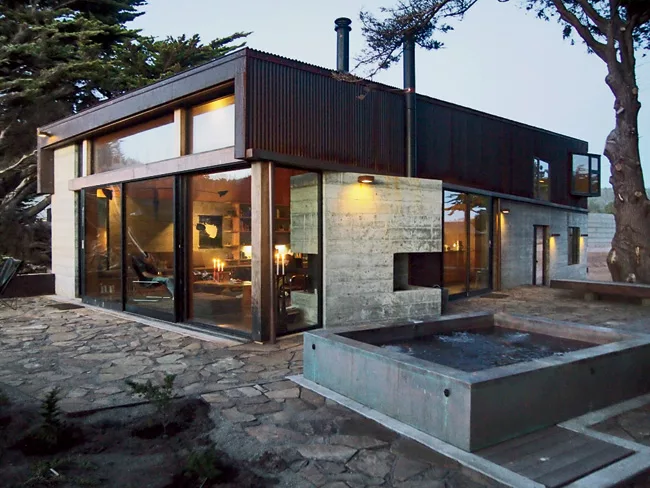
Yet the architect Donlyn Lyndon, 79, who lives part-time at the Sea Ranch, is an active keeper of the flame; so are other homeowners in the Sea Ranch Association, which holds democratic Halprin-style workshops about the future of the place (not necessarily with dancing on the beach). Lyndon has continued to design houses that embody what he and his colleagues intended in scale and craftsmanship. Just as heartening is an innovative new dwelling that doesn't faithfully comply with the dominant material palette but is simply good architecture: a handsome house designed by Norman Millar and Judith Sheine that fits beautifully into its cliffside site, clad in concrete and Cor-Ten.
Despite the imperfections of its evolution over half a century, the influence of the Sea Ranch is unmistakable. Long before the current popularity of vernacular modernism and the push for sustainable architecture, the houses and planning here exemplified the power of design inspired by place. Brian Mackay Lyons, the award-winning Nova Scotia'based architect, who worked for Charles Moore from 1980 to '82, was a frequent visitor in those days. “Our work wouldn't be possible without the Sea Ranch,” he says. And the land-management plan that RECORD extolled in 1965 as “dynamic conservation” was far ahead of its time. Though mankind's footprint on the land has occasionally been clumsy, the beauty of the wild acres of meadows and forests, the sea and the sky, triumph over all.
Looking for a reprint of this article?
From high-res PDFs to custom plaques, order your copy today!