Modernism, Latin Style
A revelatory exhibition at MoMA in New York highlights South America's innovative architecture
Sixty years after its exhibition Latin American Architecture Since 1945, the Museum of Modern Art is picking up the story where it left off. But the sequel, Latin America in Construction: Architecture 1955–1980, is on a different order of ambition. Where the first show covered a mere decade, this one spans a quarter of a century during the most architecturally fertile period in the region's history. As a backdrop, two factors propel the architectural agenda. The first is unprecedented urbanization, with cities such as São Paulo and Mexico City doubling in population every decade. The second is a furious process of modernization. The fact that the force behind much of the architecture in this show is the state—whether elected governments or military dictatorships—explains why the curtain comes down in 1980, with the arrival of market-driven neoliberalism. One might call this Latin American Architecture from Henry Russell Hitchcock to Ronald Reagan.
What no visitor to the show can fail to notice is the scale of vision demonstrated by nations that, in Octavio Paz's words, were “condemned to be modern.” Taking in the 13-foot-long drawing of Rio's Flamengo Park by Affonso Reidy and Roberto Burle Marx, it finally dawned on me what a bold and extravagant plan that was. But it is through another type of master plan that the curators drive their point home: the university campus. Crucial to the act of nation-building was the education of a new professional cadre, and these campuses were conceived as ideal cities on a sweeping scale. Carlos Raúl Villanueva's Universidad Central de Venezuela, in Caracas, is a tropical idyll of landscaped parkland, with covered walkways, monumental architecture, and decorative murals. Like its counterpart, the Universidad Nacional Autónoma de Mexico (UNAM), in Mexico City, it is a Unesco heritage site.
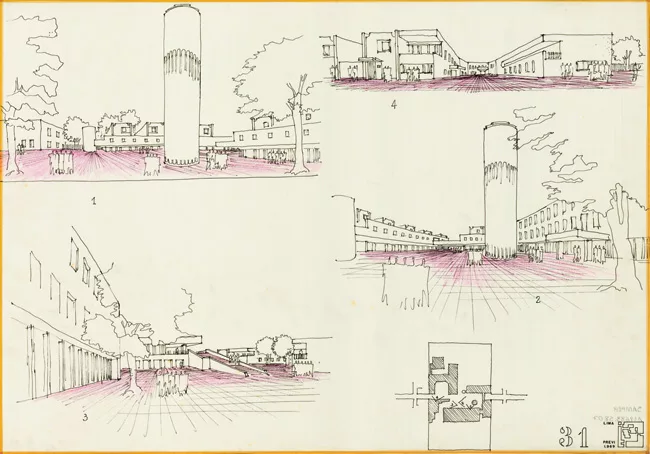
No survey of the period would be complete without the vast modernist housing estates with which the governments of the day attempted to address the urban population explosion. And though present, the most famous of these—Mario Pani's enormous Nonoalco-Tlatelolco in Mexico City and Villanueva's earlier 23 de Enero in Caracas—are relegated to unlabeled images on the exhibition's graphic timeline. Throughout the show, the curators have downplayed what they consider to be obvious in favor of lesser-known projects. While perhaps they expect rather a lot of the audience, the advantage is that they create room for other work to be reevaluated. Most significantly, PREVI, the experimental housing project in Lima (1969), gets pride of place. That PREVI has been rediscovered owes much to the fact that its central concept— houses designed for incremental expansion by residents—fits a contemporary ethos of participative design. And while the international architects who took part (James Stirling, Charles Correa, Georges Candilis, Kiyonori Kikutake, Kisho Kurokawa, and Fumihiko Maki, among others) normally get all the attention, here it is the Colombian Germán Samper who comes to the fore, redressing the balance.
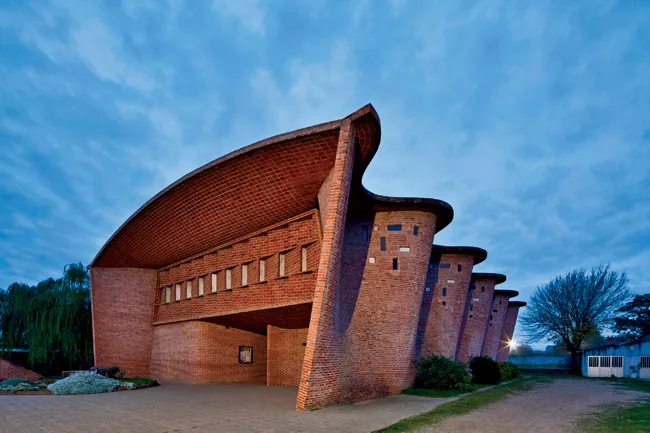
There are also fragments that allude to much bigger stories. One such is a simple sketch, presumably by or with Carlos Nelson (unnamed), of a floor plan for a house in the Brás de Pina favela in Rio. One of the fathers of participative design, Carlos Nelson prefigures a later generation's commitment to working in the favelas. Like PREVI, Brás de Pina illustrates the radical ways Latin America was beginning to rethink housing and the role of the architect by the late 1960s. And such originality is very much the crux of what the exhibit is trying to communicate. Far from the show's being a tale of how Latin America absorbed the International Style, the curators highlight the region as a crucible of innovation. While many of the architects here were educated or indeed born in Europe, they developed their own language—witness the structural inventiveness of Uruguay's Eladio Dieste or Venezuela's Jesús Tenreiro—and by the 1960s Mexico is even exporting prefab schools to parts of Europe and Asia.
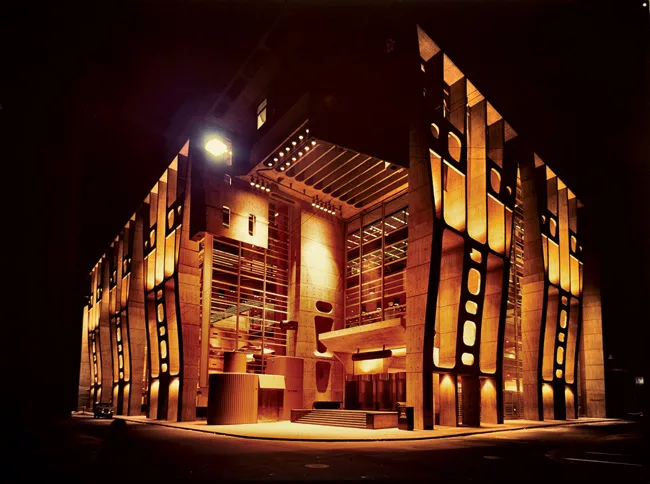
This structural and spatial originality is exemplified by Clorindo Testa's Banco de Londres in Buenos Aires. Testa's brutalist structure is not just arresting as form; it is the building's porosity that is so unusual, with its open hall that treats a bank as civic space—hard to imagine these days. Indeed, brutalism and grand civic gestures go hand in hand in Latin American architecture of the period. One thinks of João Vilanova Artigas's imposing architecture-faculty building at the University of São Paulo, whose vast atrium was so important to student politics during the dictatorship, or the public plaza beneath Lina Bo Bardi's raised Museu de Arte de São Paulo.
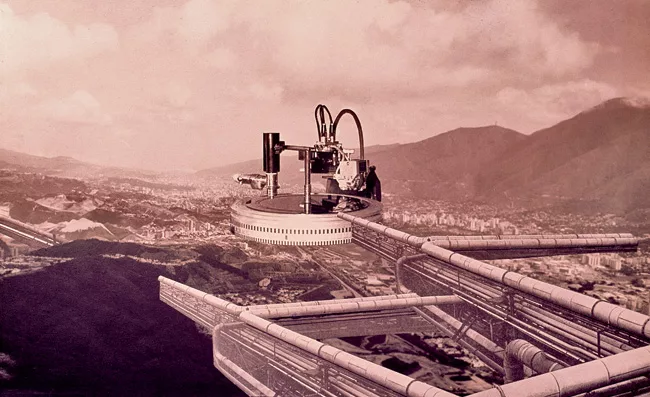
Interestingly, the word utopia emerges only at the end of the show, long after Brasilia is a fact. The final section is a dreamland comprised of Valparaiso's Open City school of architecture, where poetry and performance are as important as building, and the dystopian collages of Jorge Rigamonti depict Venezuela as a technical fantasia of resource extraction. The Argentine Amancio Williams has the last word, with “The city that humanity needs” (1982), a series of drawings of a city as a ribbon wall weaving through green pampas—as the state gives way to the market, buildings give way to paper architecture.
It is in keeping with the tone of the exhibition that Williams's drawings overshadow Oscar Niemeyer's model of the Communist Party HQ in Paris. Niemeyer, the household name, is almost invisible here—too familiar. Williams, on the other hand, emerges as an éminence grise— his drawing of a suspended office building anticipates Testa's bank by more than a decade. These threads and layers are what the show is good at.
This is a rich, kaleidoscopic, and nuanced portrait of the era. And the archival material is sensational—here you can see Lucio Costa's original entry to the Brasilia competition next to those by Artigas and Rino Levi. But the artifacts are occasionally privileged over clarity. How useful is Juan O'Gorman's painting for the mural of the UNAM library without a photograph showing what a controversial building it created? This is a show for aficionados and posterity. It was a hefty undertaking, with four curators—led by MoMA's Barry Bergdoll—and at times it buckles under its own weight.
In the end, though, mass and complexity are exactly what the curators want to communicate. Their disclaimer is in the title— “in construction” refers not just to pouring concrete but to the architectural history of the period, which is still a work in progress. Places in the architectural canon are up for grabs, and many of these architects are long overdue.
Radical Cities: Across Latin America in Search of a New Architecture.
Looking for a reprint of this article?
From high-res PDFs to custom plaques, order your copy today!