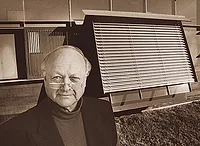
Beyond Habitat: Interview with Moshe Safdie, 2015 AIA Gold Medal Recipient
Architects & Firms
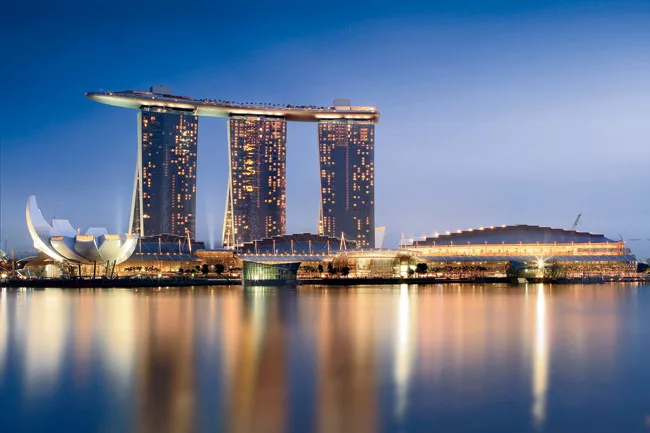
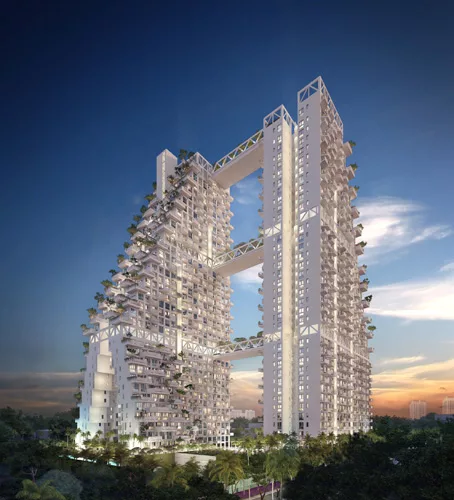
Marina Bay Sands, the resort and mixed-use development in Singapore (2006–11) that recast Safdie’s practice.
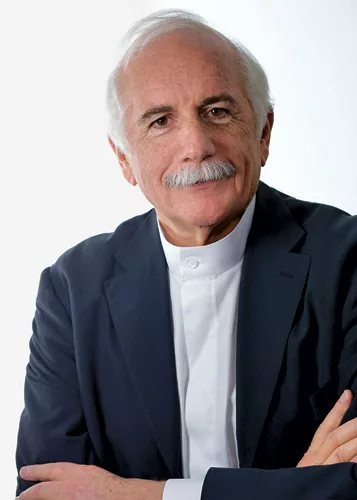
This month, Moshe Safdie, 76, will receive the 2015 AIA Gold Medal. He first burst onto the architectural scene with his innovative design for Habitat, the clustered, prefabricated housing units built for the Montreal Expo in 1967. A graduate of McGill University's architecture school, the Israeli-born Safdie had been an apprentice to Louis Kahn in 1962–63, before he established a practice in Canada. After designing such projects there as the National Gallery of Canada in Ottawa, he moved his office to Boston, where he ran the urban-design program for Harvard's Graduate School of Design from 1978–84. Still based in Boston, he also has offices in Jerusalem, Shanghai, and Singapore. Among his major works are the Yad Vashem Holocaust History Museum in Jerusalem (1976–2005), the Crystal Bridges Museum of American Art in Bentonville, Arkansas (2005–11), and Marina Bay Sands in Singapore (2006–11). He continues to design large-scale mixed-use projects in Asia and the Middle East and has plans for a residential tower for lower Manhattan. He spoke with RECORD's editor in chief, Cathleen McGuigan.
Moshe Safdie: You know, it's been incremental. With Habitat and subsequent projects, I dealt with radical ideas about urbanism and housing. For a long time, developers were afraid to engage me—they saw me as a kind of dreamer. Then we established ourselves as architects of cultural buildings. And, based on track records like the National Gallery in Canada [1983–88], we started getting commissions around the world in the cultural realm.
But the breakthrough to getting engaged in mixed-use buildings, and in dense urbanism, was Marina Bay Sands. The commercial viability recast us as a practice. Now we have the opportunity to go back 50 years and start realizing ideas that were incubating after Habitat.
Was this a strategy on your part?
No, not really. The only strategic thinking that I've done was not to specialize. As we started to get too many museums, I tried to get a library, and as we were doing libraries, I tried to get an airport. Also, very few offices deal with the range of urbanism that we do, as well as architecture.
How did you get the Marina Bay Sands project?
I got to do Marina Bay Sands because [the developer] Sheldon Adelson loved Yad Vashem, and on the opening night, he offered me the commission. It was an invited competition—I would say that much more than half of what we do comes from competitions.
You now have projects on at least three continents, but you've managed not to balloon beyond about 100 people in your office. How do you manage that?
First, I would say that the practice really was influenced by my apprenticeship with Kahn in the 1960s. What I learned from Kahn is, you get involved in every phase of the work—from the sketch to the detailing of the doorknobs—with equal passion. I decided that's the way I want to make architecture. So that limits what I can be involved in personally.
So you make all the design decisions.
Yes—but that does not diminish the extraordinary contribution of my staff, many of whom have been with me 20 or 30 or 40 years. And the second component is to develop very close relationships with the associate architects with whom we collaborate locally.
How does that work?
We bring their people to Boston—where we do all the design—and they spend months with us during the design phase so that they buy in to the project and become part of the design effort. The house next door to the office is our hotel. And when we turn over the production and oversight, we always send our people to the site to work in their office through construction—always. No exceptions. And that way we have a seamless, harmonious relationship.
And there's one way you really differ from Louis Kahn—you're not broke!
That's true.
You've made your model of practice very successful.
I think it has to do with the fact that, particularly through the design phases, we are very, very efficient. We work very fast as a team. I'm very fast as a decision-maker. I don't procrastinate. It's not in my nature, you know? And in a larger firm, there's a bigger bureaucracy, a more complex process.
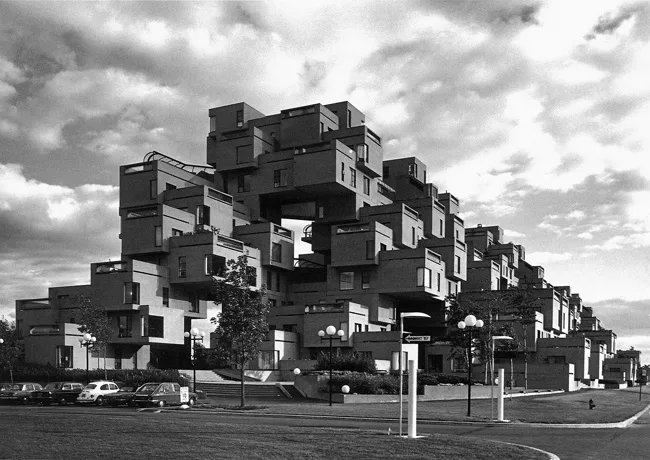
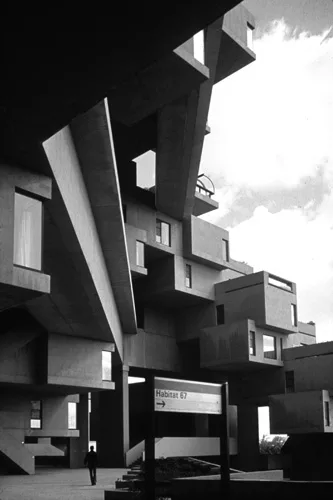
Habitat is almost 50 years old now. It's extraordinary that your very first project propelled you to international renown—and landed you on the cover of Newsweek. And some critics—this won't be a secret to you—think that it remains your best project. What was the impact of Habitat on your thinking going forward? There are clearly aspects of it that appear in some of your most recent designs.
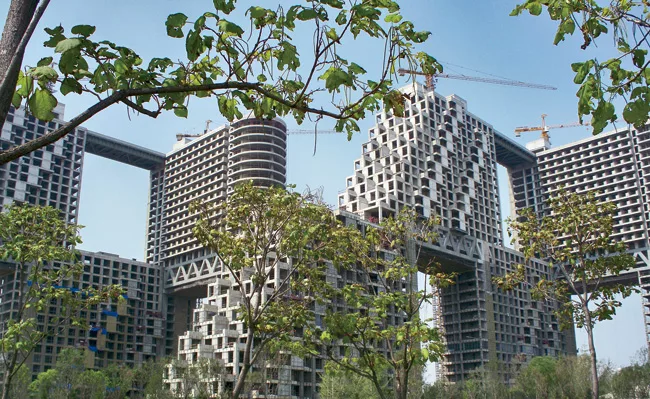
It's still difficult to understand how, at age 25, without having built a single building, that something would coalesce—if I can say with all humility—that is such a mature and complex work. It's extremely sophisticated—technically, conceptually. A lot of people were speaking about terraced buildings and new spatial relationships. Many of the ideas that were in the air—and some that were not—coalesced into a building that combined the technology of prefabrication and concepts of the three-dimensional organization of space in a new kind of, so to speak, urban zoning. It was a complete rethinking of what a multiple high-rise structure could be. It opened the way for others and for myself, to a whole range of urban and architectural ideas. Hence its power. For the public, its imagery conjured up hill towns, villages, hanging gardens—all archetypal stuff that wasn't present in architecture at that moment.
Personally, it meant that I'd achieved something early in life that I spent the rest of my life aspiring to, which is okay. On the journey, I discovered many other issues that Habitat did not address, such as regionalism and contextualism. I learned that when building in Jerusalem, and then I applied it to the Canadian work and after, depending on where I was building.
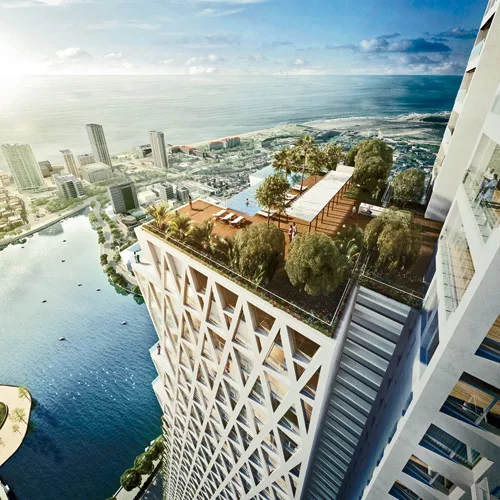
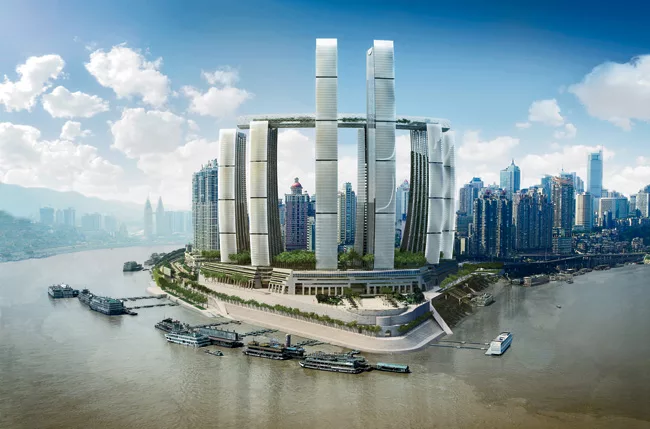
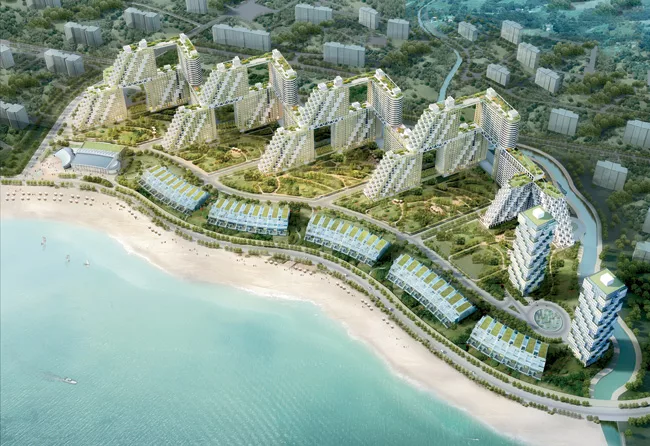
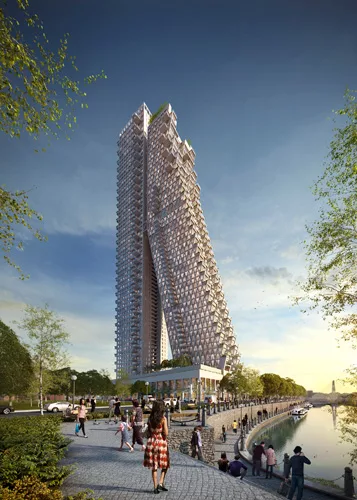
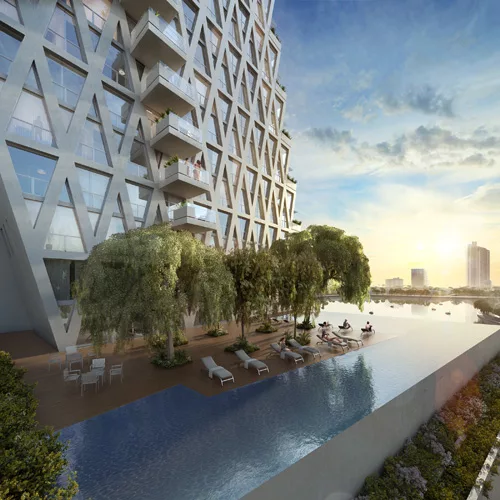
You can see echoes of Habitat on a much vaster scale in the housing complexes you're designing today for places like Colombo in Sri Lanka, and Golden Dream Bay, in 2010, China, with its terraces, gardens, and indoor-outdoor spaces. But there is the issue of scale. Your mixed-use residential project in Chongqing, China, now under construction, will be the biggest work you've built, right? You talk a lot about the values of urbanism and the human experience of architecture. How do you design a megaproject like Chongqing around human scale?
The strategy has to do with light, air and openness, and the hierarchy that gives a complex project a sense of orientation and visibility. These problems actually occur in one form or another in every project, but when you go to a project like Chongqing it becomes even more challenging. The podium has millions of square feet in it. There are eight towers and many entrances, subways and bus stations. You have to give it a structure, so that people know where they are. You've got to manage to get daylight in and some contact with the exterior at every level. You position towers to optimize view and light. You orient functions, for example, so that housing has a southern exposure. A whole series of morphological imperatives are necessary to resolve when you do dense urbanism.
Regrettably, a lot of them don't get enough attention these days. The emphasis is much more on the formal qualities. Yet when you start manipulating towers to optimize views and light, you get very interesting forms.
What about context in places where there really is very little historic context, such as a rapidly expanding megacity like Chongqing?
In Chongqing the context around it is just the wild, contemporary city, growing like weeds. So you want to give it deeper meaning, and I thought well, this site is where the city originated—a great shipping center on the Yangtze. So the inspiration was to create something that had a sense of a gateway and of movement. The project almost appears to be in the motion of a sailing ship—all the way to the deployment of sun screens that look like sails. We curved the buildings in the downriver direction so the complex seems to be pulling the whole city along the river.
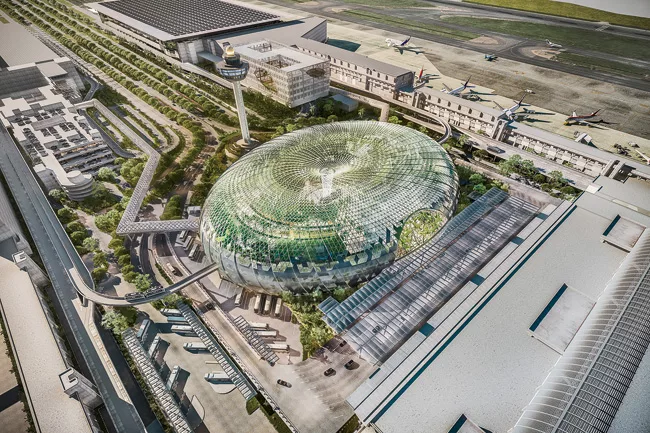
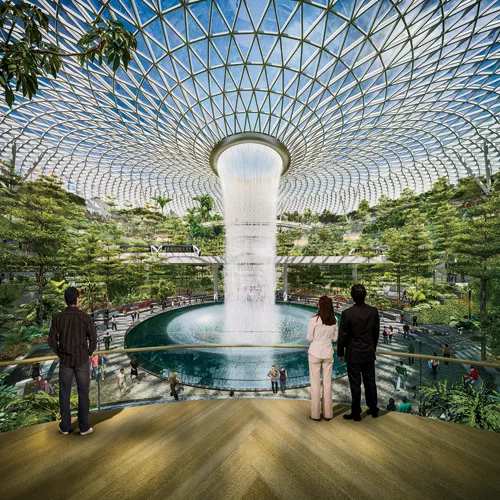
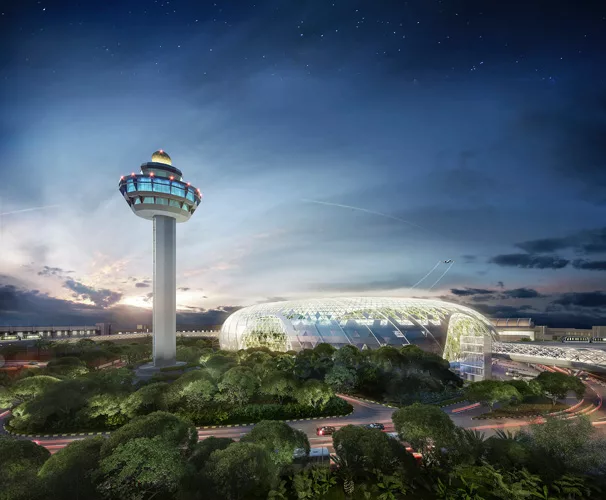
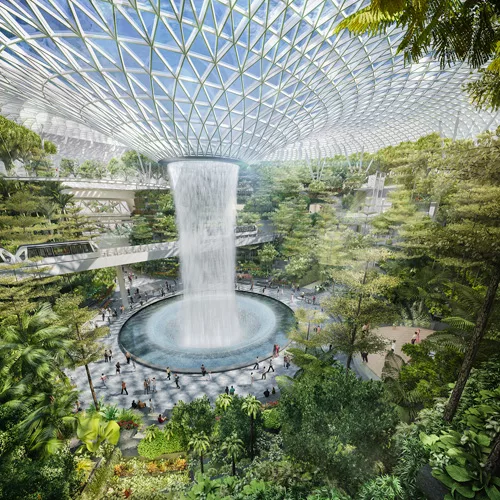
Talk about the Jewel Changi Airport project in Singapore, which is not an air terminal but a huge destination park under an immense glass dome.
It's almost 2 million square feet, with retail, a rail line, and a bus terminal. But we wanted it to be very special, so my proposal was to create a great garden.
That's an unusual program for an airport. Do you find you have more freedom working in places like the Far East than in North America? Are they more open, despite what the Chinese president said about no more weird buildings?
They're much more open. In Asia, they associate modern, contemporary buildings with progress. This has a good side and a bad side. In my case, I have been able to advance adventurous ideas that I certainly would not have been able to do in North America. The negative side of it is that, because anything contemporary and unusual is associated with progress, it can be misused. So their openness to new ideas and experimentation brings with it a heavy responsibility for the designer.
Considering that you control every aspect of design in your office, do you have a succession plan?
Yeah. In the last five years I've brought in the younger generation in my practice, the ones I have felt had the greatest potential, and I've given—or sold them, technically, but in a very discounted way—a certain percentage of ownership in the firm. I've done it a little differently than the standard kind of formula, because I want them to feel that they have the potential to take this practice and continue it. Obviously, I hope they would complete the projects that we have, because at any given time there's about five years of work on the table in the office. But I do want it to become its own entity, whatever shape it takes. So the practice will continue to bear my name for five years. After that, they need to rename it.
I have just one last question, kind of a silly one. Certain designers can be counted on to wear distinctive shirts—like the late Massimo Vignelli's black tunics or Richard Rogers's bright colors. You always wear those beautifully crisp white shirts. What's the story?
About 40 years ago, it was the era of Mad Men and everybody wore ties, right? I figured, if I made myself a collarless shirt, then I can button it and I don't need ties. So I designed the shirt and the same tailor in Montreal has been making it ever since. All we discuss is whether it's going to be the heavy cotton or light cotton or twill and that's it.
Well, your practice and your projects may have grown exponentially, but some things never change. Thank you so much.
|
Sky Habitat, Safdie Architects from Neoscape on Vimeo. |
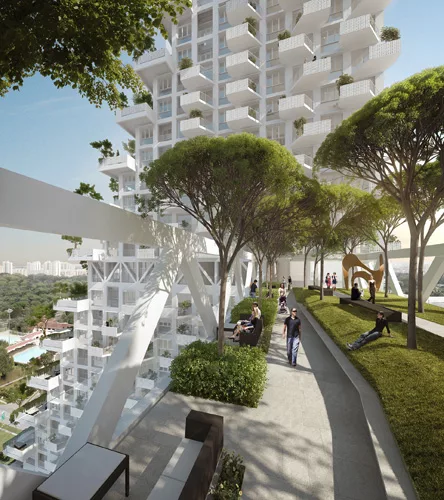
| A visualization of Moshe Safdie's Sky Habitat in Singapore. |
Looking for a reprint of this article?
From high-res PDFs to custom plaques, order your copy today!