Architectural Record
search
cart
facebook twitter linkedin youtube
  • Sign In
  • Subscribe
  • Sign Out
  • My Account
Architectural Record
  • NEWS
    • Latest News
    • Awards
    • Interviews
    • Obituaries
    • Podcasts
      • Design:Ed Podcast
      • Sponsored Podcasts
  • OPINION
    • Book Reviews / Excerpts
    • Exhibition Reviews
    • Forum
  • EXCLUSIVES
    • Videos
    • Design Vanguard
    • Top 300 Firms
    • Sponsored Content
    • Sponsored eBooks
    • From the Archives
  • CONTINUING ED
    • Editorial Continuing Ed
    • CE Center
    • CE Academies
  • PROJECTS
    • Buildings By Type
    • Reuse & Renovation
    • Museums & Arts Centers
    • Colleges & Universities
    • Multifamily Housing
    • Interiors
    • Lighting
    • Kitchen & Bath
  • HOUSES
    • Record Houses
    • House of the Month
    • Featured Houses
  • PRODUCTS
    • Products by Category
    • Record Products of the Year
    • Latest Products
  • EVENTS
    • Dates & Events
    • Record on the Road
    • Innovation Conference
    • Sustainability in Practice
    • Women In Architecture
    • Webinars
    • Ad Excellence Awards
    • Submit an Event
  • CONNECT
    • Ask RECORD AI
    • Newsletters
    • Contact
    • Advertise
    • Editorial Calendar
    • Store
    • Customer Service
  • SUBMIT
    • Submission Guidelines
    • RECORD Competitions
  • MAGAZINE
    • Subscribe
    • My Account
    • Digital Edition
    • Current Issue
    • Firm Pass
    • Historic Archive

Expo 2015 Milan

By Fred A. Bernstein
Size isn&#8217;t everything. The UK learned that at the 2010 Shanghai Exposition with its <a href='http://archrecord.construction.com/ar_china/2010/shanghai_world_expo/pavilions-2.asp' target='_blank'
Expo 2015 Milan
United Kingdom
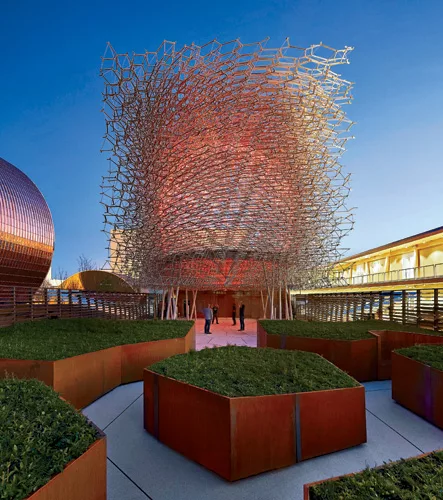
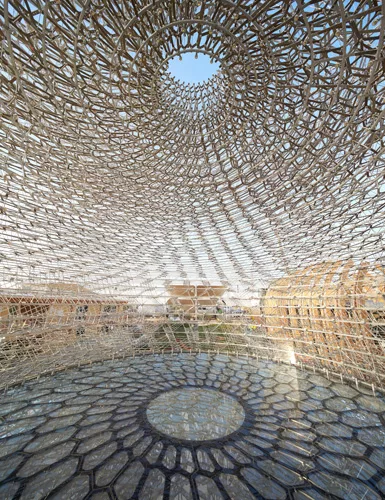
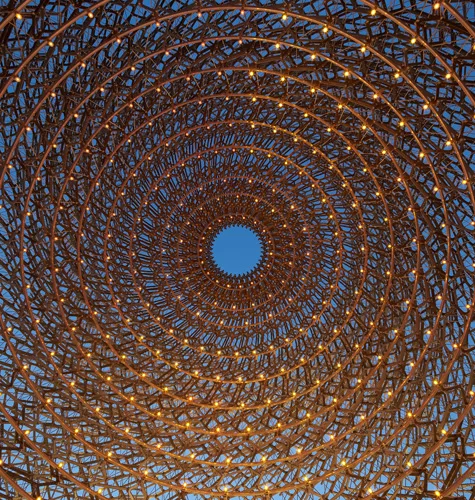
Size isn’t everything. The UK learned that at the 2010 Shanghai Exposition with its Seed Cathedral, a diminutive yet stunning pavilion by Thomas Heatherwick seen in photographs around the world. This time, British artist Wolfgang Buttress designed and built an aluminum erector set–like “beehive” with fellow Britons—engineer Tristan Simmonds, the architecture firm BDP, and the fabrication team at Stage One. While Heatherwick’s pavilion occupied a giant plinth, this one sits on a narrow lot, cleverly landscaped to suggest a meadow.
Photo courtesy UKTI
Since 1999, the U.S. has been hobbled by a law that prevents government funding of expo pavilions. That means America either doesn&#8217;t participate, as in the 2000 Hannover Expo, or depends on corp
Expo 2015 Milan
United States
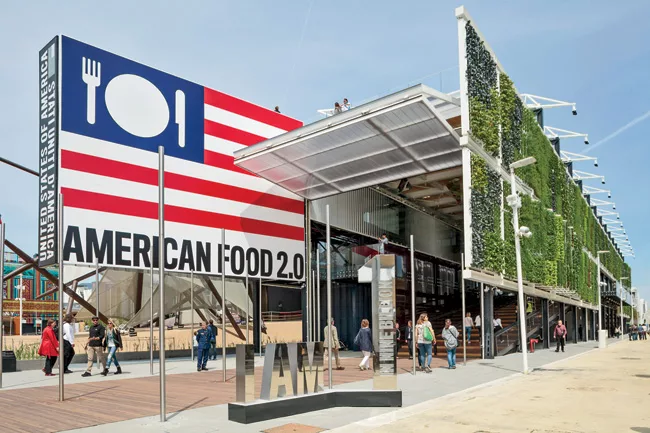
Since 1999, the U.S. has been hobbled by a law that prevents government funding of expo pavilions. That means America either doesn’t participate, as in the 2000 Hannover Expo, or depends on corporate sponsors. This time, New York architect James Biber built a handsome, educational, and largely ad-free building on a shoestring budget. A huge U.S. flag with a knife and fork in the blue field (part of a crisp graphic identity created by Michael Bierut) entices visitors. So, too, does a 7,200-square-foot green wall, where vegetables, grains, and herbs grow on metal frames that swivel as the sun changes position. Visitors move up a large ramp made of recycled Coney Island boardwalk planks, to exhibitions on agriculture and nutrition by Tom Hennes of Thinc Design. Hennes also produced a series of films about the American way of eating, projected on multiple screens around the ground floor.
Photo © Tom Hennes
Though Jacques Herzog resigned from the Expo planning team, he agreed to design a pavilion for his friend Carlo Petrini, the founder of the Slow Food movement. On opening day, a dozen people milled ar
Expo 2015 Milan
Slow Food
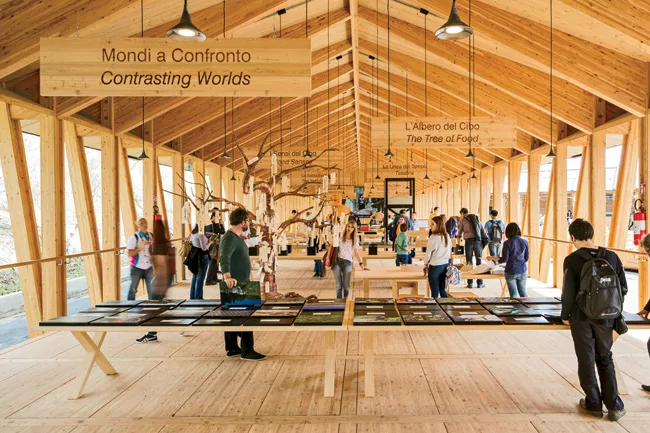
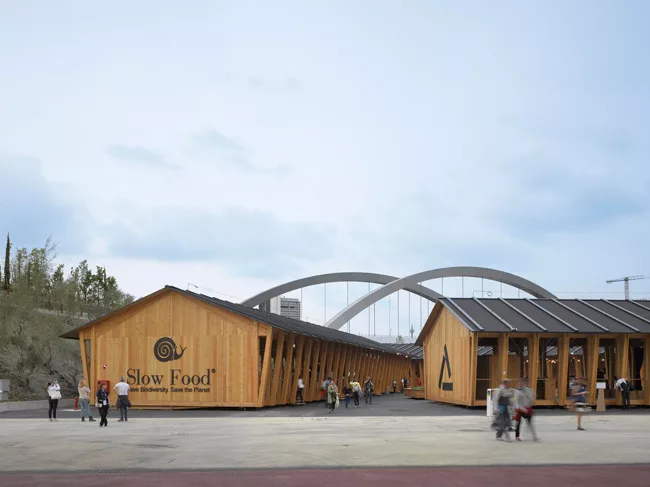
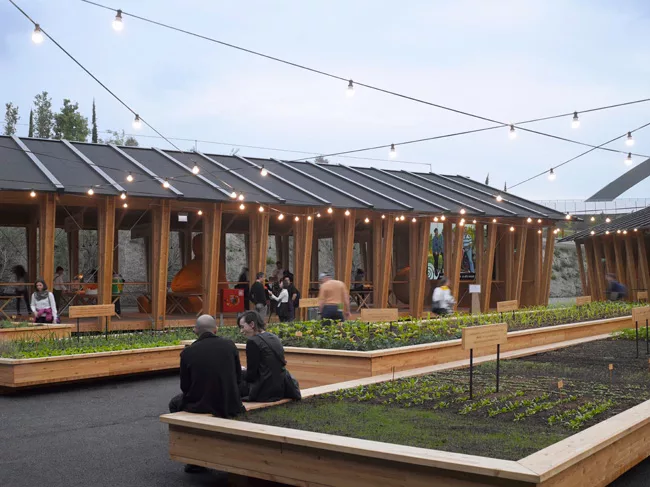
Though Jacques Herzog resigned from the Expo planning team, he agreed to design a pavilion for his friend Carlo Petrini, the founder of the Slow Food movement. On opening day, a dozen people milled around the pavilion (three buildings arranged around a triangular vegetable garden), sampling its offerings—”slow wine” and “slow cheese” served at a long counter. Though the pavilion, filled with informative signage, never really explains why slow is better, the architecture does convey what Herzog intended for the standardized pavilions. The simple, cabin-like structures the architect calls shacks are made almost entirely of ordinary lumber and masterfully detailed. When the fair is over, the long buildings will be transformed into a dozen cabins, possibly for school gardens where students can learn Petrini’s methods. Drawings and models illustrate how the transformation could occur: not slowly but fast.
Photo © Paul Raftery
The Chinese real-estate developer known for its architectural bona fides and a pavilion by Duoxiang Studio at the 2010 Shanghai Expo hired Daniel Libeskind, who designed a building that, surprisingly,
Expo 2015 Milan
Vanke
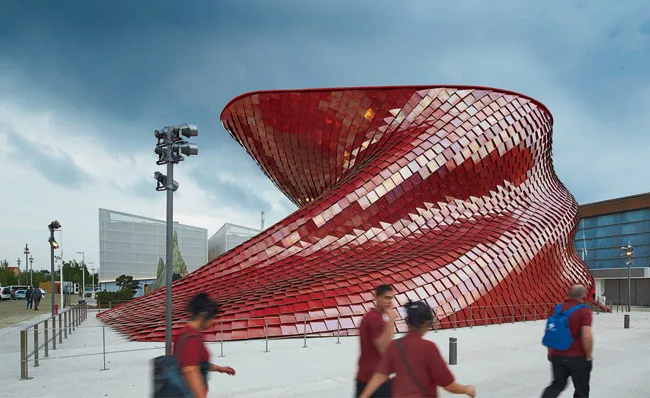
The Chinese real-estate developer known for its architectural bona fides and a pavilion by Duoxiang Studio at the 2010 Shanghai Expo hired Daniel Libeskind, who designed a building that, surprisingly, lacks acute—or any—angles. Its vaguely serpentine form is, according to Libeskind, derived from Chinese shitangs (dining halls), though the architect gave it a reptilian skin of metal-infused red porcelain tiles, which shimmers alluringly. Inside, a show by New York exhibition designer Ralph Appelbaum Associates looks at communal dining in China. Less communal is the VIP area, up one flight of stairs, where company executives wine and dine potential clients.
Photo © Hufton + Crow
Designed by Studio Nemesi of Rome, the 150,000-square-foot building is wrapped in white concrete panels molded to look as if they were spun from threads. The concrete, made by Italcementi, is said to
Expo 2015 Milan
Italy
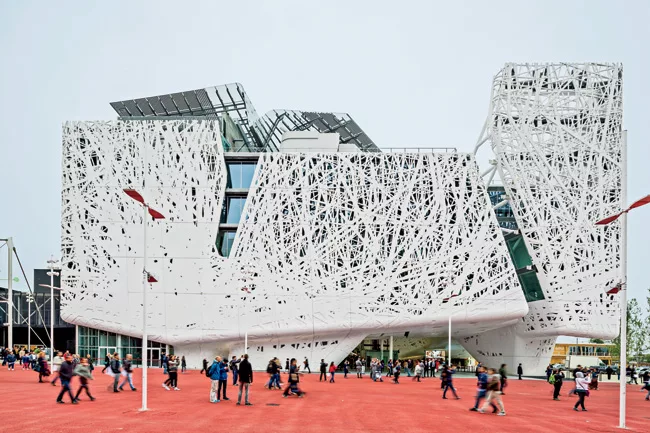
Designed by Studio Nemesi of Rome, the 150,000-square-foot building is wrapped in white concrete panels molded to look as if they were spun from threads. The concrete, made by Italcementi, is said to capture pollution and thereby reduce smog (a claim made for years about various “photocatalytic” building materials, which at the very least requires more research). The interior is less coherent. Rooms open onto a glass-roofed atrium with angled surfaces that suggest a poor imitation of a Frank Gehry design—and the exhibition seems purposely vague, with topic titles like “The Power of the Future.” It includes an interactive system that allows Italy’s great fruit and vegetable markets in Florence, Rome, and Palermo to communicate. This is one of a few buildings that will remain, as a center for technological innovation, after the expo closes. Its perma­-­nence will provide a chance to study whether the concrete actually reduces air pollution.
Photo © Paul Raftery
Dubai will host the next world expo in 2020, and a number of Persian Gulf countries are exhibiting at this one. Bahrain has the strongest showing, thanks to the young Dutch architect Anne Holtrop. Exp
Expo 2015 Milan
Bahrain
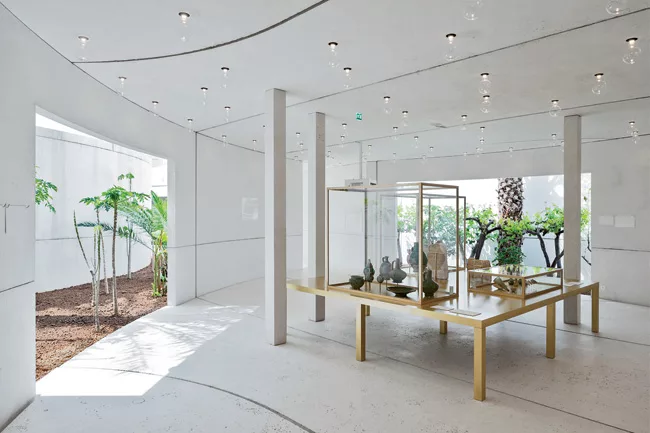
Dubai will host the next world expo in 2020, and a number of Persian Gulf countries are exhibiting at this one. Bahrain has the strongest showing, thanks to the young Dutch architect Anne Holtrop. Exploring how space can be shaped without being fully enclosed (the approach taken by Mies van der Rohe for the Barcelona Pavilion at that city’s 1929 expo), Holtrop designed a one-story building that houses Bahraini antiquities in rooms that open onto desert gardens. Made of precast concrete panels connected with elegant brass hardware, the pavilion can be disassembled and moved after the expo’s six-month run.
Photo © Iwan Baan
A significant number of Expo pavilions are built with glulam beams, a material that allows roofs to take dramatic twists and turns. New York&#8211;based architect Yichen Lu used glulam for the Chinese
Expo 2015 Milan
China
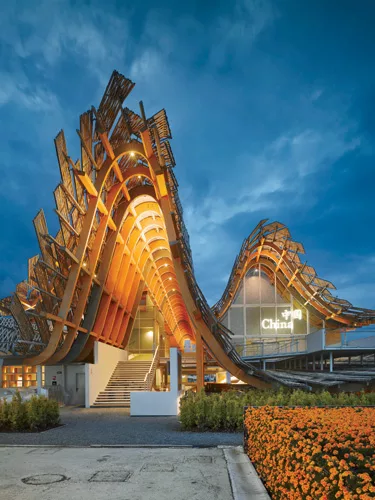
A significant number of Expo pavilions are built with glulam beams, a material that allows roofs to take dramatic twists and turns. New York–based architect Yichen Lu used glulam for the Chinese pavilion to mimic the shape of a Chinese mountain range and, at the back (sadly not visible to most fairgoers), the skyline of Beijing’s central business district.
Photo © Roland Halbe
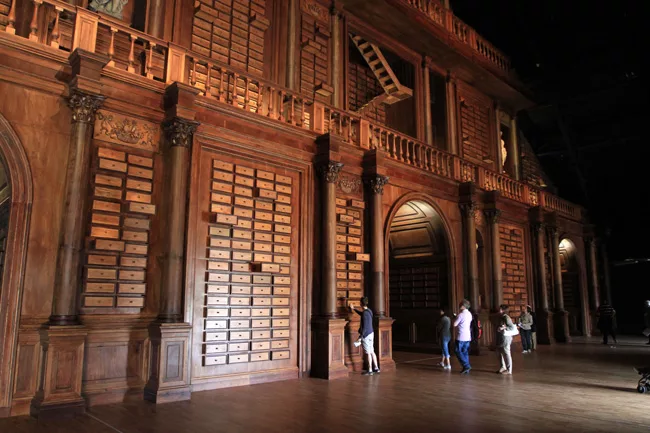
Pavilion Zero.
Expo 2015 Milan
Milan
Pavilion Zero.
Photo courtesy Expo 2015 / Daniele Mascolo
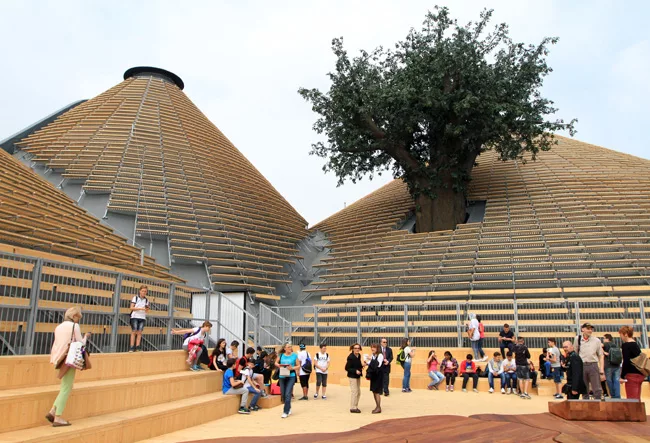
Pavilion Zero.
Expo 2015 Milan
Milan
Pavilion Zero.
Photo courtesy Expo 2015 / Daniele Mascolo
Pavilion Zero.
Expo 2015 Milan
Milan
Pavilion Zero.
Photo courtesy Expo 2015 / Daniele Mascolo
Located at the end of the Cardo, the 1,148-foot-long path that connects the Expo's north and south axis, and adjacent to the Italian Pavilion, the Tree of Life rises 121 feet and is reflected in the t
Expo 2015 Milan
Milan
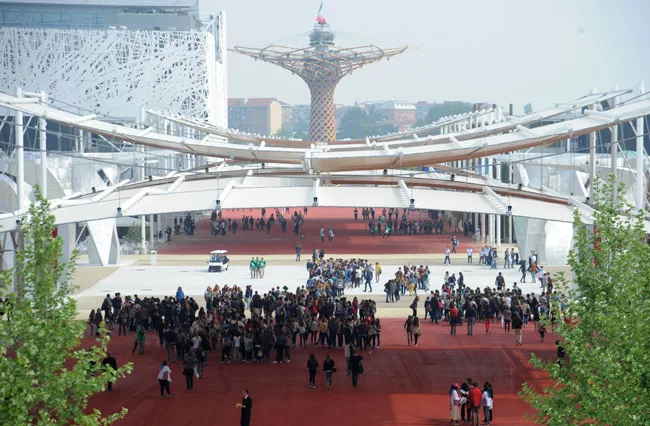
Located at the end of the Cardo, the 1,148-foot-long path that connects the Expo's north and south axis, and adjacent to the Italian Pavilion, the Tree of Life rises 121 feet and is reflected in the the LakeArena. Designed by Marco Balich for Orgoglio Brescia, a consortium of local businesses, the Tree of Life will be a reference point during the six months of the exhibition.
Photo courtesy Expo 2015 / Daniele Mascolo
Covered promenade.
Expo 2015 Milan
Milan
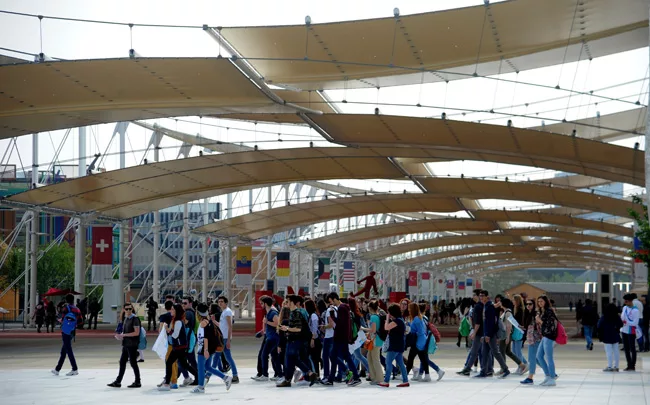
Covered promenade.
Photo courtesy Expo 2015 / Daniele Mascolo
Slow Food Pavilion.
Expo 2015 Milan
Herzog & de Meuron
Milan
Slow Food Pavilion.
Photo © Roland Halbe
Slow Food Pavilion.
Expo 2015 Milan
Herzog & de Meuron
Milan
Slow Food Pavilion.
Photo © Roland Halbe
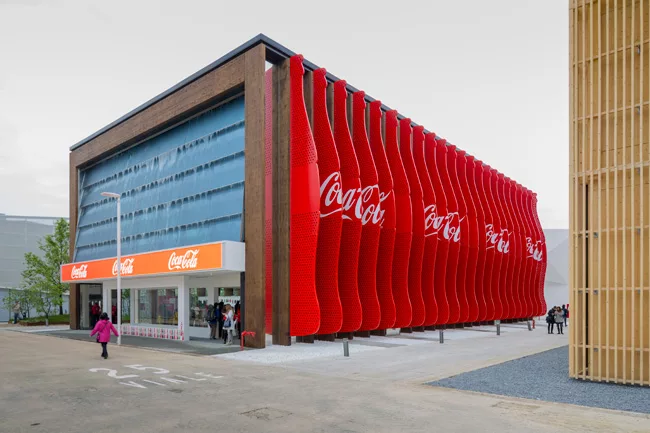
Coca Cola Pavilion.
Expo 2015 Milan
Peia Associati
Milan
Coca Cola Pavilion.
Photo © Paul Raftery
UK Pavilion.
Expo 2015 Milan
Wolfgang Buttress / Tristan Simmonds / BDP
Milan
UK Pavilion.
Photo courtesy UKTI
UK Pavilion.
Expo 2015 Milan
Wolfgang Buttress / BDP / Tristan Simmonds
Milan
UK Pavilion.
Photo © Hufton & Crow
Russia Federation Pavilion.
Expo 2015 Milan
SPEECH
Milan
Russia Federation Pavilion.
Photo © Roland Halbe
Russia Federation Pavilion.
Expo 2015 Milan
SPEECH
Milan
Russia Federation Pavilion.
Photo © Roland Halbe
Size isn&#8217;t everything. The UK learned that at the 2010 Shanghai Exposition with its <a href='http://archrecord.construction.com/ar_china/2010/shanghai_world_expo/pavilions-2.asp' target='_blank'
Since 1999, the U.S. has been hobbled by a law that prevents government funding of expo pavilions. That means America either doesn&#8217;t participate, as in the 2000 Hannover Expo, or depends on corp
Though Jacques Herzog resigned from the Expo planning team, he agreed to design a pavilion for his friend Carlo Petrini, the founder of the Slow Food movement. On opening day, a dozen people milled ar
The Chinese real-estate developer known for its architectural bona fides and a pavilion by Duoxiang Studio at the 2010 Shanghai Expo hired Daniel Libeskind, who designed a building that, surprisingly,
Designed by Studio Nemesi of Rome, the 150,000-square-foot building is wrapped in white concrete panels molded to look as if they were spun from threads. The concrete, made by Italcementi, is said to
Dubai will host the next world expo in 2020, and a number of Persian Gulf countries are exhibiting at this one. Bahrain has the strongest showing, thanks to the young Dutch architect Anne Holtrop. Exp
A significant number of Expo pavilions are built with glulam beams, a material that allows roofs to take dramatic twists and turns. New York&#8211;based architect Yichen Lu used glulam for the Chinese
Pavilion Zero.
Pavilion Zero.
Pavilion Zero.
Located at the end of the Cardo, the 1,148-foot-long path that connects the Expo's north and south axis, and adjacent to the Italian Pavilion, the Tree of Life rises 121 feet and is reflected in the t
Covered promenade.
Slow Food Pavilion.
Slow Food Pavilion.
Coca Cola Pavilion.
UK Pavilion.
UK Pavilion.
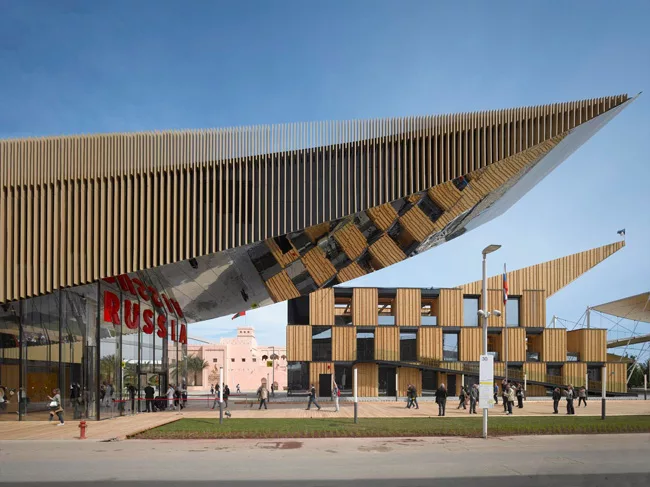
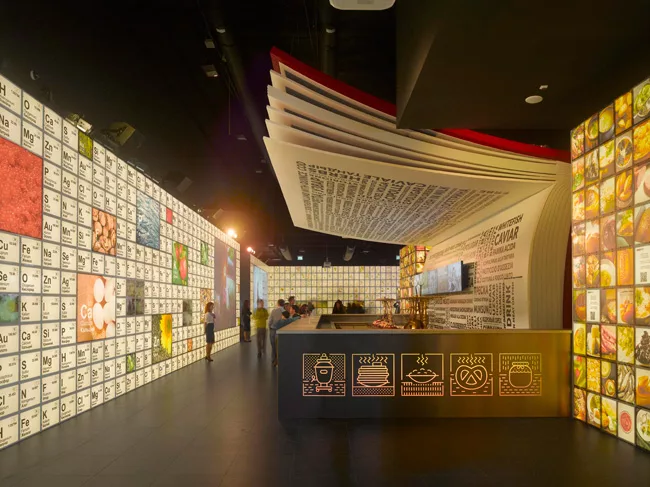
Russia Federation Pavilion.
June 16, 2015

Open since May 1, this tightly packed world's fair of architectural hits and misses runs through October 31.

UK Pavilion by Tristan Simmonds in collaboration with BDP and Stage One.

The first world exposition, held in London in 1851, occupied Joseph Paxton's Crystal Palace. But during the last century, expos (also called world's fairs) evolved into collections of national pavilions that competed for attention with novel and grandiose building designs. The Shanghai Expo in 2010 kicked off the “Asian century” with a show of architectural pyrotechnics that reportedly attracted 73 million visitors.

The theme of Expo 2015 in Milan is “feeding the planet: energy for life.” Initially, a master plan by architects Jacques Herzog, Mark Rylander, Ricky Burdett, Stefano Boeri, and William McDonough proposed that each participating country get a “standardized” pavilion, giving them a chance to distinguish themselves with content, not starchitecture. But Expo organizers succumbed to political pressure, and the fair devolved into another architectural bake-off, particularly jarring because the site is relatively small at 490 acres (compared to Shanghai's 1,300 acres). This creates unfortunate adjacencies. The impressive Chinese pavilion designed by Yichen Lu, for example, looks almost ridiculous flanked by a “Zen Express Street Food Corner” and a gaudy Swatch kiosk. Every few hundred yards, there's a large, motel-like building housing restrooms, cafés, and other essentials. Otherwise, the expo is a free-for-all. The problem with abandoning the original master plan isn't that the architecture got wild and woolly, but that the theme—which promised discussion of a vitally important subject, and an opportunity to compare apples to apples—disappeared along with architectural restraint.

Protesters have denounced the expo for a wide range of issues including reported corruption, expense, and what they see as pseudo-environmentalism, given the presence of corporations like McDonald's and Coca-Cola at the Expo. And almost everyone has complained about all the walking. Unlike previous world's fairs, which offered monorails, cable cars, and innovative “people movers,” this expo offers no transportation other than a bus plying a lonely perimeter road. “I know it's a problem; we're going to fix it,” said the CEO of the fair, Giuseppe Sala. (I met him when, exhausted, I decided to hitch-hike, and Sala gave me a lift on his golf cart.)

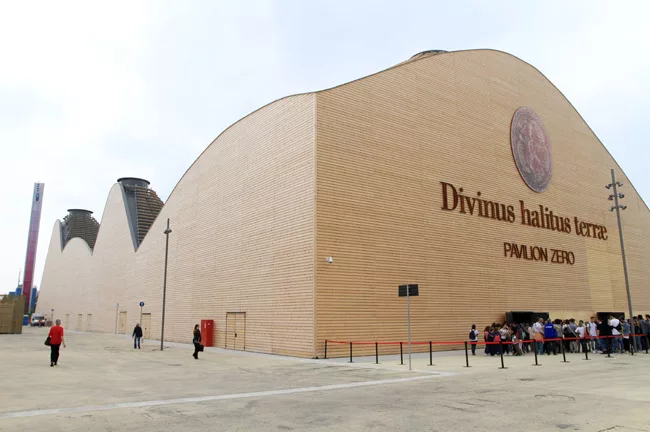
There were also delays getting the pavilions finished in time for opening day. Pavilion Zero, hugging the main entrance to orient visitors to Expo, was among the unready. It turns out to be the best pavilion by a long shot. Designed by Italian architect Michele de Lucchi as a series of domed buildings, it illustrates key Expo themes. In the first room, de Lucchi built a wooden library that is as heroically scaled as the all-wood Teatro Farnese in Parma. In the succeeding rooms, models, videos, and immersive environments demonstrate the effect of man's search for food on the planet.

Another pavilion that opened late is the Future Food District, a working supermarket with sci-fi touches conceived by Turin-based architect and MIT professor Carlo Ratti. Future grocery shopping may involve “printing” meals, and robots that gather our favorite items, adding personalized cocktails of nutrients, and wrapping the results in edible spray-on packaging. Most of the innovations seem hokey—perhaps the way television seemed at the 1939 New York World's Fair—but at the very least Ratti's clean-lined supermarket promises an architecturally elegant future.

KEYWORDS: World Expo

Share This Story

Looking for a reprint of this article?
From high-res PDFs to custom plaques, order your copy today!
Fred Bernstein studied architecture at Princeton and law at NYU and writes about both subjects.

Post a comment to this article

Report Abusive Comment

Subscription Center
  • Create an Account
  • Start a Subscription
  • Manage My Account
  • Sign Up for Newsletters
  • Visit Customer Service
  • Update Preferences

More Videos

Sponsored Content

Sponsored Content is a special paid section where industry companies provide high quality, objective, non-commercial content around topics of interest to the Architectural Record audience. All Sponsored Content is supplied by the advertising company and any opinions expressed in this article are those of the author and not necessarily reflect the views of Architectural Record or its parent company, BNP Media. Interested in participating in our Sponsored Content section? Contact your local rep!

close
  • cold storage facility
    Sponsored byCarlisle SynTec Systems

    How Architects Can Design More Continuous Cold Storage Envelopes

  • TAMLYN XtremeTrim Exterior Trim
    Sponsored byTamlyn

    Designing Cleaner Panel Facades: Why Exterior Trim Details Matter

  • Building with Vapor Barriers
    Sponsored byReef Industries, Inc.

    Vapor Barriers Help Control Moisture in Tighter Building Designs

DESIGN:ED Podcast
Listen to Architectural Record’s DESIGN:ED Podcast

Events

June 23, 2026

Enhancing Fire Resistance with Advanced PVC Solutions

Credits: 1 AIA LU/HSW; 1 AIBD P-CE; 0.1 ICC CEU; 1 IIBEC CEH

Evaluate advanced PVC solutions that improve fire resistance, support WUI compliance, and enhance resilience in residential and commercial building design.

June 25, 2026

Designing Glass Railing Systems that Enhance Aesthetics and Meet Code

Credits: 1 AIA LU/HSW; 1 AIBD P-CE; 0.1 ICC CEU

Upon course completion, participants will possess a deeper understanding of glass railings to help ensure that safety, aesthetic, and performance objectives are achieved.

View All Submit An Event

Products

2026 Architect's Square Foot Costbook

2026 Architect's Square Foot Costbook

See More Products

Popular Stories

Lorcan O' Herilhy

California Architect Lorcan O’Herlihy Has Died, Age 66

Obama Presidential Center, Chicago

The Obama Presidential Center Opens on Chicago’s South Side

Spoonbill Ranch

Johnsen Schmaling Architects Integrates Spoonbill Ranch into a Pristine Landscape

Image of Bruce Springsteen Center for American Music

The CookFox-designed Bruce Springsteen Center for American Music Opens in New Jersey

Three Courtyards House

Design Vanguard 2026: Balsa Crosetto Piazzi

Enhancing Fire Resistance with Advanced PVC Solutions - Free Webinar - June 23, 2026

Related Articles

  • U.S. Pavilion Milan Expo Designers Unpaid

    Designers of U.S. Pavilion at 2015 Milan Expo Shortchanged

    See More
  • Russia's Pavilion at EXPO 2015

    See More
  • Dispatch from Milan: Expo Milano 2015 Focuses on an Immaterial, not Architectural, Legacy

    See More
×

The latest news and information

#1 Source for Architectural Design, News and Products

SUBSCRIBE
  • RESOURCES
    • Advertise
    • Contact Us
    • Submit
    • Store
  • ACCOUNT CENTER
    • Create an Account
    • Start a Subscription
    • Manage My Account
    • Sign Up for Newsletters
    • Visit Customer Service
    • Update Preferences
  • PRIVACY
    • PRIVACY POLICY
    • TERMS & CONDITIONS
    • DO NOT SELL MY PERSONAL INFORMATION
    • PRIVACY REQUEST
    • ACCESSIBILITY
  • SERVICES
    • Marketing Services
    • Reprints
    • Market Research
    • List Rental
    • Survey/Respondent Access
  • STAY CONNECTED
    • Linkedin
    • Facebook
    • Instagram
    • YouTube
    • X (Twitter)

Copyright ©2026. All Rights Reserved BNP Media, Inc. and BNP Media II, LLC.

Design, CMS, Hosting & Web Development :: ePublishing