Border Crossings


Architecture schools are applying innovative educational models that foster new ways of thinking and challenge the role of the profession.
| Photo courtesy UCLA Architecture and Urban Design |
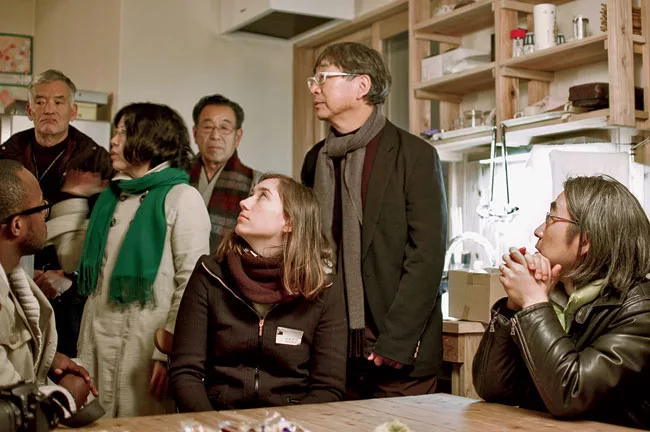
| Thom Mayne and graduate students visit an artists’ collective in Port-au-Prince, Haiti, as part of a yearlong studio course at the university’s Now Institute. |
Toyo Ito’s Tokyo office hosted students in 2012, who worked on tsunami relief projects.
Architecture School isn't what it used to be. While core fundamentals, including tectonics and the tools of design, still form the basis of accredited B.Arch. and M.Arch. programs throughout the nation, many schools are broadening and deepening the educational terrain with studios that cross boundaries—geographically, within communities, and into diverse areas of knowledge or investigation.
The general trajectory has shifted decisively in the 21st century from the narrower realm of form-making. As Hitoshi Abe, chair of UCLA's Department of Architecture and Urban Design (AUD), recently put it, “The important question is: 'How can architectural education, with its potential for experimental research, continually challenge the role of the profession so that it remains engaged, energetic, and alive, rather than fixed or stagnant?' ”
Many schools have made leaps and also inventively modified features long embedded in their programs. At Yale, for example, community outreach and design-build have been essential in the M.Arch. curriculum at least since the 1960s, when the pioneering Yale Building Project (YBP) was born. Three decades later, YBP reframed its mission, zeroing in on much-needed affordable housing for the surrounding distressed New Haven neighborhoods. This required M.Arch. I course, now called the Jim Vlock First-Year Building Project, still retains that focus, responding to changing societal, urban, and technological conditions. It has provided single-family homes with income-generating rental units to empower the owners economically; it also has created prototypes for the city's many difficult sliver lots and has advanced prefab techniques through digital modeling and CNC-fabrication.
Design-build within the professional architectural curriculum was literally and figuratively groundbreaking when Yale first introduced it. Now, hands-on construction and community service have become widespread in academia, though they vary in scope and approach. One outstanding example is an institution-wide, ongoing initiative at the University of Cincinnati to create a multi-phase, net zero energy health complex in rural Tanzania. It engages students and faculty from the colleges of design, architecture, art, and planning, as well as medicine, engineering, nursing, and applied sciences.
The drive for global experience in this age of increasingly international practice has found many channels in architectural education. Dean Mohsen Mostafavi of Harvard's Graduate School of Design (GSD) outlines three major ways its M.Arch. candidates travel afar within the program: a) through upper-level studio-site visits that provide exposure to local context, culture, and expertise (an offering at many architecture schools today); b) with the school's multiyear research projects, such as one focused on emerging cities in China, building on a growing body of student-engaged research; and c) in studios embedded in the workplaces of leading architects abroad.
This last is specific to the GSD. Instead of having architectural luminaries like Rem Koolhaas, Toyo Ito, or Jacques Herzog jet in to teach advanced studios, this program, launched two years ago, brings a dozen students to the architect for the entire semester. With student workspace within or adjacent to the practitioner's office, the Harvard group gets cultural immersion in the foreign city, as well as in the practice itself, and related coursework in what Mostafavi calls a “mini-GSD” abroad. These design studios (not to be confused with paid or unpaid internships) essentially “bring the mountain to Muhammad,” giving students more time with the master architect than they'd have with that teacher commuting to them.
Other notable academic offerings far from the mother ship include Cornell's required B.Arch. semester at its palazzo in Rome and MIT's ongoing 28-year collaboration with Tsinghua University in China, where students spend a semester on location, rethinking areas of Beijing. Also, at many schools, the shorter summer and winter terms have spawned such opportunities as the University of Michigan's workshop in Jakarta that enabled M.Arch. students to research the ecological issues of rising water, or the groups from MIT that probed the future possibilities for a textile-manufacturing city in India or built a health facility in Cambodia.
Though some schools are endowed for travel (as with Yale's dedicated Henry Hart Rice Fund in Architecture), other models exist. The University of Cincinnati, a public institution, has been resourceful in developing student engagement around the globe. Since 1922, its virtually year-round architectural program has alternated terms of paid work with academic ones. What began as a local cooperative to help students cover tuition has grown into a network of 400 architectural firms, worldwide. “It's a vital program, and placement in offices is competitive, with some even covering airfare and housing,” says Cincinnati dean Robert Probst. “The learning opportunities are tremendous and, in the end, 70 percent of our students have jobs lined up before graduation.”
Even with all the travel, most academic leaders still stress the unwavering importance of education at the home base, with an emphasis on what Yale's dean, Robert A. M. Stern, describes as “actually making things and training the eye and hand.” This comes at a time when Yale and many other schools also run active labs, fully equipped with cutting-edge technologies, including robots and 3-D printers.
And while some studios focus on extremely deep rather than broad inquiry (such as those at the GSD investigating the properties and potential of a single material), “border crossings” between disciplines are common. This can happen under one roof, as with the GSD's or MIT's urban planning programs, or across a university, with such entities as Harvard's Wyss Institute for biologically inspired engineering, which explores naturally occurring structures.
Cross-pollination and even joint degrees with, for instance, business schools have long been possible at universities that include Cornell, Harvard, Cincinnati, and Yale (the latter also offering a dual degree in forestry). One of the most intriguing and earliest “crucibles” remains MIT's Media Lab. Founded in 1985, under the auspices of the School of Architecture and Planning, it proposed a paradigm for “anti-disciplinary” research into new technologies, multimedia design, and human experience. Evolving ever since, it has drawn on the university's culture of entrepreneurial and creative research. The many life-changing, real-world applications emerging from it include credit-card security holograms and robotic ankle-foot prostheses. Media Lab's classic “How to Make Almost Anything” has become a standard first-year M.Arch. course, often inspiring interactive, digitally innervated projects (such as a porcupine-like dress that responds to intrusions on personal space). “For one studio, not long ago,” dean Adèle Naudé Santos recalls, “every single piece of a building, down to the bricks, had to be 'wired.' ”
As advanced digital tools permeate architectural education, they have become both widely used and been challenged. For a recent University of Michigan studio examining contemporary technology's impact on design, the accompanying history seminar, led partly in Rome, considered how the Baroque period's architectural innovations grew from that era's emerging technologies.
“At SCI-Arc [Southern California Institute of Architecture],” says its director, Eric Owen Moss, “there's simultaneous deployment and questioning of the tools of technology. Here, nothing is sacred. Agents and reagents of contamination, corruption, and provocation are all part of the vigorous and ongoing discourse.” While university-based architecture programs draw increasingly from broad offerings within their institutions, Moss sees the stand-alone independence of SCI-Arc, a school proud of its rebellious history, as an asset, affording it nimbleness to veer in or out of radical experiments (those that succeed and those that don't) without a university's bureaucratic structure or red tape.
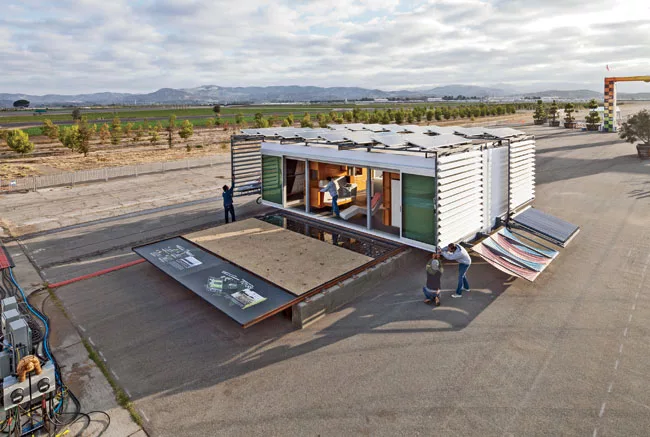
But like many of its peers, particularly those venturing abroad or into specialized areas of knowledge, SCI-Arc reaches into its larger community to partner with leading experts or fellow institutions. The school did this with the U.S. Department of Energy–sponsored Solar Decathlon—a biennial competition for the design and construction of a prototype net zero energy house. For their entry, an expandable-contractible, climate-adjusting structure, students worked with the California Institute of Technology and Buro Happold engineers. The SCI-Arc team was responsible for raising and managing the necessary funds, in addition to design and fabrication.
The increasingly powerful convergence of real-world challenges, outside expertise, and speculative research has also contributed to the formation of Suprastudios at UCLA. This immersive program models itself on professional R&D teamwork, enabling M.Arch. II students to collaborate for an entire year on a complex problem they help define. With one master professor and state-of-the-art technologies, the students join forces with experts from a forward-thinking Southern California industry such as aerospace (Boeing) or entertainment (Disney). Similarly, in the Now Institute, UCLA AUD's public service version of the Suprastudio, students partner with policymakers or governmental and community agencies to tackle issues in struggling cities. Both programs are like thesis work in duration and depth, but the team structure more closely resembles scientific post-docs.
These are just a few of the innovative offerings across the nation. “We're working with new educational models, many of them trans-disciplinary,” Mostafavi recently said of the GSD, but his comments could apply to enlightened trends in architectural programs more broadly. “Through publications, exhibitions, and ongoing dialogues with experts,” he continued, “we're putting the work much more in the public sphere. In speculative and experimental ways, students are researching real problems with unknown answers. And all this provides catalysts for new ways of thinking.”
Looking for a reprint of this article?
From high-res PDFs to custom plaques, order your copy today!