Architectural Record
search
cart
facebook twitter linkedin youtube
  • Sign In
  • Subscribe
  • Sign Out
  • My Account
Architectural Record
  • NEWS
    • Latest News
    • Awards
    • Interviews
    • Obituaries
    • Podcasts
      • Design:Ed Podcast
      • Sponsored Podcasts
  • OPINION
    • Book Reviews / Excerpts
    • Exhibition Reviews
    • Forum
  • EXCLUSIVES
    • Videos
    • Design Vanguard
    • Top 300 Firms
    • Sponsored Content
    • Sponsored eBooks
    • From the Archives
  • CONTINUING ED
    • Editorial Continuing Ed
    • CE Center
    • CE Academies
  • PROJECTS
    • Buildings By Type
    • Reuse & Renovation
    • Museums & Arts Centers
    • Colleges & Universities
    • Multifamily Housing
    • Interiors
    • Lighting
    • Kitchen & Bath
  • HOUSES
    • Record Houses
    • House of the Month
    • Featured Houses
  • PRODUCTS
    • Products by Category
    • Record Products of the Year
    • Latest Products
  • EVENTS
    • Dates & Events
    • Record on the Road
    • Innovation Conference
    • Sustainability in Practice
    • Women In Architecture
    • Webinars
    • Ad Excellence Awards
    • Submit an Event
  • CONNECT
    • Ask RECORD AI
    • Newsletters
    • Contact
    • Advertise
    • Editorial Calendar
    • Store
    • Customer Service
  • SUBMIT
    • Submission Guidelines
    • RECORD Competitions
  • MAGAZINE
    • Subscribe
    • My Account
    • Digital Edition
    • Current Issue
    • Firm Pass
    • Historic Archive

Firm Award: KieranTimberlake Associates

By Charles Linn, FAIA
May 16, 2008

This Firm Award winner's long-range plan led to a successful research-based culture

James Timberlake, FAIA, has often described his firm, KieranTimberlake Associates (KTA), as a tortoise. “We’ve not done things fast,” he says. And although it is almost 25 years old, until the past six or seven years, the firm did its work “in relative obscurity.” Timberlake’s partner, Stephen Kieran, FAIA, agrees. “One of the things about being located in Philadelphia is that you can work there for a long time and never get noticed.” But, he says, it was during those early years they developed the culture that made KTA this year’s Firm Award winner. That culture emphasizes the value of doing research and having a great deal of skill in understanding building systems and how to detail them in ways that are efficient and elegant.
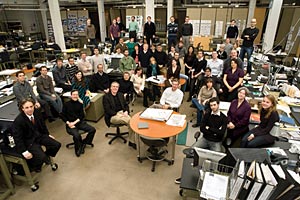
KieranTimberlake Associates
Photo ' Barry Halkin
Related Links:
Honor Awards: Architecture Honor Awards: Interiors Honor Awards: Regional and Urban Design 25 Year Award: The Atheneum Firm Award: KieranTimberlake Associates Gold Medal: Renzo Piano

The pair are both graduates of the Department of Architecture at the University of Pennsylvania and began working together in the mid-1970s while employees of Venturi, Scott Brown and Associates. Each won a Rome Prize from the American Academy—Kieran in 1981 and Timberlake in 1983. They set up their own practice the following year, taking teaching jobs to support the firm and their families. “We were able to afford some sessions with the management consultant Weld Coxe,”says Kieran. “He taught us the value of making long-range plans that would allow us to build our firm, both strategically and financially. We spent more time doing small projects, but we also gave ourselves time to learn the craft of building. And it is a real painful craft to learn.”

It was not until 1996, when the firm won the $25 million commission to renovate Berkeley College at Yale University, that the partners felt they finally turned the corner financially. “People whose doors we had been knocking on for years were suddenly calling us,” Kieran says. Then in 1998, the firm held strategic planning sessions that examined what it had achieved. “We knew there were internal impediments to what we could achieve, which we could address. But there were external ones, too,” says Timberlake. “We felt we could address the external ones by formalizing the research culture in our office.” Kieran adds, “We had become known as architects who could put together some beautifully detailed buildings. But quality and productivity problems were threatening the art of what we were doing and the rest of the construction industry. We felt we could address that using research. And we oriented our financial plan, marketing, and public relations to support that agenda.”

Addressing quality and productivity issues in construction became the basis of KTA’s proposal for the first-ever Latrobe Fellowship for architectural design research, which the AIA College of Fellows awarded the firm in 2001. The grant allowed the team to hire a full-time director of research and travel the country visiting aircraft, automobile, and ship manufacturers to understand how the technologies they use to improve quality and productivity while cutting costs could be applied to construction. This study resulted in the publication of the book Refabricating Architecture (McGraw-Hill Companies, 2004). Since then, KTA has documented its research efforts by publishing three more books.

Meanwhile, research into materials and mass customization was paying off elsewhere. In 2003, the firm’s Levine Hall building at the University of Pennsylvania used a factory-built, double-walled facade whose ventilating system was preinstalled. It was the first of its kind in the U.S. Later that year, the firm installed the Smartwrap exhibition on the grounds of the Cooper-Hewitt museum in New York City. Its photovoltaic cells and organic light-emitting diodes were printed on a composite skin, then stretched over a proprietary prefabricated- aluminum-alloy frame that the firm invented. Its principles of mass customization were fully exploited in the construction of the Loblolly House, which was fabricated in New Hampshire and put up in Maryland in just seven weeks. This fall, the firm will construct its prefabricated Cellophane House in the courtyard of the Museum of Modern Art in New York City.

Doing research has not put KTA off its game. It continues to do higher-education projects for Princeton, Cornell, and Yale, and it designed Sidwell Friends School, the nation’s first LEED-Platinum K-12 school building. Yet, Kieran says, “I can’t understate what the research agenda has done for us on all fronts, including making money. It gives the firm a competitive edge that’s not insignificant, and people hire us because they believe we will give them a competitive advantage. We’ve gained a lot we did not necessarily envision.”

Share This Story

Looking for a reprint of this article?
From high-res PDFs to custom plaques, order your copy today!

Charles Linn is a Kansas City–based writer and architect and a former deputy editor of Architectural Record.

Post a comment to this article

Report Abusive Comment

Subscription Center
  • Create an Account
  • Start a Subscription
  • Manage My Account
  • Sign Up for Newsletters
  • Visit Customer Service
  • Update Preferences

More Videos

Sponsored Content

Sponsored Content is a special paid section where industry companies provide high quality, objective, non-commercial content around topics of interest to the Architectural Record audience. All Sponsored Content is supplied by the advertising company and any opinions expressed in this article are those of the author and not necessarily reflect the views of Architectural Record or its parent company, BNP Media. Interested in participating in our Sponsored Content section? Contact your local rep!

close
  • TAMLYN XtremeTrim Exterior Trim
    Sponsored byTamlyn

    Designing Cleaner Panel Facades: Why Exterior Trim Details Matter

  • Building with Vapor Barriers
    Sponsored byReef Industries, Inc.

    Vapor Barriers Help Control Moisture in Tighter Building Designs

  • Duct Interior with Prodeq System
    Sponsored byHenry, a Carlisle Company

    Designing Resilient Water Containment Systems

DESIGN:ED Podcast
Listen to Architectural Record’s DESIGN:ED Podcast

Events

June 10, 2026

Rethinking Stormwater – The Power of Porous Paving

Credits: 1 AIA LU/HSW; 1 AIBD P-CE; 0.1 ICC CEU

Learn how porous paving systems support stormwater management, reduce heat island effects, and enhance sustainable site design performance.

June 11, 2026

Very Early Warning Fire Detection for Mission-Critical Facilities

Credits: 1 AIA LU/HSW; 1 AIBD P-CE; 0.1 ICC CEU

Examine advanced fire detection strategies that support uptime and enhance safety in data centers and other mission-critical facilities.

View All Submit An Event

Products

2026 Architect's Square Foot Costbook

2026 Architect's Square Foot Costbook

See More Products

Popular Stories

Practice Matters illustration

What’s in a (Firm’s) Name? Thinking About Succession and Legacy

Practice Matters illustration

By the Numbers: Counting America's Architects

House on a Hill

Design Vanguard 2026: Forma

Crane Cove, ONO

Design Vanguard 2026 Winners

House A on a Hill

Design Vanguard 2026: Santiago Valdivieso

Broader Sustainability of CMU - Free Webinar - May 21, 2026

Related Articles

  • Firm Award: Leers Weinzapfel Associates

    See More
  • Firm Award: Pugh + Scarpa Architects

    See More
  • Firm Award: Olson Sundberg Kundig Allen Architects

    See More
×

The latest news and information

#1 Source for Architectural Design, News and Products

SUBSCRIBE
  • RESOURCES
    • Advertise
    • Contact Us
    • Submit
    • Store
  • ACCOUNT CENTER
    • Create an Account
    • Start a Subscription
    • Manage My Account
    • Sign Up for Newsletters
    • Visit Customer Service
    • Update Preferences
  • PRIVACY
    • PRIVACY POLICY
    • TERMS & CONDITIONS
    • DO NOT SELL MY PERSONAL INFORMATION
    • PRIVACY REQUEST
    • ACCESSIBILITY
  • SERVICES
    • Marketing Services
    • Reprints
    • Market Research
    • List Rental
    • Survey/Respondent Access
  • STAY CONNECTED
    • Linkedin
    • Facebook
    • Instagram
    • YouTube
    • X (Twitter)

Copyright ©2026. All Rights Reserved BNP Media, Inc. and BNP Media II, LLC.

Design, CMS, Hosting & Web Development :: ePublishing