Shopping
Boston has its fair share of upscale shopping malls and fashion boutiques but for the real deal—a Boston original—begin your shopping day at LouisBoston, the name in high fashion and bespoke tailoring since the late 1800s. Located in an Italianate-style building originally erected in 1863 as the city’s natural history museum, designed by William G. Preston, LouisBoston is a touch of Paris in Boston’s Back Bay. If you’ve been to Paris’s trendy Colette boutique, you’ll feel right at home here. The ground floor features an elegant housewares department, a candy bar—a counter where you can buy hand-crafted gourmet chocolates—unique art books, and a deejay spinning house music. Upstairs, three floors of men’s and women’s apparel await. The sales staff is friendly and more than willing to assist: but don’t worry, a discrete sign posted near the changing rooms states that they work on “collaboration” not commissions.
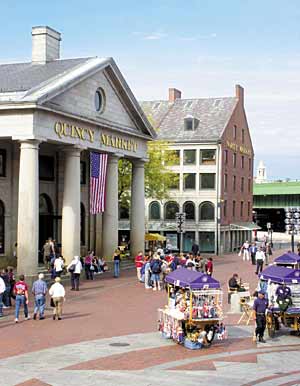
Photo courtesy Greater Boston CVB/ FayFoto
Newbury Street is truly one of the world’s great streets, a mile-long strip full of art galleries, fashion boutiques, bookshops, cafés, bars, and restaurants. Most are located in elegantly maintained 19th century brownstones. You’ll find the fanciest shops clustered between Arlington and Berkeley Streets, a stretch that’s anchored by the swanky Ritz-Carlton hotel and includes boutiques for Giorgio Armani, Burberry, Cartier and Ermenegildo Zegna: names that speak for themselves.
Newbury Street isn’t all high fashion. Bliss Home features Alessi-designed house wares and art glass, as well as furnishings made by Jonathan Adler—a latter day David Hicks—and Marimekko fabrics from Sweden. Lavender Home & Table, meanwhile, offers a mixture of antique furniture, dishes, and cutlery—as well as one-of-a-kind vintage signs and advertising.
Speaking of vintage, if you’re in the market for refurbished watches and antique jewelry, then check out Small Pleasures, whose beatifically carved facade resembles the Alhambra palace in Spain. The Society of Arts and Crafts, meanwhile, sells ceramics, pottery, and handcrafted furniture made by local artisans.
Regardless of whether or not you’re in the market for a gargoyle to grace your home’s gutters, you must poke your head into Gargoyles, Grotesques & Chimeras, at 262 Newbury Street. As its name suggests, its narrow, darkened aisles are full of creepy sculptures.
When the weather outside is frightful, head over to The Shops at Prudential Center and Copley Place. These two malls, connected via a series of sky-bridges, span all the way from Boylston Street to Huntington Avenue. Both feature typical mall fare, but Copley Place—designed by the Boston-based architect Elkus Manfredi—is the more upscale of the two: with marble floors, an indoor waterfall, a Neiman Marcus, and a Barney’s New York outpost.
Faneuil Hall Marketplace is also a shopping mall—albeit one that’s located in a proud, historic location. When this center opened in the late 1970s, it was an exemplar of downtown redevelopment: in this case, a set of three market buildings, dating to the 1820s, that were refurbished by the Rouse Company and filled with a funky mixture of shops and outdoor cafés. Although the main building is called Quincy Market, the area gets its name from nearby Faneuil Hall, a meeting house originally built in 1742, then rebuilt and expanded by architect Charles Bullfinch in 1806. Since Quincy Market’s redevelopment in the 1970s, the funky mix of shops has grown more mainstream. Even so, few malls in America can claim a heritage dating back 200 years.
Another historic shopping area in Boston is the brick-paved Charles Street in Beacon Hill. It offers a mixture of Asian art galleries, antiquarian bookshops, antique stores, and swanky restaurants. Notables include No. 119, Bruce Cherner Antique Silver , a silver specialty shop; Elegant Findings, offering European porcelains at No. 89; and, at No. 88, is a shop simply named Good, although “excellent” would be a better word to describe the selection of artisan-crafted jewelry and unique housewares. On Chestnut Street, which crosses Charles, two more antique shops are also worth a visit: Gallagher Christopher Antiques, at No. 84, and Hilary House, No. 86A.
If you’re looking for rare books, then look no further than the Brattle Bookshop, a mainstay of Boston since 1825 and one of the largest independent bookshops nationwide. Located near Downtown Crossing, in the heart of Boston, this vast store has been owned by the Gloss family since 1949. Regular viewers of the PBS series Antiques Roadshow might recognize the name because Ken Gloss, the current proprietor, makes periodic appearances as an appraiser.
When it comes to bookshops, Cambridge, Massachusetts, offers more than enough to satisfy an entire day of browsing. Despite its name, the Harvard Bookstore, at 1256 Mass Ave, is privately owned—and has been since it opened in 1932. Given its academic location, though, its strongest suits are philosophy, cultural and critical theory, politics, and African-American studies. Around the corner, at No. 6 Plympton Street, is the Grolier Poetry Shop. Going strong since 1927, this cozy shop stocks more than 15,000 volumes, both new and old, written by poets from around the world.
In Harvard Square you’ll find Harvard University’s official bookstore—which it actually shares with MIT—the Harvard / MIT Coop. The area is also home to the nation’s oldest foreign language bookshop, Schoenhof's Foreign Books; a science fiction specialist called Pandemonium Books & Games; and Curious George Goes to Wordsworth, a children’s book and toy store that is the only remaining part of the highly regarded, now-closed independent bookseller Wordsworth Books.
As the closing of Wordsworth indicates, Harvard Square once boasted more independent retailers than it does today. Despite the near constant flow of students and tourists through the square, competition from Internet retailers and rising rents has forced many to close. Chain stores, such as Aldo and Urban Outfitters, have been only too happy to take their place.
A few independent holdouts persist. At the heart of the square, where buskers and skater punks abound, there’s Out of Town News, a kiosk selling newspapers and magazines from around the world. For housewares, office supplies, and cooking utensils you never knew existed but won’t be able to imagine life without, stop into the Museum of Useful Things, behind Harvard Square on Brattle Street. Its products, like a four-way rubber band that adapts to hold objects of differing shapes, or a pie-server contoured to grab an entire slice of pie without crumbling it, are truly one of a kind and especially appeal to architects and other design-minded buyers.
Looking for a reprint of this article?
From high-res PDFs to custom plaques, order your copy today!