Rolling out the unwelcome mat for visitor centers
My misgivings about “interpretive” interventions in historic precincts grew during a 2003 trip to see a trio of additions at Philadelphia’s Independence National Historical Park: Bohlin Cywinski Jackson’s Liberty Bell Center; Kallmann, McKinnel & Wood’s Independence Visitor Center; and Pei Cobb Freed’s National Constitution Center. I’ve admired work by each of those partnerships elsewhere, but at Independence Mall, all three seemed badly miscast, particularly Bohlin Cywinski Jackson. Perhaps they were intimidated by the setting’s gravitas, or were persuaded to abandon their woodsy post-and-beam manner for a less congenial mix of masonry and metal. Whatever the reason, inside their new shelter the real Liberty Bell looks fake.
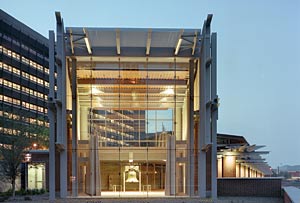
Variations on that phenomenon recur with distressing regularity at other visitor centers. Although double-take simulacra of world-famous structures can be a hoot on the Vegas Strip, at revered historic shrines confusion between true and false amounts to sacrilege. I have come to realize that visitor centers subvert credibility through the extra degree of separation they impose between viewer and artifact, and that all visitor centers abet that pernicious process to some extent.
I’m also skeptical of marketers’ insistence that the survival of our cultural institutions demands extreme museological means to beguile a cyber-addicted populace. Earlier generations found ways to enjoy historic sites without the aid of touch screens, surround sound, interactive simulations, holograms, costumed reenactors, cappuccino, T-shirts, and Ralph Appelbaum (whose firm designed the Capitol Visitor Center’s exhibits). If such gimmicks are now deemed obligatory, how did unmediated landmarks sustain America’s collective imagination — what Abraham Lincoln called “the mystic chords of memory” — for so long?
Nowhere has the communicative power of a pure historic environment been conveyed with more palpable personal immediacy than at George Washington’s Virginia estate, Mount Vernon. Established as a house museum 150 years ago by the pioneering Mount Vernon Ladies Association, the home of our first President would still be familiar to him, thanks to vigilant preservation of pristine vistas from the house in every direction — a miraculous accomplishment amid a modern megalopolis. The mansion itself, filled with original Washington furnishings and memorabilia, feels as if its illustrious owner has just stepped out for a stroll.
After valiantly fending off anachronisms for so long, why did Mount Vernon’s venerable Ladies permit the intrusive and distracting additions by GWWO Inc./Architects — the Ford Orientation Center and the Donald W. Reynolds Museum and Education Center — that opened there in 2006? Partially submerged beneath a meadow adjacent to the mansion, the new facilities are banked by grass-covered berms intended to render them invisible. The trick fails, and the patriot weeps. Until these dreadful impositions, Mount Vernon survived as our pluperfect 18th-century time machine: historically veracious, high-mindedly noncommercial, and astonishingly unspoiled.
Well before the current economic meltdown, several American museums faced ruin because they overspent on ill-considered architectural adventures. An overreaching visitor center can be equally ruinous for a historic site. In 2003, the Mark Twain House in Hartford, Connecticut — Edward T. Potter’s 1874 Stick Style masterpiece — inaugurated an annex by Robert A.M. Stern Architects. It cost $19 million, twice the initial budget, and now the foundation that runs the property faces insolvency. The Stern addition, another of the firm’s overinflated, misproportioned, historicizing pastiches, is excruciating enough in itself. Equally grotesque is how this story might end, with a plot twist reminiscent of the cynical Twain’s most corrosive satires. The author’s dream house, which he lost through foolhardy investment schemes, could again meet that fate, as America’s second Gilded Age reprises the follies of the first one.
Even when visitor centers are well designed, other caveats arise. Now under construction in Buffalo is a Minimalist glass-walled entry pavilion by Toshiko Mori at Frank Lloyd Wright’s Martin house (1907). That long-neglected Prairie Style house is undergoing a $38 million restoration as part of a tourism development program premised on that city’s notable architectural heritage. Mori’s vitrine is exquisite, but also jarringly contrary to Wrightian precepts cherished by his countless fans, none of whom will come because of a visitor center, let alone this one.
Architourists (as the scholar Joan Ockman has termed them) are a resourceful lot, as the much-put-upon private owners of landmark houses can attest. Practitioners, historians, and students don’t need to be told what they’re about to see. Neither do nonprofessional design buffs, who outnumber the uninitiated at architectural landmarks. Amenities be damned: Well-read pilgrims don’t want entry-level explication. If there’s no on-site café, they can find one nearby. If there’s no souvenir shop, they can send JPGs instead of postcards. The only improvements we’d all welcome are more and better bathrooms.
An imploding economy will doubtless curtail proliferation of visitor centers, though regrettably, not one planned for Maya Lin’s Vietnam Veterans Memorial (1982) in Washington, D.C., still in the fund-raising phase. As a New York Times editorial rightly warned, “At best, the visitor center can offer only a sanitized glimpse of that deeply controversial war. At worst, it will become a political battleground. Either way, it will damage the clarity of what Maya Lin achieved.” That contradiction is emblematic of a pointless, wasteful building type we’d be well rid of. Lincoln once compared some conventional redundancy to writing “horse” on the side of a horse. When our mania for visitor centers abates, the liberating logic of simplification will seem as self-evident as Lincoln’s unlabeled steed.
Looking for a reprint of this article?
From high-res PDFs to custom plaques, order your copy today!