Architectural Record
search
cart
facebook twitter linkedin youtube
  • Sign In
  • Subscribe
  • Sign Out
  • My Account
Architectural Record
  • NEWS
    • Latest News
    • Awards
    • Interviews
    • Obituaries
    • Podcasts
      • Design:Ed Podcast
      • Sponsored Podcasts
  • OPINION
    • Book Reviews / Excerpts
    • Exhibition Reviews
    • Forum
  • EXCLUSIVES
    • Videos
    • Design Vanguard
    • Top 300 Firms
    • Sponsored Content
    • Sponsored eBooks
    • From the Archives
  • CONTINUING ED
    • Editorial Continuing Ed
    • CE Center
    • CE Academies
  • PROJECTS
    • Buildings By Type
    • Reuse & Renovation
    • Museums & Arts Centers
    • Colleges & Universities
    • Multifamily Housing
    • Interiors
    • Lighting
    • Kitchen & Bath
  • HOUSES
    • Record Houses
    • House of the Month
    • Featured Houses
  • PRODUCTS
    • Products by Category
    • Record Products of the Year
    • Latest Products
  • EVENTS
    • Dates & Events
    • Record on the Road
    • Innovation Conference
    • Sustainability in Practice
    • Women In Architecture
    • Webinars
    • Ad Excellence Awards
    • AIA 2026 Videos
    • Submit an Event
  • CONNECT
    • Ask RECORD AI
    • Newsletters
    • Contact
    • Advertise
    • Editorial Calendar
    • Store
    • Customer Service
  • SUBMIT
    • Submission Guidelines
    • RECORD Competitions
  • MAGAZINE
    • Subscribe
    • My Account
    • Digital Edition
    • Current Issue
    • Firm Pass
    • Historic Archive
Commentary & Criticism

Making monuments right before an era comes to a close

By Robert Campbell, FAIA
April 16, 2009

There are a number of Campbell’s Laws of Architecture; they tend to take the form of paradoxes.

Campbell’s First Law, for example, states: “The faster the means of transportation in any society, the larger will be the portion of the average citizen’s life that is spent in getting from one place to another.”
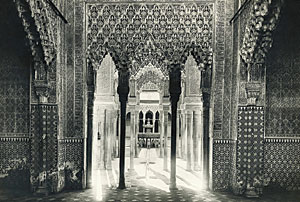
The Moors built the Alhambra in Granada
Photo ' Bettmann/Corbis
The Moors built the Alhambra in Granada as they were losing control of Spain to the Christians.

Peasant’s walk to the fields? Twenty minutes. Commute from the suburbs? Fifty minutes. Plane to the coast? Six hours. Rocket to the moon? Four days. As the world becomes more accessible, we access it more, and we waste more time doing so.

Okay, here’s Campbell’s Second Law: “With every advance in technology, there is a corresponding loss of sensory experience.”

Again, we can take transportation as an example, although just about anything will do. You’re on a horse, your butt is sore, it’s raining, you’re sneezing from hay fever, a highwayman waits behind a tree — you’re experiencing the world with all your senses. Then technology advances and creates the railroad, where the world resembles a visual film strip, unspooling itself past the frames of the windows. At least you can still sense the lurch and whistle of the train. But then in an airplane, you’re confronted with an actual film, a further step removed from sensory experience. Finally, on the space ship, you don’t even have gravity.

This law works with writing, too. As I type this, I’m reminded that I miss the sociable clatter of keys and bells and the smell of the ribbon of my old typewriters. Would I go back? Of course not. But I’ve traded away experience in order to gain convenience. So often, that’s what technology accomplishes.

The particular Campbell’s Law I want to discuss today, though, is the Third. It runs as follows: “A society will create its most monumental buildings when the society and its culture are about to disappear. They will be the product of a last desperate effort to impede the forces of decay.”

My favorite example of this law has always been the Alhambra Palace in Granada, Spain, which may be my all-time favorite building. It was erected by the Moors just in time for the Spaniards to drive them out of the country. Banister Fletcher calls it “the last purely Muslim building in Spain.” I just looked it up and discovered that the Moors kept it longer than I thought, nearly 100 years. But throughout that time, the borders of Moorish Spain were shrinking until Granada and its palace had become a Muslim island in a Christian sea.

I thought I’d invented the Third Law for myself, but I find in this week’s New York Review of Books a quotation from the great American theologian Reinhold Neibuhr. It seems Neibuhr got there first. He wrote: “One of the most pathetic aspects of human history is that every civilization expresses itself most pretentiously, compounds its partial and universal values most convincingly, and claims immortality for its finite existence at the very moment when the decay that leads to death has already begun.” Yikes!

Should we worry? Are any aspects of our own culture claiming immortality through the creation of pretentious architectural tombstones?

Share This Story

Looking for a reprint of this article?
From high-res PDFs to custom plaques, order your copy today!

Robert Campbell, FAIA, was architecture critic for the Boston Globe and a longtime RECORD contributor.

Post a comment to this article

Report Abusive Comment

Subscription Center
  • Create an Account
  • Start a Subscription
  • Manage My Account
  • Sign Up for Newsletters
  • Visit Customer Service
  • Update Preferences

More Videos

Sponsored Content

Sponsored Content is a special paid section where industry companies provide high quality, objective, non-commercial content around topics of interest to the Architectural Record audience. All Sponsored Content is supplied by the advertising company and any opinions expressed in this article are those of the author and not necessarily reflect the views of Architectural Record or its parent company, BNP Media. Interested in participating in our Sponsored Content section? Contact your local rep!

close
  • 3D configurator
    Sponsored byDoorBird

    How DoorBird’s 3D Configurator Is Redefining Customization Across Residential and Commercial Design

  • interior of modern office
    Sponsored byCurrent

    The Downlight's Second Life: Why Below-Ceiling Serviceability Is the Specification Detail That Matters Most

  • cold storage facility
    Sponsored byCarlisle SynTec Systems

    How Architects Can Design More Continuous Cold Storage Envelopes

DESIGN:ED Podcast
Listen to Architectural Record’s DESIGN:ED Podcast

Events

July 22, 2026

Water Containment Waterproofing: Best Practices and System Selection

Credits: 1 AIA LU/HSW; 1 AIBD P-CE; 0.1 ICC CEU

Examine waterproofing strategies for water containment structures that enhance durability, prevent failures, and support long-term building performance.

July 29, 2026

Adaptive Reuse Reimagined: Designing Multifamily Housing from Existing Buildings

Credits: 1 AIA LU/HSW; 1 AIBD P-CE; 0.1 ICC CEU; 1 IIBEC CEH

Examine adaptive reuse envelope strategies that improve energy performance, preserve architectural character, and transform existing buildings into high-performing multifamily housing.

View All Submit An Event

Products

2026 Architect's Square Foot Costbook

2026 Architect's Square Foot Costbook

See More Products

Popular Stories

7480 N Delaware

A Portland Apartment Building by Daniel Toole Architecture Stands as a Study in Adaptation

Bergen complex frontage

Brooklyn’s Bergen Establishes Place with a Modulated Concrete Facade and an Idyllic Garden

Chacarita Alta Housing

In Paraguay’s Capital, MOS and Adamo-Faiden Rethink Public Housing for Residents of Informal Settlements

Kaya, San Diego

With San Diego’s Kaya, Jeff Svitak Melds Housing Density with Community

The Bend in Winnipeg, Canada

The Bend Wraps an Adapted Winnipeg Warehouse, Adding Apartments and Defining Public Space

Water Containment Waterproofing: Best Practices and System Selection - Free Webinar - July 22, 2026

Related Articles

  • Making monuments right before an era comes to a close

    See More
  • Greenbuild 2017 Closing

    Neil deGrasse Tyson Brings Greenbuild 2017 to a Close

    See More
  • 30-Year Construction Draws to a Close for Skirball Cultural Center in Los Angeles

    See More

Related Products

See More Products
  • 1118978811.gif

    Architectural Design with SketchUp: 3D Modeling, Extensions, BIM, Rendering, Making, and Scripting, 2nd Edition

  • movable arch.jpg

    Movable Architecture: A Design Guide to Container Reuse

See More Products
×

The latest news and information

#1 Source for Architectural Design, News and Products

SUBSCRIBE
  • RESOURCES
    • Advertise
    • Contact Us
    • Submit
    • Store
  • ACCOUNT CENTER
    • Create an Account
    • Start a Subscription
    • Manage My Account
    • Sign Up for Newsletters
    • Visit Customer Service
    • Update Preferences
  • PRIVACY
    • PRIVACY POLICY
    • TERMS & CONDITIONS
    • DO NOT SELL MY PERSONAL INFORMATION
    • PRIVACY REQUEST
    • ACCESSIBILITY
  • SERVICES
    • Marketing Services
    • Reprints
    • Market Research
    • List Rental
    • Survey/Respondent Access
  • STAY CONNECTED
    • Linkedin
    • Facebook
    • Instagram
    • YouTube
    • X (Twitter)

Copyright ©2026. All Rights Reserved BNP Media, Inc. and BNP Media II, LLC.

Design, CMS, Hosting & Web Development :: ePublishing