Architectural Record
search
cart
facebook twitter linkedin youtube
  • Sign In
  • Subscribe
  • Sign Out
  • My Account
Architectural Record
  • NEWS
    • Latest News
    • Awards
    • Interviews
    • Obituaries
    • Podcasts
      • Design:Ed Podcast
      • Sponsored Podcasts
  • OPINION
    • Book Reviews / Excerpts
    • Exhibition Reviews
    • Forum
  • EXCLUSIVES
    • Videos
    • Design Vanguard
    • Top 300 Firms
    • Sponsored Content
    • Sponsored eBooks
    • From the Archives
  • CONTINUING ED
    • Editorial Continuing Ed
    • CE Center
    • CE Academies
  • PROJECTS
    • Buildings By Type
    • Reuse & Renovation
    • Museums & Arts Centers
    • Colleges & Universities
    • Multifamily Housing
    • Interiors
    • Lighting
    • Kitchen & Bath
  • HOUSES
    • Record Houses
    • House of the Month
    • Featured Houses
  • PRODUCTS
    • Products by Category
    • Record Products of the Year
    • Latest Products
  • EVENTS
    • Dates & Events
    • Record on the Road
    • Innovation Conference
    • Sustainability in Practice
    • Women In Architecture
    • Webinars
    • Ad Excellence Awards
    • Submit an Event
  • CONNECT
    • Ask RECORD AI
    • Newsletters
    • Contact
    • Advertise
    • Editorial Calendar
    • Store
    • Customer Service
  • SUBMIT
    • Submission Guidelines
    • RECORD Competitions
  • MAGAZINE
    • Subscribe
    • My Account
    • Digital Edition
    • Current Issue
    • Firm Pass
    • Historic Archive
Commentary & Criticism

Critique: There Goes the Neighborhood

By Justin Davidson
 The architect for the Stedelijk Museum extension, Mels Crouwel of Benthem Crouwel, has dubbed the wing, contoured in a white synthetic-fiber panel, the “bathtub.” The controversial struct
Critique: There Goes the Neighborhood
Bentham Crouwel
Amsterdam, Netherlands
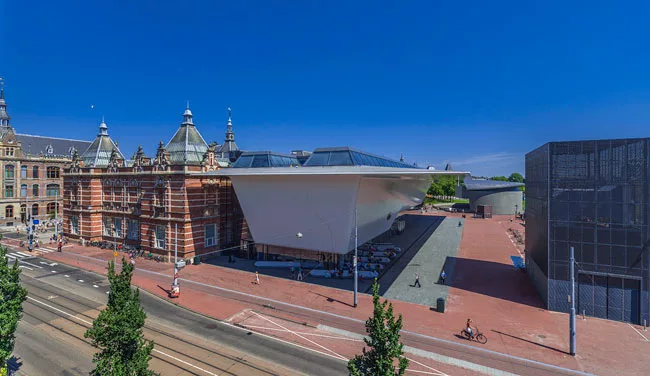
The architect for the Stedelijk Museum extension, Mels Crouwel of Benthem Crouwel, has dubbed the wing, contoured in a white synthetic-fiber panel, the “bathtub.” The controversial structure redirects the entrance of the 1895 neo-Renaissance museum designed by A.W. Weissman away from Van Baerlestraat to the Museumplein (Museum Plaza).
Photo © John Lewis Marshall
The new entrance for the Stedelijk is now at the former rear of the old museum where the new wing extends out to the Museumplein.
Critique: There Goes the Neighborhood
Bentham Crouwel
Amsterdam, Netherlands
The new entrance for the Stedelijk is now at the former rear of the old museum where the new wing extends out to the Museumplein.
Photo © John Lewis Marshall
The light-filled lobby contains an escalator and stair  that take visitors to a column-free lower-level gallery. There, much of the modern art will be on display in spaces that have no daylight.
Critique: There Goes the Neighborhood
Bentham Crouwel
Amsterdam, Netherlands
The light-filled lobby contains an escalator and stair that take visitors to a column-free lower-level gallery. There, much of the modern art will be on display in spaces that have no daylight.
Photo courtesy Stedelijk Museum Amsterdam
Critique: There Goes the Neighborhood
Bentham Crouwel
Amsterdam, Netherlands
Photo courtesy Stedelijk Museum Amsterdam
Critique: There Goes the Neighborhood
Bentham Crouwel
Amsterdam, Netherlands
Photo courtesy Stedelijk Museum Amsterdam
Critique: There Goes the Neighborhood
Bentham Crouwel
Amsterdam, Netherlands
Photo courtesy Stedelijk Museum Amsterdam
Critique: There Goes the Neighborhood
Bentham Crouwel
Amsterdam, Netherlands
Photo courtesy Stedelijk Museum Amsterdam
Critique: There Goes the Neighborhood
Bentham Crouwel
Amsterdam, Netherlands
Photo courtesy Stedelijk Museum Amsterdam
Critique: There Goes the Neighborhood
Bentham Crouwel
Amsterdam, Netherlands
Photo courtesy Stedelijk Museum Amsterdam
 The architect for the Stedelijk Museum extension, Mels Crouwel of Benthem Crouwel, has dubbed the wing, contoured in a white synthetic-fiber panel, the “bathtub.” The controversial struct
The new entrance for the Stedelijk is now at the former rear of the old museum where the new wing extends out to the Museumplein.
The light-filled lobby contains an escalator and stair  that take visitors to a column-free lower-level gallery. There, much of the modern art will be on display in spaces that have no daylight.
Critique: There Goes the Neighborhood
September 16, 2012

The Stedelijk's jarring addition strikes discord in Amsterdam's cultural enclave.

Photo © John Lewis Marshall
The architect for the Stedelijk Museum extension, Mels Crouwel of Benthem Crouwel, has dubbed the wing, contoured in a white synthetic-fiber panel, the “bathtub.” The controversial structure redirects the entrance of the 1895 neo-Renaissance museum designed by A.W. Weissman away from Van Baerlestraat to the Museumplein (Museum Plaza).

For nine years, the Stedelijk Museum has been Amsterdam's most forlorn and hopeful institution—shuttered, vacant, and in terrible need of an overhaul that was always just about to get started and would surely be finished sometime soon. Finally, all the delays have been overcome, overruns absorbed, and embarrassments set aside: The Netherlands' modern-art mecca can finally reopen. Its collection, which stretches from van Gogh to last week's wunderkind via Mondrian, Malevich, Picasso, de Kooning, and Warhol, is returning to public view. Unfortunately, the museum that contains such bounty has disappeared.

The flamboyant neo-Renaissance palazzo from 1895 hasn't vaporized, of course. Seen from the old front entrance—now the rear—its red-brick facade, striped with white stone bands and topped by fanciful Dutch gables and pyramidal turrets, looks cleaner and more exuberant than ever. But approach it from the bustling greensward of the Museumplein—or Museum Plaza—and the original building appears to be cowering behind a glossy white bathtub. This outsized plumbing fixture, clad in para-aramid, a synthetic-fiber panel, and finished with airplane paint to give it that enameled luxury look, is the long-awaited, crushingly disappointing extension designed by the Amsterdam-based firm Benthem Crouwel.

Something about this project brings out the worst in major talents. First Robert Venturi and then Álvaro Siza got the job, and both came up with unworkable designs. Now long deliberation and careful planning have produced a new wing that doubles the institution's bulk, blares its presence, and solves some internal problems while creating a whole passel of new ones for a troubled public space.

There's much to like on the inside. Visitors will have a more focused, better-lit, smoother, and more properly climate-controlled experience than they ever could before. The new Stedelijk can once again start borrowing works from other institutions, which had been loath to expose their fragile treasures to its damp and drafts. The addition touches the original building only gently, sealing the old rear facade inside the new glass entrance lobby. A double-height escalator threads through a bright yellow tube and down to a 10,000-square-foot, column-free underground gallery for really big art.

Lead architect Mels Crouwel has preserved the beloved white-brick interiors of the original, and at the same time ensured that old and new galleries flow together in a smoothly continuous sequence. The blind arcade and crown moldings remain in place at the top of the grand stair (now the school-group entrance); elsewhere, unadorned white walls float a few inches off the floor. Gone is the familiar herringbone parquet, replaced by pale wood flooring that would be the pride of a Swedish sauna.

There's a conceit at work here: The seamless integration of the old and new interiors correlates with the seamless sheen of the new building's envelope. In theory, the defiant juxtaposition in architectural styles highlights the continuity of the artistic experience. But this reasoning seems awfully gaseous when you're confronted with the way the building asserts itself on the city.

The museum borders the Museumplein, a vast open plaza where for more than a century Amsterdammers have gathered to ice-skate, listen to concerts, protest, or just loll in the sun. The square has had a tortuous evolution. At the end of the 19th century, as Amsterdam expanded, city fathers envisioned not just a national museum—the Rijksmuseum—but an entire cultural district, organized around an ample park. Vienna was opening its Ringstrasse, Paris its Haussmannian boulevards, and New York was erecting a massive Metropolitan Museum with an 800-acre backyard called Central Park. Amsterdam built three cultural châteaux: the Rijks- and Stedelijk museums and the Concertgebouw, home of the storied royal orchestra. The great green mall that stretched between these national homes of art and music had to negotiate a change in orientation, since the Concertgebouw turned its facade coquettishly aside to conform to a new street plan. Perhaps it's that slight kink that has allowed successive generations to nibble at the park's borders and muddy its symmetries.

The Museumplein has been designed, destroyed, redesigned, and tinkered with, blurring the gracious original almost beyond recognition. Invading German armies filled it with bunkers. Postwar planners ran a multilane highway through it. In 1973 the Van Gogh Museum expanded into the park with Gerrit Rietveld's severe brick block, then did so again in 1999, with an appalling addition by Kisho Kurokawa. In the 1990s the landscape architect Sven-Ingvar Andersson had tried to clean up the mess. He replaced part of the roadway with a reflecting pool and greened over the rest—but he also sliced up the square with light paths that killed off symmetry once and for all. Andersson's boldest move was the ezelsoor (donkey's ear), created by peeling up one corner of the lawn above a buried supermarket. On one side is an attractive and popular grassy slope; on the other—the side facing the Stedelijk—is a grim, blank wall.

Andersson had handed Crouwel his greatest challenge. Instead of opening expansively onto the Museumplein, the new entrance would be staring into the wrong side of the donkey's ear. Worse, the people hanging out on the inclined green would have their backs to the museum. So instead of building out to the property line, Crouwel put half the new gallery space (plus an auditorium) on an upper floor and buried the other half, leaving the ground level for a plaza sheltered by an extravagantly cantilevered canopy. There is talk of keeping that outdoor area buzzing with activities. But left alone, the plaza, which is bounded by the glassed-in lobby and that unfortunate wall, seems likely to become an isolated and needless appendage to a grand civic square. Crouwel's design practically acknowledges as much: At one end of this potential dead zone, he has plunked a freestanding mechanical tower and loading dock that generally gets cropped out of photos but can't be edited out of existence.

The new Stedelijk's ungainliness is especially mystifying because few old cities have hitched their future to new architecture as decisively as Amsterdam. It's been expanding in every direction, most dramatically into the northern archipelago of artificial islands, where what were once green smudges on a gray horizon have sprouted crystalline structures. The Eye, a just-opened film museum by Delugan Meissl Associated Architects, swoops down to the water, and the future Palace of Justice by Claus en Kaan Architecten rears energetically above it. Old brick warehouses peek out from within new apartment complexes, idle piers sprout fresh neighborhoods, and 17th-century houses stand alongside modernist lofts. This is a city that takes its history and urbanism seriously.

Crouwel has tried to honor that tradition by establishing a new equilibrium at the Stedelijk Museum, balancing fussy masonry with sleek industrial surfaces, ornamental curlicues with aerodynamic curves, and earthy color with white glare. If this were a movie about shackled strangers who discover how much they have in common, it would feel unbearably contrived. The new museum is an architectural odd couple, a pair of mismatched buildings trying to ignore the fact that they are joined at the hip.

Justin Davidson, a Pulitzer Prize–winning critic, writes on both architecture and music for New York magazine.

Share This Story

Looking for a reprint of this article?
From high-res PDFs to custom plaques, order your copy today!

Post a comment to this article

Report Abusive Comment

Subscription Center
  • Create an Account
  • Start a Subscription
  • Manage My Account
  • Sign Up for Newsletters
  • Visit Customer Service
  • Update Preferences

More Videos

Sponsored Content

Sponsored Content is a special paid section where industry companies provide high quality, objective, non-commercial content around topics of interest to the Architectural Record audience. All Sponsored Content is supplied by the advertising company and any opinions expressed in this article are those of the author and not necessarily reflect the views of Architectural Record or its parent company, BNP Media. Interested in participating in our Sponsored Content section? Contact your local rep!

close
  • cold storage facility
    Sponsored byCarlisle SynTec Systems

    How Architects Can Design More Continuous Cold Storage Envelopes

  • TAMLYN XtremeTrim Exterior Trim
    Sponsored byTamlyn

    Designing Cleaner Panel Facades: Why Exterior Trim Details Matter

  • Building with Vapor Barriers
    Sponsored byReef Industries, Inc.

    Vapor Barriers Help Control Moisture in Tighter Building Designs

DESIGN:ED Podcast
Listen to Architectural Record’s DESIGN:ED Podcast

Events

June 18, 2026

Rebooting the Aging Office Building

Credits: 1 AIA LU/HSW; 1 AIBD P-CE; 0.1 ICC CEU; 1 PDH

Explore façade retrofit strategies and award-winning design concepts that can transform aging office buildings into healthier, higher-performing workplaces for today’s hybrid workforce.

June 23, 2026

Enhancing Fire Resistance with Advanced PVC Solutions

Credits: 1 AIA LU/HSW; 1 AIBD P-CE; 0.1 ICC CEU; 1 IIBEC CEH

Evaluate advanced PVC solutions that improve fire resistance, support WUI compliance, and enhance resilience in residential and commercial building design.

View All Submit An Event

Products

2026 Architect's Square Foot Costbook

2026 Architect's Square Foot Costbook

See More Products

Popular Stories

SanDiegoAirport

Top 300 Architecture Firms of 2026

Lorcan O' Herilhy

California Architect Lorcan O’Herlihy Has Died, Age 66

Coronado Bridge

The Architect’s Guide to San Diego

CCA, Studio Gang

The Winners of the AIA’s 2026 Architecture Award Range from Collegiate Rowing Hubs to Housing for the Homeless

Dusk House

Design Vanguard 2026: ONO

Rebooting the Aging Office Building - Free Webinar - June 18, 2026

Related Articles

  • Sperone Westwater

    There Goes the Neighborhood: Sperone Westwater Opens on Manhattan's Lower East Side

    See More
  • Masters of the Neighborhood

    See More
  • Eternal Medium - Seeing the World in Stone

    An Exhibition Goes Beyond the White Cube into Dark Territory

    See More

Related Products

See More Products
  • 047177751X.gif

    Sustainable Urbanism: Urban Design With Nature

See More Products
×

The latest news and information

#1 Source for Architectural Design, News and Products

SUBSCRIBE
  • RESOURCES
    • Advertise
    • Contact Us
    • Submit
    • Store
  • ACCOUNT CENTER
    • Create an Account
    • Start a Subscription
    • Manage My Account
    • Sign Up for Newsletters
    • Visit Customer Service
    • Update Preferences
  • PRIVACY
    • PRIVACY POLICY
    • TERMS & CONDITIONS
    • DO NOT SELL MY PERSONAL INFORMATION
    • PRIVACY REQUEST
    • ACCESSIBILITY
  • SERVICES
    • Marketing Services
    • Reprints
    • Market Research
    • List Rental
    • Survey/Respondent Access
  • STAY CONNECTED
    • Linkedin
    • Facebook
    • Instagram
    • YouTube
    • X (Twitter)

Copyright ©2026. All Rights Reserved BNP Media, Inc. and BNP Media II, LLC.

Design, CMS, Hosting & Web Development :: ePublishing