Architectural Record
search
cart
facebook twitter linkedin youtube
  • Sign In
  • Subscribe
  • Sign Out
  • My Account
Architectural Record
  • NEWS
    • Latest News
    • Awards
    • Interviews
    • Obituaries
    • Podcasts
      • Design:Ed Podcast
      • Sponsored Podcasts
  • OPINION
    • Book Reviews / Excerpts
    • Exhibition Reviews
    • Forum
  • EXCLUSIVES
    • Videos
    • Design Vanguard
    • Top 300 Firms
    • Sponsored Content
    • Sponsored eBooks
    • From the Archives
  • CONTINUING ED
    • Editorial Continuing Ed
    • CE Center
    • CE Academies
  • PROJECTS
    • Buildings By Type
    • Reuse & Renovation
    • Museums & Arts Centers
    • Colleges & Universities
    • Multifamily Housing
    • Interiors
    • Lighting
    • Kitchen & Bath
  • HOUSES
    • Record Houses
    • House of the Month
    • Featured Houses
  • PRODUCTS
    • Products by Category
    • Record Products of the Year
    • Latest Products
  • EVENTS
    • Dates & Events
    • Record on the Road
    • Innovation Conference
    • Sustainability in Practice
    • Women In Architecture
    • Webinars
    • Ad Excellence Awards
    • Submit an Event
  • CONNECT
    • Ask RECORD AI
    • Newsletters
    • Contact
    • Advertise
    • Editorial Calendar
    • Store
    • Customer Service
  • SUBMIT
    • Submission Guidelines
    • RECORD Competitions
  • MAGAZINE
    • Subscribe
    • My Account
    • Digital Edition
    • Current Issue
    • Firm Pass
    • Historic Archive
Commentary & CriticismOpinion

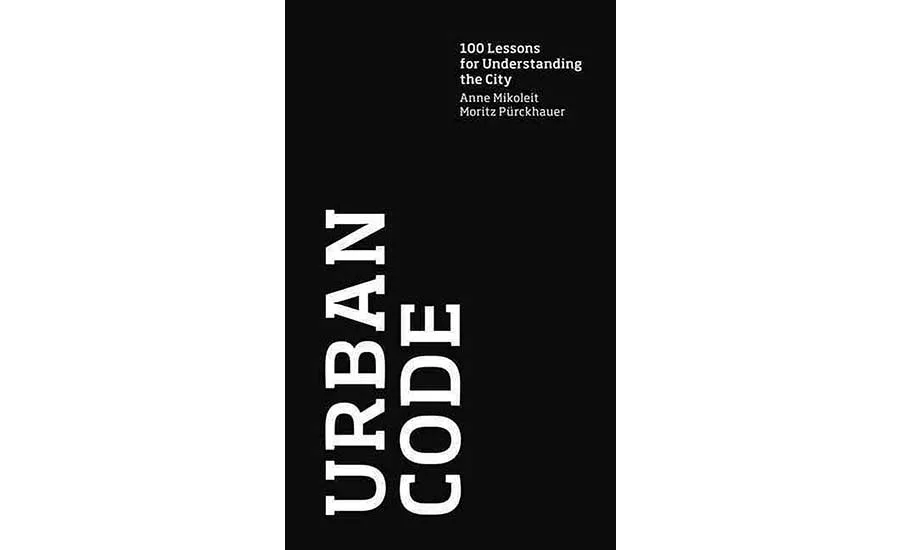
Urban Code: 100 Lessons for Understanding the City
By Claire Weisz
Urban Code: 100 Lessons for Understanding the City

Urban Code: 100 Lessons for Understanding the City, by Anne Mikolet & Moritz P'rckhauer. MIT Press, 2011, 112 pages, $19.

December 16, 2011
Picking up this little black-and-white volume and spying its table of contents, I couldn’t help but intone her name—Jane Jacobs. Since The Death and Life of Great American Cities was published in 1961, the term “city planning” has been replaced, over time, by “urban.” Today we have “urban design,” “urban planning” and now “urban code,” all of which legitimize making sense of cities based on observation.
 
Urban Code is a tribute to the paradigm shift that began 50 years ago, when observation of the environment replaced abstract theoretical constructs. Inspired by this method, Urban Code by Mikolet and Pürckhauer focuses on New York’s SoHo in 2011 to produce a small accessible handbook of place-based rules. From Jacobs’ four plainly stated conditions for sustaining a diverse and lively neighborhood (a mix of uses, small blocks, aged buildings, and concentration), these authors propose 100 illustrated rules, apparently based simply on looking at a popular neighborhood for what seems to be a couple of weeks. Jacobs’ emphasis reverberates through many of the authors’ concerns from No. 32 (“Each building houses a business”) to No.70 (“Groups attract people”). But most maxims need to be read in pairs so it makes sense to read No. 70 with No. 69: “When people stand still, groups develop.”

Ignoring my desire for a new take on Jacobs’ plainly stated conditions for urban diversity, I accepted the case for 100 rules at face value. After all, an annotated list with its Twitter-like format lends itself to contemporary dissemination. 

But do these urban rules hold up for a biased reader who has lived and works in SoHo? I like lists as much as anyone and appreciate the allure of a number, a title, a small illustration, and a couple of paragraphs on each entry. The problem is that the titles tend to influence the reading of each rule.

For No. 1: “People Walk in the Sunshine”, there was no argument. Most of us would admit that, unless it's blazing hot or there's a line to get into the Apple Store, we like walking in the sun. But the need for that “unless” is the book’s weakness and strength—the fact that it acknowledges both the limits of brief observations and the contradictions inherent in cities. The text acknowledges that each rule applies only to a particular place and time—a fine sentiment but one that makes it hard for the reader to understand the authors’ intention. Equally confusing is the title for No 45: “Workers Wear Work Clothes,” accompanied by a photograph that shows people in uniforms cleaning up after litter bugs. In fact, No. 45 contains a keen set of observations about how daily work rituals—as much as built form—mark the qualities that emerge from a neighborhood's authentic experiences. But shouldn’t the title be: “Maintenance Matters” or something like that?

The best parts of this book derive from the chance to observe a place being keenly observed. I liked very much the explanation of why taxis are urban design: “by outnumbering other modes of transportation and being on equal footing with people desiring their services, they have become part of the “street spectacle.” Urban Code’s real value is as an urban diary. Hopefully, this little volume will spark a rash of urban observers to publish more lessons gleaned from places in their cities at specific moments in time.

Claire Weisz, a partner in the New York firm WXY Architecture who teaches urban design to planners at New York University’s Robert F. Wagner Graduate School of Public Service, has lived and works in SoHo.

KEYWORDS: Book Reviews / Excerpts Jane Jacobs

Share This Story

Looking for a reprint of this article?
From high-res PDFs to custom plaques, order your copy today!


Post a comment to this article

Report Abusive Comment

Subscription Center
  • Create an Account
  • Start a Subscription
  • Manage My Account
  • Sign Up for Newsletters
  • Visit Customer Service
  • Update Preferences

More Videos

Sponsored Content

Sponsored Content is a special paid section where industry companies provide high quality, objective, non-commercial content around topics of interest to the Architectural Record audience. All Sponsored Content is supplied by the advertising company and any opinions expressed in this article are those of the author and not necessarily reflect the views of Architectural Record or its parent company, BNP Media. Interested in participating in our Sponsored Content section? Contact your local rep!

close
  • cold storage facility
    Sponsored byCarlisle SynTec Systems

    How Architects Can Design More Continuous Cold Storage Envelopes

  • TAMLYN XtremeTrim Exterior Trim
    Sponsored byTamlyn

    Designing Cleaner Panel Facades: Why Exterior Trim Details Matter

  • Building with Vapor Barriers
    Sponsored byReef Industries, Inc.

    Vapor Barriers Help Control Moisture in Tighter Building Designs

DESIGN:ED Podcast
Listen to Architectural Record’s DESIGN:ED Podcast

Events

June 25, 2026

Designing Glass Railing Systems that Enhance Aesthetics and Meet Code

Credits: 1 AIA LU/HSW; 1 AIBD P-CE; 0.1 ICC CEU

Upon course completion, participants will possess a deeper understanding of glass railings to help ensure that safety, aesthetic, and performance objectives are achieved.

June 30, 2026

Generator Selection and Sizing for Outage-Ready Homes

Credits: 1 AIA LU/HSW; 1 AIBD P-CE; 0.1 ICC CEU

Explore how propane-powered systems and whole-home generators can improve energy resilience, reduce electrical loads, and lower long-term residential costs.

View All Submit An Event

Products

2026 Architect's Square Foot Costbook

2026 Architect's Square Foot Costbook

See More Products

Popular Stories

Obama Presidential Center, Chicago

The Obama Presidential Center Opens on Chicago’s South Side

Lorcan O' Herilhy

California Architect Lorcan O’Herlihy Has Died, Age 66

Spoonbill Ranch

Johnsen Schmaling Architects Integrates Spoonbill Ranch into a Pristine Landscape

Image of Bruce Springsteen Center for American Music

The CookFox-designed Bruce Springsteen Center for American Music Opens in New Jersey

Kìwekì Point, Ottawa, Canada

Perched High Above the Ottawa River, Kìwekì Point Showcases Sweeping Views of the Canadian Capital Region

Designing Glass Railing Systems that Enhance Aesthetics and Meet Code - Free Webinar - June 25, 2026

Related Articles

  • Call for Entries! By the City / For the City Design Competition

    See More
  • Citizen ane

    Review of New Film 'Citizen Jane: Battle for the City'

    See More

Related Products

See More Products
  • WC_-SCA.png

    Building Great Schools for a Great City

See More Products

Events

View AllSubmit An Event
  • March 25, 2026

    Rewards and Challenges of Design-Assist: Lessons for Students in Collaborative Project Delivery

    NOW ON DEMANDCredits: 1 AIA LU/HSW; 1 AIBD P-CE;  0.1 ICC CEU; 0.1 IACET CEULearn how design-assist collaboration among architects, engineers, and contractors improves efficiency and constructability through real-world case studies and expert insights.
View AllSubmit An Event
×

The latest news and information

#1 Source for Architectural Design, News and Products

SUBSCRIBE
  • RESOURCES
    • Advertise
    • Contact Us
    • Submit
    • Store
  • ACCOUNT CENTER
    • Create an Account
    • Start a Subscription
    • Manage My Account
    • Sign Up for Newsletters
    • Visit Customer Service
    • Update Preferences
  • PRIVACY
    • PRIVACY POLICY
    • TERMS & CONDITIONS
    • DO NOT SELL MY PERSONAL INFORMATION
    • PRIVACY REQUEST
    • ACCESSIBILITY
  • SERVICES
    • Marketing Services
    • Reprints
    • Market Research
    • List Rental
    • Survey/Respondent Access
  • STAY CONNECTED
    • Linkedin
    • Facebook
    • Instagram
    • YouTube
    • X (Twitter)

Copyright ©2026. All Rights Reserved BNP Media, Inc. and BNP Media II, LLC.

Design, CMS, Hosting & Web Development :: ePublishing