Architectural Record
search
cart
facebook twitter linkedin youtube
  • Sign In
  • Subscribe
  • Sign Out
  • My Account
Architectural Record
  • NEWS
    • Latest News
    • Awards
    • Interviews
    • Obituaries
    • Podcasts
      • Design:Ed Podcast
      • Sponsored Podcasts
  • OPINION
    • Book Reviews / Excerpts
    • Exhibition Reviews
    • Forum
  • EXCLUSIVES
    • Videos
    • Design Vanguard
    • Top 300 Firms
    • Sponsored Content
    • Sponsored eBooks
    • From the Archives
  • CONTINUING ED
    • Editorial Continuing Ed
    • CE Center
    • CE Academies
  • PROJECTS
    • Buildings By Type
    • Reuse & Renovation
    • Museums & Arts Centers
    • Colleges & Universities
    • Multifamily Housing
    • Interiors
    • Lighting
    • Kitchen & Bath
  • HOUSES
    • Record Houses
    • House of the Month
    • Featured Houses
  • PRODUCTS
    • Products by Category
    • Record Products of the Year
    • Latest Products
  • EVENTS
    • Dates & Events
    • Record on the Road
    • Innovation Conference
    • Sustainability in Practice
    • Women In Architecture
    • Webinars
    • Ad Excellence Awards
    • Submit an Event
  • CONNECT
    • Ask RECORD AI
    • Newsletters
    • Contact
    • Advertise
    • Editorial Calendar
    • Store
    • Customer Service
  • SUBMIT
    • Submission Guidelines
    • RECORD Competitions
  • MAGAZINE
    • Subscribe
    • My Account
    • Digital Edition
    • Current Issue
    • Firm Pass
    • Historic Archive
Design Vanguard

Trace Architecture Office

A busy firm layers a commitment to social and environmental issues onto its projects in many different parts of China.
By Clare Jacobson
TAO designed this museum in Yunnan province as a cluster of volumes, echoing the ad hoc pattern of buildings in the adjacent village of Gaoligong. The museum's timber-framed buildings use nail-free su
Gaoligong Museum of Handcraft Paper
Trace Architecture Office
Beijing
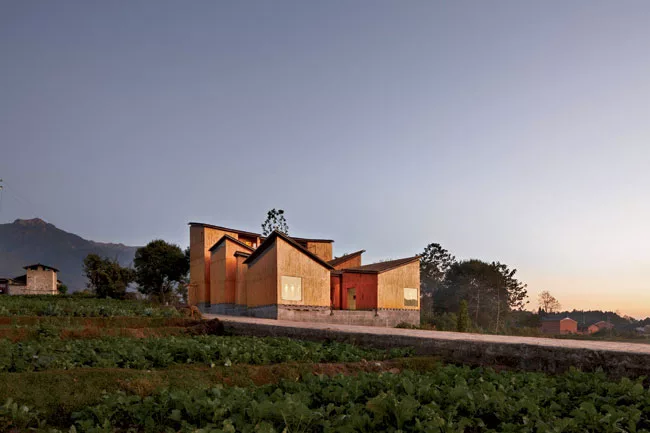
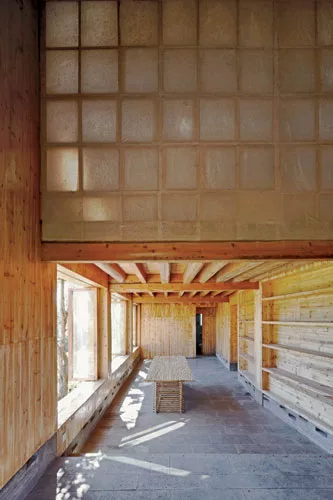
TAO designed this museum in Yunnan province as a cluster of volumes, echoing the ad hoc pattern of buildings in the adjacent village of Gaoligong. The museum's timber-framed buildings use nail-free sunmao joints, and its simple construction honors the local tradition of handcrafts. 'We liked the possibility of using this traditional technique in a modern form,' says Hua. He compares the quality of the construction to that of the paper it celebrates. 'The handmade paper, at first look, seems quite rough,' he says. 'But its texture tells many stories, which you never see on machine-made paper. The architecture has a similar intention.'
Photo © Shu He
TAO designed this museum in Yunnan province as a cluster of volumes, echoing the ad hoc pattern of buildings in the adjacent village of Gaoligong. The museum's timber-framed buildings use nail-free su
Gaoligong Museum of Handcraft Paper
Trace Architecture Office
Beijing
TAO designed this museum in Yunnan province as a cluster of volumes, echoing the ad hoc pattern of buildings in the adjacent village of Gaoligong. The museum's timber-framed buildings use nail-free sunmao joints, and its simple construction honors the local tradition of handcrafts. 'We liked the possibility of using this traditional technique in a modern form,' says Hua. He compares the quality of the construction to that of the paper it celebrates. 'The handmade paper, at first look, seems quite rough,' he says. 'But its texture tells many stories, which you never see on machine-made paper. The architecture has a similar intention.'
Photo © Shu He
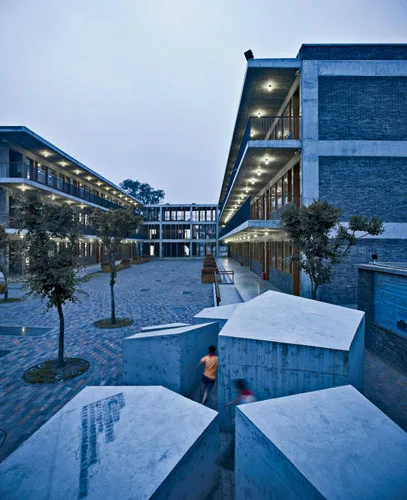
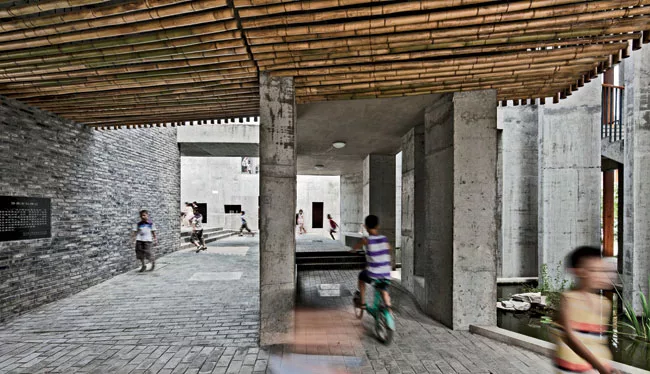
'We're trying to do something different, to challenge the clich'd educational approach,' says Hua. TAO's gathering of buildings and outdoor spaces allows children to pursue individual activities in ad
Xiaoquan Elementary School
Trace Architecture Office
Beijing
'We're trying to do something different, to challenge the clich'd educational approach,' says Hua. TAO's gathering of buildings and outdoor spaces allows children to pursue individual activities in addition to group exercises. The school replaces a building that was destroyed in the devastating 2008 Sichuan earthquake. To enact its design, TAO had to win over not only school administrators but also six organizations (including a group of Buddhist monks) that had donated money to the school's rebuilding.
Photo © Shu He
'We're trying to do something different, to challenge the clich'd educational approach,' says Hua. TAO's gathering of buildings and outdoor spaces allows children to pursue individual activities in ad
Xiaoquan Elementary School
Trace Architecture Office
Beijing
'We're trying to do something different, to challenge the clich'd educational approach,' says Hua. TAO's gathering of buildings and outdoor spaces allows children to pursue individual activities in addition to group exercises. The school replaces a building that was destroyed in the devastating 2008 Sichuan earthquake. To enact its design, TAO had to win over not only school administrators but also six organizations (including a group of Buddhist monks) that had donated money to the school's rebuilding.
Photo © Shu He
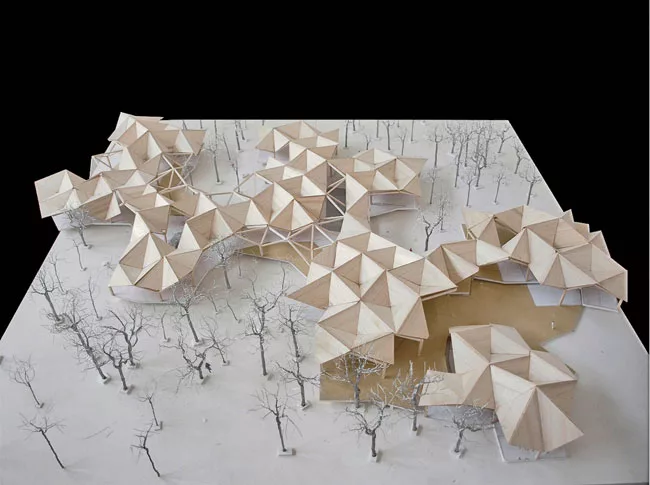
Tree-shaped columns with cantilevered beams form a rambling structure that zigzags between real trees in a riverside Beijing park. The project will be built in phases, so TAO designed a grid that can
Tree Clubhouse
Trace Architecture Office
Beijing
Tree-shaped columns with cantilevered beams form a rambling structure that zigzags between real trees in a riverside Beijing park. The project will be built in phases, so TAO designed a grid that can grow in parts.
Photo © Shu He
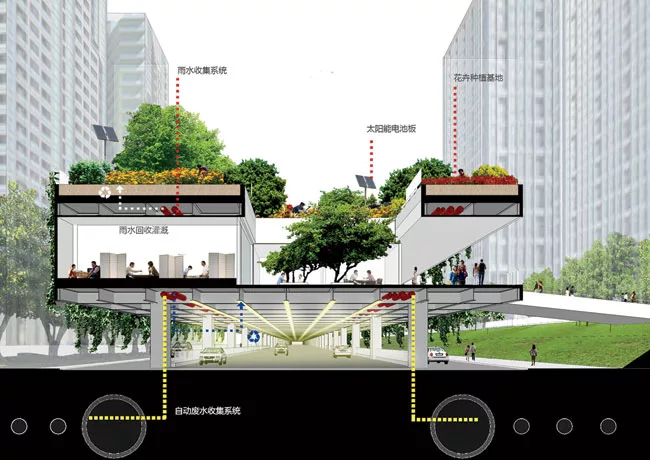
Created for the 2011 Chengdu Biennale, this project finds room for the public amenities missing in many Chinese cities. 'Currently in China, land is sold to profit-driven developers, and they always b
Streetacre City
Trace Architecture Office
Chengdu, China
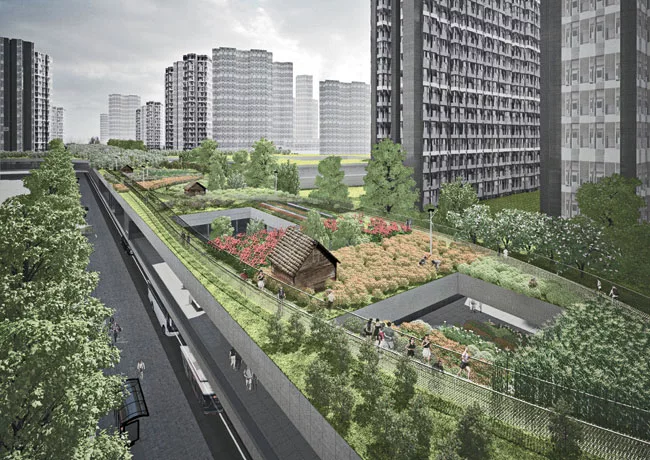
Created for the 2011 Chengdu Biennale, this project finds room for the public amenities missing in many Chinese cities. 'Currently in China, land is sold to profit-driven developers, and they always build super-high-density residential complexes that lack public facilities,' says Hua. 'Our idea is to improve the quality of public space and provide local services.' TAO uses Chengdu's street grid'a rare public space'as the site for parks, gardens, exercise trails, restaurants, markets, and the like. The firm proposes layers of activity above the car traffic below. Residents of the surrounding towers can look down on the top layer of linear gardens that weave through their neighborhood.
Photo © Shu He
Created for the 2011 Chengdu Biennale, this project finds room for the public amenities missing in many Chinese cities. 'Currently in China, land is sold to profit-driven developers, and they always b
Streetacre City
Trace Architecture Office
Chengdu, China
Created for the 2011 Chengdu Biennale, this project finds room for the public amenities missing in many Chinese cities. 'Currently in China, land is sold to profit-driven developers, and they always build super-high-density residential complexes that lack public facilities,' says Hua. 'Our idea is to improve the quality of public space and provide local services.' TAO uses Chengdu's street grid'a rare public space'as the site for parks, gardens, exercise trails, restaurants, markets, and the like. The firm proposes layers of activity above the car traffic below. Residents of the surrounding towers can look down on the top layer of linear gardens that weave through their neighborhood.
Photo © Shu He
TAO took its design cues for this 5,380-square-foot building in Yancheng, 200 miles north of Shanghai, from the riverside site. The steel-framed, glass-walled building hovers above the ground, running
Riverside Clubhouse
Trace Architecture Office
Yancheng, China
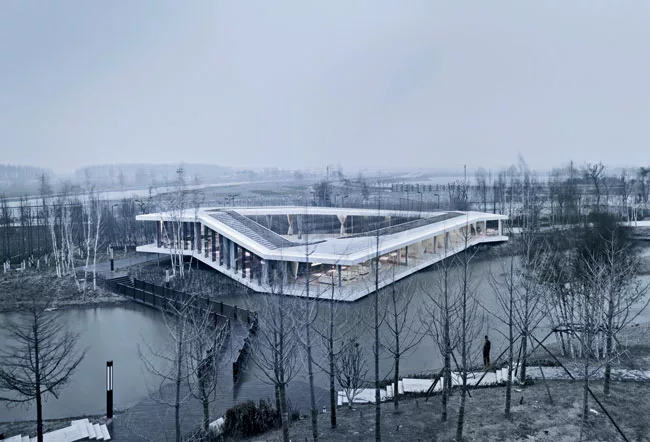
TAO took its design cues for this 5,380-square-foot building in Yancheng, 200 miles north of Shanghai, from the riverside site. The steel-framed, glass-walled building hovers above the ground, running an irregular loop around groves of bamboo and other vegetation. Hua calls it his 'folded Farnsworth' for its transparency and fluid interior space. The program includes exhibition and meeting spaces, along with reception, lounge, and office areas.
Photo © Yao Li
TAO designed this museum in Yunnan province as a cluster of volumes, echoing the ad hoc pattern of buildings in the adjacent village of Gaoligong. The museum's timber-framed buildings use nail-free su
'We're trying to do something different, to challenge the clich'd educational approach,' says Hua. TAO's gathering of buildings and outdoor spaces allows children to pursue individual activities in ad
Tree-shaped columns with cantilevered beams form a rambling structure that zigzags between real trees in a riverside Beijing park. The project will be built in phases, so TAO designed a grid that can
Created for the 2011 Chengdu Biennale, this project finds room for the public amenities missing in many Chinese cities. 'Currently in China, land is sold to profit-driven developers, and they always b
TAO took its design cues for this 5,380-square-foot building in Yancheng, 200 miles north of Shanghai, from the riverside site. The steel-framed, glass-walled building hovers above the ground, running
December 16, 2012

Beijing

China is a big country, and Trace Architecture Office (TAO) is leaving its mark all over it. The Beijing-based firm's portfolio includes a teahouse overlooking the Yellow Sea in northeastern Shandong province, a museum in southwestern Yunnan province near the Myanmar border, and a factory in Fujian province 140 miles from the Taiwan Strait. Hua Li, founding principal of TAO, prefers these projects because their locations 'still have diversity; they're not yet globalized.' These places have cultures that retain traces of local material usage and construction techniques and inform TAO's work. In turn, Hua's interest in leaving an architectural trace'both artistically and socially'sets his agenda and gives his firm its name.

' 'Trace' suggests our concern for the social commitment and environmental impact of architecture,' says Hua. He describes TAO's efforts both to manage its aesthetic ideal and its social concerns'balancing individual artistry with communal integrity, expressive forms with socially structured spaces, and global sophistication with local materials. To explain his outlook, Hua offers the example of his Xiaoquan Elementary School in Sichuan province. 'Instead of making a centralized, single building, we designed a cluster of small structures to create a kind of urban condition.' This helps form a community for children who both study and live at the school, as their parents have emigrated from Sichuan for work opportunities. At the same time, TAO inserted specific spaces to encourage exploration. For example, it cut an alcove into a wall and envisioned it as a seating area; children instead filled it with books to create an informal outdoor library. Hua commends the work done by the local contractor on the concrete structure, but 'it's not like a Tadao Ando concrete wall,' he says. He ground out some of the rough spots left over from the formwork. 'With this trace of fixing the problem, you see the process of working. I think it's more meaningful to see the history of the building.'

' 'Trace' is the meaning recorded in the process of making things,' says Hua. 'It makes architecture more like an archaeological object, which expresses its real condition, in contrast to the form that is only an abstraction or representation. I think this is just like history. The history we know is only a small part of the real things that happened. Many other things are hidden or lost or silent. So to work with traces is our effort to reveal these hidden things.' TAO's attitude can also be seen in its working method, which includes building physical models and using a lot of hand drawing. (Hua denies any conscious connection between 'trace' and the paper he so often uses.)

Hua grew up in Lanzhou in the northwestern province of Gansu. 'People there are straightforward and honest,' he says. His neighbors taught him 'to live a simple life, to care about things that are basic and fundamental.' He left home to study at Beijing's prestigious Tsinghua University and then at Yale. There he was influenced by Raimund Abraham, who emphasized poetics over practicality. After graduating, Hua worked in New York for Herbert Beckhard, who had been a partner of Marcel Breuer and brought Breuer's concern for details and tectonics to his work.

In 2003 Hua returned to China and cofounded Universal Architecture Studio, which focused on large sports facilities, mixed-use complexes, and urban design. Working on mega-projects, though, proved frustrating, because they often didn't move beyond the drawing board. Hua wanted to build. So in 2009 he founded TAO to refocus his efforts on smaller works. Each of his projects responds to its particular setting, so there is no identifiable TAO look, which is fine with Hua. 'We don't like to copy forms or repeat ourselves,' he says. 'To me it's more important to understand architecture's social commitment and meaning. I think it has the power to transform culture.'

Trace Architecture Office

FOUNDED: 2009

DESIGN STAFF: 12

PRINCIPAL: Hua Li

EDUCATION: Yale University, M.Arch., 1999; Tsinghua University, B.Arch., 1994

WORK HISTORY: Universal Architecture Studio, 2003–09; Herbert Beckhard Frank Richlan & Associates, 2001–02; Westfourth Architecture, 1999–2001

KEY COMPLETED PROJECTS: Huancui Park Visitor Center, Weihai, China, 2012; Xiaoquan Elementary School, Sichuan province, 2011; Riverside Clubhouse, Yancheng, 2011; Gaoligong Museum of Handcraft Paper, Yunnan province, 2010

KEY CURRENT PROJECTS: Tree Clubhouse, Beijing, 2013; Wuyishan Bamboo Raft Factory, Fujian province, 2013; Film Director’s Center, Beijing, 2013; Kindergarten, Sichuan province, 2014

WEB SITE: www.T-A-O.Cn


Share This Story

Looking for a reprint of this article?
From high-res PDFs to custom plaques, order your copy today!
Clare Jacobson is a San Francisco-based contributor to Architectural Record.

Post a comment to this article

Report Abusive Comment

Subscription Center
  • Create an Account
  • Start a Subscription
  • Manage My Account
  • Sign Up for Newsletters
  • Visit Customer Service
  • Update Preferences

More Videos

Sponsored Content

Sponsored Content is a special paid section where industry companies provide high quality, objective, non-commercial content around topics of interest to the Architectural Record audience. All Sponsored Content is supplied by the advertising company and any opinions expressed in this article are those of the author and not necessarily reflect the views of Architectural Record or its parent company, BNP Media. Interested in participating in our Sponsored Content section? Contact your local rep!

close
  • TAMLYN XtremeTrim Exterior Trim
    Sponsored byTamlyn

    Designing Cleaner Panel Facades: Why Exterior Trim Details Matter

  • Building with Vapor Barriers
    Sponsored byReef Industries, Inc.

    Vapor Barriers Help Control Moisture in Tighter Building Designs

  • Duct Interior with Prodeq System
    Sponsored byHenry, a Carlisle Company

    Designing Resilient Water Containment Systems

DESIGN:ED Podcast
Listen to Architectural Record’s DESIGN:ED Podcast

Events

June 10, 2026

Rethinking Stormwater – The Power of Porous Paving

Credits: 1 AIA LU/HSW; 1 AIBD P-CE; 0.1 ICC CEU

Learn how porous paving systems support stormwater management, reduce heat island effects, and enhance sustainable site design performance.

June 11, 2026

Very Early Warning Fire Detection for Mission-Critical Facilities

Credits: 1 AIA LU/HSW; 1 AIBD P-CE; 0.1 ICC CEU

Examine advanced fire detection strategies that support uptime and enhance safety in data centers and other mission-critical facilities.

View All Submit An Event

Products

2026 Architect's Square Foot Costbook

2026 Architect's Square Foot Costbook

See More Products

Popular Stories

Practice Matters illustration

What’s in a (Firm’s) Name? Thinking About Succession and Legacy

Practice Matters illustration

By the Numbers: Counting America's Architects

House on a Hill

Design Vanguard 2026: Forma

Crane Cove, ONO

Design Vanguard 2026 Winners

House A on a Hill

Design Vanguard 2026: Santiago Valdivieso

Broader Sustainability of CMU - Free Webinar - May 21, 2026

Related Articles

  • Xiaoquan Elementary School

    China Awards 2012: Xiaoquan Elementary School by TAO (Trace Architecture Office)

    See More
  • Akihisa Hirata Architecture Office

    See More
  • City Kids Education Center.

    Barker Associates Architecture Office Creates Unexpected Interiors for City Kids in Brooklyn, New York

    See More

Related Products

See More Products
  • ribbonarch.jpg

    Ribbon Architecture: Light, Shadow, and Reflection in Architecture

  • 3dthinking.jpg

    3D Thinking in Design and Architecture: From Antiquity to the Future

See More Products
×

The latest news and information

#1 Source for Architectural Design, News and Products

SUBSCRIBE
  • RESOURCES
    • Advertise
    • Contact Us
    • Submit
    • Store
  • ACCOUNT CENTER
    • Create an Account
    • Start a Subscription
    • Manage My Account
    • Sign Up for Newsletters
    • Visit Customer Service
    • Update Preferences
  • PRIVACY
    • PRIVACY POLICY
    • TERMS & CONDITIONS
    • DO NOT SELL MY PERSONAL INFORMATION
    • PRIVACY REQUEST
    • ACCESSIBILITY
  • SERVICES
    • Marketing Services
    • Reprints
    • Market Research
    • List Rental
    • Survey/Respondent Access
  • STAY CONNECTED
    • Linkedin
    • Facebook
    • Instagram
    • YouTube
    • X (Twitter)

Copyright ©2026. All Rights Reserved BNP Media, Inc. and BNP Media II, LLC.

Design, CMS, Hosting & Web Development :: ePublishing