Architectural Record
search
cart
facebook twitter linkedin youtube
  • Sign In
  • Subscribe
  • Sign Out
  • My Account
Architectural Record
  • NEWS
    • Latest News
    • Awards
    • Interviews
    • Obituaries
    • Podcasts
      • Design:Ed Podcast
      • Sponsored Podcasts
  • OPINION
    • Book Reviews / Excerpts
    • Exhibition Reviews
    • Forum
  • EXCLUSIVES
    • Videos
    • Design Vanguard
    • Top 300 Firms
    • Sponsored Content
    • Sponsored eBooks
    • From the Archives
  • CONTINUING ED
    • Editorial Continuing Ed
    • CE Center
    • CE Academies
  • PROJECTS
    • Buildings By Type
    • Reuse & Renovation
    • Museums & Arts Centers
    • Colleges & Universities
    • Multifamily Housing
    • Interiors
    • Lighting
    • Kitchen & Bath
  • HOUSES
    • Record Houses
    • House of the Month
    • Featured Houses
  • PRODUCTS
    • Products by Category
    • Record Products of the Year
    • Latest Products
  • EVENTS
    • Dates & Events
    • Record on the Road
    • Innovation Conference
    • Sustainability in Practice
    • Women In Architecture
    • Webinars
    • Ad Excellence Awards
    • Submit an Event
  • CONNECT
    • Ask RECORD AI
    • Newsletters
    • Contact
    • Advertise
    • Editorial Calendar
    • Store
    • Customer Service
  • SUBMIT
    • Submission Guidelines
    • RECORD Competitions
  • MAGAZINE
    • Subscribe
    • My Account
    • Digital Edition
    • Current Issue
    • Firm Pass
    • Historic Archive

The Engineers Moment
By Nina Rappaport
The Engineers Moment

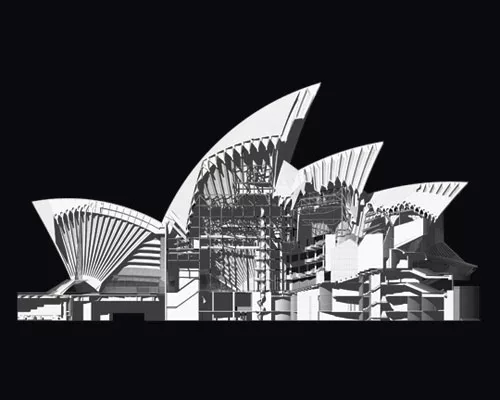
Building Information Model from 2007 of the Sydney Opera House (1957–73).

Photo © Sydney Opera House, Courtesy Utzon Architects/Johnson Pilton Walker (Architects in collaboration)
The Engineers Moment

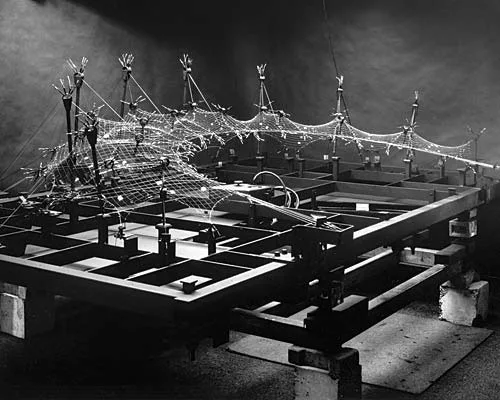
Structural study model for the Munich Olympic Stadium (1972), Behnisch Architekten, with Frei Otto.

Photo courtesy The Institute for Lightweight Structures and Conceptual Design
The Engineers Moment

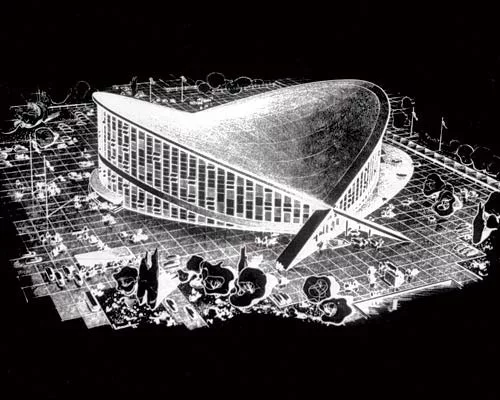
Dorton (Raleigh) Arena (1952), North Carolina, Matthew Nowicki, with Frederick Severud.

Photo courtesy North Carolina State Fair Division
The Engineers Moment

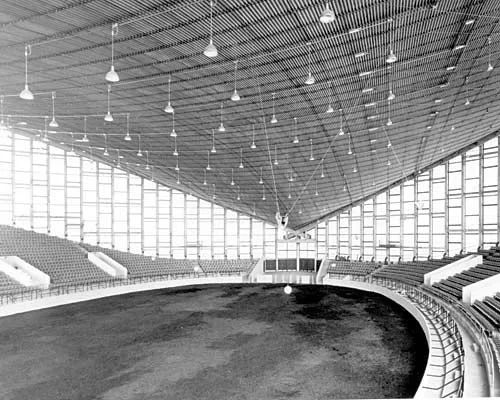
Dorton (Raleigh) Arena (1952), North Carolina, Matthew Nowicki, with Frederick Severud.

Photo courtesy North Carolina State Fair Division

The Engineers Moment
August 16, 2007
A shift in the architecture profession, already entrenched with issues of control and authorship, affords the engineer an expanded role during initial project design discussions, not just as consultants after the fact. Structural engineers like Chris Wise—formerly of Arup, now at Expedition Engineering—are literally drawing at the table, which is how he explains his collaboration at Arup with Norman Foster’s office on London’s Millennium Bridge. Engineers are featured prominently in conceptual design discussions, and they are even once again writing books on their philosophy of structures. The blurring of professional boundaries between architect and engineer is making the design process more flexible and malleable, and thus experimental, providing a new space for the structural engineer to merge the overemphasized divide between math, nature, technology, and design.
 
In part, this shift is due to a renewed interest in structures by contemporary architects, such as the Office for Metropolitan Architecture with Cecil Balmond, Michael Maltzan and Steven Holl with Guy Nordenson, Toyo Ito and Arata Isozaki with Mutsuro Sasaki, Coop Himmelb(l)au with Bollinger & Grohmann, to name just a few. This paradigm has emerged through intense collaboration, open design dialogue, and radical advances in digital design and fabrication technology, resulting in new arrangements of the “bones” of a building, the design of occupiable structural elements, new structural “skins” to envelop massive spaces, form-finding, and environmental integration. Structural designs that embrace a new holistic integration have also been inspired by the internal structures of nature, as found in things such as crystals, coral, and bones. Engineering falls between science and art, intuition and empiricism and is thus often not accepted in its full creative potential. Creativity results from intuitive interpretation of first principles of physics, mathematics, and code, which, while abstract, can result in new, nonstandard techniques in the physical world. Structure, so often only discussed in terms of economy and efficiency, is also about aesthetics.
 
In considering the rise of the contemporary engineer, what comes to light are three important moments of design input in the past century: the early Modern era; the 1950s; and again today, where geometry, structures in nature, and collaboration all play a role in shaping new spaces as described in this rather brief history. During the early Modern movement, the engineer came into the foreground, with or without architects, often patenting structural steel and concrete inventions for large spans, such as those by Owen Williams for Boots, Giacomo Matte-Trucco for Fiat, or the shell structures of Pier Luigi Nervi. Robert Maillart became a de facto Modern designer with his minimal bridge structures in Switzerland, as did the anonymous American engineers of grain silos admired by Erich Mendelsohn and Le Corbusier. The late London structural engineer Ove Arup started his career designing projects in concrete with Tecton Architects, such as London Zoo’s Penguin Pool (1934), which Arup designed with engineer Felix Samuely.

Midcentury masters

Those Modern structural design engineers engaged the next generation, who by the 1950s and 1960s inserted themselves into larger consultancy roles for new building typologies, such as massive skyscraper projects. For example, Frederick Severud, with architect Matthew Nowicki, made possible the design of the suspended roof of the Raleigh Arena in North Carolina (1952). With its unique saddle shape, it fast became a pilgrimage stop for engineers Frank Newby, Ted Happold, and Frei Otto on their first visits to the U.S. in the early 1950s. Severud’s ability to free structure to express the potentials of nonlinear space, breaking away from the rigid grid, also inspired Eero Saarinen’s concrete shell for Ingalls Rink in New Haven (1956–59).

Ove Arup was also outspoken in his dedication to structure as a force for design, articulating in his landmark 1970 “Key Speech” concepts of “total design” and “total architecture.” For Arup, these two points described a necessary and productive synthesis in the collaboration between architects and engineers, between design and construction. Although he died in 1989, his influence has been broad, not only through the 9,000 employees who constitute his present firm, but in the spawning of other firms, such as the late Ted Happold’s Buro Happold, the late Peter Rice’s RFR, Jane Wernick’s firm, Chris Wise’s Expedition Engineering, and Guy Nordenson, who started in Arup’s New York office and then founded his own practice. While Arup has had lasting influence for the development of the multidisciplinary practice—structural, mechanical, electrical, plumbing, acoustics, lighting, and so on—Arup, the man, was never alone in his pursuit of structural innovation. The work of Jack Zunz on Jørn Utzon’s Sydney Opera House in Australia (1957–73), which expanded the potential of shell structures, and Rice’s work on the “high-tech” Centre Pompidou in Paris (1971–76), with Richard Rogers and Renzo Piano, both represent signatures for the firm at the time, as more individual engineers developed collaborative relationships with specific architects. Since 2005, engineers at Arup have been completing a precise 3D digital model of the Sydney Opera House for future construction projects and analysis.

In Germany, Frei Otto’s collaborative investigations of lightweight structures took shape with the unique topographic roof surface of the Munich Olympic Park (1972), designed by Behnisch Architekten (then called Benisch + Partner), with engineers Leonhardt, Andrä and Partners. Engineers Jörg Schlaich and Rudolph Bergermann, who later formed their own influential practice, were also part of the team. The project epitomizes Otto’s ideas from his tensile structures of the 1960s, which used the principles of economy in large-span, lightweight membranes. This experimentation relied on Otto’s position as the founder of the Lightweight Structures Institute at the University of Stuttgart, where he could use numerous modeling techniques—such as soap film structures, hanging chain models, and mechanical models—in which the radically simple processes resulted in form. At the institute, the baton was passed to Jörg Schlaich, who then taught Werner Sobek, the current director of the renamed Institute for Lightweight Structures and Conceptual Design. Otto’s embrace of flexible and lightweight structures forms a contrast to monumental and weighty architecture.

Share This Story

Looking for a reprint of this article?
From high-res PDFs to custom plaques, order your copy today!
Post a comment to this article

Report Abusive Comment

Subscription Center
  • Create an Account
  • Start a Subscription
  • Manage My Account
  • Sign Up for Newsletters
  • Visit Customer Service
  • Update Preferences

More Videos

Sponsored Content

Sponsored Content is a special paid section where industry companies provide high quality, objective, non-commercial content around topics of interest to the Architectural Record audience. All Sponsored Content is supplied by the advertising company and any opinions expressed in this article are those of the author and not necessarily reflect the views of Architectural Record or its parent company, BNP Media. Interested in participating in our Sponsored Content section? Contact your local rep!

close
  • TAMLYN XtremeTrim Exterior Trim
    Sponsored byTamlyn

    Designing Cleaner Panel Facades: Why Exterior Trim Details Matter

  • Building with Vapor Barriers
    Sponsored byReef Industries, Inc.

    Vapor Barriers Help Control Moisture in Tighter Building Designs

  • Duct Interior with Prodeq System
    Sponsored byHenry, a Carlisle Company

    Designing Resilient Water Containment Systems

DESIGN:ED Podcast
Listen to Architectural Record’s DESIGN:ED Podcast

Events

June 10, 2026

Rethinking Stormwater – The Power of Porous Paving

Credits: 1 AIA LU/HSW; 1 AIBD P-CE; 0.1 ICC CEU

Learn how porous paving systems support stormwater management, reduce heat island effects, and enhance sustainable site design performance.

June 11, 2026

Very Early Warning Fire Detection for Mission-Critical Facilities

Credits: 1 AIA LU/HSW; 1 AIBD P-CE; 0.1 ICC CEU

Examine advanced fire detection strategies that support uptime and enhance safety in data centers and other mission-critical facilities.

View All Submit An Event

Products

2026 Architect's Square Foot Costbook

2026 Architect's Square Foot Costbook

See More Products

Popular Stories

Practice Matters illustration

What’s in a (Firm’s) Name? Thinking About Succession and Legacy

Practice Matters illustration

By the Numbers: Counting America's Architects

Riverdale House by Studio Lau

Riverdale House by Studio Lau

House on a Hill

Design Vanguard 2026: Forma

Crane Cove, ONO

Design Vanguard 2026 Winners

Broader Sustainability of CMU - Free Webinar - May 21, 2026

Related Articles

  • The Engineer's Moment

    See More
  • Brooklyn's Architectural Moment

    See More
  • Grand Ring at 2025 World Expo in Osaka

    Osaka‘s World Expo Arrives, Out of Step with Its Moment

    See More
×

The latest news and information

#1 Source for Architectural Design, News and Products

SUBSCRIBE
  • RESOURCES
    • Advertise
    • Contact Us
    • Submit
    • Store
  • ACCOUNT CENTER
    • Create an Account
    • Start a Subscription
    • Manage My Account
    • Sign Up for Newsletters
    • Visit Customer Service
    • Update Preferences
  • PRIVACY
    • PRIVACY POLICY
    • TERMS & CONDITIONS
    • DO NOT SELL MY PERSONAL INFORMATION
    • PRIVACY REQUEST
    • ACCESSIBILITY
  • SERVICES
    • Marketing Services
    • Reprints
    • Market Research
    • List Rental
    • Survey/Respondent Access
  • STAY CONNECTED
    • Linkedin
    • Facebook
    • Instagram
    • YouTube
    • X (Twitter)

Copyright ©2026. All Rights Reserved BNP Media, Inc. and BNP Media II, LLC.

Design, CMS, Hosting & Web Development :: ePublishing