Teaching by Example: Design-Build Educators
AR: The Greensburg project is a prefabricated, 1,600-square-foot office and gallery, not to mention the first LEED Platinum building in the state of Kansas. Dan, why did you decide to wrap up-to-the-minute prefab construction into Studio 804? Was there longstanding student demand for it?
Badanes: It has to do with the Kansas winter!
Rockhill: We still froze our tails off in the warehouse, but it really was for that reason Steve mentions. We took down a building no more than 15 minutes away from the school and we recycled it into prefab modules that we eventually brought to Greensburg.
It wasn’t philosophical. These kids have never had their hands in concrete, nor driven a nail. They need to have some of that under their belt before taking it to the next level.
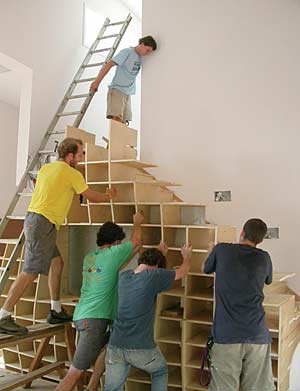
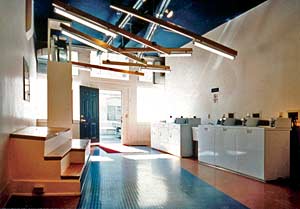
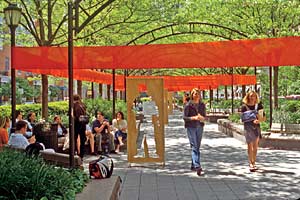
Photos courtesy Yale Building Project (top); Thomas A. Dutton (middle and above).
Working with the Yale Building Project, in 2004 Adam Hopfner began exploring prefabrication and digital technology with a stair system made entirely of CNC-routed sheets of Baltic birch plywood (top). In addition to doing traditional building and rehabilitation projects in Cincinnati’s Over-the-Rhine neighborhood, such as a laundromat and meeting room (middle), Thomas Dutton’s design-build studio will stage “agitprop” art installations that commemorate events such as the demolition of the SRO Milner Hotel (above).
Hopfner: There is a push for prefabrication and digital fabrication in general at our school. So prior to a Yale Build Project design we look at what is possible with our timeframe and support. Given that I have 60 laborers, it’s harder to justify the lead times of prefabrication for the entire thing. And yet we do try to identify components that might be made on a CNC mill, whether it’s a stair or a cabinet piece or a cladding system. So there’s exposure to it. I don’t see this technology as a danger, but as just another tool with its own opportunities and limitations.
AR: Tom, the Over-the-Rhine Design/Build Studio has a political component. What’s the origin of that?
Dutton: Design-build is just one of many things we do. It comes out of the Center, which is affiliated with these other institutions trying to service Over-the-Rhine. So we also do agit props—artistic installations that are devised with community leadership to make people aware of what happened at a particular site. They’re like learning devices to raise questions about history and urban space. We also do straight-up advocacy planning. It’s all determined by the community at that particular time.
AR: Clearly you all have many hats to wear. Which task outside of design-build consumes most of your time?
Rockhill: For us it’s really fundraising. We’re not supported by the university. As a not-for-profit corporation, the burden is on us to raise whatever funds we can from year to year. That consumes a lot of time, at least for students, who think of the studio as all nails and two-by-fours.
AR: Are there some loyal supporters you can rely on every year?
Rockhill: I try to do something different with materiality each year, so as a result it’s hard to go back to a supplier who donated materials for a previous project.
Lewis: We have a slightly different structure in which we work with a private client each year. The client essentially pays for all materials, so there really isn’t private fundraising. One of our questions is how The Design Workshop is integrated with the client logistically. We present very clearly to the client that they can hire a contractor for the same money, but that we provide extraordinary amounts of investment in the project that they wouldn’t get with a contractor—that there’s a stretching of money that’s not just about learning to build something but also about challenging expectations.
Badanes: As a state school with tuition supported by taxpayers, we need to work in the public realm and finish projects by graduation. The rest of the year is spent getting the project ready, getting the scale right, and getting the grant, just like the regular architect trying to find work. Aside from fundraising and giving lectures and consulting on other programs, of course. We don’t do so much design.
Louis: Although we have people respond to us each year, such as a construction-company president who sits on my board, much of our time is spent worrying about fundraising. Students are working all the time to get different materials donated, although we try mostly to use natural and local materials. And I’ve been trying to raise the visibility of the program, and the issue is that I’m not there all the time.
Freear: Our students traditionally have raised phenomenal material donations, but because of gas prices and the economic squeeze in the last year it’s become very difficult. We are contemplating completely different approaches to projects for the next couple years simply because of that: The tax write-offs and material donations are not going to be there.
Hopfner: I’ve had a significant drop-off in contributions from suppliers, whether vendors or distributors or even the local plumber. And the prices of the things we do purchase have really shot up this year.
AR: What preparatory advice would you give all those professors who are considering starting their own design-build studios, especially in an economic downturn?
Badanes: They always think they should start with something on campus, and that’s often a bad idea. My advice is to start with something small, out in the community. The biggest problem is that faculty and students start new programs thinking they can do large projects faster and cheaper than is realistically possible.
Rockhill: I find that people tend to overthink the complexity of the issues in front of them. They tend to meet with everybody on campus and get everybody involved, and that’s a surefire way to draw something out for eternity. I tell them to just do it. You run a design-build studio like a business and people are starting businesses everyday. It’s not all that complicated
Looking for a reprint of this article?
From high-res PDFs to custom plaques, order your copy today!