The ArchRecord Interview: Chad Oppenheim
BR: Chad, let’s talk about Cor, your high-profile green tower in the design district. Your press release describes this building as “revolutionary … the building of the future.” What are the green features that really set this project apart?
CO: It’s a building where the architecture is fully integrated with the ecological ideologies. For example, with the wind turbines on the roof, it looks like a green building—whereas so many other sustainable projects just look like generic buildings.
The architectural and the ecological also fuse together in the building’s skin. A hyper-efficient exoskeleton shell simultaneously provides building structure, thermal mass for insulation, shading for natural cooling, enclosure for terraces, armatures for the wind turbines, and plazas on the ground level.
And the shifting in the patterns of the circular openings is intentional: It’s much more efficient to have diagonal gridding rather than vertical.
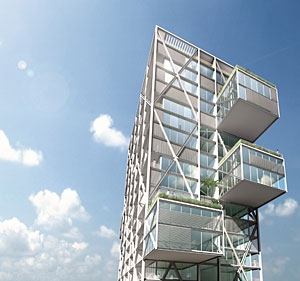
This slideshow includes more images of two of Oppenheim’s more radical projects: Cor and Cube.
BR: The skin is also somewhat suggestive of a living, breathing creature…
CO: It is organic in that there is no greater ecological entity than the human body, which has this organic perfection in dealing with climate. Our skin is so amazingly complex, and this skin is complex in its structure, its ecology, its urban gesture. It was not the intent, but it does somehow does evoke an organic life with its fluidity.
BR: Walk me through your conversations with developers about green design. Is it an expected component of the design today, or do you still have to sell them on green?
CO: We start with explaining why a green approach should be taken and then work to find an angle for the particular project.
With Cor, for example, we said [to the developer], “Because of how this building looks, you’ll get a tremendous amount of free exposure. So instead of spending $1 million in marketing, let’s put that money into the technology of the wind turbines, the solar generation of hot water, photovoltaics.” We thought that, being in a [condo] saturated marketplace, this would give us a unique selling proposition for the project, one that would generate a lot of energy and excitement, get more people passionate about it, supporting it, investing in it.
As architects, it is our responsibility to lead the way, but it ultimately takes great clients to follow an idea through. No one wants to pollute their environment or do something bad. Everyone wants to do green, but it all boils down to cost. There are still big clients who are not ready for it; they’re saying they’ll make room for solar panels, but in the future.
Normally, the 5-10 percent cost increase that a green building would require wouldn’t be an issue. But with the prices for basic materials costing so much more—100 percent more in some cases—there’s a real sensitivity to adding any extra costs. If we hadn’t seen this spike in material prices, I think everyone would be more excited about doing green right now.
BR: User-generated content is all the rage right now online, with sites such as YouTube, Flickr, and MySpace transforming the Web. You have a “new frontier” type of project, Cube, that is perhaps somewhat analogous: It’s user-generated design. Let me read to you what you’ve said about Cube: It “creates the possibility for ultimate volumetric flexibility ... [It] promotes its occupants to design vertically, horizontally, and diagonally. … [It’s ] true interactive architecture.” It’s an overused word, but maybe it’s fair to say Cube is quite a radical concept, allowing buyers, to some extent, to shape the final form of the building—and taking some of the control away from the architect. What was its original inspiration?
CO: The original inspiration was my thesis project at Cornell, an idea of creating a vertical neighborhood, with people building and defining their own domains similar to how they do so in horizontal developments of single-family houses.
But that being said, this project is not an opportunity to put something learned in school into the work of my practice. Whenever we are confronted with a project, we think first of the structural systems to get efficiency and clarity. Before we design, it’s not here is the pretty picture; it’s here is the most efficient and pure and elemental way to design a project in context of the program.
So in examining this project, and the complex configurations of the site, I began having conversations with my engineer. And this building was made possible because of the amazing Yrsael Seinuk, one of the greatest living engineers.
In discussions I had with him, it was, “What if we do the structural system on the outside, a gridded, diagonal bracing, so we don’t need sheer walls to come down internally?” And it was this analysis of how to deal with the structure on the outside, how do we simplify the building, how do we make it more economical, that generated the ideas that led to this steel-structure concept: People buy cubes of space and connect them in whatever way fits their domestic requirements, with all the mechanical systems tapped from the central core.
Buyers can configure the cubes in many ways. You can buy two cubes and place them horizontally, buy three and go with two horizontal, one vertical, et cetera. The idea being you can start to define your own domain; we want people to have the flexibility to dream.
As architects, we’re always creating infrastructure, but what happens inside is up to the occupant. I love that personalization, and this project [enables] it at the massive scale of a high-rise building where the buyers have flexibility and control over the final look of the project. There is a definite appeal to me in letting this randomness affect the architecture.
Looking for a reprint of this article?
From high-res PDFs to custom plaques, order your copy today!