The ArchRecord Interview: Tom Kundig
JM: Your firm is perhaps best known for its residential, but then you also have the other aspect which is museums and cultural spaces. Particularly when it comes to controlling light, I’m wondering if there are any similarities between the two building types?

Are we seeing the end of the McMansion—and, if so, what is leading to its demise? Click here for Kundig’s one-minute answer.
TK: Architecture is about the manipulation of light: both artificial light and day lighting. Architecture is basically shelter and whether that shelter is where you live as a home or a residence, or whether that shelter is a place of a museum or exhibit, as human beings we have needs. We have light needs; we have conditioning needs; we have protection needs; and we have refuge needs. We have all of these sort of shelter needs. So, really there is a natural overlay between the residential shelter and sort of the public venue / exhibit / museum shelter. Some of the things you develop and learn in either area overlap to the others.
JM: So people need shelter, they need food—and they need light?
TK: That’s exactly right. Exactly right. You need all of those things. I always say one of the reasons I love doing residential work is that residential work really is one of those sort of fundamental, primeval needs that we have as an animal. So once you begin to understand the residential needs—and I’m not saying the sort of stylistic needs, I’m talking about just those genetic rumblings, those ancient rumblings of what shelter means—when you understand it at that level, that really becomes probably the most important element of doing a residential project. And because those are primal needs, because those are sort of visceral, primitive needs, they certainly translate to our needs in public buildings. They become a sort of learning ground. A professor of landscape architecture at the University of Oregon, Ron Lovinger, once said to me: truly the best landscape architects in the world, historically, have understood the garden at its root. I think that’s true for architecture, too. Truly the best architects, historically, have been the ones that have understood the home needs, the shelter needs, at its root.
JM: It seems like the juxtaposition of spaces is very important in museums, in terms of the light and how it penetrates through the building, but how does that work in residential settings? Is there almost a narrative quality to it?
TK: That’s a really good question, too, because again it’s referring to something I was talking about a little earlier: a lot of these needs are frankly sort of primitive needs, genetic needs. At its root, shelter really is about prospect and refuge. It is all about defensible space: about feeling comfortable and protected not only from invasions, other groups of people and animals, but also protection from the elements. You’re always trying to make the building sensitive to all of those issues. The whole idea of prospect and refuge is that idea of, I guess, drama might be one way to describe it—it is a way of shaping a space that meets some of those primitive needs in a poetic way. So the way you move from a more open, prospect situation into a more interior sort of refuge situation, which then opens up into a prospect situation. It’s that yin and yang and you’re always looking for that black and white: in other words, you never see black until you see white. You’re always trying to balance those extremes back towards this middle, which is the place you live.
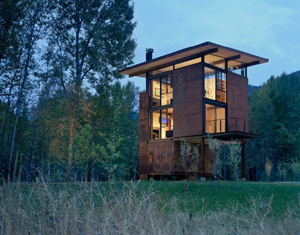
JM: You described the Delta Shelter as a little house in a large landscape, but how about in urban settings: how do you introduce landscape or the lack thereof?
TK: That’s a really good question because landscape is not just the natural landscape, landscape is also the cultural landscape. Cities are a cultural landscape. They are certainly affected by the natural influences of sun, light, climate, all of the natural outside forces that work in an urban setting just as much as they do in a natural landscape setting. But in a city you’re dealing more with cultural landscape and that’s a very fascinating place to react to when you’re designing a building because you really are trying to understand: what are those cultural influences, those cultural forces that are the reason that we like collecting in a city? If it’s at all possible to glean an understanding of those forces and imbue the project with those forces, you’ve got a meaningful building that really does fit in its landscape—in its city landscape and in its cultural landscape.
JM: We’ve been talking in very philosophical terms, but your houses seem very livable and human. How do you make the leap from the philosophical back to the practical realm for the person who has to live somewhere on a daily basis?
TK: The practical realm is in fact part of the function of a building. Architects are more of applied artists, in a sense, because you really do have sort of functional needs. It goes back to the prospect/refuge: the shelter, the place you feel like you’ve been protected, but also the place that sort of opens up to this sort of larger realm. These are all practical needs and certainly the relationships, the functional relationships inside, all are part of that experience: where you cook your food; where you sleep; where you gather as a family; where you park your horse, your carriage, or your car. All of those relationships in fact are fairly similar over the years. There have been cultural changes that we’ve seen. We’ve seen these buildings grow, and I think that’s kind of an interesting phenomenon, but I think we’re going to be seeing the buildings shrink. There is a sort of an inner sense of scale of what a home really is that is challenged, frankly, by the larger homes. I’m seeing, personally, homes getting smaller and smaller and, not precious necessarily, but more carefully assembled.
Looking for a reprint of this article?
From high-res PDFs to custom plaques, order your copy today!