The ArchRecord Interview: Alan Maskin
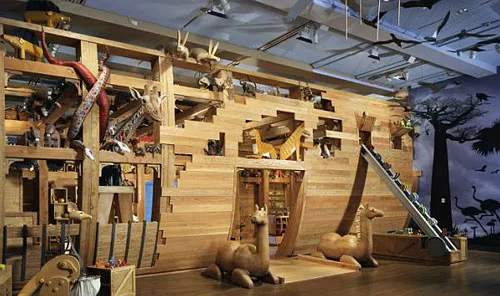
The Skirball Cultural Center opens a new children’s exhibit about Noah’s Ark.
Photo: © Grant Mudford.
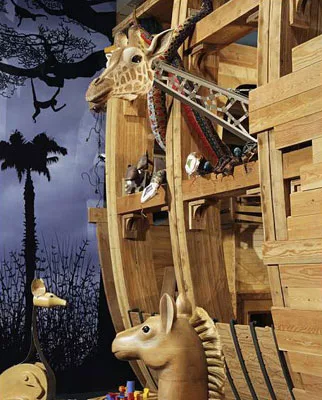
Giraffe in Ark.
Photo: © Grant Mudford.
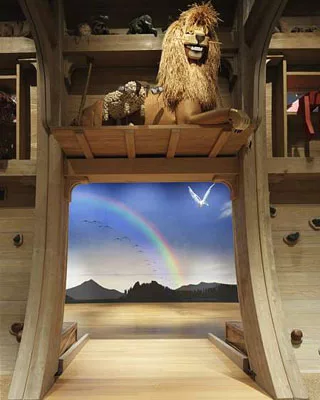
-Lion and lamb inside Ark.
Photo: © Grant Mudford.
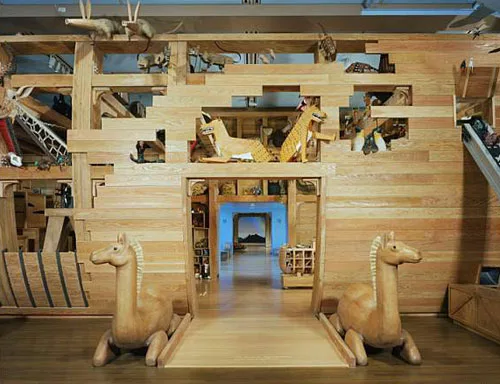
View through ark from north
Photo: © Grant Mudford.
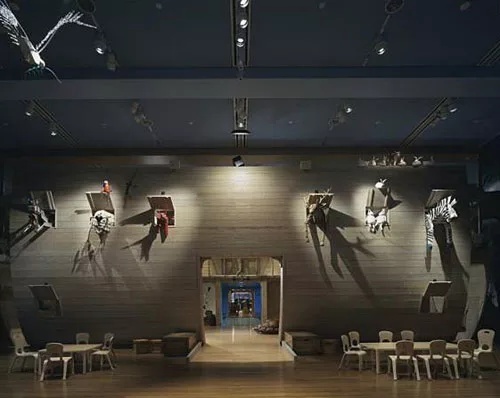
View through ark from south
Photo: © Grant Mudford.
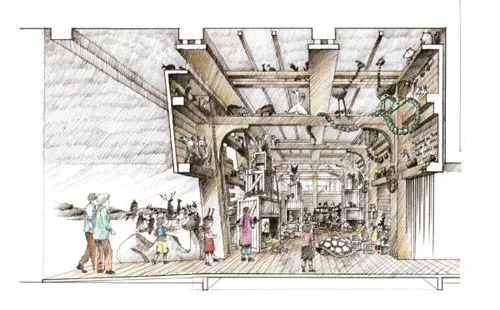
Rendering from east.
Rndering Courtesy Olson Sundberg Kundig Allen Architects
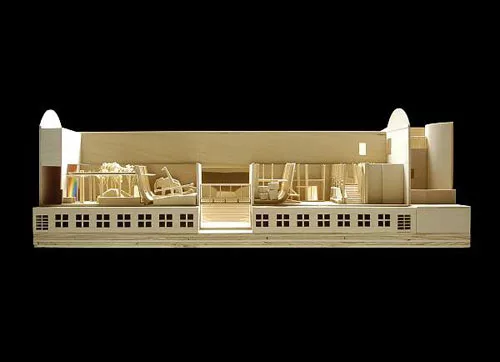
View of model main elevation
Photo: © Grant Mudford.
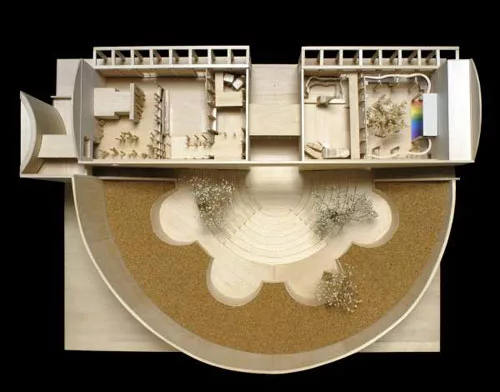
View of model from overhead
Photo: © Grant Mudford.
The Skirball Cultural Center opens a new children’s exhibit about Noah’s Ark this week. Although this Los Angeles institution is dedicated to exploring Jewish history and culture, the new 8,000-square-foot gallery explores themes common across humanity. Alan Maskin, a principal of the Seattle-based firm Olson Sundberg Kundig Allen Architects, led the design team that created the exhibit. Before becoming an architect, he had worked as an art teacher.
Architectural Record’s news editor, James Murdock, sat down with Maskin to discuss the project. In Part I of the interview, Maskin describes why the project appealed to him. In Part II, he explores his inspiration for certain design elements. And in Part III, Maskin shares a little bit about the other projects that he designs with Olson Sundberg Kundig Allen.
James Murdock: I’ve read that you were surprised you got the Skirball commission—why is that?
Alan Maskin: We came at this project entirely out of left field. There was a shortlist of about 40 different firms that the Skirball sent the RFQ. We were not on that shortlist and there was no reason we would be. We are an architecture firm in the Pacific Northwest and we’ve mostly done museums and residences. But, a friend called me up and told me about the project and sent me the RFQ.
RFQs are usually five or six pages long. What we got from the Skirball was, I think, 27 pages long. I stood at the fax machine and I was flipping through these pages and reading them and it seemed like there was this extraordinary project they wanted to create that was unlike anything I’d ever seen before for children and families. We were drawn to it magnetically. There were things we wanted to try and thought they might be the perfect client for a little bit of experimentation in terms of what you could do with children and families.
JM: What was in those 27 pages that gave you the sense that the Skirball was a little experimental?
AM: One of the things that jumped out at us immediately is that they were interested in designing an experience for kids that was about certain values they felt were important for our society today. For one thing, it’s a Jewish cultural center but they were interested in making a place where all children could come and play. That actually felt to us like a brave and radical idea, and it’s one that we really supported. There aren’t that many places in the world that literally everyone can come to, so in that regard we were right there behind that. They were interested in exploring three main core values: they wanted to explore the importance of diversity; the importance of working together for survival; and the incredible importance of second chances.
They chose the Noah’s ark story, or flood narratives, because these themes are inherent within these stories. In doing research for the project we discovered there’s over 450 different cultures over time where flood narratives have come from and all of them share these very similar qualities to the Noah’s ark story. The second chances and the new beginnings aspect was literally found in stories from Alaska, China, Africa, anywhere there was a river or body of water a story comes from there. Those values were something that, from a design standpoint, we completely got behind so we very aggressively pursued the project.
JM: Tell me about the exhibit. I read that the animals were made out of durable, natural materials rather than the plastics we would associate with children’s exhibits. It sounds like there was a sustainable element to this.
AM: One of the things stated very early on in the Skirball’s RFQ mission statement was that they were interested in concepts of sustainability. So we knew that the sustainable materials aspect would be there. When the project began all we basically had were these values and the fact that we were going to connect it to the narratives. We then we worked very closely with the Skirball Cultural Center and Marni Gittleman, who is their exhibit developer, as well as the rest of the Skirball team and tried to figure out what should this thing actually be: how literal should it be.
We realized that animals, in the Noah’s ark story, are in fact the great magnet for children. Everyone knows that kids light up when they’re around animals and involved with them. So we created roughly 160 different species, different pairs. They represent animals that people would recognize but we also tried very hard, from a diversity standpoint, to find animals that would be obscure and that people would not necessarily be familiar with. We went with animals that are soft and cute, and recognizable, but also ones that have sort of what we call “bad public relations,” which are animals like snakes, spiders, and bats, and things like that which some people are squeamish around but are incredibly important in a bio-diversity type of way.
We decided that wouldn’t it be great if these animals weren’t just sculptures but that some of them could come to life. At that point, we were connected with Christopher Green, who’s an artist and puppeteer based in Red Hook, Brooklyn. He made about 16 pairs of animals including elephants and really huge green anacondas. These things were made from repurposed objects and the staff can inhabit them and actually bring these things to life.
JM: So some of the animals are made out of recycled objects?
AM: Yeah, a lot of the design in the project was centered around repurposing objects and it was very intentional: there was a sort of educational desire there. It was based on this idea that inventive thinking, any sort of thinking about inventing something, is a result of understanding the parts in terms of their properties and then putting them together to make something else. That idea is an inherent. You’ll see a boxing glove that’s been turned into a kiwi, or you will see a bicycle seat that became a ram’s head. There are many, many objects and pieces that are actually extremely recognizable but they become something else.
One of the project managers brought his daughter in during construction, when we were just beginning to install the animals, she was taken with them and what they were made of and recognizing their parts and pieces. She went home and started taking parts and pieces and making animals herself. It was the perfect response to the project, in many ways, because it’s that kind of thinking that we were trying to create. And there is a laboratory at the very end of the exhibit where kids actually can make design and do things, where they can actually take the parts and pieces together and not only make their own animals but they’re being asked questions about how to make the world a better place and how would they imagine doing it.
Looking for a reprint of this article?
From high-res PDFs to custom plaques, order your copy today!