Architectural Record
search
cart
facebook twitter linkedin youtube
  • Sign In
  • Subscribe
  • Sign Out
  • My Account
Architectural Record
  • NEWS
    • Latest News
    • Awards
    • Interviews
    • Obituaries
    • Podcasts
      • Design:Ed Podcast
      • Sponsored Podcasts
  • OPINION
    • Book Reviews / Excerpts
    • Exhibition Reviews
    • Forum
  • EXCLUSIVES
    • Videos
    • Design Vanguard
    • Top 300 Firms
    • Sponsored Content
    • Sponsored eBooks
    • From the Archives
  • CONTINUING ED
    • Editorial Continuing Ed
    • CE Center
    • CE Academies
  • PROJECTS
    • Buildings By Type
    • Reuse & Renovation
    • Museums & Arts Centers
    • Colleges & Universities
    • Multifamily Housing
    • Interiors
    • Lighting
    • Kitchen & Bath
  • HOUSES
    • Record Houses
    • House of the Month
    • Featured Houses
  • PRODUCTS
    • Products by Category
    • Record Products of the Year
    • Latest Products
  • EVENTS
    • Dates & Events
    • Record on the Road
    • Innovation Conference
    • Sustainability in Practice
    • Women In Architecture
    • Webinars
    • Ad Excellence Awards
    • Submit an Event
  • CONNECT
    • Ask RECORD AI
    • Newsletters
    • Contact
    • Advertise
    • Editorial Calendar
    • Store
    • Customer Service
  • SUBMIT
    • Submission Guidelines
    • RECORD Competitions
  • MAGAZINE
    • Subscribe
    • My Account
    • Digital Edition
    • Current Issue
    • Firm Pass
    • Historic Archive
ProjectsArchitectural Technology

The Engineering of Art

Artists who use public space as their canvas often depend on structural experts to help them realize their visions.
By Joann Gonchar, FAIA
The Engineering of Art
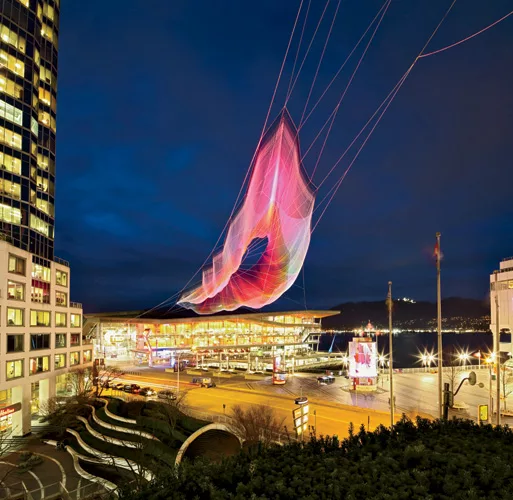
Janet Echelman's 745-foot-long sculpture, installed for about two weeks in March outside the Vancouver Convention Centre, is the largest prestressed rope structure in the world, according to engineers at Arup. It consists of a structural net of polyethylene rope and a draped net of polyester twine.
 
Photo © Ema Peter
The Engineering of Art
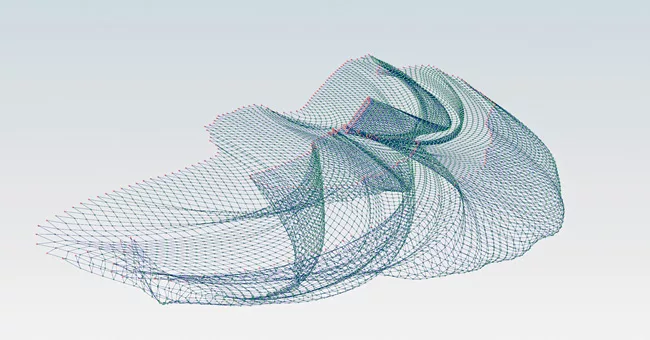
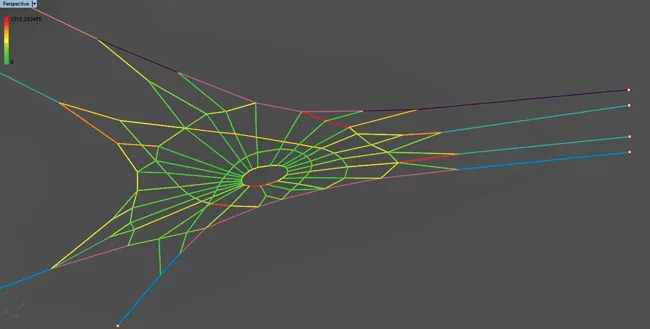
Among the analyses that engineers performed were iterative studies of the stresses in the structural net (left)'with the goal of achieving a uniform distribution'and explorations of the deformations of the draped net from wind.
 
Image courtesy Arup
The Engineering of Art
Among the analyses that engineers performed were iterative studies of the stresses in the structural net'with the goal of achieving a uniform distribution'and explorations of the deformations of the draped net (left) from wind.
 
Image courtesy Arup
The Engineering of Art
Unnumbered Sparks is made of almost 1 million feet of braided fibers held together by 8,600 machine- and hand-tied knots. It ripples and undulates in the wind and appears lighter than air, even though it weighs about 3,200 pounds.
 
Photo © Ema Peter
The Engineering of Art
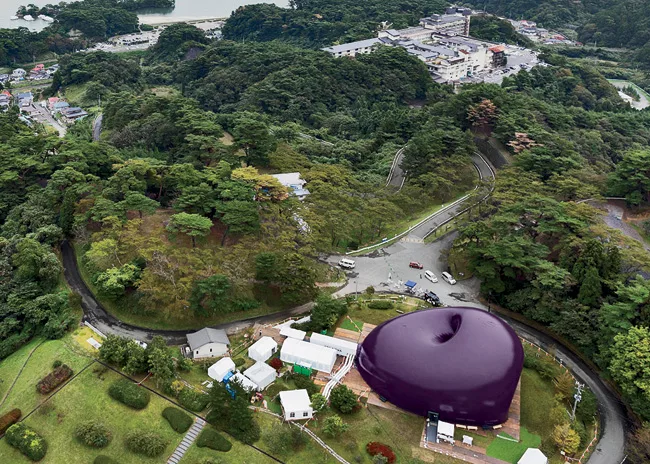
Conceived as a performance venue that would tour the region of Japan devastated by the 2011 Tohoku earthquake and tsunami, Ark Nova was first deployed last fall in Matsushima (left). The inflatable 500-seat hall, designed by Anish Kapoor and Arata Isozaki, is enclosed by 22,000 square feet of PVC-coated polyester.
 
Photo © Iwan Baan
The Engineering of Art
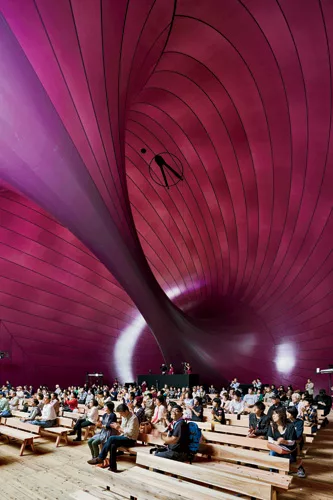
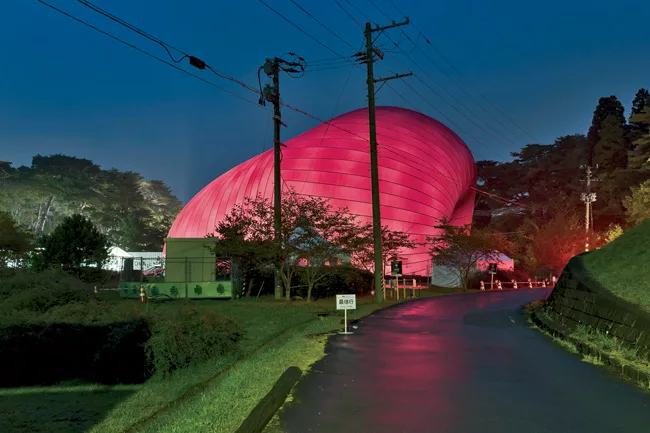
The normally opaque eggplant-colored membrane becomes nearly translucent when light shines through it. The welded seams between sections of the skin are revealed on the interior during the day (left) and on the outside at night, when Ark Nova is illuminated from within.
 
Photo © Iwan Baan
The Engineering of Art
The normally opaque eggplant-colored membrane becomes nearly translucent when light shines through it. The welded seams between sections of the skin are revealed on the interior during the day and on the outside at night, when Ark Nova is illuminated from within (left).
 
Photo © Iwan Baan
The Engineering of Art
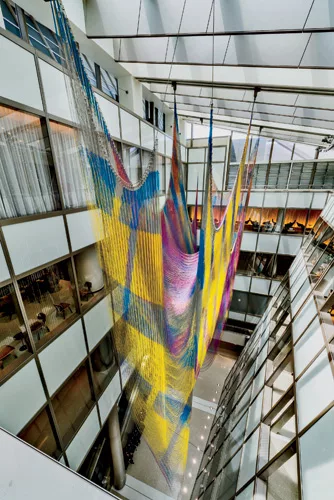
Ball-Nogues Studios' installation for the Los Angeles International Airport extends 95 feet below a skylight to just 13 feet above the floor.
 
Photo © Joshua White
The Engineering of Art
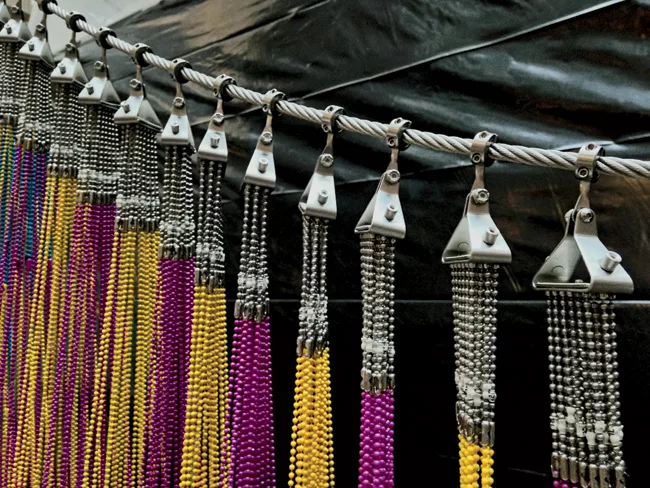
The almost 6,000-pound sculpture is made of thousands of stainless-steel bead chains suspended from six cables that in turn are hung from the skylight's structural members.
 
Photo courtesy Ball-Nogues
The Engineering of Art
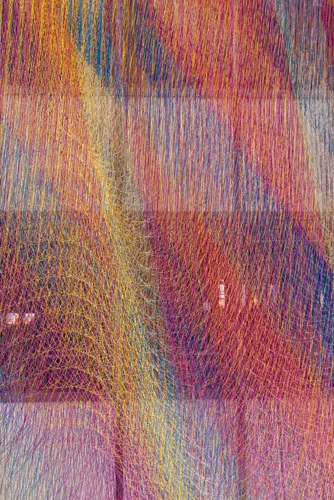
The colorful chains overlap in space, creating moiré patterns that shift depending on the quality of light coming through the skylight and the vantage point of the viewer.
 
Image © Joshua White
The Engineering of Art
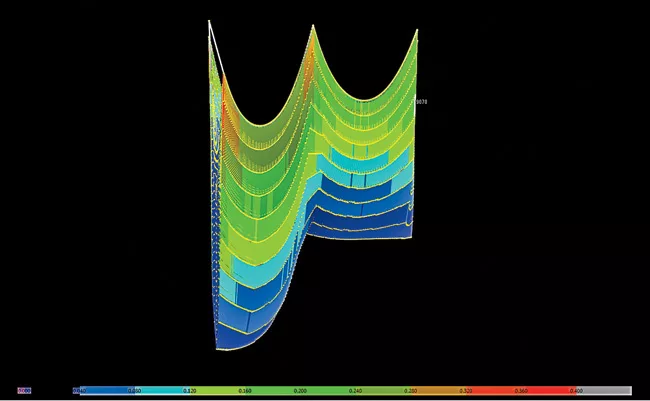
Engineers from Buro Happold created a finite-element-analysis model of Air Garden. An axonometric view created from this model, reveals the amount and complexity of the data that was analyzed. Among the studies that the engineers performed for Ball-Nogues was an examination of the forces acting on the bead chains (left). Stress increases near the supports, since the uppermost sections of the bead chains must carry the weight of those below.
 
Image courtesy Buro Happold
The Engineering of Art
Engineers from Buro Happold created a finite-element-analysis model of Air Garden. An axonometric view (left) created from this model, reveals the amount and complexity of the data that was analyzed. Among the studies that the engineers performed for Ball-Nogues was an examination of the forces acting on the bead chains. Stress increases near the supports, since the uppermost sections of the bead chains must carry the weight of those below.
 
Image courtesy Buro Happold
The Engineering of Art
August 16, 2014
The artist toiling in solitude has long been a romantic ideal. But it rarely holds in reality, especially for those who work at the civic scale, making pieces that straddle the blurry boundary between art and architecture. These artists rarely work alone, typically relying on a host of collaborators to realize their visions, including studio assistants, fabricators, and even city officials. Frequently, they also need engineers—not only to ensure the works' structural soundness and the public's safety, but also to understand or refine the response of their pieces to the surrounding environment.
 
Engineers who work with artists say it can provide a particularly satisfying challenge, especially when it involves unconventional materials. There are rarely codes or prescriptive design standards that apply to such structures; instead, they must depend on the fundamentals of engineering physics.

PUBLIC ANEMONE

The collaboration between the Seattle office of Arup and Boston-based artist Janet Echelman illustrates this reliance on “first principles” of engineering, as Cormac Deavy, an Arup principal, puts it. Echelman's installations, often made of woven net, respond to the forces of nature, including wind, sun, and water. Her most recently completed piece—Skies Painted with Unnumbered Sparks—was installed for about two weeks in March outside the Vancouver Convention Centre, marking the 30th anniversary of the Technology, Entertainment and Design (TED) Talks and the event's move to British Columbia from its previous home in Long Beach, California.

The work, which resembles an airborne sea anemone, ripples and undulates against the sky. It animates the public space below with its constantly changing form and an interactive feature, devised with the help of Google, that allows visitors to control its lighting with their mobile devices.

Spanning a plaza between the convention center and a hotel across the street, Unnumbered Sparks consists of a structural net made of polyethylene rope that's about 1.5 inches in diameter, and a draped net of polyester twine held together by 8,600 hand- and machine-tied knots. At 745 feet long, it is more than twice the size of any of Echelman's earlier pieces. However, Echelman maintains that bigger isn't necessarily better. “Everything is about the proportional relationship between the human body and the spatial context,” she says, adding, “It is about finding the right scale for the right place.”

Although size, in and of itself, was not one of Echelman's goals, Unnumbered Sparks turns out to be the largest prestressed rope structure in the world, according to Clayton Binkley, an Arup senior engineer. (The piece is “prestressed,” he explains, because tension has been applied to the structural net during installation in addition to the loads created by the work's own weight.) Complexities accompany this distinction, since the magnitude of the forces in the rope net are proportional to the square of the span.

Working closely with Echelman's studio, in a highly iterative process, Arup studied various aspects of the piece, such as the size and number of panels making up each section of the draped net. Echelman and her team used custom software developed for her by Autodesk, and Arup, in turn, used the data generated by the tool for its analyses, which included evaluating the distribution of stresses over both the draped net and the cover net, as well as modeling the sculpture's response to the wind. Often they would rely on algorithms that Arup developed specifically for Echelman's work.

Based on these investigations, Arup provided the artist with design parameters, including a weight limit. With such information, she could make some areas of netting more dense and others more open. The structural consideration that governed the design was actually how much wind Unnumbered Sparks would catch—a quantity dependent on the net's surface area—rather than how heavy it was. But weight provided a metric that was easier to work with than twine area was, explains Binkley.

The final sculpture weighed in at about 3,200 pounds, which included its moorings to the convention center and the hotel, devised by local engineers Glotman Simpson. These connections—five sets of eyelets and shackles for each building—tied into the existing structures' columns with steel plates and epoxy, and were designed to withstand 200,000 pounds of wind force, a load that firm principal Rob Simpson considered the “worst-case” scenario.

The anchorage details, as well as the structural net, will need to be modified if Unnumbered Sparks is installed elsewhere—a possibility that Echelman says she is exploring with several cities, both in the United States and internationally.

PLUM COMMISSION

Wind loads were also a critical concern for Ark Nova, an inflatable and movable concert hall designed by London-based sculptor Anish Kapoor and Tokyo-based architect Arata Isozaki. First deployed for a music festival held last fall in Matsushima, Japan, the bloblike but engaging form of eggplant-colored PVC-coated polyester was conceived as a performance venue that would tour the region affected by the 2011 Tohoku earthquake and tsunami.

Mitigating the response of the roughly 500-seat hall to the wind was particularly tricky, since the 318,000-cubic-foot volume has a “toroidal” form—one that turns in on itself—creating a diagonal tube that penetrates the interior. Wind flowing through this tube accelerates and can produce suction, explains Christopher Hornzee-Jones, director of Aerotrope, a Brighton-based aeronautical and structural-engineering firm that has consulted on Kapoor's projects for more than a decade.

To counteract uplift forces, Aerotrope studied several possibilities for securing the hall, including ground anchors and water-filled containers as ballast. Hornzee-Jones preferred the latter solution, because it would be simple to transport the containers once they were emptied. But, due to concerns about the containers' performance during an earthquake, the team finally settled on a more conventional ballast system of steel plates. “We didn't have the development time to prove that it would all be okay,” he says, “though I am sure it could be done.”

According to Hornzee-Jones, the fabric itself can withstand high forces sustained for a short amount of time, such as those produced by gusts. But one concern over the long term, he says, is creep—deformation that increases over time when stress is maintained on a material. To mitigate this phenomenon, Ark Nova's inflation pressure is kept at a level adequate to maintain its form but low enough to limit the permanent stresses on the membrane.

Critical to the perception of the concert hall's shape is the articulation provided by the seams between sections of membrane fabric. These are particularly evident from the inside during the day, when sunlight shining through the skin makes it almost translucent. Aerotrope, along with Tensys, a firm that specializes in tensile structures, worked out the layout of the seams with Kapoor and Isozaki before sending the final geometry and detailed engineering studies to MakMax, the fabricator in Japan. MakMax generated the cutting files and welded the pieces together to create a single membrane with a surface area of 22,000 square feet.

Last October, after the festival in Matsushima ended, Ark Nova was deflated and folded in a packing sequence carefully worked out to avoid damage to the membrane. The resulting bundle, which Hornzee-Jones describes as “a several-ton brick,” now awaits deployment this coming fall at a yet-to-be-announced location elsewhere in the Tohoku region.

JUST BEAD IT

Not all civic-scale installations are exposed to the elements, as Ark Nova and Unnumbered Sparks were. Air Garden, a permanent piece completed last fall by Los Angeles'based design and fabrication practice Ball-Nogues Studio, is sheltered from the wind and rain. Made of thousands of stainless-steel-bead chains—the type that are often used as light pulls—the sculpture is installed inside the Tom Bradley International Terminal at the Los Angeles International Airport, extending down 95 feet below a skylight.

But even though architects Benjamin Ball and Gaston Nogues did not have to consider the impact of weather on their piece, the design process and structural analysis of Air Garden were far from straightforward. The colorful bead chains hang from six cables that in turn are suspended directly from the skylight's structural elements, an arrangement that creates difficult-to-analyze double catenaries. The almost 6,000-pound sculpture “is entirely soft in tension, like a big wet rag,” says Ball. “If you move one point, the whole thing changes.”

The result is considerably more appealing than a wet rag: Air Garden is a diaphanous veil with moir' patterns that shift depending on one's vantage point and the quality of light coming through the skylight. In order to predict these effects during design, Ball and Nogues use proprietary software created specially for them, as well as visualization tricks that help the designers cope with the resolution limitations of a computer screen. “The size of a pixel is greater than the width of a bead chain,” Ball points out.

To determine how best to attach the piece to the skylight and understand the loads and stresses in each of the bead chains and cables, Ball-Nogues worked closely with the Los Angeles office of engineering firm Buro Happold. Using a method of numerical analysis known as “dynamic relaxation,” the firm also helped the designers fine-tune Air Garden's ultimate geometry. The technique can be used to determine, for example, how much the individual bead chains will stretch due to gravity, how weight would be redistributed as a result, and how long each chain should be, explains Ron Elad, an associate principal in Buro Happold's Los Angeles office.

Elad emphasizes that even before this step, Air Garden's form was nearly set. “The architecture and design tools get very close to the final solution,” he says. What's more, the piece is the product of themes that Ball-Nogues has been exploring for several years. “They select a material and technology that they want to work with and continue to refine them, each time pushing them more and more,” says Elad. But that is what he finds so satisfying about working with Ball-Nogues and artists in general: “It is an opportunity to show the care we take to create elegant solutions,” he says.

These sentiments echo those of Aerotrope's Hornzee-Jones, who maintains that, with artwork, “it is absolutely crucial that the details all come out right, even if that means they essentially disappear.” He seems to have no qualms, however, about his efforts' being almost invisible. “It's when the engineering disappears,” he says, “that you end up with art.”

People


Products


Share This Story

Looking for a reprint of this article?
From high-res PDFs to custom plaques, order your copy today!


Joann gonchar

Joann Gonchar, FAIA, LEED AP, is deputy editor at Architectural Record. She joined RECORD in 2006, after working for eight years at its sister publication, Engineering News-Record. Before starting her career as a journalist, Joann worked for several architecture firms and spent three years in Kobe, Japan, with the firm Team Zoo, Atelier Iruka. She earned a Master of Architecture degree from the University of Pennsylvania and a Bachelor of Arts from Brown University. She is licensed to practice architecture in New York State.

Post a comment to this article

Report Abusive Comment

Subscription Center
  • Create an Account
  • Start a Subscription
  • Manage My Account
  • Sign Up for Newsletters
  • Visit Customer Service
  • Update Preferences

More Videos

Sponsored Content

Sponsored Content is a special paid section where industry companies provide high quality, objective, non-commercial content around topics of interest to the Architectural Record audience. All Sponsored Content is supplied by the advertising company and any opinions expressed in this article are those of the author and not necessarily reflect the views of Architectural Record or its parent company, BNP Media. Interested in participating in our Sponsored Content section? Contact your local rep!

close
  • cold storage facility
    Sponsored byCarlisle SynTec Systems

    How Architects Can Design More Continuous Cold Storage Envelopes

  • TAMLYN XtremeTrim Exterior Trim
    Sponsored byTamlyn

    Designing Cleaner Panel Facades: Why Exterior Trim Details Matter

  • Building with Vapor Barriers
    Sponsored byReef Industries, Inc.

    Vapor Barriers Help Control Moisture in Tighter Building Designs

DESIGN:ED Podcast
Listen to Architectural Record’s DESIGN:ED Podcast

Events

June 23, 2026

Enhancing Fire Resistance with Advanced PVC Solutions

Credits: 1 AIA LU/HSW; 1 AIBD P-CE; 0.1 ICC CEU; 1 IIBEC CEH

Evaluate advanced PVC solutions that improve fire resistance, support WUI compliance, and enhance resilience in residential and commercial building design.

June 25, 2026

Designing Glass Railing Systems that Enhance Aesthetics and Meet Code

Credits: 1 AIA LU/HSW; 1 AIBD P-CE; 0.1 ICC CEU

Upon course completion, participants will possess a deeper understanding of glass railings to help ensure that safety, aesthetic, and performance objectives are achieved.

View All Submit An Event

Products

2026 Architect's Square Foot Costbook

2026 Architect's Square Foot Costbook

See More Products

Popular Stories

SanDiegoAirport

Top 300 Architecture Firms of 2026

Lorcan O' Herilhy

California Architect Lorcan O’Herlihy Has Died, Age 66

CCA, Studio Gang

The Winners of the AIA’s 2026 Architecture Award Range from Collegiate Rowing Hubs to Housing for the Homeless

Spoonbill Ranch

Johnsen Schmaling Architects Integrates Spoonbill Ranch into a Pristine Landscape

Obama Presidential Center, Chicago

The Obama Presidential Center Opens on Chicago’s South Side

Enhancing Fire Resistance with Advanced PVC Solutions - Free Webinar - June 23, 2026

Related Articles

  • Museum of Modern Art in Warsaw

    Warsaw’s Museum of Modern Art is a Lesson in Contrast

    See More
  • Art Gallery of New South Wales

    SANAA’s New Sydney Landmark at the Art Gallery of New South Wales

    See More
  • palmer museum of art

    The Allied Works–Designed Palmer Museum of Art Stands Out with a Facade of Locally Sourced Sandstone

    See More

Related Products

See More Products
  • 0470130628.gif

    Sustainable Design: The Science of Sustainability and Green Engineering

  • reuse.jpg

    Resource Salvation: The Architecture of Reuse

See More Products
×

The latest news and information

#1 Source for Architectural Design, News and Products

SUBSCRIBE
  • RESOURCES
    • Advertise
    • Contact Us
    • Submit
    • Store
  • ACCOUNT CENTER
    • Create an Account
    • Start a Subscription
    • Manage My Account
    • Sign Up for Newsletters
    • Visit Customer Service
    • Update Preferences
  • PRIVACY
    • PRIVACY POLICY
    • TERMS & CONDITIONS
    • DO NOT SELL MY PERSONAL INFORMATION
    • PRIVACY REQUEST
    • ACCESSIBILITY
  • SERVICES
    • Marketing Services
    • Reprints
    • Market Research
    • List Rental
    • Survey/Respondent Access
  • STAY CONNECTED
    • Linkedin
    • Facebook
    • Instagram
    • YouTube
    • X (Twitter)

Copyright ©2026. All Rights Reserved BNP Media, Inc. and BNP Media II, LLC.

Design, CMS, Hosting & Web Development :: ePublishing