Continuing Education: Post-Occupancy Evaluations
Feedback Loop: With a frequent gap between predicted and actual performance, post-occupancy evaluations begin to catch on.

Post-occupancy evaluation, or POE, is a diverse practice that can feed back data into the design process on everything from energy and water consumption to workplace satisfaction and even occupants' sleep cycles. According to sustainability-minded architects, POE is a prerequisite to closing the all-too-frequent gap between predicted and actual performance.
'If we want to design high-performing buildings that use very little energy, it's imperative that we be able to predict the impact of our design decisions. We have to get to that point,' says Shawn Pr'au, an associate at New Orleans'based Eskew+Dumez+Ripple.
Many architects recognize that tracking the performance of their designs is good practice, and say they are ready to face the results, be they flattering or not. Yet POEs remain far from standard practice. 'We're putting all these technologies and strategies into buildings, but, most of the time, as architects, we're not benefiting from the feedback loop,' says Ilana Judah, principal and director of sustainability at FXFOWLE.
A recent survey on the state of play of POEs affirms Judah's take. The survey, conducted by Skidmore, Owings & Merrill associate Julie Hiromoto, garnered responses from 29 U.S. and Canadian architecture firms. Most expressed a desire to perform POEs, but only 18 of 29 are actually conducting them. Most did so on less than 5 percent of projects completed in the previous year.
This gap between aspiration and implementation is not solely a North American issue. A 2012 report on POEs from the SCI-Network, an organization of European public agencies focused on best practices in construction procurement, found POE use was 'very low.'
In spite of the stats, architects who are involved in POEs say their value is becoming better recognized within the industry. And they see a number of developments that are raising the profile of the practice with their clients, including more stringent building codes, energy consumption reporting mandates, and design-build contracts that link a portion of the project team's compensation to the post-occupancy performance of their designs. 'There's more accountability than there used to be,' says Judah. 'The community of folks who believe in this is beginning to coalesce,' agrees Janice Barnes, who leads the strategy group for Perkins+Will.
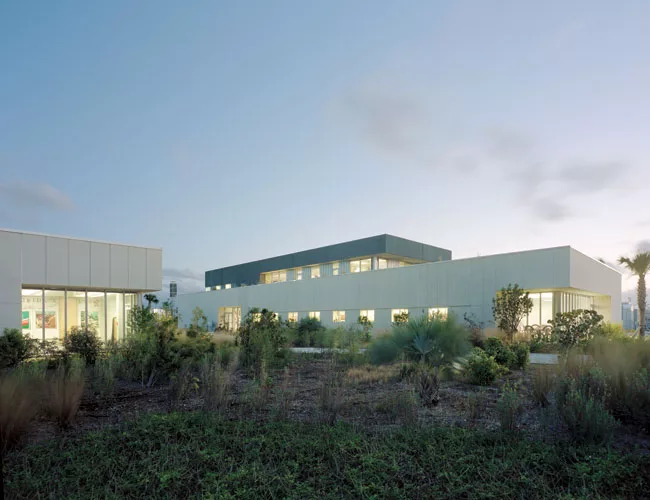
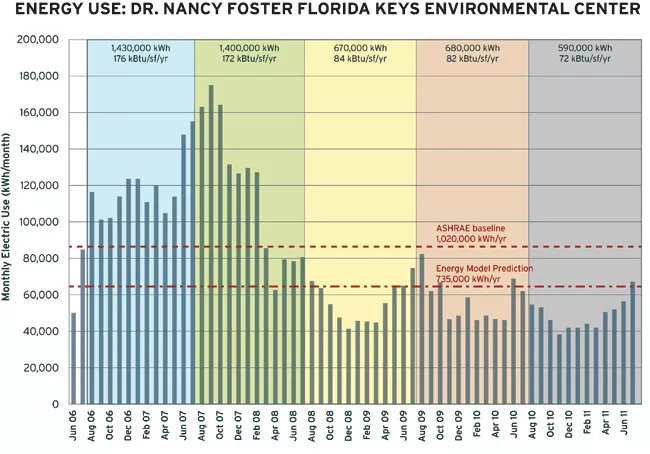
The value of getting feedback on projects hit home for Pr'au's firm after the opening of its first LEED-certified building: the Dr. Nancy Foster Florida Keys Environmental Center in Key West. The 30,000-square-foot multipurpose facility, occupied by the U.S. National Oceanic and Atmospheric Administration in 2006, was predicted to consume 735,000 kilowatt-hours per year'28 percent fewer than the ASHRAE baseline. In its first two years of operation, however, the LEED Silver building was consuming almost twice that amount.
Looking for quick answers on architecture and design topics?
Try Ask RECORD, our new smart AI search tool.
Ask RECORD →
Faulty settings in the building-management system were the culprit: two months after commissioning, a software upgrade wiped out the settings tuned by the commissioning agent. A local consultant's efforts to fix the problem fell short. Ultimately, humidity and mold issues convinced the owner to bring Eskew+Dumez+Ripple and the commissioning agent back into the picture nearly two years later. The problems were then quickly resolved. Energy consumption immediately fell below what designers had originally predicted.
Eskew+Dumez+Ripple determined that from that point forward they would attempt to track energy consumption of all their LEED projects. They wanted to understand the variables affecting performance and get a jump on any issues that arose. 'It's a lot of fun to make a baby. But for that baby to live a long and healthy life, there's a whole lot of care and feeding that needs to take place,' says Pr'au.
Revisiting projects is about fully understanding the effectiveness of innovative design solutions, says Ed Clark, an associate with the Seattle office of ZGF Architects, a firm that also seeks to track all projects designed to meet industry certification standards such as LEED. To Clark, POE is a way of grappling with the seemingly 'overwhelming' level of complexity creeping into building design. 'It creates an opportunity to understand how to make the next project better,' he says.
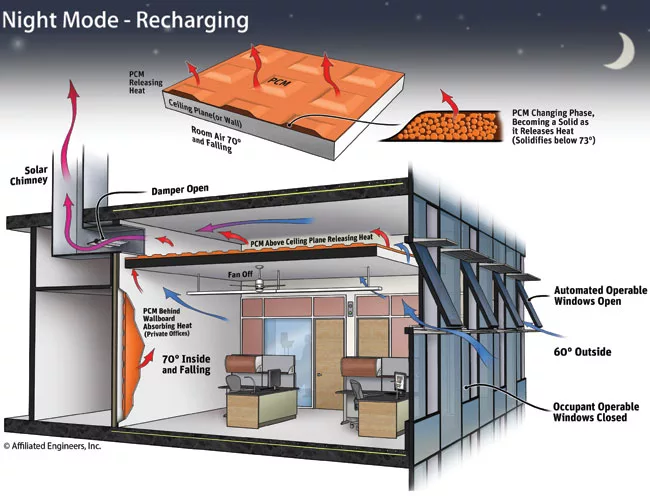
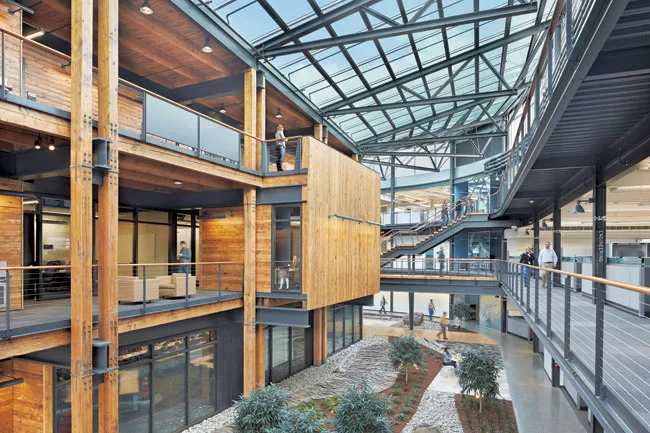
Clark cites ZGF's recent work on the Molecular Engineering & Sciences Building at the University of Washington in Seattle, a lab and office complex that was occupied in 2012, with a second phase now under construction. ZGF wanted feedback on its strategy to moderate temperature swings in the building's naturally ventilated offices. Most of the cooling happens at night, through flushing the space with fresh air, with a phase change material (PCM) in some wall and ceiling cavities absorbing heat throughout the day.
ZGF is tracking energy consumption on the complex's LEED Gold'certified phase I, and it placed data-loggers in wall cavities and dropped ceilings containing PCM to record temperature. ZGF also engaged the Center for the Built Environment (CBE) at the University of California Berkeley to conduct occupant comfort surveys.
The building met requirements for temperature consistency and occupant comfort (Clark says occupants of the fresh-air-cooled building comment on how well the 'air-conditioning systems' perform). For phase II, ZGF is bumping up the benefit from the PCM by shifting from a uniform ceiling to clouds and replacing some acoustic tile with perforated panels.
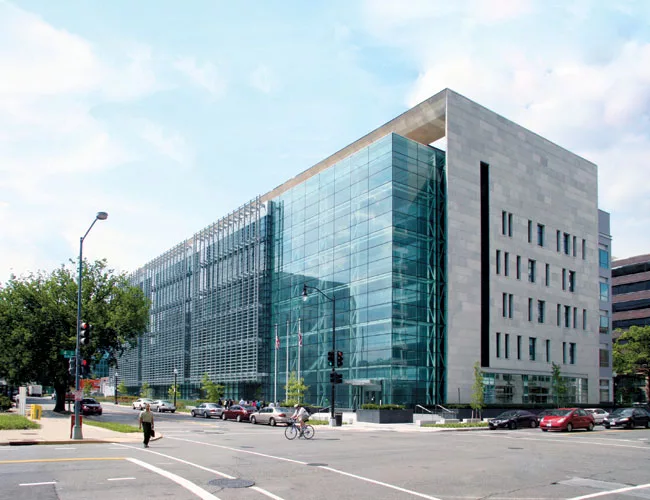
Anica Landreneau, director of sustainable consulting for HOK, cites a similar scenario for close tracking of the Consolidated Forensic Laboratory that her firm designed for the District of Columbia. The LEED Platinum laboratory and morgue, completed in 2012, relies on chilled beams for cooling. POE, they determined, would be crucial to take that strategy forward. 'A lot of clients are skeptical that chilled beams will perform in that humid climate,' she says.
HOK has been tracking the building's energy data, and performance is better than was modeled. Simulations predicted an energy use intensity (EUI) of 230.5 kBtu/sf/yr'half as much as a design with a more conventional climate-control strategy. Instead, the latest data HOK collected, from last year, pegged the building at 165.
HOK also conducted a comfort survey after 10 months of occupancy. It revealed an unanticipated issue: more daylight than occupants desired. Even though readings taken by HOK at the Consolidated Forensics building found low natural light levels (nowhere near the 25 footcandles required to earn a LEED daylighting credit), the laboratories were too bright for some workers who relocated from basement labs elsewhere. Interior operable shades controlled by the occupants solved the problem.
The SOM survey and anecdotal examples such as ZGF's and HOK's demonstrate that POEs encompass a diverse range of activities. Firms who embrace POEs are tracking a broad array of physical and psychosocial measures. They are conducting their own investigations, working with UC Berkeley's CBE, and collecting data from building owners and facility managers. Some POEs are completed within 8 hours, while others reflect weeks or months of work.
Whatever the duration, and no matter how comprehensive, few POEs are billed to clients. A POE was not specified in the architect's contract for either HOK's Consolidated Forensics project or ZGF's University of Washington designs, and that's par for the course, according to the SOM survey. Just one of 18 firms said clients routinely paid for POEs.
However, there are signs of change. Another three out of 18 firms reported that they were 'sometimes' compensated for performing POEs. This is most often the case, say architects interviewed for this article, in work for institutional clients, and for office or medical-interior projects where workplace assessment is employed to maximize human productivity.
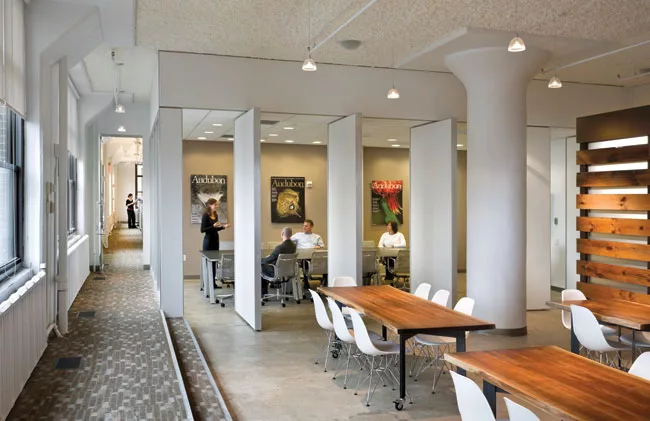
Judah estimates that over half of FXFOWLE's institutional projects include some form of paid POE by her firm, the engineering firm of record, and/or a consultant. POE was a programmed element of FXFOWLE's interior redesign for the National Audubon Society headquarters in New York, completed in 2008, but was handled by the project's sustainability consultant, YR&G. For its interior for the Rockefeller Brothers Fund headquarters, completed in 2009, FXFOWLE performed surveys before and after occupancy that informed not only the interior design but also a revamp of the foundation's grant-making process.
Kelly Griffin, a principal with NBBJ, reports that major corporate clients are also paying for POEs to boost employee satisfaction. Pre-design surveys at existing offices inform designs intended to maximize employee productivity and retention, and POE tracks their impact. 'More and more projects start with workplace assessment. Clients are seeing that buildings are not just places to pack people in, and they are being very deliberate,' she says.
One barrier to widespread adoption is the concern among architects (and their lawyers) that interest in POEs will be misinterpreted as an implied guarantee of performance. Architects say there is growing recognition that this concern is more perceived than real, and that both clients and designers are ready for a more open dialogue about building performance.
Rising energy reporting and performance mandates may ultimately be what standardizes POEs. Beginning in 2016 in the UK, for example, all major projects commissioned by the central government must comply with a cradle-to-occupation 'Soft Landings' framework to ensure that building handover is considered from the earliest design stages. To prepare for that, the Royal Institute of British Architects' standard Plan of Work requires 'post handover monitoring and feedback.'
In North America, meanwhile, POE is an explicit feature of the small but growing number of design-build projects that include specific performance incentives or guarantees. ZGF and Seattle-based Sellen Construction had targets to meet for the Federal Center South Building, completed in 2012 for the U.S. General Services Administration. Hitting the EUI, water-consumption, and comfort goals released the final 0.5 percent of the budget to the project team about one year after occupation.
Comprehensive POE efforts showed that the design's climate-control system, built around passive chilled beams and displacement ventilation, is beating expectations. The project targeted an EUI of 27.6'four times better than the regional average for office buildings'and is delivering an EUI of 25.7. Occupant feedback, meanwhile, provided a reminder that daylighting'especially valued in the Northwest, where dark winters fuel brisk sales of vitamin D'must be carefully configured.
Employees exposed to Fed Center South's transparent atrium complained of glare. Clark says relatively inflexible furniture (which was outside the scope of ZGF's design) exacerbated the issue, as users were unable to easily alter their point of view. Adding occupant-controlled roller shades at atrium-facing offices ultimately fixed the problem.
In this case, POE highlighted the importance of seemingly minor details. 'It argues for tighter integration of furniture design, and more scrutiny of the daylight resource,' says Clark. The lessons fed immediately into ZGF's practice, informing the design of a high-performance state office building in Olympia whose skylights will feature a mix of transparent and translucent bands. The design-build contract for that building, secured last year in partnership with Sellen, includes incentives based on building performance at five years after occupancy.
Clark believes this model will become more common as building codes become more stringent, and he's convinced that the increased level of accountability will lift the level of the entire industry. 'A very integrated process was required to meet the goals outlined by the GSA at Fed Center South. You learn a lot through that process, and it ripples through your portfolio. Everybody wins,' he says.
Perkins+Will's Barnes maintains that firms that do more POEs have a competitive advantage, because they are better positioned to provide objective backing for design claims. But she predicts this advantage will prove short-lived as POE transitions from best practice to standard practice. She compares the current level of POE use to LEED's early days. 'LEED was an advantage initially, but now it's just the way business is done. In the not-too-distant future, we'll get there with POEs.'
|
Continuing Education
 To earn one AIA learning unit (LU), including one hour of health, safety, and welfare (HSW) credit, read “Feedback Loop,” review the supplemental material at architecturalrecord.com, and complete the online test. Upon passing the test, you will receive a certificate of completion, and your credit will be automatically reported to the AIA. Additional information regarding credit reporting and continuing-education requirements can be found online at continuingeducation.bnpmedia.com. To earn one AIA learning unit (LU), including one hour of health, safety, and welfare (HSW) credit, read “Feedback Loop,” review the supplemental material at architecturalrecord.com, and complete the online test. Upon passing the test, you will receive a certificate of completion, and your credit will be automatically reported to the AIA. Additional information regarding credit reporting and continuing-education requirements can be found online at continuingeducation.bnpmedia.com.
Supplemental Material
Post Occupancy Survey Report
Skidmore, Owings & Merrill
Post Occupancy Evaluation
Sci-Network
Learning Objectives
1 Define the term post-occupancy evaluation (POE). 2 Identify quantitative and qualitative factors that POEs can be used to study. 3 Discuss legal and practical barriers that prevent some architecture firms from performing POEs. 4 Discuss recent legislative and regulatory developments that are helping spur more interest in POEs.
AIA/CES Course #K1508A
For CEU credit, Read “Feedback Loop” and take the Quiz at continuingeducation.bnpmedia.com, or use our architectural record continuing-education app, available in the itunes store.
|
Looking for a reprint of this article?
From high-res PDFs to custom plaques, order your copy today!