Architectural Record
search
cart
facebook twitter linkedin youtube
  • Sign In
  • Subscribe
  • Sign Out
  • My Account
Architectural Record
  • NEWS
    • Latest News
    • Awards
    • Interviews
    • Obituaries
    • Podcasts
      • Design:Ed Podcast
      • Sponsored Podcasts
  • OPINION
    • Book Reviews / Excerpts
    • Exhibition Reviews
    • Forum
  • EXCLUSIVES
    • Videos
    • Design Vanguard
    • Top 300 Firms
    • Sponsored Content
    • Sponsored eBooks
    • From the Archives
  • CONTINUING ED
    • Editorial Continuing Ed
    • CE Center
    • CE Academies
  • PROJECTS
    • Buildings By Type
    • Reuse & Renovation
    • Museums & Arts Centers
    • Colleges & Universities
    • Multifamily Housing
    • Interiors
    • Lighting
    • Kitchen & Bath
  • HOUSES
    • Record Houses
    • House of the Month
    • Featured Houses
  • PRODUCTS
    • Products by Category
    • Record Products of the Year
    • Latest Products
  • EVENTS
    • Dates & Events
    • Record on the Road
    • Innovation Conference
    • Sustainability in Practice
    • Women In Architecture
    • Webinars
    • Ad Excellence Awards
    • Submit an Event
  • CONNECT
    • Ask RECORD AI
    • Newsletters
    • Contact
    • Advertise
    • Editorial Calendar
    • Store
    • Customer Service
  • SUBMIT
    • Submission Guidelines
    • RECORD Competitions
  • MAGAZINE
    • Subscribe
    • My Account
    • Digital Edition
    • Current Issue
    • Firm Pass
    • Historic Archive
ProjectsBuildings by TypeMultifamily Housing Architecture

Via Verde by Dattner Architects and Grimshaw Architects

The Bronx, New York
By Joann Gonchar, FAIA
Via Verde has several features intended to support healthy and active living. A medical clinic will occupy the ground floor. Stairwells, which are expressed on the front facade, include windows to mak
Via Verde
Dattner Architects/Grimshaw Architects
New York
Via Verde has several features intended to support healthy and active living. A medical clinic will occupy the ground floor. Stairwells, which are expressed on the front facade, include windows to make them an attractive alternative to the elevators.
Photo © David Sundberg/Esto
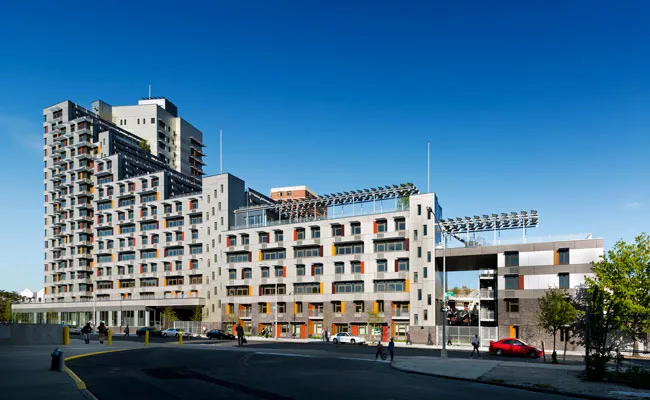
The building's rainscreen facades are made of warm-toned wood, matte fiber cement, and silvery aluminum panels.
Via Verde
Dattner Architects/Grimshaw Architects
New York
The building's rainscreen facades are made of warm-toned wood, matte fiber cement, and silvery aluminum panels.
Photo © David Sundberg/Esto
Residents will be able to grow their own vegetables in rooftop planter boxes.
Via Verde
Dattner Architects/Grimshaw Architects
New York
Residents will be able to grow their own vegetables in rooftop planter boxes.
Photo © David Sundberg/Esto
The stepped profile of Via Verde provides space for facade-mounted photovoltaic panels'one of many tightly integrated systems that have put the project on track for LEED Gold. Because city-owned athle
Via Verde
Dattner Architects/Grimshaw Architects
New York
The stepped profile of Via Verde provides space for facade-mounted photovoltaic panels'one of many tightly integrated systems that have put the project on track for LEED Gold. Because city-owned athletic fields sit directly to the south of the site, designers felt confident that a building would never obstruct the panels' solar access.
Photo © David Sundberg/Esto
The planted roofs of Via Verde'many of which are accessible to residents'spiral down from a 20-story tower, meeting the ground with an amphitheatre-like set of steps. The terraced roofs include an eve
Via Verde
Dattner Architects/Grimshaw Architects
New York
The planted roofs of Via Verde'many of which are accessible to residents'spiral down from a 20-story tower, meeting the ground with an amphitheatre-like set of steps. The terraced roofs include an evergreen grove, an apple orchard, and vegetable plots.
Photo © David Sundberg/Esto
Via Verde offers cooperative and rental units for New Yorkers in low- to middle-income brackets and includes simplex and duplex configurations. About 90 percent of the apartments have dual access. Tri
Via Verde
Dattner Architects/Grimshaw Architects
New York
Via Verde offers cooperative and rental units for New Yorkers in low- to middle-income brackets and includes simplex and duplex configurations. About 90 percent of the apartments have dual access. Trickle vents allow residents to make the most of the cross ventilation this layout feature provides, even when windows are closed.
Photo © David Sundberg/Esto
Via Verde offers cooperative and rental units for New Yorkers in low- to middle-income brackets and includes simplex and duplex configurations. About 90 percent of the apartments have dual access. Tri
Via Verde
Dattner Architects/Grimshaw Architects
New York
Via Verde offers cooperative and rental units for New Yorkers in low- to middle-income brackets and includes simplex and duplex configurations. About 90 percent of the apartments have dual access. Trickle vents allow residents to make the most of the cross ventilation this layout feature provides, even when windows are closed.
Photo © Vanni Archive
Via Verde
Via Verde
Dattner Architects/Grimshaw Architects
New York
Image courtesy Dattner Architects/Grimshaw Architects
Via Verde
Via Verde
Dattner Architects/Grimshaw Architects
New York
Image courtesy Dattner Architects/Grimshaw Architects
Via Verde
Via Verde
Dattner Architects/Grimshaw Architects
New York
Image courtesy Dattner Architects / Grimshaw Architects
Via Verde has several features intended to support healthy and active living. A medical clinic will occupy the ground floor. Stairwells, which are expressed on the front facade, include windows to mak
The building's rainscreen facades are made of warm-toned wood, matte fiber cement, and silvery aluminum panels.
Residents will be able to grow their own vegetables in rooftop planter boxes.
The stepped profile of Via Verde provides space for facade-mounted photovoltaic panels'one of many tightly integrated systems that have put the project on track for LEED Gold. Because city-owned athle
The planted roofs of Via Verde'many of which are accessible to residents'spiral down from a 20-story tower, meeting the ground with an amphitheatre-like set of steps. The terraced roofs include an eve
Via Verde offers cooperative and rental units for New Yorkers in low- to middle-income brackets and includes simplex and duplex configurations. About 90 percent of the apartments have dual access. Tri
Via Verde
Via Verde
Via Verde
July 16, 2012

Architects & Firms

Dattner Architects
Grimshaw

The newest sign of the ongoing upswing in the South Bronx, once a national symbol of urban decay, is the dynamic exterior of Via Verde, a just-completed 222-unit apartment complex for households in the low- to middle-income brackets. It has a 20-story tower anchoring one end and terraces that step down toward the other. Projecting sunshades punctuate the street-facing elevation, which is made up of warm-toned wood, matte fiber cement, and silvery aluminum rainscreen panels.


Upon first seeing this project and its lively exterior, many people are surprised to learn that it is subsidized housing. However, its designers think this is an odd response. “There shouldn’t be a different lens for evaluating affordable housing,” says Vincent Chang, a partner in the New York office of London-based Grimshaw Architects. “Quality should exist at every market sector.”

In early 2007, Grimshaw, the New York firm Dattner Architects, and development partners Phipps Houses and Jonathan Rose Companies won the $70 million Via Verde project as part of a two-stage competition—the first juried competition for affordable and sustainable housing in the city's history. The competition emerged from a collaboration of the local chapter of the AIA, the New York City Department of Housing Preservation and Development (HPD), and a volunteer steering committee made up of 20 experts in housing design, finance, and development. In the competition’s final phase, the jury selected the Via Verde scheme over proposals by four teams that included the New York architects Cook + Fox, Kiss + Cathcart, and Rogers Marvel, as well as Stuttgart, Germany–based Behnisch Architekten.

That Via Verde isn’t immediately identifiable as affordable is just one indication of the competition’s mission. “It wasn’t a beauty contest,” says Lance Brown, the steering committee’s founding member and a professor of architecture at the City College of New York. The ambition was to establish a financially viable and replicable model, he says.

With residents just now moving in, it is too soon to judge how well the built Via Verde satisfies all the aspirations behind the competition. However, the complex has proved highly desirable: The developers received about 7,500 applications for the 151 rental units, and 80 percent of the 71 cooperative apartments—priced from around $79,000 for a one-bedroom to $193,00 for a three-bedroom—have sold.

It is easy to understand the appeal, especially if you walk into Via Verde’s inner courtyard. Here the inventiveness of the Dattner-Grimshaw solution becomes apparent: The stepped profile that begins with the street facade continues with the building hugging the edges of the 1.4-acre trapezoidal former brownfield site. The roofs descend in a series of terraces, eventually meeting the ground in a set of bleacherlike steps.

Within this courtyard, elements conspire to create a sense of shelter. Although the facades defining the court are made up of the same types of rainscreen components as those facing the street, and all were assembled off-site in 25-foot-long sections (a time-saving and quality-control strategy), these inner elevations contain more of the colorful wood panels.

Looking for quick answers on architecture and design topics?
Try Ask RECORD, our new smart AI search tool.
Ask RECORD →

And of course, there is the greenery that provided the inspiration for the building’s name. Although Via Verde was completed only in April, by mid-May the courtyard’s triangular lawn was already a thick carpet of grass. The tops of the complex’s staggered terraces—many of which are accessible to residents—were also sprouting plantings. These roofs include a grove of about two dozen evergreen trees, a small apple orchard, and plots for growing vegetables.

All of the grass and foliage makes for an inviting series of outdoor spaces. However, the landscape was conceived to do more than just look good. “It also has got to do something,” says Lee Weintraub, principal of the eponymous Yonkers, New York–based landscape architecture firm that designed Via Verde’s roofscape and courtyard. This “something” includes providing a supply of fresh produce and benefits like stormwater management and heat-island mitigation. In addition, Weintraub predicts that the outdoor spaces will offer a less tangible benefit—a sense of community. With the help of GrowNYC, an environmental organization that builds and supports community gardens, residents will decide how to distribute the orchard’s fruit and determine a system for sharing and tending to the garden plots. “Culture will evolve around the open space,” says Weintraub.

The roof gardens and the courtyard that they spiral around are not the development’s only shared amenity: A seventh-floor fitness room overlooks one of the green roofs; a ground-level laundry room faces the courtyard’s play area, allowing parents to keep an eye on their children while washing clothes; and a community room occupying a privileged spot on the tower’s top floor offers an adjacent terrace that commands views of both the rapidly transforming South Bronx and the Manhattan skyline.

Paradoxically, it is Via Verde’s affordable status that allowed the design and development team to place the shared elements of the program in what would be considered prime revenue-generating locations in a market-rate development, explains Ari Goldstein, a senior project manager at Jonathan Rose Companies. “Since all the units are essentially the same price,” he says, “we can put the community room on the 20th floor, instead of putting a penthouse there.”

The individual apartments—a mix of duplexes, simplexes, live-work units, and townhouses—are as intelligently laid out as the rest of the complex. About 90 percent have dual exposure, providing cross ventilation and access to daylight while also minimizing the need for faceless corridors. Oak floors, bamboo cabinets, and subway-tiled baths make the interiors feel clean and modern, but not slick.

Arguably, just as important as the finished product is the process that produced it. Although HPD has not conducted another competition, the agency has made some changes to the way it awards projects, modeling it after the Via Verde process. For example, requests for proposals now clearly rank the selection criteria—such as design, sustainability, and financing—according to importance. This new transparency allows applicants to make more informed design decisions “and leads to higher quality proposals,” says Beatriz de la Torre, an HPD assistant commissioner.

For their part, the architects say that designing and building Via Verde was a rewarding experience. Contractually, Dattner was the architect of record with Grimshaw as its consultant. However, “from the very beginning, we viewed the project as a full design partnership,” says William Stein, Dattner principal. According to Chang, who calls the relationship “synergetic,” the firms have already identified their next collaboration—another urban, mixed-use project they will compete for within the next year.

Size: 294,00 square feet

Construction cost: $70 million

Completion date: April 2012

Architects:
Dattner Architects
1385 Broadway, 15th Floor
New York, New York 10018
T: 212.247.2660
F: 212.245.7132

Grimshaw Architects
637 W 27th Street
New York, New York 10001
T: 646.293.3600
F: 646.293.3610

People

Owner-Developer: Phipps Houses/Jonathan Rose Companies

Architects:
Dattner Architects
1385 Broadway, 15th Floor
New York, New York 10018
T: 212.247.2660
F: 212.245.7132

Grimshaw Architects
637 W 27th Street
New York, New York 10001
T: 646.293.3600
F: 646.293.3610

Personnel in architect's firm who should receive special credit:
Dattner Architects:
Richard Dattner FAIA, design partner (registered architect)
William Stein FAIA, partner in charge (registered architect)
Adam Watson AIA, project architect (registered architect)
Steven Frankel AIA, project architect (registered architect)
Venesa Alicea AIA, architect (registered architect)
Joon Cho AIA, architect (registered architect)
Eugene Kwak, architectural designer

Grimshaw Architects:
Vincent Chang AIA, partner in charge (registered architect)
Nikolas Dando-Haenisch AIA, project manager (registered architect)
Robert Garneau AIA, project architect (registered architect)
Chung Yeon Won AIA, architect (registered architect)
Juan Porral, architect (registered architect)
Virginia Little, architect (registered architect)
Aaron Hockett AIA, architect (registered architect)
Christine Caine, architectural designer
Eric Johnson, architectural designer
Shane Burger

Architect of record: Dattner Architects

Engineer(s):
Structural Engineer: Robert Silman Associates

MEP Engineer: Ettinger Engineering Associates

Geotechnical Engineer: Pillori Associates

Civil Engineer: Langan Engineering

Consultant(s):
Landscape Architect: Lee Weintraub Landscape Architects

Lighting Designer: Domingo Gonzalez Associates

Other:
Exterior Wall Consultant: Front, Inc.

Specifications Consultant: Robert Schwartz Associates

Solar Consultant: Bright Power

Energy Consultant: Association for Energy Affordability

Commissioning Agent: Dome Tech, Inc.

Filing Representative: William Vitacco Associates

Remediation Consultant: CA Rich Inc.

Land use Attorney: Bryan Cave LLP

General contractor: Lettire Construction Corp.

Photographer(s): David Sundberg/ESTO

Renderer(s): Phipps Houses, Jonathan Rose Companies, Dattner Architects, Grimshaw Architects

CAD system, project management, or other software used: Auto CAD


Products

Structural system
Concrete masonry units bearing wall and plank at Townhomes and Midrise (Kingston Possotive Plus CMU).
Poured in place concrete at Tower.

Exterior cladding
Masonry:
Wire-cut Dark Iron Spot modular face brick - (Yankee Hill Brick & Tile). 
Hand-crafted clear glass bricks with bubbles - (Blenko Glass Company, Milton, WV).

Metal Panels:  Aluminum exterior open-joint soffit panels (Accent Ceilings and Walls, CA)

Metal/glass curtain wall:  Thermal storefront system (Kawneer)

Pre-fabricated Rainscreen: 3 materials used in prefabricated rainscreen panel system:
Auria-C fiber cement panels (Eternit)
Reynobond aluminum composite panels (Alcoa)
Prodex wood composite panels (Prodema)
Fabricator / Installer: Island Fabricators

Precast concrete: Amphitheater steps & seating (Roman Stone OPC, Arverne, NY)

Wood: see Rainscreen above

EIFS, ACM, or other: see Rainscreen above

Moisture barrier:
Perm-A-Barrier wall membrane at prefab panel walls (Grace)
WallShield vapor-permeable barrier at prefab panel walls (VaproShield)
Blueskin SA vapor barrier at masonry walls (Henry)

Curtain wall:
Prefabricated rainscreen panel system (Island International Exterior Fabricators, Calverton, NY)

Other cladding unique to this project: Insulation:
Rainbarrier 45 Special ‘Green’ Fiber insulation at prefab wall panels (Thermafiber)
Cavitymate Ultra insulation at brick walls (Dow)

Roofing
Built-up roofing:         
Garden Roof Assembly at intensive, extensive & paver locations (Hydrotech)
‘Cool Roof’ SBS modified bitumen at bulkhead roofs (Johns Manville)

Tile/shingles: Glacier White plaza pavers on pedestals at occupied roofs (Hanover)

Other: Sequentia Super 600 Corrugated fiberglass panels at trellis roofs (Crane Composites)

Windows
Metal frame:  3903 series aluminum thermal casement and hopper windows (EFCO)

Glazing
Glass: Solarban 70XL (PPG)

Doors
Entrances: 350 series standard entrances at storefront system (Kawneer)

Metal doors:   
Hollow metal doors (Long Island Fireproof Doors)
T350 series aluminum Terrastile backyard & balcony doors (EFCO)

Interior finishes
Acoustical ceilings: Armstrong Ultima

Cabinetwork and custom woodwork: plywood bamboo (Direct Cabinets)

Paints and stains: Low VOC latex (Sherwin Williams)

Plastic laminate: Formica Microdot at kitchen counters and homework desks

Solid surfacing: Caesarstone

Floor and wall tile:
Casalgrande Balsaltina (Lobby, kitchen, and bath floors)

Resilient flooring:Forbo MCT

Carpet: Masland Contract "eNerGy" collection

Raised flooring: Oak Strip Flooring (C-Tender)

Lighting
Downlights: Edison Price

Exterior: Design Plan Mini Facet

Conveyance
Elevators/Escalators: ThyssenKrup machine room less elevators

Energy
Energy management or building automation system: TekWorks and Intech21

Photovoltaic system: E18/230 Solar Panels (SunPower)

 
KEYWORDS: New York City

Share This Story

Looking for a reprint of this article?
From high-res PDFs to custom plaques, order your copy today!

Joann gonchar

Joann Gonchar, FAIA, LEED AP, is deputy editor at Architectural Record. She joined RECORD in 2006, after working for eight years at its sister publication, Engineering News-Record. Before starting her career as a journalist, Joann worked for several architecture firms and spent three years in Kobe, Japan, with the firm Team Zoo, Atelier Iruka. She earned a Master of Architecture degree from the University of Pennsylvania and a Bachelor of Arts from Brown University. She is licensed to practice architecture in New York State.

Post a comment to this article

Report Abusive Comment

Subscription Center
  • Create an Account
  • Start a Subscription
  • Manage My Account
  • Sign Up for Newsletters
  • Visit Customer Service
  • Update Preferences

More Videos

Sponsored Content

Sponsored Content is a special paid section where industry companies provide high quality, objective, non-commercial content around topics of interest to the Architectural Record audience. All Sponsored Content is supplied by the advertising company and any opinions expressed in this article are those of the author and not necessarily reflect the views of Architectural Record or its parent company, BNP Media. Interested in participating in our Sponsored Content section? Contact your local rep!

close
  • TAMLYN XtremeTrim Exterior Trim
    Sponsored byTamlyn

    Designing Cleaner Panel Facades: Why Exterior Trim Details Matter

  • Building with Vapor Barriers
    Sponsored byReef Industries, Inc.

    Vapor Barriers Help Control Moisture in Tighter Building Designs

  • Duct Interior with Prodeq System
    Sponsored byHenry, a Carlisle Company

    Designing Resilient Water Containment Systems

DESIGN:ED Podcast
Listen to Architectural Record’s DESIGN:ED Podcast

Events

June 16, 2026

Focus on the Façade: Exploring Steel, Timber & Fire-Rated Curtain Walls and Channel Glass Systems

Credits: 1 AIA LU/HSW; 1 AIBD P-CE; 0.1 ICC CEU

Explore modern façade and glazing systems that enhance daylighting, fire safety, and thermal performance while expanding architectural design possibilities.

June 18, 2026

Rebooting the Aging Office Building

Credits: 1 AIA LU/HSW; 1 AIBD P-CE; 0.1 ICC CEU; 1 PDH

Explore façade retrofit strategies and award-winning design concepts that can transform aging office buildings into healthier, higher-performing workplaces for today’s hybrid workforce.

View All Submit An Event

Products

2026 Architect's Square Foot Costbook

2026 Architect's Square Foot Costbook

See More Products

Popular Stories

Coronado Bridge

The Architect’s Guide to San Diego

SanDiegoAirport

Top 300 Architecture Firms of 2026

Crane Cove, ONO

Design Vanguard 2026 Winners

House on a Hill

Design Vanguard 2026: Forma

House A on a Hill

Design Vanguard 2026: Santiago Valdivieso

Focus on the Facade - Free Webinar - June 16, 2026

Related Articles

  • Manhattan Districts 1/2/5 Garage

    Spring Street Salt Shed by Dattner Architects and WXY

    See More
  • Residences at P.S. 186

    The Residences at P.S. 186 by Dattner Architects

    See More
  • Via Verde

    See More
×

The latest news and information

#1 Source for Architectural Design, News and Products

SUBSCRIBE
  • RESOURCES
    • Advertise
    • Contact Us
    • Submit
    • Store
  • ACCOUNT CENTER
    • Create an Account
    • Start a Subscription
    • Manage My Account
    • Sign Up for Newsletters
    • Visit Customer Service
    • Update Preferences
  • PRIVACY
    • PRIVACY POLICY
    • TERMS & CONDITIONS
    • DO NOT SELL MY PERSONAL INFORMATION
    • PRIVACY REQUEST
    • ACCESSIBILITY
  • SERVICES
    • Marketing Services
    • Reprints
    • Market Research
    • List Rental
    • Survey/Respondent Access
  • STAY CONNECTED
    • Linkedin
    • Facebook
    • Instagram
    • YouTube
    • X (Twitter)

Copyright ©2026. All Rights Reserved BNP Media, Inc. and BNP Media II, LLC.

Design, CMS, Hosting & Web Development :: ePublishing