Architectural Record
search
cart
facebook twitter linkedin youtube
  • Sign In
  • Subscribe
  • Sign Out
  • My Account
Architectural Record
  • NEWS
    • Latest News
    • Awards
    • Interviews
    • Obituaries
    • Podcasts
      • Design:Ed Podcast
      • Sponsored Podcasts
  • OPINION
    • Book Reviews / Excerpts
    • Exhibition Reviews
    • Forum
  • EXCLUSIVES
    • Videos
    • Design Vanguard
    • Top 300 Firms
    • Sponsored Content
    • Sponsored eBooks
    • From the Archives
  • CONTINUING ED
    • Editorial Continuing Ed
    • CE Center
    • CE Academies
  • PROJECTS
    • Buildings By Type
    • Reuse & Renovation
    • Museums & Arts Centers
    • Colleges & Universities
    • Multifamily Housing
    • Interiors
    • Lighting
    • Kitchen & Bath
  • HOUSES
    • Record Houses
    • House of the Month
    • Featured Houses
  • PRODUCTS
    • Products by Category
    • Record Products of the Year
    • Latest Products
  • EVENTS
    • Dates & Events
    • Record on the Road
    • Innovation Conference
    • Sustainability in Practice
    • Women In Architecture
    • Webinars
    • Ad Excellence Awards
    • Submit an Event
  • CONNECT
    • Ask RECORD AI
    • Newsletters
    • Contact
    • Advertise
    • Editorial Calendar
    • Store
    • Customer Service
  • SUBMIT
    • Submission Guidelines
    • RECORD Competitions
  • MAGAZINE
    • Subscribe
    • My Account
    • Digital Edition
    • Current Issue
    • Firm Pass
    • Historic Archive
ProjectsBuildings by TypeK-12 School Design

Leutschenbach School

A School With a View: A Swiss city in transition employs bold architecture as a functional and symbolic catalyst for change in a traditional education system.

By Linda C. Lentz
Kerez stacked the required building components to create a parklike setting for the children and community.
Leutschenbach School
Christian Kerez
Zurich
Kerez stacked the required building components to create a parklike setting for the children and community.
Photo © Leonardo Finotti
The school’s lightweight concrete slabs extend beyond the glazing to form balconies with fire escape stairs.
Leutschenbach School
Christian Kerez
Zurich
The school’s lightweight concrete slabs extend beyond the glazing to form balconies with fire escape stairs.
Photo © Leonardo Finotti
To moderate heat loads, the top-floor gym is outfitted with an automatic shading system and a ceiling that vents.
Leutschenbach School
Christian Kerez
Zurich
To moderate heat loads, the top-floor gym is outfitted with an automatic shading system and a ceiling that vents.
Photo © Leonardo Finotti
Generous common areas replace typical corridors and receive plenty of daylight through the translucent channel-glass walls.
Leutschenbach School
Christian Kerez
Zurich
Generous common areas replace typical corridors and receive plenty of daylight through the translucent channel-glass walls.
Photo © Leonardo Finotti
Versatile classrooms allow teachers to arrange the school’s standard-issue furnishings to best suit their agenda.
Leutschenbach School
Christian Kerez
Zurich
Versatile classrooms allow teachers to arrange the school’s standard-issue furnishings to best suit their agenda.
Photo © Leonardo Finotti
Frameless triple-glazing around the ground floor provides a sound- and weather-insulating barrier for students inside and visually brings the outdoors in.
Leutschenbach School
Christian Kerez
Zurich
Frameless triple-glazing around the ground floor provides a sound- and weather-insulating barrier for students inside and visually brings the outdoors in.
Photo © Leonardo Finotti
A row of stainless-steel lavs fits into the materials palette and keeps young pupils organized after meals.
Leutschenbach School
Christian Kerez
Zurich
A row of stainless-steel lavs fits into the materials palette and keeps young pupils organized after meals.
Photo © Leonardo Finotti
A pair of glass-lined stairs at the building’s core direct vertical circulation.
Leutschenbach School
Christian Kerez
Zurich
A pair of glass-lined stairs at the building’s core direct vertical circulation.
Photo © Leonardo Finotti
Leutschenbach School
Christian Kerez
Zurich
Photo © Leonardo Finotti
Leutschenbach School
Christian Kerez
Zurich
Photo © Leonardo Finotti
Leutschenbach School
Christian Kerez
Zurich
Photo courtesy Christian Kerez
Leutschenbach School
Christian Kerez
Zurich
Photo © Walter Mair
Leutschenbach School
Christian Kerez
Zurich
Photo © Walter Mair
Leutschenbach School
Christian Kerez
Zurich
Photo © Leonardo Finotti
Leutschenbach School
Christian Kerez
Zurich
Photo © Leonardo Finotti
Leutschenbach School
Christian Kerez
Zurich
Photo © Leonardo Finotti
Leutschenbach School
Christian Kerez
Zurich
Image courtesy Christian Kerez
Leutschenbach School
Christian Kerez
Zurich
Image courtesy Christian Kerez
Leutschenbach School
Christian Kerez
Zurich
Image courtesy Christian Kerez
Leutschenbach School
Christian Kerez
Zurich
Image courtesy Christian Kerez
Leutschenbach School
Christian Kerez
Zurich
Image courtesy Christian Kerez
Leutschenbach School
Christian Kerez
Zurich
Image courtesy Christian Kerez
Kerez stacked the required building components to create a parklike setting for the children and community.
The school’s lightweight concrete slabs extend beyond the glazing to form balconies with fire escape stairs.
To moderate heat loads, the top-floor gym is outfitted with an automatic shading system and a ceiling that vents.
Generous common areas replace typical corridors and receive plenty of daylight through the translucent channel-glass walls.
Versatile classrooms allow teachers to arrange the school’s standard-issue furnishings to best suit their agenda.
Frameless triple-glazing around the ground floor provides a sound- and weather-insulating barrier for students inside and visually brings the outdoors in.
A row of stainless-steel lavs fits into the materials palette and keeps young pupils organized after meals.
A pair of glass-lined stairs at the building’s core direct vertical circulation.
Leutschenbach School
January 16, 2012

Architects & Firms

Christian Kerez

Zurich

The schoolhouse as we know it has been upended in Leutschenbach, Switzerland, a quiet suburban corner north of metropolitan City of Zurich, Switzerland, where the city is transforming a former industrial site into a mixed-use, middle-class neighborhood infused with green spaces. Rising six stories above the trees, housing developments, and remaining factories, a crystalline new school designed by Christian Kerez not only treats students to sweeping views from the top-floor gym, it represents a clear vision for the future of a community and its children.

The initiative for change began in the mid-1990s. At that time education reforms prompted new guidelines for school construction emphasizing the need for more flexible, sustainable spaces that accommodate current instructional needs like group learning, team teaching, computer workspaces, and early childhood centers. More importantly, since pedagogical concepts are subject to change, a building must be adaptable for subsequent trends. Four schools have been built and 15 more renovated or expanded since 1998. In each case, a project-planning committee made up of school and building authorities, invited programmatic design proposals from architects through an open competition.

“They didn't only give a brief with square meters and functional definitions,” says Kerez about the Leutschenbach call for bids. “They also asked us to envision how a child would experience the school in the future.” Recalling how he enjoyed the large public spaces of his own school and how free he felt running around the grounds, the City of Zurich, Switzerland-based architect elected to “make this a very public building with large halls and staircases.” Additionally, he chose to retain as much of the 177,600-square-foot lot as possible by reducing the building's footprint.

“This was crucial for the quality of the school,” says Kerez. While the land allotment was generous, the site was under the flight path of the nearby international airport and adjacent to a high-speed rail line and factory incinerator. Maintaining an open field with a compact, stacked structure at its center—instead of with a typical two-level building spread over it—would enable the architect to create a park around the school, insulating its occupants from grit and noise while enhancing the developing community.

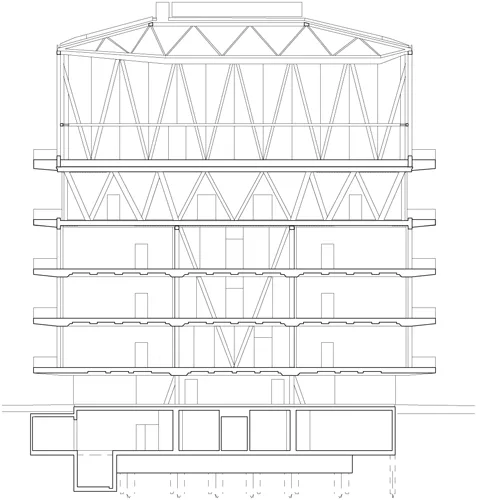
Once this decision was made, Kerez's solution began to take shape. He developed a scheme for a mid-rise box that fits neatly within a 95- by 148-foot footprint, the dimensions of the school's largest component—the gym. Collaborating closely with structural engineer Joseph Schwartz, the architect devised a bridgelike, steel-frame structure supported by six tripods at grade. An alternating sequence of trusses, internal and external, distributes and bears the building's weight, freeing the design team to cantilever slabs of lightweight, recycled concrete beyond the structural, triple-glazed facade. The resulting balconies provide sunshade and necessary fire-egress, and extend the sense of interior space. The pleated ceilings on the undersides reduce the structure's visual weight, and allow for room heights up to 121/2 feet.

The column-free construction also gave Kerez the ability to satisfy the client's request for open-ended, versatile floor plans. As Leutschenbach serves 500 kindergarten-through-secondary-school children, the teachers requested the ability to separate different age groups as needed. Kerez arranged the interior into four logical sections, one above the other, organized by general function, and unified by a simple palette of materials. Double-glazed, translucent channel-glass walls maximize transparency and light, and creamy terrazzo floors distribute radiant heat fueled by the nearby incinerator. (Indeed, the certified low-energy building is vented naturally through outlets in the roof.)

The children enter on either side of the ground level, which is basically a core with a wide, open area around it. This is where they eat and hang out after class—completely surrounded by unobstructed spans of glass, as if outdoors.

Kerez created a vertical trajectory that directs circulation up two central stairways to the second-, third-, and fourth-floor classroom clusters, nine classrooms lining the sides of each floor. Rather than the typical corridor though, he carved a generous communal area between them for group activities and lessons. Then, he carried this plan up to the fifth floor, tweaking it to fit the shared auditorium, library, and administrative offices around a courtyardlike common.

Saving his most spirited—and daring—move for last, Kerez set the double-height gym directly on top of this volume, as if resting a final layer on a tiered cake. Accessible by elevator or secondary stair, the gym spans the entire upper level, acoustically isolated from the floor below, so races can be run and games played without disturbing the activities beneath them. Not surprisingly, says Kerez, when he asks pupils what they like most about the school, nearly all say the gym.

The unconventional layout is still a challenge for some teachers accustomed to more defined, private spaces. But there is an overall commitment to the concept, says the architect. This was apparent during a recent visit on a blustery Friday afternoon, when the staff seemed to have things well under control as kids of varying ages snacked and played within the vast ground floor.

“I'm glad the students and many of the teachers appreciate the building,” says Kerez. “We did it for them—they spend so much time in the building. We also wanted to pay respect to the site and the people who live here.”

Total construction cost: $51 million

Size: 105,900 sq.ft. / 9840 m2

Completion date: August 2009

Architect:
Christian Kerez AG
Architekt ETH/SIA/BSA
Eibenstrasse 9, 8045
Zurich, Switzerland
mail@kerez.ch
phone: +41 44 454 40 70

People

Owner:
City of Zurich

Architect:
Christian Kerez AG
Architekt ETH/SIA/BSA
Eibenstrasse 9, 8045
Zurich, Switzerland
mail@kerez.ch
phone: +41 44 454 40 70

Personnel in architect's firm who should receive special credit:
Christian Kerez, Christian Scheidegger (project manager), Lukas Camponovo, Andrea Casiraghi

Engineer(s):
Overall concept / concrete structure: Schwartz Consulting, Zug, Switzerland; Dr. Joseph Schwartz, Christian Weber (project manager)
Steel structure: dsp Ingenieure & Planer AG, Greifensee, Switzerland; Dr. Walter Kaufmann, Dr. Mario Monotti (project manager)

Project management / owners representative:
Beta Projekt Management AG, Zurich, Switzerland, Mike Critchley

Consultant(s):
Landscape:
4d Landschaftsarchitekten Bern, Switzerland; Maurus Schifferli

Lighting:
Amstein & Waltert AG, Zurich, Switzerland; Frank Dardel

Acoustical:
Martin Lienhard, Langenbruck, Switzerland

Other:
Building Services Planning:
Waldhauser Haustechnik AG, Münchenstein, Switzerland; Robert Gschwend

Electrical Applications:
Meili Tanner Partner AG, Uster, Switzerland, Reto Ming

Facade Planning:
GKP Fassadentechnik AG, Aadorf, Switzerland, Reto Gloor

Artworks:
Oliver Mosset, New York

General contractor:
No General Contractor
Site Planning and Construction Management:
BGS Architekten AG, Rapperswil, Switzerland; Heinz Gmür, Fredi Küng

Photographer(s):
Walter Mair, Niklaus Spoerri, Hannes Henz (all Zurich)

Leonardo Finotti

CAD system, project management, or other software used:
Various CAD systems have been used, depending on the engineers


Products

Structural system
Steel frame / structure: Zwahlen & Mayr SA, 8152 Glattbrugg, Switzerland

Master builder: Barizzi AG, 8614 Bertschikon, Switzerland

Manufacturer of any structural components unique to this project:
Concrete: Liapor
Construction of a special light-weight concrete made of recycled aggregate
Supplier of concrete: Eberhard Bau AG, 8302 Kloten , Switzerland

Roofing
Elastomeric:
Sarnafil by Sika Sarnafil AG, Switzerland

Glazing
Glass:
Frameless façade with triple glazing panes. Argon gas filling, K-Value 0,6 W/m2K, G-Value/ SHGC 37%, heat protection film on pos. 5 of glass and sun+heat protection film on pos. 2 of glass.

Contractor:
Fahrni Fassadensysteme AG, 3250 Lyss, Switzerland

Skylights:
Triple glazing, accessible by car, nonskid

Doors
Entrances:
Part of the frameless façade with glass filling identical to façade

Fire-control doors, security grilles:
Fire protection sliding doors withstanding 60 minutes

Interior finishes
Acoustical ceilings:
Baswaphon seamless sound absorbing plaster system

Paneling:
Fermacell plaster boards with graffiti protection

Special surfacing:
Epoxy based floor covering system Raroc by Radix AG, 9314 Steinebrunn, Switzerland (in changing rooms, showers and kitchen)
On wall 2-component coating system Racolor by Radix AG, 9314 Steinebrunn, Switzerland (in changing rooms, showers and kitchen)

Floor and wall tile:
Floor tiles: Terrazzo tiles (including balconies)

Resilient flooring:
Concrete floating floor screed

Special interior finishes unique to this project:
Glas partition walls made of Profilit profiled glass by Pilkington

Furnishings
Classroom furniture:
All chairs and tables by Embru-Werke AG, 8630 Rüti, Switzerland

Chairs:
Chair 1255 by Embru-Werke AG, 8630 Rüti, Switzerland

Tables:
Table 1795 by Embru-Werke AG, 8630 Rüti, Switzerland

Other unique products that contribute to sustainability:
Heating energy is provided by the city incinerator through direct piping

KEYWORDS: Zurich

Share This Story

Looking for a reprint of this article?
From high-res PDFs to custom plaques, order your copy today!
Linda Lentz is a former editor at Architectural Record.

Post a comment to this article

Report Abusive Comment

Subscription Center
  • Create an Account
  • Start a Subscription
  • Manage My Account
  • Sign Up for Newsletters
  • Visit Customer Service
  • Update Preferences

More Videos

Sponsored Content

Sponsored Content is a special paid section where industry companies provide high quality, objective, non-commercial content around topics of interest to the Architectural Record audience. All Sponsored Content is supplied by the advertising company and any opinions expressed in this article are those of the author and not necessarily reflect the views of Architectural Record or its parent company, BNP Media. Interested in participating in our Sponsored Content section? Contact your local rep!

close
  • TAMLYN XtremeTrim Exterior Trim
    Sponsored byTamlyn

    Designing Cleaner Panel Facades: Why Exterior Trim Details Matter

  • Building with Vapor Barriers
    Sponsored byReef Industries, Inc.

    Vapor Barriers Help Control Moisture in Tighter Building Designs

  • Duct Interior with Prodeq System
    Sponsored byHenry, a Carlisle Company

    Designing Resilient Water Containment Systems

DESIGN:ED Podcast
Listen to Architectural Record’s DESIGN:ED Podcast

Events

June 10, 2026

Rethinking Stormwater – The Power of Porous Paving

Credits: 1 AIA LU/HSW; 1 AIBD P-CE; 0.1 ICC CEU

Learn how porous paving systems support stormwater management, reduce heat island effects, and enhance sustainable site design performance.

June 11, 2026

Very Early Warning Fire Detection for Mission-Critical Facilities

Credits: 1 AIA LU/HSW; 1 AIBD P-CE; 0.1 ICC CEU

Examine advanced fire detection strategies that support uptime and enhance safety in data centers and other mission-critical facilities.

View All Submit An Event

Products

2026 Architect's Square Foot Costbook

2026 Architect's Square Foot Costbook

See More Products

Popular Stories

Practice Matters illustration

What’s in a (Firm’s) Name? Thinking About Succession and Legacy

Coronado Bridge

The Architect’s Guide to San Diego

Practice Matters illustration

By the Numbers: Counting America's Architects

Riverdale House by Studio Lau

Riverdale House by Studio Lau

House on a Hill

Design Vanguard 2026: Forma

Broader Sustainability of CMU - Free Webinar - May 21, 2026

Related Articles

  • After Newtown, Architects Weigh School Design Changes

    See More
  • Samuel Powel Elementary School.

    Samuel Powel Elementary School and Science Leadership Academy Middle School by Rogers Partners

    See More

Related Products

See More Products
  • Web-Regenerative-school4-1920x1125.jpg

    Creating the Regenerative School

  • WC_-SCA.png

    Building Great Schools for a Great City

See More Products
×

The latest news and information

#1 Source for Architectural Design, News and Products

SUBSCRIBE
  • RESOURCES
    • Advertise
    • Contact Us
    • Submit
    • Store
  • ACCOUNT CENTER
    • Create an Account
    • Start a Subscription
    • Manage My Account
    • Sign Up for Newsletters
    • Visit Customer Service
    • Update Preferences
  • PRIVACY
    • PRIVACY POLICY
    • TERMS & CONDITIONS
    • DO NOT SELL MY PERSONAL INFORMATION
    • PRIVACY REQUEST
    • ACCESSIBILITY
  • SERVICES
    • Marketing Services
    • Reprints
    • Market Research
    • List Rental
    • Survey/Respondent Access
  • STAY CONNECTED
    • Linkedin
    • Facebook
    • Instagram
    • YouTube
    • X (Twitter)

Copyright ©2026. All Rights Reserved BNP Media, Inc. and BNP Media II, LLC.

Design, CMS, Hosting & Web Development :: ePublishing